
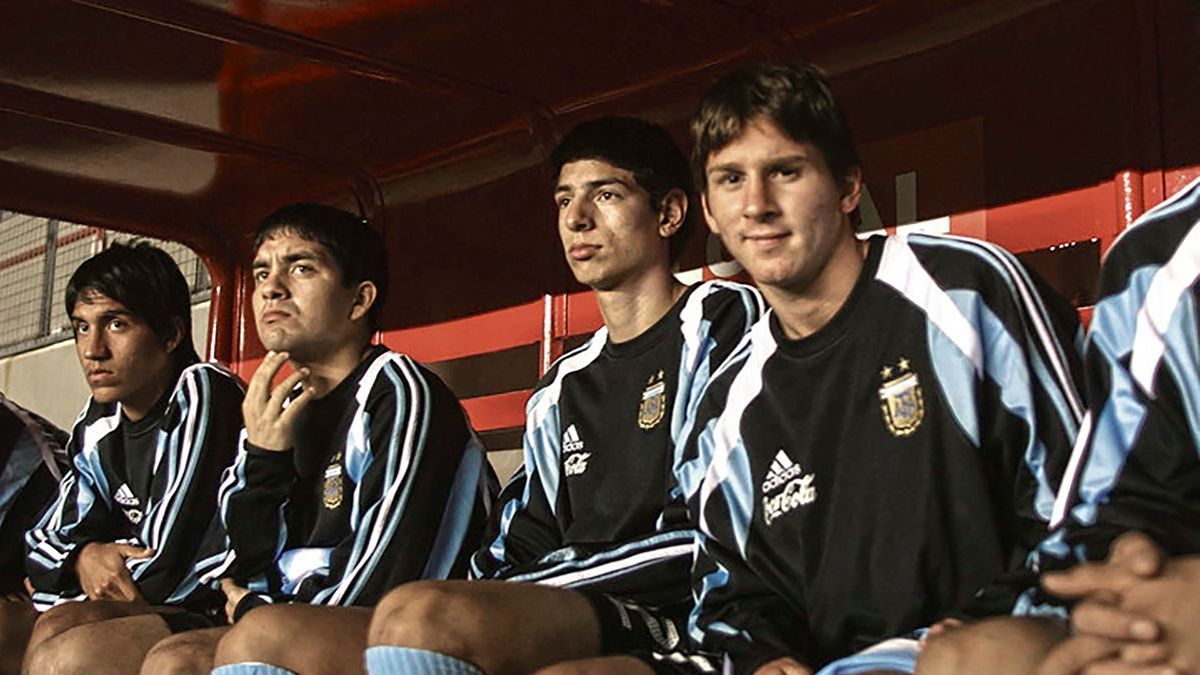
EmailPrintOpen Extended ReactionsHow would the past 20 years of international football have looked if Lionel Messi had played for Spain and not Argentina?For Messi, not representing the country of his birth was never an option. But there was a moment in his young career when, still unknown in his homeland, Spain sensed an opportunity to get him to commit his future to La Roja.With Spain on the scene, once word escaped of this long-haired teenager from Rosario tearing it up for Barcelona's academy, panic set in at the Argentine Football Association (AFA).What followed is a remarkable story involving a Messi highlight reel on VHS tape, a frantic day ringing everyone called Messi in the phone book, people repeatedly getting the future superstar's name wrong, and a hastily arranged match to ensure Argentina tied him down.- Stream 'Messi: The Forgotten Tape' on ESPN+ (U.S.)As part of a new documentary, ESPN spoke to those behind Messi's first international call-up, providing new details on the start of a tale that culminated in 2022 when the eight-time Ballon d'Or winner led La Albiceleste to their third FIFA World Cup triumph.Editor's Note: All of the quotes from interviewees were originally in Spanish, and have been translated Spain's long shotThe 13-year-old Messi arrived in Barcelona in 2000, and it was soon obvious inside the club's La Masia academy that he was a generational talent. Bara youth team coach Alex Garca and Messi's teammate Vctor Vzquez couldn't understand why there was such little interest from Argentina. Spain youth team coach Gins Melndez set them a task: convince him to play for La Roja. The same question was put to Horacio Gaggioli, one of Messi's early representatives.Garca: Messi had come to Barcelona with his father. He was alone, the family was far away, but he was determined to be a professional footballer. From the very first minute, we could see that he was going to be the best player on our team, there was no doubt about it.Vzquez: He had a different speed, a much faster way of thinking and a way of interpreting the game before receiving the ball, always keeping his head up. He was completely different from everything we had in that great generation of 1987.Garca: Players from that generation like [Gerard] Piqu, Cesc [Fbregas], Marc Valiente and Vctor Vzquez were going with the Spain national teams, but Leo wasn't being called up. I was surprised. It wasn't normal for a player like Leo not to be on any national team. So, I told the national team coach at the time, Melndez: "There's a kid here, an Argentine, but they don't call him up. Maybe there's a possibility he might want to play for Spain."Melndez: I was coaching Spain's U15 and U16 teams, traveling all over the country looking for players. Messi was part of a wonderful generation Barcelona had. Piqu, Valiente, Vzquez, Sito Riera, Tony Calvo, Fbregas. I even had the goalkeeper from that team. All I was missing was Leo. I imagined him with that team. I imagined my national team being completely invincible.The strategy ran through his coach and teammates: "You have to convince him, please. You have to convince him." That way we wouldn't offend the Argentine Federation, because [AFA president] Julio Grondona, may he rest in peace, was a close friend of [Royal Spanish Football Federation] president ngel Mara Villar.Vzquez: When we would return from playing with Spain, in one of those conversations we had as young guys full of enthusiasm, I must have said to him: "Hey, Leo, have you ever considered playing with us?"Garca: I said: "Wouldn't you like to play for Spain so you don't end up here all alone when everyone's away?"Melndez: I reminded them: "Tell him that until he's 21, he can change his mind. He can still play for his country if he plays with our youth teams."Gaggioli: I received many calls: "Hey Horacio, do you think he can play for the Spanish national team?" I would say: "We'd have to talk to him, and the family, of course he can play, he's more than capable, but he has to decide." But Leo was always clear: He wanted to play for Argentina and Barcelona.The Messi mixtapeAt the end of 2002, Argentina coach Marcelo Bielsa and his assistant Claudio Vivas were in Barcelona as part of a trip to check in on some of their senior players. Gaggioli seized the opportunity to get Messi on their radar, requesting help from Bara TV journalist Jaume Marcet.Marcet: Gaggioli said to me one day: "Jaume, I need a favor. The Argentine youth teams don't know about Leo. We need to send them a video so they can call him up, because here the Spanish national team want him, but he's Argentine." I looked for goals and some collective plays and asked an operator to convert it to a VHS tape.Gaggioli: That was [Messi's dad] Jorge's idea. He told me: "Horacio, the Argentine national team is coming to Barcelona, can you get them some footage of Leo?" Leo wasn't well known in Argentina. We had a video that I was given by Bara with some plays, and I went to the Hotel Princesa Sofia in Barcelona where they were staying. I asked for Vivas, who was Bielsa's assistant.Vivas: When Marcelo renewed his contract with Argentina, we toured Europe to explain to the players why we had renewed after the South Korea-Japan World Cup [in 2002]. During that stop in Barcelona, an Argentine man approached me.Gaggioli: "I want to talk to you about a boy who's at Bara who I'm absolutely sure you're going to love," was my message. And [Vivas] came downstairs.Vivas: He started talking about Messi and offered me some footage because Spain were trying to lure him to play for them. The tape had quick dribbles zigzagging opponents, he was wearing a Bara shirt with long hair; very small but very incisive, very determined.I told Marcelo about him and he asked: "Does he play well?" I said: "He doesn't just play well, he's incredible!" "Let me see, play a little bit of it," Marcelo said, adding as I played the tape: "But play it at normal speed, you can't see anything like this." I said: "Marcelo, it is at normal speed, I just pressed play." He said: "But this kid is unbelievable!"Messi misses the World CupBy the time the tape made it to Hugo Tocalli, coach of Argentina's youth teams, the 2003 U17 World Cup was around the corner. However, Tocalli took the decision not to call Messi up for the tournament in Finland, a decision La Nacin journalist Andrs Eliceche remembers as the final push needed to rush through Messi's first international call-up.Eliceche: That tape took two months to arrive in Argentina because Vivas and Bielsa had gone with the national team to play a series of friendly matches. When they returned, Vivas went directly from the airport to the training ground to meet with Tocalli.Tocalli: There were 15 days left before we had to travel to the World Cup in Finland and Vivas gave me a VHS tape. He said to me: "Look, this is a kid from Rosario, he's playing in Spain, see if you like him, if not, that's fine." I played it and there were five plays. He was playing for Barcelona; I don't remember who they were playing against. I watched it again and again, those five or six plays. I loved the speed he had. He was like a squirrel when he started running.Vivas: All I asked Tocalli was: "As an Argentine and a fan of football, please don't let this player get away."Tocalli: I didn't take him to Finland because we were very close to traveling. It was a squad that had played in the South American Championship and had worked very hard for the World Cup. I didn't want to leave out a player who had been practicing for almost two years just to bring him along.Melndez: In 2003, we went to the World Cup in Finland and we played against Argentina in the semifinal.Tocalli: We were up 2-0, Lucas Biglia got injured and we lost 3-2. The last two goals were scored by [Spain's] Fbregas.Vivas: It caught my attention because at that World Cup, Fbregas, [Messi's] teammate, was the star and they played together in the same category. I think [Messi] would have contributed a lot to the team.Elicheche: After the game, there's a dinner and the leaders of both federations met. At some point, Messi's name comes up in the conversation.Tocalli: We finished eating. Spain's team was next to us. Their chef comes out, we knew him, and he says: "Tocalli, if you would've brought the kid from Barcelona, you would've been champions with the team you have." That hit me hard, like someone had stabbed me with a dagger, you know? So, I stopped and said: "Don't tell me, Messi?" The chef's reply was: "How can you not bring him here if you know him?"Elicheche: It was just too much, I mean, it wasn't just a professional who worked [coaching the team]. Now, even the chef from Spain was telling Tocalli: "You're failing at something."Tocalli: That night I didn't sleep. I was anxious about talking to Grondona the next day to see how we could urgently arrange for [Messi] to play for the Argentine national team. He told me: "Stay calm, when you come back, organize a match with an international referee and make sure he signs the match report, stay calm, don't worry."The match for MessiBack in Buenos Aires, Tocalli set the wheels in motion to avoid losing Messi to Spain. Omar Souto, the Argentina national team's manager, was tasked with locating the family. Meanwhile, a friendly, which also featured Federico Almerares, was so hastily arranged that it had the bizarre twist of an Argentine, Gabriel Brazenas, refereeing an Argentina national team because of the urgent need for a FIFA-recognized match official.Souto: The World Cup ended, and one morning Tocalli came in and said: "I need you to bring in the Barcelona player." I had heard of Messi before, but I had forgotten about him. In fact, I thought he was called Leonardo because everyone called him Leo.Eliceche: We had no idea who he was until he debuted with Barcelona's senior squad in that friendly match against FC Porto. So, in 2004, at the AFA office they started looking for Messi. There was no way to reach him. They didn't have the phone number for Messi's family's home in Barcelona. They started by trying Rosario.Souto: Nobody knew him. What should I do? I went to Montegrande to find a phone booth. I asked for the Yellow Pages of Rosario, found the letter M where the Messi's were and started calling one by one ... until I found the grandmother who gave me the uncle's number, who then gave me his father's number. I called Spain and said: "I'm calling on behalf of the Argentine national team, I want to speak with Leonardo Messi." And [Jorge] says: "No, his name is not Leonardo."Eliceche: When the phone rang for the first time and Jorge answered, his first response was to say: "Finally."Souto: "Finally you've remembered about my son... he wants to play for Argentina." And that's how we built the relationship. I sent the request to Barcelona and we brought him over to play.Eliceche: For Lionel Andrs Messi Cuccittini's first Argentina call-up, the AFA sent the fax to Barcelona with his name misspelled, written "LEONEL MECCI."Toccali: We organized two matches for Leo in June 2004 -- the Paraguay match and Uruguay after. They were arranged for Leo. Grondona had told us to play against an international team and for the game to be FIFA official. We did it specifically for him.Eliceche: Argentina needed Messi to play an official match because FIFA rules at that time stipulated that any player who played one official match would be permanently linked to that federation. And that had to be registered on the forms that FIFA sent to each federation to be used in official matches.Brazenas: I received a call on a Monday from the AFA referees' office: "You have to officiate a match at Argentinos Juniors' stadium, between Argentina and Paraguay, but you need a FIFA form." "But I don't have any." "Find some. You need the FIFA form." It seemed strange. Normally when Argentina play, the referee is from another country. "And pay attention, a young kid is going to play, he's going to come on in the second half."Eliceche: The game is between a U20 Argentina squad and Paraguay U23s. All this was because of him. That's why the game was broadcast, the FIFA form needed and a referee called the night before. His presence was the seed for the night. In the same stadium where Diego Maradona had made his debut, and on a symbolic date, June 29, the anniversary of the World Cup title that Argentina won in Mexico. This match took place 18 years later.Brazenas: It never occurred to me to ask: "Who was behind all this?" Until, in the second half, the little one comes on.Almerares: We knew he was an attacking midfielder. In the match against Paraguay, he came on in that position and that's where he started to show his full potential.Brazenas: He went ta-ta-ta and passed by me.Almerares: He was going to dribble around the keeper, so I stopped because it looked like a goal. We were all amazed.Tocalli: That's when we start to see: "This one is different."Zabaleta: Once he'd dribbled past everyone and scored is when we all saw how easy he made things look. I think it was when everyone realized we were looking at a phenomenon.Eliceche: It was after that that he became more known and considered as someone who was effectively coming to mark an era.Tocalli: For me it was a relief, a feeling of tranquility. Because losing a player, and especially losing a player like Messi, would have meant the end of the best part of my football career.What could have been?In another timeline, Messi could have been part of the Spain team that won back-to-back UEFA European Championships and the FIFA World Cup between 2008 and 2012. Perhaps they would have even won more with him on the team? But then we would have been denied one of the sport's greatest stories, capped by him finally getting his hands on the World Cup with Argentina four years ago.Almerares: That Paraguay game marked what came after. What would have happened if he played for Spain? It marked Argentine football history because we have all been so happy watching Messi with the national team. It was a before-and-after moment, which ended with us as world champions.Vivas: Hindsight is 20/20, but I do think fate would have found them anyway, Argentina and Messi.Garca: If he would have played for Spain? That's the million-dollar question.Vzquez: At youth level, we would have won everything. With the senior team, with Xavi [Hernndez] and [Andrs] Iniesta, we would have won even more European Championships and World Cups by now. For sure.Melndez: We weren't wrong. When he was a kid, we knew he was different and was going to be a star.He would have made me the happiest man in the world if he'd played with our youth teams. But there was a huge amount of happiness seeing him win the World Cup in Qatar, although also the thought that if he had played for us, maybe we would have won more World Cups.But in the end, we gave up because, by the time he'd played for Argentina for the first time, we already knew it was a lost cause -- especially when we went to the U20 World Cup in the Netherlands in 2005 and had to face Argentina in the quarterfinal. They beat us 3-1, with the third goal scored by, yes, Leo Messi.Tocalli: And it all started with a VHS tape.