
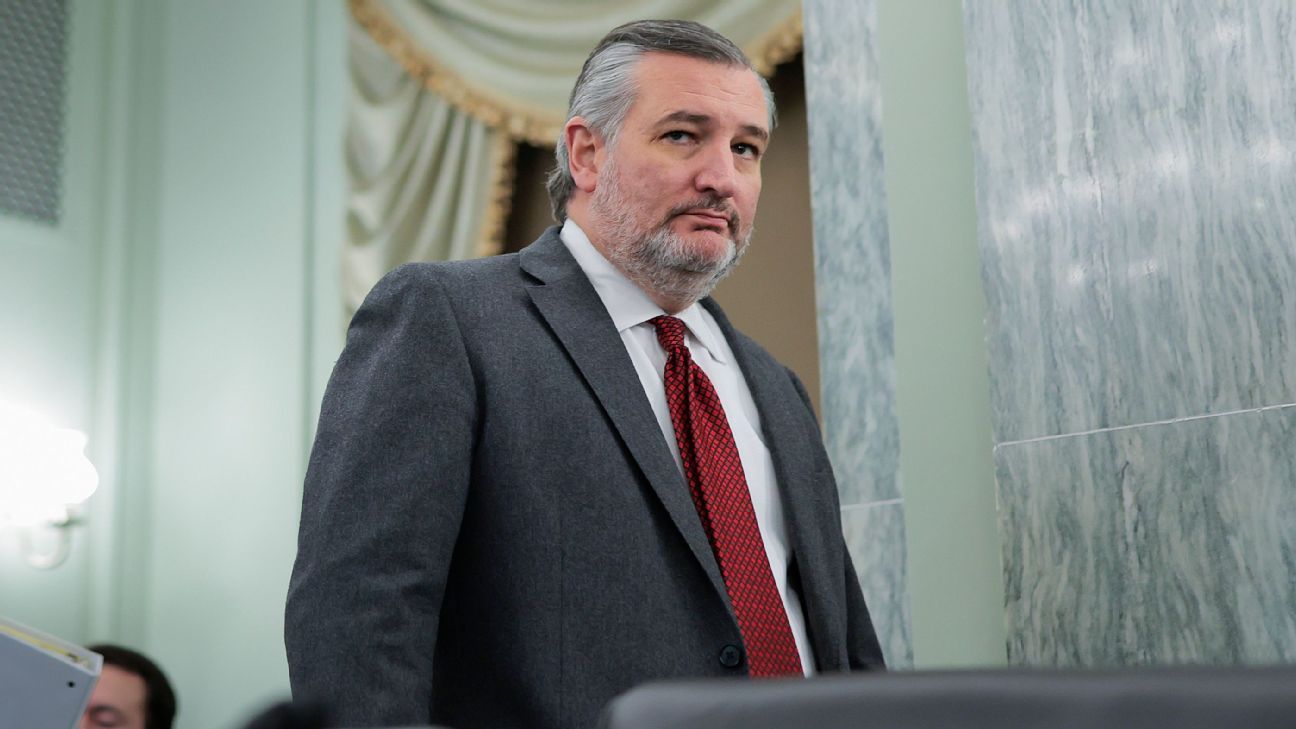
Sen. Ted Cruz said it is "absolutely critical" that any federal law related to college sports includes a provision that prevents athletes from being deemed employees of their school.
The Republican from Texas, who holds a key position in advancing NCAA legislation as chair of the Senate Commerce Committee, told ESPN in an interview Wednesday that Congress may run out of time to act if they can't find a bipartisan solution in the coming months. During a years-long effort to restore order to the college sports industry, Republicans and Democrats have remained largely divided on whether college athletes should have a future avenue for collective bargaining, which would require them to be employees.
"Clarifying that student athletes are not employees is absolutely critical," Cruz told ESPN. "Without it, we will see enormous and irreparable damage to college sports."
Cruz and NCAA leaders say many smaller schools would not be able to afford their sports teams if athletes had to be paid and receive benefits as employees. However, as lawsuits over player contracts and eligibility rules continue to mount, a growing number of frustrated coaches and athletic directors from major programs say they are open to collective bargaining as a solution.
"I've always been against this idea of players as employees, but quite frankly, that might be the only way to protect the collegiate model," Clemson football coach Dabo Swinney, a longtime defender of amateurism, said at a news conference last week.
The NCAA and its members have spent millions of dollars in the last several years lobbying Congress for a bill that would grant the association an antitrust exemption, supersede state laws related to college sports and block attempts to gain employee status for athletes. Despite more than a dozen Capitol Hill hearings and a long list of proposals, no bill has reached a full vote in either chamber of Congress to date.
Senate Commerce Committee staff told ESPN that Cruz and a bipartisan group of senators have made significant progress on a new draft of a bill but are at an impasse on the employment issue. Cruz said Democrats and labor unions are concerned about setting a broader precedent for other industries by closing the door on college athlete employment, which has led to the current stalemate.
"From a political perspective, you have labor union bosses that would love to see every college athlete deemed an employee made a member of a union and contributing union dues to elect Democrats," Cruz said. "It's terrible for college sports, but I get that there's some partisan appeal to it."
Sen. Maria Cantwell, the highest-ranking Democrat on the Commerce Committee, said in a statement to ESPN she also sees "growing bipartisan interest" for Congress to act. She has proposed separate college sports legislation that doesn't advocate for athletes to be employees, but leaves the door open for employment or collective bargaining in the future. She told ESPN that the committee "should move the ball forward with a hearing on this [topic]."
The large and expanding gap between the top tier of college sports teams and the rest of the NCAA has made it difficult to find a fair solution for all parties.
Last September, the commissioners of four conferences that comprise many of the nation's historically Black colleges and universities told members of Congress in a letter that making college athletes employees would "pose an existential threat" to their teams.
Most schools in those conferences spend somewhere between $10 million and $20 million annually on their entire athletic department -- roughly 10% the size of athletic budgets at power conference schools. Their commissioners told Congress that a legal need to pay additional benefits to athletes "could lead to the elimination of intercollegiate athletics" at some of their schools.
Meanwhile, the pressing problems the NCAA says can only be solved via federal legislation -- schools suing players over contract disputes, players suing the NCAA to extend their eligibility or to return to college from professional careers -- are exclusively happening at the wealthier power conference schools.
Congress could help by distinguishing between college athletes who should be considered school employees and those who shouldn't, said employment attorney Scott Schneider, who works with athletic departments at both small and large universities.
Schneider said he does not see a clear legal path to collective bargaining, but schools could solve many of their most pressing problems by signing athletes to employment contracts instead of the name, image and likeness licensing deals that schools currently use to pay players.
Schneider believes treating all Division I athletes as a "monolith is absurd." He said it's clear that the relationship between an athlete and a small institution is "vastly different" from the relationship between a star player and an SEC school, for example.
"The smaller university doesn't have the same degree of day-to-day control over how the player spends their time," Schneider said. He pointed to Colorado coach Deion Sanders' recent announcement that he would fine players for missing practice or breaking other team rules as an example of employment-like control.
"There is a way to draw that line in legislation so you don't have to draw it through years and years of litigation," Schneider said.
When asked if creating a distinction between groups of college athletes was a viable compromise for Congress, Cruz told ESPN he does not think "employment status is the answer to this problem."
Employment and collective bargaining could give athletes benefits beyond negotiating for more money, such as healthcare, scholarship guarantees and a more significant voice in making rules. Senate Commerce Committee staff said the proposal they are currently negotiating includes all of those benefits in a way that "would exceed what they could get in collective bargaining." The staffer said their hope is to provide more benefits to athletes without creating fundamental changes to the college sports system.
"The employment system is dramatically different than what a student-athlete is," Cruz told ESPN. "A student-athlete is meant to be a student, to get a degree. And the entire world of employment regulation is designed for a totally different system."
The NCAA is the defendant in one active federal lawsuit that claims all Division I athletes should be deemed employees of their school. The plaintiffs, led by former Villanova football player Trey Johnson and attorney Paul McDonald, argue that athletes should be given the same rights as students who sell tickets or concessions at college sports games, who are treated as employees while still working toward their degrees.
The Johnson case has been awaiting its next hearing for more than a year. Many college sports leaders are concerned that if Congress doesn't make a decision on employment status in the near future, a federal judge will make it for them.