
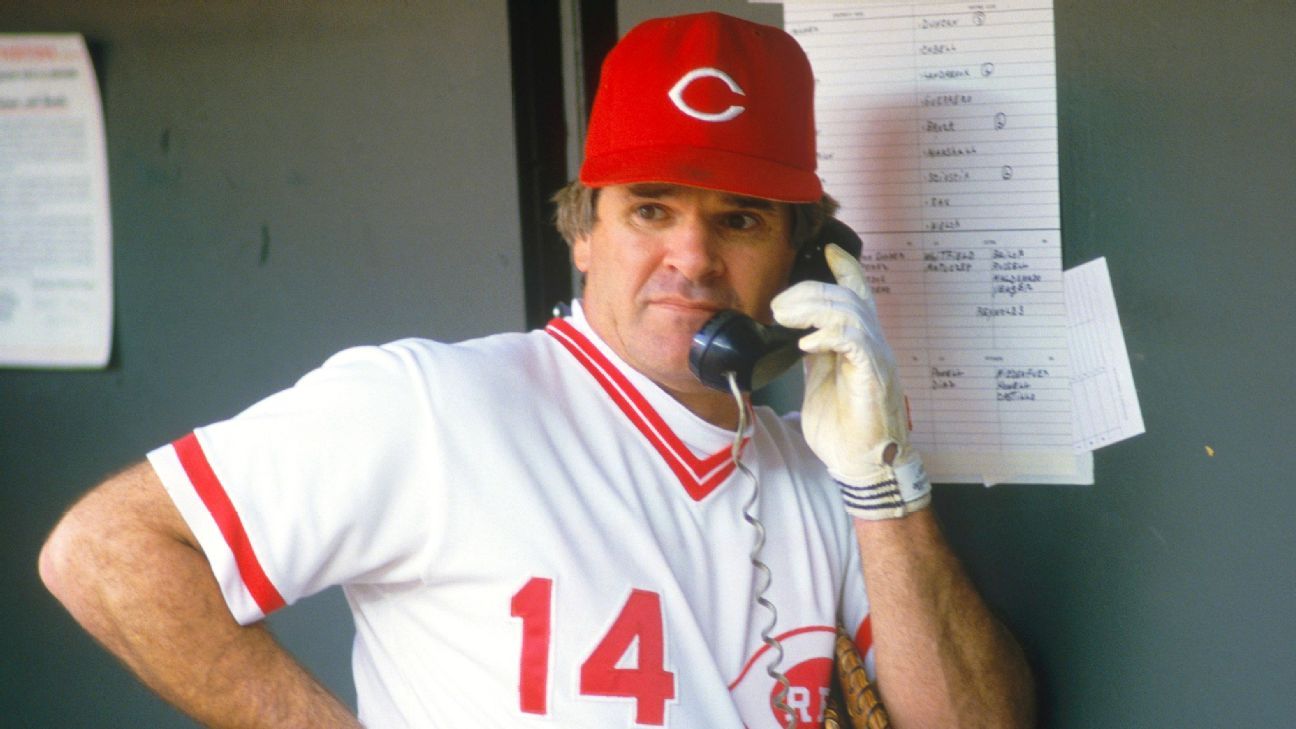
Major League Baseball began investigating Pete Rose in 1988, the year before it launched the full-blown, publicly announced probe that resulted in his banishment, according to newly released FBI documents. MLB, however, suspended its investigation at the request of federal law enforcement officials who were investigating Rose's finances at the time.
The documents show that MLB suspected in 1988, months before the public became aware of any investigation, that Rose was betting on baseball and was hundreds of thousands of dollars in debt. MLB did not respond to an ESPN request for comment.
In February 1989, MLB hired John Dowd, a former federal prosecutor, to lead its investigation of Rose. The resulting Dowd Report led to Rose's lifetime ban that August for betting on MLB games, including those of his own team. MLB commissioner Rob Manfred lifted Rose's ban this May, eight months after the all-time hit leader's death at age 83, making him eligible for election to the Baseball Hall of Fame.
The FBI file casts new light on the timeline for MLB's decision to impose a lifetime ban on Rose for his gambling activity. Rose's entry into the Hall of Fame remains in question despite his record-setting career.
As early as the 1970s, MLB looked into Rose for suspected associations with bookmakers, investigators said years later. But the investigation did not lead to any action against him.
The new information from the FBI is part of its second release of documents in response to a request by ESPN. The bureau publicly releases some records it maintains on individuals, after their deaths, often with redactions. This heavily redacted batch of documents includes 93 deleted pages, although the majority of those listed were labeled as duplicates.
The government, per a memo in the files, asked MLB to suspend its investigation into Rose on April 13, 1988, due to concern that the "investigation might in some way impede the efforts of law enforcement." That FBI memo, sent to the FBI's Cincinnati office, had a subject line naming Ronald Peters, who was one of Rose's bookmakers. The memo said the FBI didn't discuss its Rose investigation in detail with an MLB representative it quoted, whose name was redacted.
That MLB representative, a source familiar with the investigation told ESPN this week, was former FBI agent Joe Daly. According to the FBI documents, the man identified by ESPN's source as Daly spoke with the FBI about MLB's investigation of Rose on April 12, 1988. The source said MLB was investigating Rose in 1988 for suspected betting on baseball.
Daly told the FBI that Rose was "reputedly $300,000 to $400,000 in debt at this date," according to the documents.
According to the interview summary, Daly said that at the time, he "had found only one person" who alleged that Rose bet on MLB games.
The government asked MLB to suspend its investigation because the Internal Revenue Service was investigating Rose, the source said, adding that the FBI promised it would introduce MLB to a potentially crucial witness regarding Rose's gambling. The source said that a few weeks after MLB agreed to suspend its probe, it got the green light to resume its efforts. The FBI followed through, providing the promised witness for MLB's investigation.
Most of the newly released documents focus on the narcotics and bookmaking operation investigations into Peters during the mid-1980s. Rose's gambling and financial habits were mentioned throughout the documents, including a reference to the IRS investigation.
The documents reference an FBI interview with Rose in April 1988 about sports memorabilia, specifically the bejeweled Hickok Belt Award that Rose won as professional athlete of the year for 1975. Rose served five months in federal prison after pleading guilty in 1990 to filing false tax returns related to income from his memorabilia sales, gambling and other activities.
Also referenced are organized crime figures in New York, but the documents do not state any link between Rose or Peters and the New York mob.
According to the rules of the Hall of Fame, the earliest consideration of Rose's candidacy for Cooperstown would be in 2027, when he would be eligible for inclusion on the Classic Era Committee ballot. The 16-person committee is to meet that December and weigh eight candidates' resumes, integrity, sportsmanship and character.
ESPN's T.J. Quinn contributed to this report.