
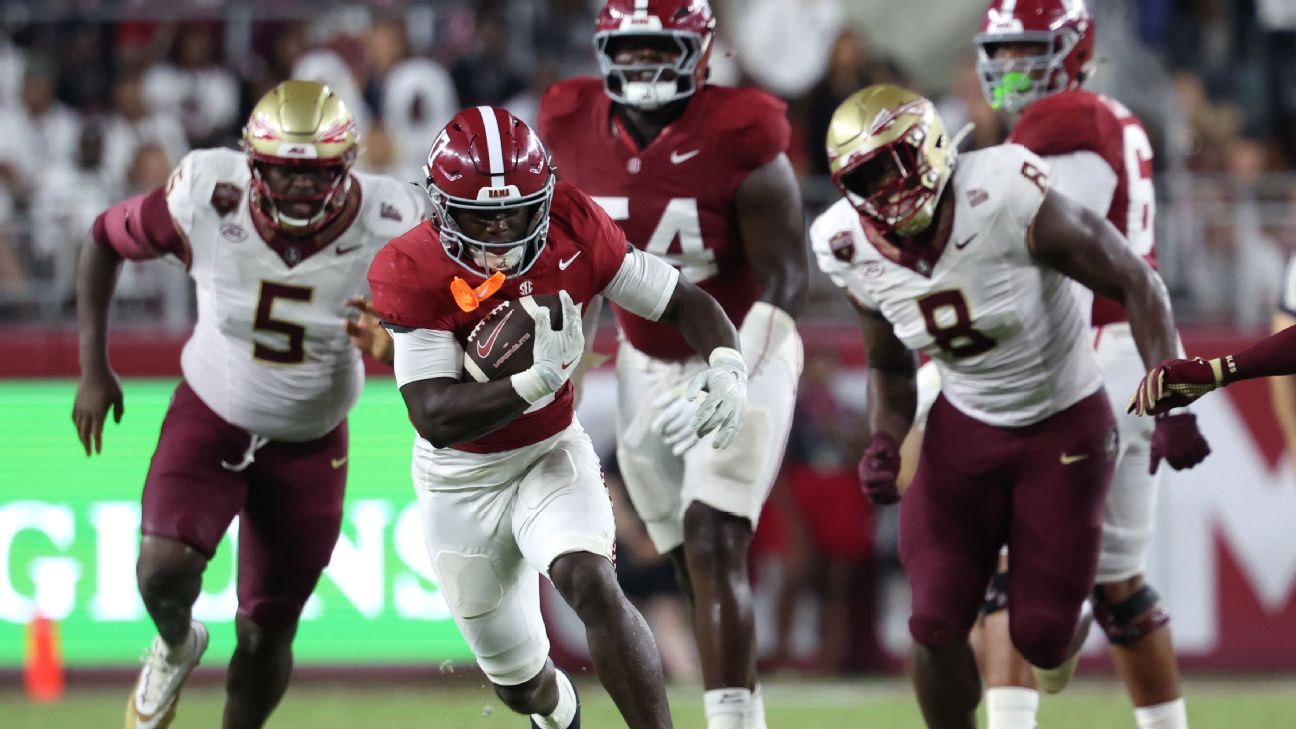
EmailPrintOpen Extended ReactionsThe college football season is almost halfway finished, but we have enough of a sample size for us to know a few things by now.Some top programs (and surprise risers) successfully addressed glaring needs from 2025, while some fading contenders failed to do so. We're talking about the rushing attacks at Alabama and Oklahoma, the offenses at Clemson and Northwestern and the run defense at Utah. Did those units get fixed in the offseason? Are they any better in 2026? And is the answer to that question a reason any of the above programs are any more or less in contention for the College Football Playoff as we hit Week 7?For the purpose of these evaluations, we excluded full-scale roster overhauls under first-year coaching staffs such as Oklahoma State and UCLA. We also skipped over programs that filled obvious holes. In this instance, we gave Indiana no credit for replacing an elite quarterback and wide receiver combo with another elite quarterback and wide receiver combo.In the revenue-share and transfer portal era, it has (theoretically) never been easier to address roster flaws. At the same time, the consequences of inaction or the wrong move have never been more severe. So which programs took care of their needs? And who fell short? Let's find out.Jump to:Teams that missed10 teams that addressed needs in 2026Alabama Crimson TideKey 2025 stat: 104.1 rushing yards per game, 125th in FBSNeed: Ways to improve the run gameWhat went right: A revamped blocking unit under first-year offensive line coach Adrian Klemm? An energized running back room powered by breakout freshman Trae'shawn Brown? The dual-threat ability of quarterback Keelon Russell? The exact root cause only matters so much.The bottom line is this: Alabama has a respectable run game again, and it's a key part of why the program appears to have its most legitimate national title contender of the post-Saban era.In 2025, the Crimson Tide's rushing attack averaged just 3.4 yards per carry (T-125th nationally), logged fewer runs of 10-plus yards -- 42 -- than all but one other SEC offense and floundered in the postseason. Per ESPN Research, Alabama's 104.1 yards per contest represented the program's lowest rushing average since at least 1956.At the very least, those struggles gave coach Kalen DeBoer and his staff a mandate to carry out a proper offseason overhaul. Through six games, during which the Tide have averaged 182.2 yards per contest (44th nationally), it looks like they got the rebuild right.Alabama bolstered a young offensive line with veteran transfers Racin Delgatty (Cal-Poly) and Jayvin James (Mississippi State) and added another physical blocker in former Oklahoma State tight end Josh Ford. Russell's mobility has helped, too; the ex-five-star recruit sits fourth in rushing yards among SEC quarterbacks (225). And a backfield unit led by junior Daniel Hill and a pair of freshmen -- Brown and coveted 2026 signee EJ Crowell -- is proving difficult for opposing defenses to wrap up. Among FBS offenses, Alabama rushers now rank 17th in yards after contact (737) and 29th in runs of 10-plus yards (34), per ESPN Research.Duke Blue DevilsKey 2025 stat: 276.8 passing yards allowed per game, 134th in FBSNeed: Players to improve the pass defenseWhat went right: For all the attention rightly being paid to breakout pass rushers Bryce Davis and Tyshon Reed, the most significant development for a Duke defense that ranks 14th in points allowed (14.4 per game) lies within the program's retooled secondary.The Blue Devils managed to capture their first outright ACC title since 1962 last fall despite a pass defense that finished 2025 dead last in the FBS in the following categories: yards allowed (3,875), first downs (172), completions of 20-plus yards (57) and yards after catch (2,137). Statistically, there weren't many, if any more quarterback-friendly secondaries in the country.Duke coach Manny Diaz turned to the portal for solutions. Among five veteran transfer defensive backs to join the roster in the offseason, the Blue Devils added starting cornerbacks Kyon Loud (Montana) and Dylan Flowers (Western Kentucky). Respectively, the pair ranks first and second in snaps among Duke defenders through five games, establishing themselves alongside safeties DaShawn Stone -- the lone returning starter in the program's secondary -- and Andrew Pellicciotta, the rising sophomore standout who leads the program with 27 tackles.Diaz & Co. are getting plenty of help from an impressive front seven this fall. But limiting explosives -- only three ACC defenses have given up fewer completions of 20-plus yards so far this fall -- and sitting in the top half of the country in pass defense (202.0 YPG), the Blue Devils' refurbished secondary is substantially less leaky in 2026.LSU TigersKey 2025 stat: 27 sacks, 62nd in FBSNeed: Improved pass rushWhat went right: It was easy to predict that edge rusher Princewill Umanmielen would play a significant part on LSU's 2026 defensive line when he followed Lane Kiffin from Ole Miss. Less of a given, however, was the prominent role freshman defensive tackle Deuce Geralds has carved for himself, now pairing with Umanmielen as one the key pieces behind a reenergized Tigers pass rush and what has emerged as one of the nation's fiercest defensive lines this fall.LSU possessed an adequate defensive line last fall led by the likes of Jack Pyburn, Bernard Gooden and Dominick McKinley. But the Tigers struggled to convert sacks, and a run defense that looked good on paper -- LSU finished 32nd nationally in rushing yards per game -- floundered in matchups with quality SEC opponents, including the losses to Ole Miss, Vanderbilt and Texas A&M that laid the path to Brian Kelly's late-October firing.A year later, the complexion has changed entirely. Geralds, ESPN's No. 2 defensive tackle in the 2026 cycle, asserted himself immediately this fall. Through six games, he's tallied 14 tackles, 12 pressures and five sacks as the leading snap-getter on a defensive line that ranks fifth against the run (74.5 YPG) and 14th in tackles for loss (52). Umanmielen, meanwhile, has picked up right where he left off at Ole Miss a year ago, supercharging the nation's No. 2 pass rush (23 sacks) with eight sacks of his own that trail only Texas' Colin Simmons for the national lead.LSU has gotten significantly better on the line of scrimmage in Kiffin's debut season. Geralds and Umanmielen, and the matchup nightmares they create, are a big reason why.Nebraska CornhuskersKey 2025 stat: 145.9 rushing yards per game, 80th in FBSNeed: Running back upgradeWhat went right: Unlike the previous two seasons under coach Matt Rhule, the Huskers appear to have a legit, Big Ten run game; through six games, Nebraska sits third in the league and 26th nationally in rushing (213.8 YPG). That Nebraska is off to its best start since 2016 and nearly managed to snap Indiana's FBS-best 21-game win streak last weekend is likely related.Credit, on this front, begins with freshman running back Jamal Rule. The three-star signee from North Carolina is generating 6.8 yards per carry, fourth most among Big Ten rushers with at least 50 carries, to the tune of 386 yards and five touchdowns thus far. Throw in fellow running back Mekhi Nelson and the mobile transfer quarterback Anthony Colandrea and the Huskers boast three dangerous runners who have accounted for 12 of the program's Big Ten-leading 16 rushing scores.Nebraska has, importantly, gotten its offensive line under control. Rhule made a statement in the offseason when he hired Georgia Tech assistant Geep Wade to lead his offensive line. The Huskers stocked the position group with three new starting-level transfers between right tackle Tree Babalade (South Carolina) and guards Brendan Black (Iowa State) and Paul Mubenga, and Wade is getting the most out of the talent. Nebraska enters Week 7 ranked 44th in yards before contact, up from 62nd a year ago; to date, only Indiana has recorded more runs of 10-plus yards than Nebraska (41) among Big Ten offenses.Northwestern WildcatsKey 2025 stat: 23.4 points per game, 98th in FBSNeed: Offensive upgradesWhat went right: Perhaps no offense in the country has been more exhilarating (and surprising) than the one first-year coordinator Chip Kelly is unveiling at Northwestern this fall. Not only did the wing-T he deployed shred Penn State for 413 rushing yards last month, but his refreshed Wildcats offense appears to be much more than a gimmick.Of course, we have to consider the context here. The program hasn't finished in the top half of the Big Ten in scoring offense since 2017. Just last year, the Wildcats finished 98th nationally in scoring (23.4 PPG) and total offense (346.1 YPG). If Kelly's 35.4-points-per-game offense holds any sort of real staying power, he'll have effectively exorcised nearly a decade of Northwestern offensive futility in the span of just five games.How has he done it? For starters, Kelly is getting the best out of Michigan State transfer quarterback Aidan Chiles. The fourth-year passer is expertly leading a complex offensive scheme, and doing so to the tune of a 9-0 touchdown-to-interception ratio and career highs in completion percentage (71.4%) and yards per completion (10.5). That's been the platform for the nation's 32nd-ranked rushing offense (203 YPG) and a trio of running backs -- Caleb Komolafe, Joseph Himon II and Florida State transfer Gavin Sawchuk -- averaging over 5.0 yards per carry.Most of all, Northwestern makes big plays. In five games, the Wildcats have logged 53 explosive plays (runs of 10 yards or completions of 20 yards), more than Notre Dame, Ohio State, Oregon and all but 31 other FBS programs. Per ESPN Research, that has Northwestern on pace for, quite literally, it's most explosive offensive season since at least 2005.Missouri TigersKey 2025 stat: 188 passing yards per game, 104th in FBSNeed: A better passing gameWhat went right: The Tigers didn't necessarily struggle to gain yards or put points on the board last fall; in fact, with the help of SEC rushing yards leader Ahmad Hardy, they ranked 32nd in total offense (416.3 YPG) and 44th in scoring (30.2). But where Missouri fell short was in its ability to effectively move the ball through the air, which is why the Tigers and quarterback Austin Simmons felt like a perfect marriage when the Ole Miss transfer landed in Columbia.Indeed, the big-armed passer is proving to be the ideal choice. Leaning on ex-Ole Miss teammate Cayden Lee and sophomore Donovan Olugbode, Simmons has completed 64.8% of his passes for 1,434 yards and 14 touchdowns to one interception across the Tigers' 5-1 start. In terms of downfield passing, his 67 first downs rank 18th among FBS starting quarterbacks, and only six passers have completed more throws of 20-plus yards than Simmons, who has 27. And crucially, Eli Drinkwitz and first-year offensive coordinator Chip Lindsey have kept Simmons' propensity for turnover -- he threw five interceptions on just 75 attempts at Ole Miss in 2025 -- in check.For Missouri, Simmons has delivered not only a significantly improved passing attack (256.5, 44th in the FBS) and scoring offense (35.8 PPG, 33rd in the FBS), but the mere threat of his arm has made life easier on the Tigers' run game, too. Senior Jamal Roberts is pacing the SEC with 147 carries and 828 yards.Utah UtesKey 2025 stat: 181.2 rushing yards per game, 110th in FBSNeed: Run defense upgradesWhat went right: The Utes travel to Colorado this weekend with the nation's ninth-ranked run defense, limiting opposing offenses to 78.8 yards per game. And considering that first-year head coach Morgan Scalley was calling the program's defense last fall, it's not crazy to think that Utah was likely just as good against the run in 2025.Not so fast. In nearly every facet, the Utes' smothering defensive line of 2026 is a completely different picture from a year ago.Last season, opposing offenses gashed Utah for 150-plus yards on seven occasions, including a staggering 472-yard rushing effort from Kansas State in November. All told, Scalley's 2025 unit ranked 110th nationally in run defense (181.2 YPG) and 129th in explosive runs after giving opposing rushers 80 carries of 10-plus yards. By contrast, a year later, the Utes have allowed the fewest explosive runs of any Big 12 defense (13) through five games. Per ESPN Research, there are only seven FBS defenses harder to move the sticks on via the run this fall than the Utes' defense, which has allowed first downs on just 17.3% of the run plays it has faced.Utah's swing has come with an entirely new starting defensive line unit. On the edge, North Texas transfer Ethan Day and fifth-year pass rusher Lance Holtzclaw, who has a team-best five run stops, are filling big shoes in the wake of 11.5-sack edge John Henry Daley's departure to Michigan. In defensive tackles Karson Kaufusi and San Jose State transfer Jireh Moe, the Big 12-contending Utes have a lead tandem that has held all five of their opponents to 111 rushing yards or fewer this fall.Virginia Tech HokiesKey 2025 stat: 19 sacks, 110th in FBSNeed: Pass rushersWhat went right: Last fall, Virginia Tech began its season with Brent Pry on staff and finished the year at the bottom of the ACC in sacks and pressures. This fall, the program began its season with Pry on staff again -- this time as defensive coordinator -- and through six games, the Hokies boast a ferocious front seven that enters Week 7 tied for the national lead in tackles for loss (75) and ranks fourth in sacks, having already matched the 2025 total of 19.For starters, the decision by first-year coach James Franklin to keep Pry on campus has proved to be an early masterstroke. Ditto on his hiring of defensive line coach Sean Spencer, an ex-Penn State assistant who had spent the previous four seasons in the SEC with Florida and Texas A&M. Pry and Spencer have restored the same aggressive pass rush that previously made Pry one of the most coveted playcallers in the country.That process began with the offseason retention of star defensive tackle Kemari Copeland, who leads all Virginia Tech defensive linemen with 16 tackles, including four for loss. Elsewhere, the Hokies are getting production from some less likely candidates, such as breakout sack leader Aycen Stevens. All 5.5 of the senior pass rusher's career sacks have come this fall, and Stevens is tied for 19th nationally with 18 pressures on the season. Reigning team tackles leader Kaleb Spencer has gotten in on the fun with a career-best three sacks, as have Penn State transfers Cortez Harris (five sacks) and Mylachi Williams (three), on one of the most surprisingly dangerous pass rushing units in college football this fall.Wake Forest Demon DeaconsKey 2025 stat: 237.7 passing yards per game, 58th in FBSNeed: A leap in QB playWhat went right: Coach Jake Dickert continues to perform one of the most impressive coaching jobs in the country, hanging on to a 14-5 record halfway through his second season at Wake Forest. Perhaps the biggest difference for Dickert in Year 2 with the Demon Deacons is at quarterback, where North Carolina transfer Gio Lopez has kicked things up a notch this fall.In 2025, Lopez landed with Bill Belichick and the Tar Heels after a breakout 2024 campaign at South Alabama. Stylistically, Lopez never quite fit the system North Carolina was operating in a year ago. But when he entered the transfer portal again during the offseason, Wake Forest made for a perfect match. Who better to reignite Lopez than Demon Deacons offensive coordinator Rob Ezell, the playcaller who helped launch him at South Alabama?The reunion has been fruitful thus far. Across a 5-1 start, Lopez has totaled 1,680 passing yards that rank seventh among FBS quarterbacks with a 13-1 touchdown-to-interception ratio. Lopez's 67.4% completion rate is the highest of his career, and with 202 rushing yards and six touchdowns on 56 carries, he's on pace for career highs in each category.Wake Forest has made significant strides on offense in 2026, thrusting the Demon Deacons into legitimate ACC title contention. On Saturday, Dickert takes Wake Forest to Cal with the nation's No. 18 passing offense (290.5 YPG) and 29th-ranked scoring offense (37.2 PPG), all with a big helping hand from a familiar quarterback-coordinator pairing.West Virginia MountaineersKey 2025 stat: 160.6 rushing yards per game, 64th in FBSNeed: An improved rushing attackWhat went right: With quarterback Michael Hawkins Jr. and running back Cam Cook, the Mountaineers are reestablishing a familiar identity in Year 2 of Rich Rodriguez's second stint at West Virginia.There was nothing especially remarkable or characteristic about Rodriguez's run game last fall, when the Mountaineers were middle-of-the-pack in rushing yards (160.6 YPG) and near the bottom of the Big 12 in yards per carry (3.7). Things are rather different in 2026, however. Only one FBS program has two of the nation's top 10 rushers this fall. It's West Virginia, which begins Week 7 with the country's fourth-ranked run game, averaging 295.5 yards per game.Hawkins, who played in nine games at Oklahoma from 2024 to 2025, has emerged as the top rushing quarterback in college football following his offseason arrival to the Mountaineers. He's level with Florida running back Jadan Baugh for the national rushing touchdown lead (12) and ranks second among FBS rushers in first downs (33) and explosive runs (23). Cook, the nation's rushing leader at Jacksonville State last fall, has kept it rolling in Morgantown, pacing the country in carries (153) while sitting third in total rushing (835) and yards after contact (465).West Virginia's passing game is mediocre. It has the third-worst scoring defense in the Power 4. But when the ball is the hands of Hawkins or Cook, the Mountaineers are electric again.5 teams that failed to address needs in 2026Clemson TigersKey 2025 stat: 27.2 points per game, 72nd in FBSNeed: Offensive upgradesWhat went wrong: After a 7-6 season in 2025, the Tigers needed to get better on offense in 2026. However, the Tigers are decidedly not better on offense in 2026. In fact, they've gotten worse.Coach Dabo Swinney might well have made the right call to part ways with former offensive coordinator Garrett Riley after Clemson's scoring average dipped from 34.7 PPG to 27.2 PPG last fall. What must Swinney be thinking about Chad Morris, back for his second stint calling the Tigers' offense, as the program sits 119th in scoring (19.4 PPG) and total offense (321.2 YPG) and tied with Central Michigan for the fewest passing touchdowns -- two -- of any FBS program? Clemson's ground game, however, is better in 2026, up to 95th (137.6 YPG) from 105th (124.5) last fall.And, in the interest of fairness to Morris, it's worth acknowledging the talent at his disposal. The Tigers replaced two-time ACC champion quarterback Cade Klubnik with unproven veteran Christopher Vizzina and a raw, if talented, freshman quarterback in Tait Reynolds. Meanwhile, Clemson added just two offensive players in the portal in the offseason, neither of them on the offensive line, where the Tigers allowed 188 pressures in 2025, 12th most nationally.Yet again, the decisions Swinney and Clemson made in the winter are burning them in the fall.Oklahoma SoonersKey 2025 stat: 3.5 yards per carry, 120th in FBSNeed: A rushing complement to John MateerWhat went wrong: Oklahoma made it back to the CFP last fall despite a middling offense that fielded the nation's 113th-ranked rushing attack (118.5 YPG). That gave coach Brent Venables and offensive coordinator Ben Arbuckle a clear offseason priority: To maximize quarterback John Mateer and take another step forward, the Sooners had to sort out the run game.Plenty of effort went into that mission. Oklahoma hired veteran assistant Deland McCullough to coach running backs and added a pair of new rushers in Colorado State transfer Lloyd Avant and touted four-star signee Jonathan Hatton Jr. Burly tight ends Rocky Beers (Colorado State) and Hayden Hansen (Florida) and four transfer offensive linemen, headlined by former Arkansas tackle E'Marion Harris, came via the portal, too.Yet, it has been more of the same for Oklahoma this fall. In fact, so far this season, the program's backfield (and the blocking unit in front of it) is even less reliable, and the Sooners are still overwhelmingly reliant on Mateer and the passing game; per ESPN Research, 68.5% of their total yards have come through the air this fall, the 18th most nationally.It's easy to understand why.Across five games, Oklahoma has averaged 2.9 yards per attempt on the ground, placing the Sooners alongside Stanford for the lowest tally across the FBS. Some of the blame lies with the running backs. While Avant has delivered modest production (236 yards and two touchdowns on 52 carries), the likes of Hatton and returners Tory Blaylock and Xavier Robinson have contributed even less behind him. But it's also difficult to look past an offensive line that has become a revolving door for a third consecutive season with injuries to former five-star offensive tackle Michael Fasusi and guards Heath Ozaeta and Eddy Pierre-Louis. Earlier this month, Venables called the group "incredibly inconsistent." Oklahoma's 141 rushing yards before contact this fall -- the fewest in the SEC -- support that claim.This isn't a new problem for Venables' Sooners; the program hasn't had a 1,000-yard rusher since Eric Gray in 2022. But in failing to address its biggest liability, an Oklahoma offense that hasn't exceeded 100 yards rushing against a Power 4 opponent this fall has clearly regressed.Texas A&M AggiesKey 2025 stat: 43 sacks, No. 4 in FBSNeed: Reloaded pass rushWhat went wrong: It was always lofty to expect the Aggies to properly replace the production Cashius Howell, Dayon Hayes and Tyler Onyedim provided a year ago. But one of the many glaring differences between Texas A&M in 2025 and Texas A&M in 2026 is the pass rush, or a lack thereof.Last fall, coach Mike Elko took the Aggies to their first playoff appearance with help from an elite unit of defensive line. In 2025, led by Howell and his 11.5 sacks, they tallied more sacks (43) and tackles (135) than all but three other FBS defenses in those respective categories. The pass rush was one of the keys to a defense that held opposing passers to 176.6 yards per game (16th best in the FBS) and closed with the nation's 18th-ranked scoring defense (32.7).Fast-forward a year and the Aggies' pass rush finds itself on the opposite side of the table. Texas A&M attempted to plug holes from within and via the portal with additions such as Northwestern edge rusher Anto Saka and Ryan Henderson from San Diego State, but the evidence is clear. With just five sacks on the season, the 10th fewest in the nation, and 51 pressures that rank 99th nationally, the Aggies aren't getting after the quarterback like they were a year ago, and the swarming defense they leaned on in 2025 is no longer so stout.Texas Tech Red RaidersKey 2025 stat: 278.5 passing yards per game, 17th in FBSNeed: Better QB playWhat went wrong: Setting aside the circumstances of how we got here, despite its best efforts, Texas Tech is no better at quarterback now than it was this time last year.Brendan Sorsby was supposed to be the quarterback to take the Red Raiders to the next level after Behren Morton powered the nation's 17th-ranked passing offense in 2025. But coach Joey McGuire and his staff were high on third-year passer Will Hammond before Sorsby left the program, and that confidence remained when he became QB1 this fall.But, to date, Hammond hasn't delivered the sort of punch Texas Tech was hoping to get from its quarterback in 2026. In five starts, Hammond has completed 68.3% of his passes for 1,102 yards with five touchdowns and five interceptions. That touchdown-to-interception ratio is a problem, as is the Red Raiders' lack of explosive plays in the passing game; Texas Tech's 15 completions of 20-plus yards rank 91st nationally. At the same time last year, the Red Raiders' Morton-led offense had 27.At the midway point this fall, Texas Tech has the 75th-ranked passing attack in the country (227.4 YPG). Without the same takeaway-generating defense Texas Tech possessed in 2025, it's difficult to see the Red Raiders going as deep into the postseason this fall as they did a year ago.Washington HuskiesKey 2025 stat: Four offensive linemen with 10-plus startsNeed: OL cohesionWhat went wrong: On paper, the Huskies' offensive line projected to be a strength in 2026. Among the names on the depth chart: a seasoned right tackle in Drew Azzopardi, fellow veterans Geirean Hatchett and Landen Hatchett, a second-year starter in John Mills, an intriguing portal addition in Sam Houston State transfer Kolt Dieterich and freshman tackle Kodi Greene, one of the highest-ranked offensive line recruits. With that collection of talent, the graduation of left tackle Carver Willis and portal departures of Paki Finau and Zach Henning seemed more palatable.Yet few, if any, programs that featured in the preseason AP Top 25 have had a harder time finding the right offensive line combination this fall than the Huskies. A lingering wrist injury has kept projected starting center Landen Hatchett from all but one game thus far, forcing Dieterich into the role. Greene's growing pains at left tackle have prompted Washington to shift Mills from guard to tackle in multiple games, and right guard snaps have been split between Hatchett and second-year lineman Champ Taulealea.The point is there has been very little cohesion on the Huskies' offensive line thus far, and the lack of continuity has shown. In pass protection, struggles to protect quarterback Demond Williams Jr. have translated to an FBS-worst 21 sacks conceded. And the Huskies' 135th-ranked rushing attack (90.3 yards per game) hasn't been much better aside from Williams' legs.Both issues were on full display in a 41-24 home loss to Iowa last weekend, when Washington gave up six sacks and finished with -3 rushing yards in a low point of a disappointing season.