
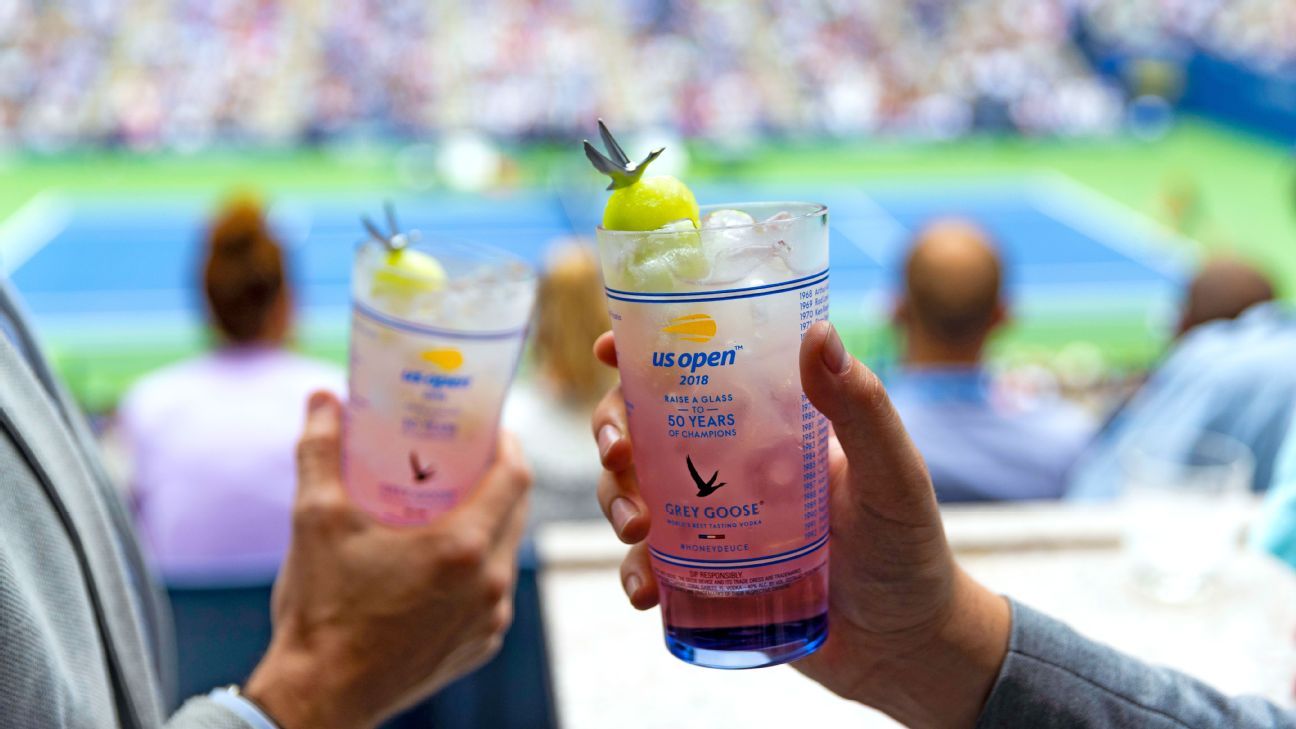
EmailPrintOpen Extended ReactionsEVERY SPRING, Jared Walton, director of national accounts for Baldor Specialty Foods, makes an important phone call to Turlock Fruit Company in California. About six months before players and fans descend upon the USTA Billie Jean King National Tennis Center in Queens, New York, it's time to calculate how many honeydew melons Turlock must plant for the upcoming US Open. The melons, cut and scooped into marble-sized balls (about 1.57 inches in diameter) and skewered three across, garnish the tournament's ubiquitous signature cocktail: the Honey Deuce.In 2025, fans consumed 738,459 Honey Deuces, generating more than $17 million in sales. This year, 8,000 cases of honeydew melons -- enough to fill eight semi-trucks -- will make the three- to four-day journey from California to New York. "They'll be on the road later today or tomorrow morning," Walton says on a mid-August morning.Lined up single file on pallets, the volume of melons ordered for the three-week tournament would stretch the length of nearly three football fields."I feel like people think honeydew balls show up in Queens every summer," Walton laughs. "And it just magically happens. But there's extensive planning."But the Honey Deuce is more than a vodka lemonade with three melon balls on top. Nearly two decades after its debut, the cocktail has become the US Open's unofficial status symbol -- part refreshment, part souvenir, part social media star -- backed by months of planning, millions in sales and a hand-scooped supply chain that starts long before the first serve in Queens.What's in a Honey Deuce?Grey Goose vodka, lemonade and a drizzle of raspberry liqueur. Of course, don't forget the melon balls. Sweet, tart and pink, the cocktail was designed for simplicity so it could be replicated at scale and reduce fans' time in line. "We knew we were going to sell a lot, so we had to simplify the recipe and make it something that could work for everybody," says Nick Mautone, creator of the Honey Deuce.What inspired the Honey Deuce?Daniel Zausner, COO at the USTA National Tennis Center, began pushing for a signature cocktail after drinking in the sights of the Kentucky Derby. Spectators were obsessed with the event's most famous drink, the mint julep."You see all the imagery of women in their stiletto heels, with the large-brim hats and their dresses. Women were walking around with stacks of these glasses," Zausner says of his experience at Churchill Downs. "It meant so much to them to take home four, six glasses, whatever it might be."Imitation is the most sincere form of flattery, Zausner says of his idea to create a signature drink for the US Open -- "I stole it from the Derby" -- and he sought to bring the same fervor to New York. "Literally the first call I made that Monday morning was to someone on our sponsorship team," Zausner says. "I said, 'We need a vodka sponsor and we need one tomorrow."Who created the Honey Deuce?Inspiration struck restaurateur and mixologist Nick Mautone after returning home from a farmers market on Long Island. In 2006, Grey Goose asked Mautone, a company ambassador at the time, to create a signature cocktail for the US Open. Mautone is a longtime tennis fan. In his early 20s, he worked at the US Open, hauling ice and barbacking. Decades later, home from the market, Mautone looked at the melon balls he was scooping for a summer salad. "It was divine inspiration, like 'Oh my god, this looks like a tennis ball," he says.Mautone tinkered with five to six variations of the cocktail before settling on the current version, which debuted in 2007. Lucky family members and visiting friends served as taste testers."Initially I called it 'Deuce,'" Mautone said of his now-famous concoction. Deuce is the scoring term for when both players are tied at 40-40. "Another version I called '30 Love.'" The 'Courtside' -- a mix of vodka, rosemary citrus syrup, fresh lemon juice and raspberry liqueur -- didn't make the cut, but Mautone still enjoys mixing Courtsides for family and friends when he hosts US Open watch parties at home. "It's a really delicious, a little bit more elevated version of what the Honey Deuce became," Mautone said.How many Honey Deuces were sold last year?Bartenders served 738,459 Honey Deuces in 2025. At $23 each (now priced more than 90% above its debut price), the cocktail generated more than $17 million in sales. Compare this to its 2007 debut, when 24,000 Honey Deuces sold for $12 each. Since the expansion of Fan Week, USTA accounts for a 20 to 30% increase in sales year over year. Overall attendance -- and thus Honey Deuce sales -- are on the rise. Attendance surpassed 1,145,000 fans last year. It was the second consecutive year the tournament reached over a million spectators. For 2026, Zausner and his team have ordered 800,000 Honey Deuce souvenir cups for the tournament.How are the melon balls made?"We've never not had melons," Walton says. As director of national accounts for Baldor Specialty Foods, it's Walton's job to feed fans' appetites for the melon balls that garnish every Honey Deuce. "800,000 cups; each cup gets three honeydew balls on it. So that's over 2.4 million melon balls," Walton says. "And that's only the benchmark."While the collectible cups might sell out, bartenders will continue to sell Honey Deuces in generic cups with melon balls. The logistics of such a feat -- maintaining a constant supply of perishable melon balls -- are considerable. While Walton begins planning for the tournament in the spring, the melon balls themselves have a max shelf life of five days. In recent years, Baldor added a refrigerated trailer onsite to keep the fruit fresh. There are no machines; everything is done by hand, and Walton's team buys 500 melon ballers for the task. Starting at 5:45 a.m., a team of 20-plus employees begins turning honeydew fruit into mini tennis balls."It's actually somewhat magical seeing them take a big, round sphere and turn it into multiple mini round spheres," says Walton.What about the cups?Each Honey Deuce is served in a clear commemorative cup printed with the names of previous US Open winners. While a Honey Deuce is only good until the last sip, the cups transform into souvenirs fans can take home. At the tournament, it's a common sight to see fans stacking cups several feet into the air. On resale sites like eBay, single cups can be listed for $10- $20. A set of six can go for $100. (You can also buy a pair of 2026 cups from the official US Open shop for $14.)The cups are ordered several months in advance. In 2020, when fans were unable to attend due to the COVID-19 pandemic, USTA found itself with 50,000 spare cups to give away. "In a sad way it became one of the only souvenirs that came out of the Open," Zausner says.Why is the Honey Deuce so popular?"People come through the gates every morning and besides asking 'How do you find this court to find a player practice,' the most asked question is 'Where's the nearest Grey Goose cup?'" Zausner says. "They just want to get a Honey Deuce, take a picture with it, let the whole world know they're at the US Open."Taylor Swift has been pictured nursing a Honey Deuce. So have Kendall Jenner, Timothe Chalamet, Leonardo DiCaprio and many of your favorite celebrities. "Seeing Bruce Springsteen last year drinking a Honey Deuce, that was the pinnacle for me," Mautone laughs."We like to say that the Honey Deuce is an overnight success 19 years in the making," says Aleco Azqueta, global vice president of marketing at Grey Goose. Azqueta, who has been involved with Grey Goose's partnership with USTA from the beginning, attributes the Honey Deuce's rise in popularity in part to the pandemic."There was so much pent-up demand during COVID for people to actually go out and experience things," Azqueta says. Coming out of COVID, the Taylor Swift Eras Tour was massive, and everyone was trading bracelets. The Honey Deuce was that for the US Open. It's like the Honey Deuce became the ultimate accessory of the tournament."The US Open store now sells Honey Deuce T-shirts and hats for $48 each. You can buy a Honey Deuce towel ($24) or even a Honey Deuce scented candle ($40). A melon baller with the US Open logo runs for $26. Nearly 20 years after its introduction, the drink has become a cultural phenomenon.Says Walton: "Everyone wants that picture with the cup saying, 'I got it this year.'"