
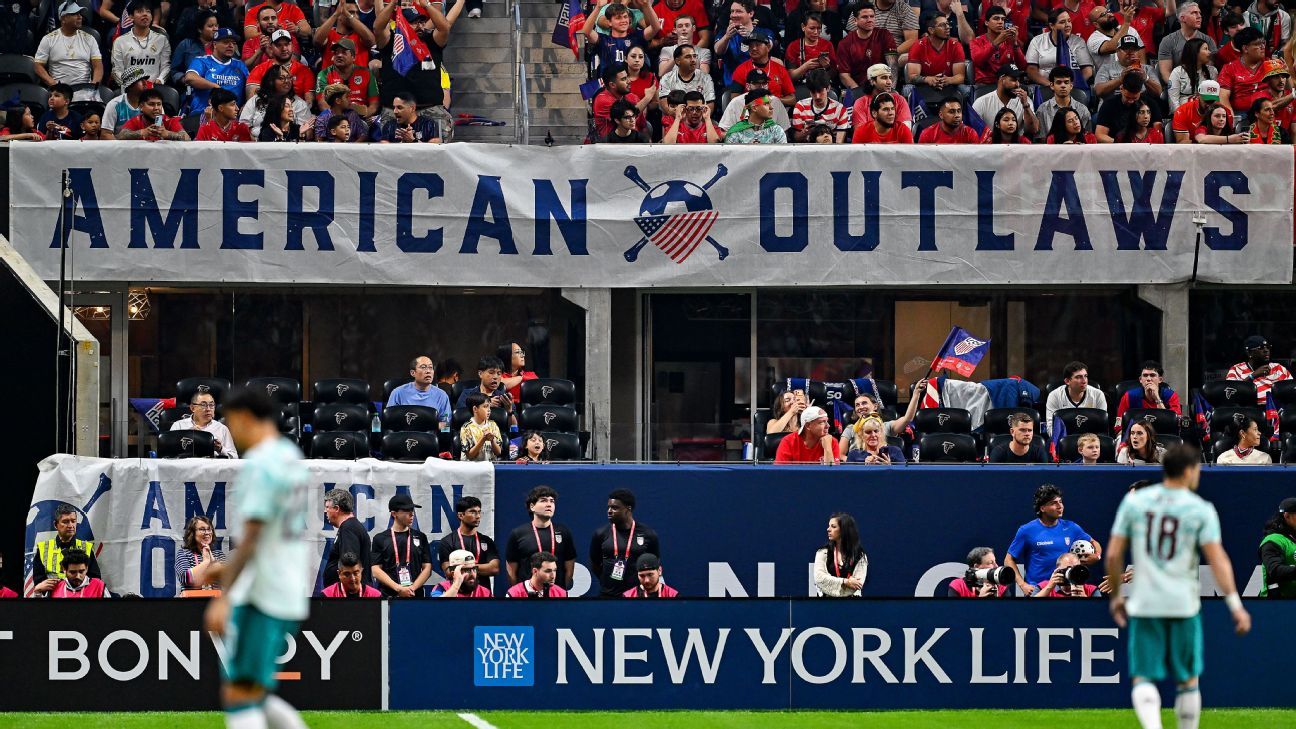
EmailPrintOpen Extended ReactionsSEVEN MONTHS before the 2026 World Cup kicks off, section 148 at Raymond James Stadium offered a glimpse of what's to come. On a Tuesday night in November, the American Outlaws' Tampa Bay chapter gathered for the U.S. men's national team's final match of 2025 against Uruguay -- and brought the show with them. As cheers billow above, a 20-by-35-foot tifo rose above the crowd and rippled through the stands, its message printed in bold black letters: Sailing to Victory in 2026. For Juan Ruiz, vice president of the chapter, the moment was more than a reveal. It was the payoff after planning for one of the country's largest soccer supporters' groups, which counts nearly 30,000 members worldwide and about 200 in Tampa Bay."It's been a number of man-hours," Ruiz says. "It's something that hopefully the Tampa Bay community will remember."Tifos have been a part of fandom and the game since the 1960s. Originating in Western Europe, these elaborate visual presentations consist of large flags, banners and signs created by dedicated fans to express their passion and support for a soccer club. The term tifo derives from the Italian word tifosi, meaning "fans." However, etymological origins of tifo trace back to the infectious disease, typhus. Newspapers in the 1930s began drawing parallels between the fever-like symptoms of typhus and the emotional outbursts from Italian soccer supporters, thereby associating soccer fandom with a sense of feverish excitement and passion.Today, tifos are the choreographed showpieces of soccer supporters' sections -- massive, coordinated displays built for maximum impact. Some are designed around rigging systems, with attachment points and ropes allowing for a controlled reveal. At their best, they turn the stands into a canvas, delivering a message, theme or tribute with scale and precision."They're fan-produced, they take hours of preparation, planning, designing, creating, then execution," says Jeffery Kassing, the co-author of the book, "The Art of Tifo." He believes that tifos serve as a "symbolic platform" for imagined communities that are created through soccer. In these communities, fans can embody their "identity" and "group membership.""It really becomes like a love letter to the club or to the team," Kassing says. " It's an extreme way to show devotion to a team."The Building of a TifoTHE "SAILING TO VICTORY" tifo was unveiled 206 days before the U.S. faced Paraguay in its opening World Cup match on June 12. The project began to take shape during a conference call in early October among members of the American Outlaws Tampa chapter and the group's national representatives. Tampa President, Andy Gustafson, expressed the group's intention to create a tifo for the match in November. The idea was fully supported, and preparations were set in motion. According to American Outlaws staffer Whitney Zaleski, designers occasionally collaborate with the national chapter to create a tifo. The majority of the time, the tifo designer comes from a local chapter or a local source."As soon as we found out, it was like, we got to find somebody to do it," says Ruiz, who was also on the conference call.A few days later, Ruiz attended a Tampa Bay Rowdies game in St. Petersburg. The Rowdies, who have competed in the United Soccer League since 2017, have produced some of the league's most memorable tifos. Behind all the artistry was Ralph's Mob, the energetic support group for the Rowdies. Following the match that night, Ruiz stayed behind and helped some of his friends from the local soccer community fold banners and put them away. He was then introduced to James Hartzell, the artistic director for Ralph's Mob. With a designer needed to help bring the tifo to life, Ruiz and Hartzell began discussing a collaboration and quickly moved into the logistics for the upcoming project. This led to an in-depth phone call the following week that sparked an idea for a concept: a World Cup-themed tifo.Tifo displays typically go through a formal approval process involving support group members and club officials to ensure design requirements are met. A similar protocol is followed in Major League Soccer, where supporters' groups coordinate with team personnel before a tifo can be displayed on matchday. The Kansas City Cauldron -- the supporters' group for Sporting Kansas City -- sends its tifos to members of the Sporting KC marketing and security team."Once we have a design, we share it with a couple of the team's folks internally so they have an idea of what we are looking at," says Chris Miles, a board member for the KC Cauldron. Unauthorized sponsors have been red-flagged in the past, but Miles says that "99%" of the time, things get approved.All tifo designs involving the American Outlaws must be approved by the group's national representatives before being sent to the U.S. Soccer Federation for final approval. This applies only if U.S. Soccer is hosting the match."Generally, we have a lot of freedom, but we typically shy away from player likenesses or trademarked logos," Zaleski says via email. One of the initial designs by Hartzell and Ruiz was flagged for including an image of the World Cup trophy. The imagery is not permitted on tifos under FIFA's intellectual property rights. After learning of this setback, the Tampa chapter went back to the drawing board and reworked its idea."Do we want to focus on where we're going, the final in New York? Or do we want to really highlight Tampa?" Ruiz asks.Tifo Concepts -- Behind the DesignsLAST JUNE, Cloud 9, the supporters' group for Gotham FC, planned a tifo around the team's Pride night. The visual display was titled, "Your True Colors Are Beautiful." The pride tifo featured rainbow hues and colors from the inclusive pride flag. Jen Muller, a board member for Cloud 9, wanted the message to resonate within the LGBTQ+ community. "With everything that is going on, just know that we see you," Muller says. "There's a large LGBTQ population in the fanbase. It's a message of inclusivity. That this is your safe space. And yeah, you belong here." The tifo went viral on social media and currently has over 2,600 likes on Instagram.When the U.S. women's national team played an international friendly against South Africa in 2023, Kristi Bridgwater Kivi brainstormed a tifo concept inspired by Taylor Swift. "I try to always think about what is going on that's relevant in pop culture and how I can connect that back to the team or the game," Bridgwater Kivi says. "Coming off the summer of 2023, it was the first summer of the Eras Tour, it was the summer of the "Barbie" movie. It was very much like the summer of girlhood. There was a huge push in women's sports as well."Bridgwater Kivi has served as the Design Director for the American Outlaws in Cincinnati since 2021. She reimagined the Eras Tour poster with legendary U.S. women's players throughout history. This tifo is another demonstration of how certain designs are embedded with meaning: "It's obviously visually appealing, and people immediately get the connection," Bridgwater Kivi says. "But, if you were to ask me, 'Oh, well, why is -- Megan Rapinoe as 'Reputation?'' like, I would give you a backstory. Or, 'Why is Brandi Chastain as 'Fearless?'' I would tell you why I chose that person for that era." Alex Morgan, who was featured on the banner, reposted a picture of the tifo on her Instagram story with the additional caption, "13 out of 10," according to Bridgwater Kivi. "That was a huge deal, cause there's a pretty good chance that Taylor Swift saw it if Alex Morgan saw it, because they are really good friends," she adds. "The fact that Alex saw it and loved it was really rewarding."The Magic Continues -- the Completion of a TifoRUIZ BUILT ANOTHER mock-up design and shared it with Hartzell. This mock-up helped set the direction for what followed. Hartzell always sketches his ideas in ink after assembling a collage of images he collects online that relate to the concept. He sent his mock-up designs to Ruiz, who gathered feedback from members of the American Outlaws Tampa group. "There were some iterations, and I wanted to make sure that the rest of the board of the American Outlaws was happy with it," Ruiz adds. The design went through twelve different versions before it was finalized. Hartzell, who describes himself as the kid who was always doodling in class, came up with an idea he initially labeled: "To Victory." The concept included a colonial-era sail ship with Tampa Bay's Skyway Bridge in the background. "The idea was to make a bridge. A set sail to victory. Our send-off from the Tampa Bay region," Hartzell says. The send-off theme would help usher the men's national team into 2026. "We hope to see you in the final in New York. Bring the cup home."The Element of SecrecyTHE FIRST RULE of tifo creation is secrecy. The design and planning of a tifo are often kept private until the display is unveiled, reflecting what Kassing describes as "intense secrecy, to avoid compromising the element of surprise." During the Cauldron's public painting parties, participants are informed that everything remains private until the day of the match. "You can take photos, but don't post them until game time so you can keep it a secret," Miles says. "For the most part, people have always respected that, fortunately."Hartzell and Ruiz followed a similar approach with the USMNT tifo. No social media posting was permitted before the official reveal at the game. Only American Outlaws members were shown glimpses of the design. "General tifo rules are like fight club ..." Hartzell says, "helps keep what we create as a surprise to the players and crowd."Materials and Endless PreparationJUST OVER TWO WEEKS before the Uruguay game, the tifo design received final approval from the American Outlaws and the U.S. Soccer Federation. During the waiting period, Ruiz ordered muslin fabric directly to Hartzell's home in Florida from Big Duck Canvas, a fabric wholesale company in Winder, Georgia, nearly 500 miles away. Muslin fabric is typically available at certain craft supply stores, but not in the large quantities needed for a tifo. Fifty yards of unbleached muslin fabric were ordered at a sale price. A parchment-colored tone was selected to give the tifo a woodblock-printed newspaper look, as the group aimed for. The lightweight cotton fabric provides an ideal surface for the detailed craftwork involved."It transfers less dirt," Hartzell says. "If someone walks on it, then you're not gonna see a footprint as easily, you can also use some of the fabric color as kind of a base. Once you paint white on top of that unbleached muslin, like a cloud in the design, then the light really pops out."Certain measures were taken to save money on supplies when possible. Hartzell provided some of his paint brushes and leftover paint from previous tifo projects. Around $80 of additional interior-quality paint was purchased from a hardware store. Interior paint is preferred because it does not soak through the fabric onto the protective plastic tarp beneath. Other minor materials, like roller heads and kneepads for tracing and painting, were also on site. All the leftover material from this tifo was donated by Ruiz to Ralph's Mob for future creations. The overall cost of the tifo was about $300, which was reimbursed by the American Outlaws. Membership fees collected from local AO chapters help fund national tifo efforts. "Some of the money that our members pay goes to National," Ruiz says. "That's how National can help support different things." The average cost of a tifo this size is usually $200 to $400.The 50 yards of muslin fabric came in a 5-foot roll. It was wrapped in plastic and sat in Hartzell's living room after delivery. The fabric was then rolled out and cut into four panels. Each of these panels was 10 feet tall and 15 feet wide. Hartzell sewed the four panels together to create the full 20-by-30-foot tifo banner that was projected. He also hemmed the edges of the fabric to help prevent fraying. In the past, Hartzell has hosted sewing parties where others come to help sew material to create a tifo. This can reduce the sewing time from two or three days to two or three hours, according to Hartzell. "It's given me great respect for anyone who does any type of sewing," Hartzell says. Due to time constraints, he finished the sewing by himself in two days. From there, the tifo was folded neatly and brought to a local middle school gymnasium for tracing and painting. Eric Turner, the principal of the middle school and a member of the American Outlaws, helped the group secure access to the gymnasium for the weekend.The tracing began that Friday with about five people. The muslin fabric was secured to the gym wall using gaffer tape. The tifo design was then uploaded from Hartzell's laptop onto a projector. The design was traced in 10-foot sections. "Ten feet and then you fold it," Hartzell explains. "You pop some tape on there to make sure you know where 10 feet is on each side, and then basically fold it and bring it back up onto the wall. Then you move the design and basically knit together where you stopped drawing." Each pattern was traced over with black markers. The tracing process took four hours to complete.The tifo was then placed on a plastic tarp and secured with tape to prevent movement during painting. It was around this time that Hartzell noticed something was off. "So technically it was supposed to be 30 feet, we projected everything, we started at the top of the design, and we flowed to the bottom, and then we realized that it was slightly off," he says. "We wanted to make sure that the design looked right and that there was enough ocean for the environment that was intended to be part of the design. So, we had to add an extra five feet." Once the scaling issue was corrected, the tifo measured 20 by 35 feet.A painting party happened over the next two days. More than a dozen people showed up to help paint the tifo. Supporters from the American Outlaws-St. Petersburg, Ralph's Mob, the Skyway Casuals, and Heatwave, the Tampa Bay Sun FC support group, joined in to help. People ate pizza, chatted and painted. "So, it kind of became a family-friendly community project," Hartzell adds. Several shoeless painters worked around one another throughout the weekend in a unique environment. "It's kind of like a game of Twister, where you're trying to step on an area, paint into a space while not touching wet paint, and not walking on someone else," Hartzell says. The painting took over 20 hours to complete from Saturday to Sunday. "It was awesome," Ruiz adds.The paint dried overnight from Sunday to early Monday morning. Turner then asked some of his students to help Hartzell fold the tifo. "Hey, you want to come into the gym and help fold up a big soccer banner?" Hartzell recalls Turner saying. It was then taken home by Hartzell, where he finished a few minor details. The tifo was completed eight days before the USMNT game. Ruiz picked it up a few days later. "It's one of those things where you feel like you've dropped your kid off on their first day of school," Hartzell says after Ruiz picked up the tifo from him. "There's some worry. You're checking in with people. You're like, 'Is it okay? Is everything dry?' And they're like, 'James, it's fine. Yeah, I got the banner.'" He says, laughing.Inside a Tifo CommunityTHE INDEPENDENT SUPPORTERS COUNCIL (ISC), a collective of soccer supporters' groups, has presented the prestigious Tifo of the Year award since 2016. The award recognizes the best tifo in North America each season. The ISC, which was founded in 2009, represents more than 140 member organizations across the United States and Canada. There have been seven recipients of the award, including several repeat winners over the past 11 years. The winner is chosen through a voting process between ISC members and later announced at the organization's annual conference in January. The recipient later receives a plaque along with widespread recognition throughout the community."It's definitely a bragging right and is cool for the group to go back and share that their work was acknowledged." ISC North America President Bailey Brown says via email. "I think many groups, though, celebrate and then go back to thinking about the next season."Cloud 9 has won the award twice, including in 2019 for its "Don't Give Up The Fight" tifo. "It was dual-purpose," Muller says of the winning tifo. "One, because the team hadn't won a game all year, and two, that was the year that things had started to come [out] about the poor conditions that players were playing and living under. 'Don't Give Up The Fight,' on the field and off the field. That was our first win at ISC."The ISC advocates for fair treatment of supporters' groups while also promoting the culture. Since 2020, the organization has hosted a tifo breakout session during its annual conference. The breakout sessions allow members to connect, share ideas and ask questions. "When groups don't have pulley systems, they ask questions about how they got them in their stadiums," Brown says. "If they are looking for certain paints or fabrics, they're able to ask. If they see groups tell a story or advocate for groups in their communities, they feel empowered to do the same.""I've been a couple of times. Folks share what they do." Muller says of the tifo breakout session. "Not everyone has the same resources. So, it's good to hear from different groups. What they're capable of, and what you can apply to your own situation.""It is something that our members ask for," Brown says. "Some years we have more demand for them than others. Those workshops are led by our members for members."The UnveilingWITH 205 DAYS remaining until the start of the World Cup, matchday had arrived. Ruiz had early entry to the stadium with other members of the American Outlaws, who were setting up drums and hanging banners in the USMNT supporters' section. He transported the tifo in an oversized blue IKEA bag before passing through security screening with an X-ray inspection. Transporting the tifo to the stadium went without any issues, but that is not always the case.In 2024, the Cauldron unveiled a 40-by-60-foot tifo at Arrowhead Stadium in Kansas City. The tifo, which supported Sporting Kansas City, weighed around 200 pounds. Aside from the challenge of fitting it into the back of a car, Miles says he learned from the experience that proper folding is essential when transporting it to the stadium. "It's a little bit like folding a fitted sheet on a massive scale," he says.Luckily for Ruiz, once the tifo cleared security at Raymond James Stadium, he placed it down in one of the first empty rows of section 148. At the right moment, the crowd would hold up the matchday banner. American Outlaws Chicago member and game capo Philip Labas was tasked with coordinating chants and timing the tifo display. A large American flag would first be raised during the National Anthem, and the tifo would come next once Labas yelled the call. After the logistics were discussed, Ruiz left and joined an American Outlaws tailgate across the street from the stadium. Soon afterward, the march to the stadium began, and everyone made their way to the section. Hartzell, who missed the pregame festivities, arrived a short time later. He had texted his family to be on the lookout for the tifo ahead of kickoff. This was his first time attending a sporting event at Raymond James Stadium, and he took in the sights before arriving at his seat. Several people in the supporters' section knew about the tifo. Word continued to spread throughout the pregame, informing everyone in the vicinity that a tifo unveiling was planned."We were able to let other people around know," Hartzell says. "So we all sing the anthem, and then after the American flag goes down, the tifo goes up."Ruiz had similar anxious thoughts moments before the unveiling. "I'm just hoping that it wasn't going to rip," he says. "Just hoping that it would go up and stay up." This past March, an Atlanta United tifo malfunctioned during its presentation. The display failed to fully rise as intended during the club's season home opener at Mercedes-Benz Stadium. Problems and malfunctions can occur. "There's nervousness, there's some jitters," Hartzell adds.Hartzell made his way back in time for the kickoff buildup -- a giant American flag went up first during the National Anthem, and then the call finally came."Tifo Up! Tifo Up!" Labas shouts.Other fans in the section began shouting the same command, alerting those seated behind them that the tifo was coming. "There's an immense amount of emotion and pride," Hartzell says. It took about 15 seconds to get the entire tifo up. It stayed raised for more than a minute before coming back down. Shortly after, the game kicked off on the field. Hartzell became emotional after the unveiling. "I'm getting a little teary even talking about it, as I was on the night. ... It was a real blessing to be able to have a big hand in the design and the paint," he says.During the television broadcast, the perfect live shot of the tifo was missed. The U.S. players were huddling in the broadcast frame as the tifo came down in the background. "I wish we'd have let it hang out for a little bit longer," Ruiz says, laughing. The tifo sat in an empty row for the rest of the game. Just 17 minutes into the match, Sebastian Berhalter scored the first goal of the match to put the USMNT up 1-0. This was followed by two consecutive goals from Alex Freeman in the 20th and 31st minutes. The game was never close. The United States scored two more goals and defeated Uruguay 5-1. The win tied a USMNT record for the largest margin of victory against a South American opponent. "I did talk to a Uruguayan family on the way out, they were like, 'Eh, the team's trying to figure out some things,'" Ruiz says. The win brought a joyful energy to cap off the night's festivities. "It was really positive. We were really sky-high. It was our World Cup campaign."What Comes AfterONCE THE GAME was over, Ruiz began to wonder, "All right. How do I get this home?" The afterlife of a tifo can follow multiple paths. Some get thrown away, while others remain stored. Bridgwater Kivi, who is also a member of The Forge -- the supporters' group that makes tifos for FC Cincinnati -- has a recurring offseason discussion. "We have something called the tifo burger, where they're just all folded up underneath the Bailey, which is our supporter section in the stands," she says. "At TQL Stadium, there's a pile of 'em. We've talked about it over the years. Is there something better we could be doing with them? We don't want to destroy them, but we also don't really know how to utilize them ever again."Miles says the Cauldron recycles its tifos if they are torn or damaged beyond repair. "We keep ours for the entirety of the season. There are a couple of older ones that we still have tucked away." Miles says. "There's a lot of different ways that people will look to upcycle them. Some teams have found a producer that'll actually make them into tote bags."Hartzell offers an alternative idea: They could be repurposed and shared in community spaces. "It would be great to have some sort of art exhibit or bring a tifo to a park where a youth soccer tournament is happening," he says. "Stretch it out, so kids can appreciate it."Despite the challenges with transporting the tifo, Ruiz folded it the best he could after the game. With some help from his 14-year-old son, he carried it back to the parking lot where his car was parked. With limited space at his home in Tampa, the tifo is now stored across state lines at his father's home in Atlanta.Tifo Culture EnduresFROM CREATION TO AFTERLIFE, tifos represent community and fandom. While co-writing his book, Kassing spent hundreds of hours researching tifos. During that process, a "strange coincidence" occurred, as he put it. The tifo culture that he was documenting suddenly "froze" due to the COVID-19 pandemic in 2020. "There weren't any tifo displays for a year or 18 months," he recalls. "It's the one and only thing I've ever written about that wasn't constant." In that time of uncertainty, the world changed. When things finally returned to a level of normalcy, Kassing expected the same for tifos, a post-2020 world of tifo culture that had gone through changes."If I'm going to write another book on Tifos, I'd have to go back and spend hundreds of hours again and see what different things have happened," Kassing explains. After enduring a sudden, prolonged absence, somehow tifo culture carried through the pandemic and emerged as an ever-evolving part of fandom."They're back now and better than ever," Kassing says.