
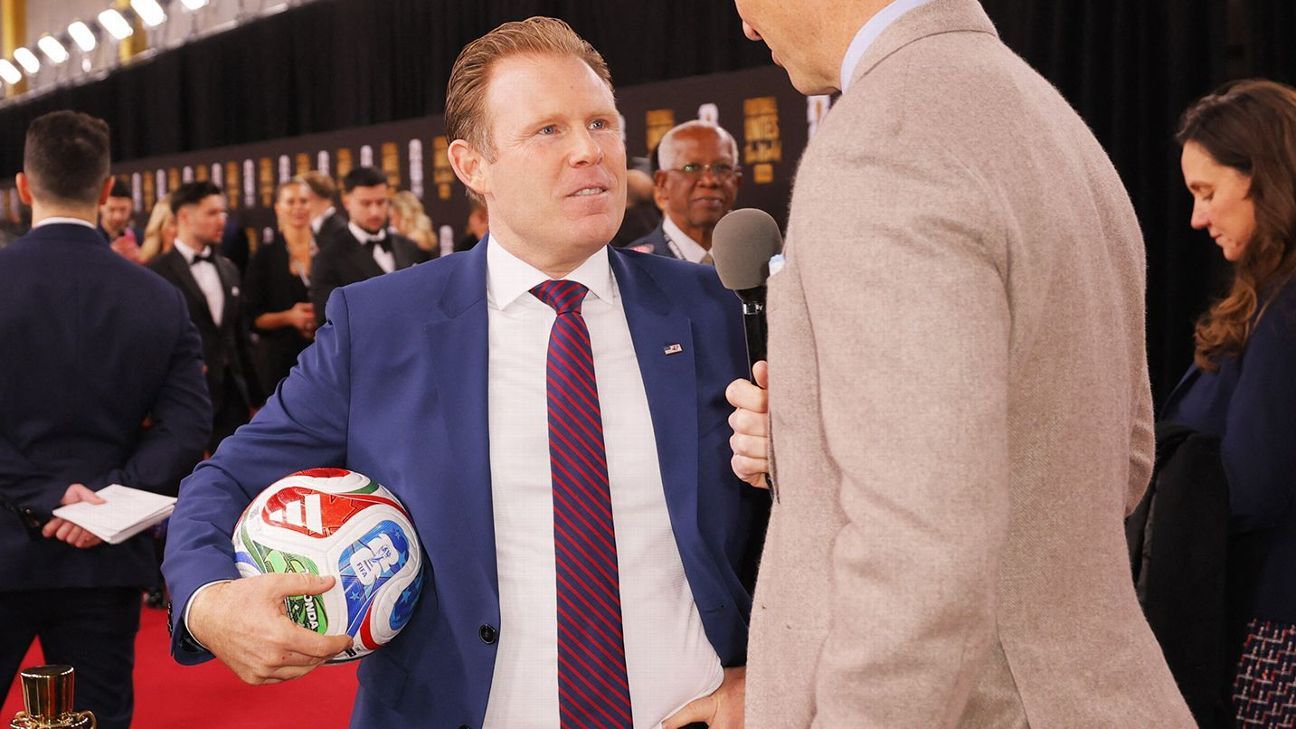
EmailPrintOpen Extended ReactionsWHEN ANDREW GIULIANI first heard about the job, he called the West Wing.Within a week, he said, he was pitching President Donald Trump on why he was the best choice to lead the federal government's preparations for the World Cup -- and why even though he didn't have any law enforcement experience, he should be put in charge of a coalition of cabinet secretaries, federal law enforcement and intelligence agencies such as the FBI, the NSA and the Department of Homeland Security.Giuliani is coy about what exactly he said in his pitch. "Some of that I want to leave between the president and myself," he told ESPN. "But what I said was simply I think that there is no better opportunity to be able to show off America's true greatness than over the course of this 40-day period, over our 250th birthday, that is the World Cup."According to Giuliani, Trump told him he would "think about it," and after a series of interviews with the Secretary of Homeland Security and "a few others in the West Wing," Giuliani received word that he would become the executive director of the White House FIFA World Cup 2026 Task Force."I was obviously very, very happy for a moment, and then you realize the responsibility, right?" he said.What Giuliani lacks in experience, he makes up for in a direct connection to Trump and what Giuliani says is an ability to anticipate what the president wants. But as the tournament opens Thursday, Giuliani knows he has a high-stakes assignment ahead, the success of which will be measured in the starkest of terms over the next six weeks."We have a zero-fail mission," he said. "We are focused on making sure nothing goes wrong."GIULIANI, 40, HAS known Trump -- whom he describes as "like an uncle" -- for most of his life thanks to his father Rudy, mayor of New York in the 1990s when Trump was a real estate magnate in the city. But their relationship was forged on the golf course, where young Andrew had a standing game on Saturdays with the future president, he said."Developing that rapport and learning from him for 30 years now, it's really helped in trying to address some of the problem sets but also understanding where the president may be on something," he said.Far from being a liability, his relationship with the president is partly what makes him good at his current job, he said. He sometimes goes weeks without talking to Trump -- "he's got a few important things that he's dealing with" -- but said a lifetime of experience helps him anticipate how Trump will see an issue."That's really been one of the strong parts of the role is always having a feel for where the president is on stuff," he said.When Trump announced Giuliani's appointment in May 2025, he joked to the cameras, "It's a big post. You better do well, Andrew."The White House did not provide further comment when ESPN asked for the president's take on Giuliani's pitch.Giuliani asked his father for advice on how to assemble the right team, but more than anything, he said Rudy instilled in him the right mindset for the job."It's never giving up. It's always making sure that you're looking under every single rock," Andrew said. "You don't want to make assumptions in this job at all."He recently traveled to South Florida to see his father, who was hospitalized in May for a severe case of pneumonia in what Giuliani called "a very near-death health scare." Rudy was unconscious when Andrew arrived but woke up the next day."After a few minutes, he looked at me and he said, 'What the hell are you doing here? You need to get back to D.C,'" Giuliani said.Giuliani has spent nearly his entire life under media scrutiny and was famously parodied by comedian Chris Farley on "Saturday Night Live" in 1994, when at just 7 years old, he stole the show at his father's swearing-in ceremony by blowing kisses, fist pumping and yawning throughout the inaugural address.After graduating from Duke, where he unsuccessfully sued the school after being kicked off the golf team, he briefly went pro. He won the Metropolitan Open in 2009, earning $27,500. At the time, he said it was "a big-time first step." But his golf career never took off, and by 2016 he had given up his pro status and said he would pursue a career in finance or real estate.A year later, after Trump was elected president for the first time, Giuliani joined the White House as an associate director for the Office of Public Liaison. In that role, he said he brought teams in for White House visits and helped leagues restart competition during the COVID-19 pandemic. In 2020, Trump and Giuliani took credit for helping the Big Ten return to the football field at the height of the pandemic. But a Washington Post story that year quoted multiple Big Ten officials who said they either didn't know who Giuliani was or what role, if any, he played in restarting competition.The Atlantic also reported during Trump's first term that the president's former chief of staff, John Kelly, revoked Giuliani's West Wing access in what the magazine described as political in-fighting and jealousy over his relationship to the president. In 2022, Giuliani made an unsuccessful run for New York governor and reappeared in headlines two years later while helping his father argue that the family should not turn over four New York Yankees World Series rings as part of a $148 million defamation judgment against the elder Giuliani.He recognizes why some people might accuse him of being the ultimate nepo baby, landing a plum job simply because of his famous name and the access his father gave him to the president."Critics are always gonna be a part of your life. And especially when you're in the public eye since you're 7 years old, that's just a part of life," he said. "For me, I think the best thing to do, just like a good athlete would do, is you block out the noise."The tale will be in the tape. We'll see on July 20."EACH WEEK, GIULIANI hosts a conference call with the 11 host committee CEOs, where they provide updates about their plans, voice concerns and raise questions."I think that's where the task force has been beneficial," said Meg Kane, CEO of Philadelphia's host committee. "There is an around the horn where cities get to ask a question, provide a comment, give an update on what's been good, what's been bad, what they've heard."The task force is responsible for coordinating between the host cities, local and state governments, more than 400 law enforcement agencies and a bevy of private businesses and security firms. The list of potential issues is dizzying: Security threats such as unauthorized drones and bomb threats, visa problems for foreign fans and teams trying to enter the country, the Iranian team playing in the U.S. during a war between the countries, coordination with FIFA and co-hosts Mexico and Canada, transportation challenges, infectious diseases such as norovirus and Ebola and weather disruptions."You really need ... a group to be able to cut down the interagency bureaucracy that just generally can exist on all different levels of government," he said.Giuliani said it was important to him to assemble a team that has worked on Super Bowls and Olympics but also understood that this event would be unique due to the size, scope and the three host countries. This World Cup will be the largest and longest ever, spanning 39 days across 16 host cities -- 11 in the U.S. -- and 48 base camps.He prioritized visiting all 11 U.S. host cities because he equates securing each match to the same level of difficulty as a Super Bowl, Giuliani said. Philadelphia police chief inspector John Przepiorka told ESPN he met with Giuliani during last summer's Club World Cup."We spoke in person," Przepiorka said. "He listened to us. We had some concerns. And the White House has stepped up to help support safety and security in Philadelphia and the other host cities."In addition to Giuliani's weekly meetings with the host committee CEOs, the task force has daily and weekly briefings with federal liaisons at each of the team base camps and federal coordination teams in each of the 11 host cities, according to Giuliani."There's not a time where you don't feel like you can text them, call them, send them a note," Kane said.Kathryn Schloessman, CEO of the Los Angeles host committee, agreed. "He's on all the calls. He's visited every city. He asks good, informed questions and listens," she said. "They have some really smart, good people who are just trying to help bring the cities together and see how they can help us."One example Giuliani gave of the task force's success was helping to reduce the cost of a shuttle bus from Manhattan, New York, to MetLife Stadium in East Rutherford, New Jersey. Transportation costs to the stadium made international headlines this spring when round-trip train prices debuted at over $100 and a bus was priced at $80. Giuliani said his team saw the headlines and "realized we need to lean back in on this." He said his team spoke with the Department of Transportation and Secretary Sean Duffy about the impact."We point out different issue sets that could be better, let's say," he said. "And that was something that certainly got the Secretary's attention."New York Gov. Kathy Hochul announced in May that the bus fare would be reduced from $80 to $20. In a statement, a spokesperson for Hochul said that when the governor "found out that shuttle bus tickets to the World Cup were going to cost $80, she knew the price was just too high. She stepped up, and her leadership slashed the price down to $20, added thousands more bus seats, and reserved 20% of tickets exclusively for New Yorkers."The federal government has announced it will disperse more than a billion dollars in taxpayer money under Giuliani's watch, including $100 million in transportation improvements, $500 million for counter-drone training and technology, and $625 million for security. Giuliani said the task force did at least five rounds of calls with state administrative agencies to help them understand how to receive the counter-drone funding.Giuliani said the task force also communicates daily with FIFA, a billion-dollar organization known to flex its political might to get what it wants. He described his relationship with FIFA as "good," noting that "doesn't mean we always agree on every single issue.""I would say we're kind of like penalty shooters. We're probably, you know, 66% of the time in line and there's probably 33% of the time where we, you know, might miss the net."When asked about their disagreements, Giuliani demurred but cited the relationship between Trump and FIFA president Gianni Infantino as a key element in bringing people together."These are two men that really want this to be the greatest sporting event in world history. Now it's our job to make sure that we can deliver on that mission."Washington, D.C. can be a rough town in terms of politics," he added, with a laugh. "There might be more politics in soccer than there is in even Washington, D.C."His team is focused on what it might have missed, he added. "That I think is the key thing," he said. "But I think by continuing to circle around that on a daily, hourly basis, we are answering the questions and leaving as few of the unknowns as possible."For the next six weeks, Giuliani expects to be living off coffee. He knows that the less anyone hears from him during the tournament, the more successful he and the task force will have been in their mission to keep everyone safe. On July 20, he wants the conversation to be about the final, not security.And he has a very clear idea of who's going to win that final."Maybe I'm dreaming, but let's go, USA."