
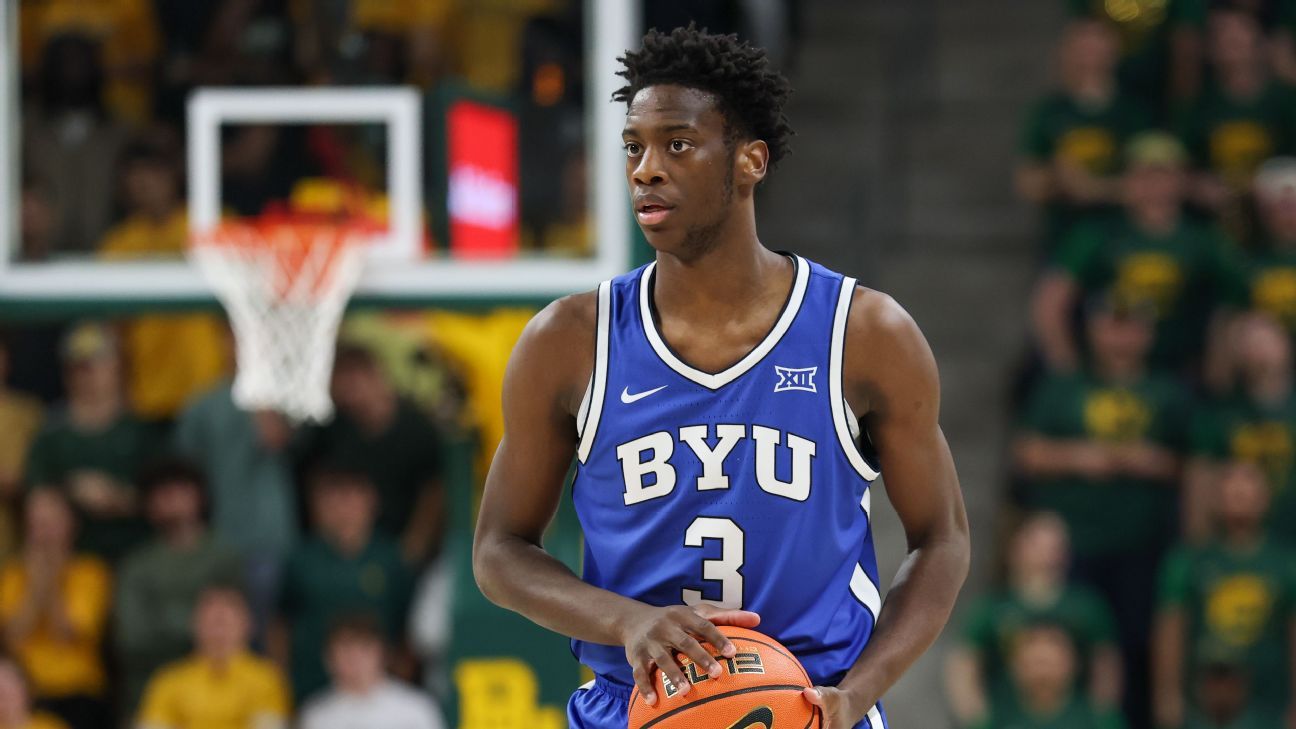
EmailPrintOpen Extended ReactionsWelcome to June, which means it's officially NBA draft time.In a little over three weeks (June 23 and 24, ESPN/ABC/ESPN App), the draft will unfold at Barclays Center in Brooklyn, where all 60 picks will be revealed for a talented 2026 class.Though the league's 30 teams are still working on their draft boards, it's never too early to play everyone's favorite parlor game: comparing incoming prospects to NBA players -- past and present.Comparisons can be risky, but they're also useful tools for gauging a player's potential when used properly.ESPN's NBA draft analyst Jeremy Woo breaks down the high- and low-end comps for the top 12 prospects in this class. NBA senior writer Tim Bontemps then gives insight into what league executives are saying about these incoming rookies.Quick links: Draft assets for every team | Latest mock draftTop 100 rankings | More draft coverageAJ Dybantsa, SF, BYUMock draft projection: No. 1 to Washington WizardsTop 100: No. 1High end: Supercharged Jaylen BrownLow end: Supercharged RJ BarrettThe easiest throughline for projecting Dybantsa is comparing him to downhill-oriented, power-wing scorers who get to the foul line and soak up offensive volume. Stylistically, it's the simplest way to make sense of his profile: He led D-I in scoring (25.5 ppg) while overpowering defenders into the paint despite missing a fully reliable 3-point shot.But Dybantsa comparisons are tricky because his physical profile is off the charts: At 6-foot-8 barefoot with a 7-0 wingspan, he can play on the perimeter with power-forward-caliber tools. He's an exceptionally coordinated driver at that size, and his college production was miles ahead of Brown's at the same stage. If Dybantsa doesn't take a major leap as a shooter or on defense, he should still clear players such as Barrett, who has come into his own gradually and is now in his seventh NBA season. Another player who comes to mind is Kawhi Leonard, but Leonard's outlier shooting development in the NBA makes it a tricky comparison for anyone.Dybantsa is still learning his craft and needs to improve reading the floor, stretching his range and becoming a more consistent defender. Though it's tricky to draw a straight comparison, there's a realistic pathway for him to become one of the NBA's best and most physical wings in time. -- Jeremy WooScout's take: Multiple scouts and executives compared Dybantsa to a bigger, longer Brown. That would be a pretty good outcome because Brown has made several All-Star teams, was just named to his second All-NBA team and has a conference finals and NBA Finals MVP trophy.On the high end, one scout also compared him to Leonard -- a nod to the seven-time All-Star's size and physicality on the wing. -- Tim BontempsDarryn Peterson, PG/SG, KansasMock draft projection: No. 2 to Utah JazzTop 100: No. 2High end: Damian Lillard with better toolsLow end: Jamal Murray with better defenseMuch of the in-season Peterson discourse centered on things other than basketball -- factors that can't be considered when drawing comparisons. If we assume good health moving forward, Peterson's ceiling is arguably the highest in this draft. His amazing 3-point shooting and the ease with which he scores could lead to him leading the league in scoring during his career.It's very tricky to project his eventual on-ball usage because Peterson didn't have the ball a lot at Kansas, and he wasn't at full health. Peterson ran a lot of pick-and-roll in high school, and his highest-end outcomes involve having the ball as a primary playmaker. If he can get to that point and unlock more passing ability, he has the scoring chops to be a full-time offensive engine.If Peterson doesn't transition to point guard, his team will still want the ball in his hands when it matters most. But it will become much easier to question his impact on winning or making teammates better as a combo or off guard. The fact that he is a willing, positive defender with solid size significantly raises his floor. -- WooScout's take: The comparisons for Peterson come down to the question posed above: How much will he be on the ball? Will he be a point guard, such as Lillard or Murray, or more of a shooting guard?Multiple scouts have compared him to Devin Booker -- a shooting guard who also spends time running point, and also has similar positional size and three-level scoring."The smoothness, the pace, he's under control all the time," one scout said in comparing the two players. "Like Devin, he knows how to get to his spots on the floor." -- BontempsCameron Boozer, PF/C, DukeMock draft projection: No. 3 to Memphis GrizzliesTop 100: No. 3High end: Kevin Love with more ball skillsLow end: Domantas Sabonis with better 3-point shootingThere's really no perfect Boozer comparison. His history of winning and incredible production suggest he is a unique player who breaks convention. But some question his lack of verticality. Though he impacts the game offensively in nearly every area, he has the occasional ugly moment or gets his shot blocked. Some worry about how his individual scoring and lack of rim protection translate to the NBA.Boozer's positives and potential drawbacks are easy to identify -- it's whether the glass is half-full or half-empty. At a certain point, his production and results are too loud to wave off -- he's an NBA-ready player who compares favorably as an incoming rookie to nearly every prolific, non rim-protecting power forward of the past 25 years.Though Boozer might not match Love's rebounding earlier in his career, Boozer's offensive game is well ahead, giving him a chance to clear Love's five All-Star selections. Boozer is a better shooter than Sabonis and far more NBA-ready. The difficulty of this comparison almost validates all the arguments for Boozer being the first pick. -- WooScout's take: Scouts have favorably compared Boozer to Love, and with the game trending closer to Love's size and strength inside when he came into the league, there's reason for optimism.Multiple scouts have also compared Boozer to Al Horford, a nod to his high basketball IQ, and his ability to make the right play and impact the game on many different levels. Similar to Horford in 2007, Boozer is likely to go No. 3 in the draft. And Boozer is also expected to immediately contribute to winning. -- BontempsCaleb Wilson, PF/C, North CarolinaMock draft projection: No. 4 to Chicago BullsTop 100: No. 4High end: Bouncier Pascal SiakamLow end: Peak John CollinsProjecting Wilson requires a bit more imagination than Dybantsa, Peterson and Boozer because Wilson is more raw in key areas of the game, including ball skills, 3-point shooting and defensive awareness. Those things might all come in time, creating developmental upside pathways.Siakam, who entered the league much older (22), offers an intriguing blueprint thanks to his evolution into a functional perimeter player, his dynamic transition play and defensive versatility. (Wilson will turn 20 in July.) Siakam has become a capable offensive hub in the NBA, relying on his tools and playmaking instincts to do damage in different areas of the floor, with enough of a handle to take advantage of mismatches.Wilson has some of these qualities, including sneaky passing instincts and potential to switch on defense. He arguably has more upside on defense, where he could be highly disruptive with better habits. Though he's a bit upright as a ball handler, tapping into that part of his game could still unlock a lot for him.If he doesn't fully develop those skills -- making him more of a play-finisher and high-energy rebounder -- he should still be a very productive NBA player and a valuable piece for a team, similar to Collins' production in Atlanta early in his career. -- WooScout's take: Wilson jumps off the screen with his athleticism, and he had plenty of eye-catching plays during his lone season at North Carolina. That, coupled with a magnetic personality, led one scout to compare him to Hall of Famer Kevin Garnett as a potential high-end outcome. Though they immediately added, "That's also not fair to him, or anyone, to make that kind of comparison."Siakam was also mentioned as a potential comp. Siakam can also get in the open floor with the ball, has a very high motor and has turned into an outstanding pro. Wilson, though, is coming into the NBA as a younger player with higher upside.-- BontempsKeaton Wagler, PG/SG, IllinoisMock draft projection: No. 5 to LA ClippersTop 100: No. 5High end: Slower-paced Tyrese HaliburtonLow end: Andrew Nembhard with less defenseWagler fits a valuable NBA archetype as a bigger on-ball guard who relies on quick decision-making and his 3-point shot to open the floor for teammates and find pockets of space to attack downhill. Though some scouts see shades of Shai Gilgeous-Alexander when Wagler creatively uses angles and change of pace going downhill, the more realistic comparison is Haliburton, whose unselfishness helps create a winning offensive environment for everyone around him.Haliburton plays at a more up-tempo pace than Wagler has shown. Wagler's relatively small sample of high-level basketball leaves room for growth, and he thinks quickly enough to operate in a more wide-open style, despite being slower for a guard. There are broad enough similarities here that offer multiple pathways for NBA success.Scout's take: Wagler's game is tough to fit. Haliburton was mentioned multiple times as a potential higher-end outcome because of his unselfishness, positional size, ability to play on and off the ball, and to excel without elite athleticism.Wagler was also compared to Josh Giddey, who shares a lot of those qualities but at a lower level. Though Giddey has steadily improved as a shooter -- hitting 37% from 3 in his past two seasons with the Chicago Bulls -- Wagler will walk into the NBA as a better shooter immediately, which should help his ultimate upside.-- BontempsDarius Acuff Jr., PG, ArkansasMock draft projection: No. 6 to Brooklyn NetsTop 100: No. 6High end: Jalen BrunsonLow end: Mike BibbyAcuff proved to be a scoring-minded guard in college who can broadly impact winning, relying on pace, strength and ability to score at all three levels to make himself hard for defenders to predict. Though some have drawn comparisons to Trae Young, the more apt stylistic comparison is Brunson, who is physically stronger, less 3-point reliant and better at limiting turnovers, something Acuff critically excelled at this season.Where Acuff lands on the spectrum of smaller, ball-dominant offensive-engine type guards remains to be seen, but his statistical profile at Arkansas demolished the preseason expectations most around the NBA had for him. Building a team around him that can mask his defensive shortcomings is a separate question, but the Knicks' current run to the Finals, built around Brunson, offers a proof of concept. -- WooScout's take: Talent evaluators see Acuff as a dynamic on-ball scorer and shot creator. There are questions about whether he will be good enough defensively and whether he can drive winning.Those questions led scouts to compare him to Young: "He will be an All-Star, like Trae has been," one scout said. "But will that help you win games?" -- BontempsKingston Flemings, PG, HoustonMock draft projection: No. 7 to Sacramento KingsTop 100: No. 8High end: De'Aaron FoxLow end: Brandon KnightNBA evaluators have most often compared Flemings to Fox, with Flemings' exceptional top-gear speed putting pressure on the paint and opening the floor in transition. Though Fox has better physical tools, with a wider wingspan and broader shoulders, the two players are stylistically similar, relying on their first step and living in midrange areas as a scorer.Flemings likely won't be the same caliber defender as Fox due to the physical disparity, but Flemings plays with energy on that end and has a chance to be more additive than most guards his size. The continued development of his jumper is pivotal, but Fox is a good example of a lead guard whose athleticism has allowed him to be successful, despite historically being average shooting from range. -- WooScout's take: Many evaluators like Flemings' intangibles and his defensive chops, and they have compared him to Fox, Derrick White and Jrue Holiday as guards who can run offense, make shots and play defense.Flemings' measurements, though, left some concern."He will find ways to impact winning," a scout said, "but he's thin and small." -- BontempsAday Mara, C, MichiganMock draft projection: No. 8 to Atlanta HawksTop 100: No. 10High end: Brook Lopez with more passingLow end: Less athletic Andrew BogutPart of Mara's unique appeal is his passing skills. There are so few players with his physical dimensions, and very few of them share his ability to process the floor and find teammates with precision. It's an extremely valuable archetype, especially if he emerges as a rim deterrent at 7-foot-3.The potential of Mara developing an outside shot -- a skill that's still at a very early stage but one that NBA scouts aren't ruling out due to his comfort level with the ball -- would be a major boon. Even without it, Mara could become an offensive hub. -- WooScout's take: Mara is a difficult player to compare, simply because of his size. The swing skill, though, is his jump shot. If he can continue to improve it, Mara will develop into someone similar to either Lopez or Kristaps Porzingis -- a true rim deterrent at one end, and a floor spacer at the other.Every team dreams of finding that skill set, especially in someone of Mara's size.But even if his shot never progresses, his ability to wall off the paint could help him become an impact player. That's why he drew comparisons to other massive players with up-and-down outside shooting, such as Donovan Clingan and Luke Kornet. -- BontempsMikel Brown Jr., PG, LouisvilleMock draft projection: No. 9 to Dallas MavericksTop 100: No. 7High end: Smaller LaMelo BallLow end: D'Angelo RussellBrown's playmaking ability and tough shotmaking from long range place him somewhere between Ball and Russell, who are physically lean and smooth with the ball. Brown's creativity, playmaking and positional size give him excellent upside to develop into a starting-level point guard who warrants having the ball.Brown's skill set and potential are readily evident. He has few holes in his offensive profile when he attacks downhill and creates for teammates rather than settling for jumpers. But he will need to improve defensively and rein in his shot selection to drive winning at a high level. He's an offensive talent who will command attention from defenses regardless, but the small sample of games at Louisville makes that piece of his projection a bit trickier. -- WooScout's take: Though Brown had an up-and-down season at Louisville before it was cut short because of a back injury, his play with Team USA in the Under-19 World Cup last summer has resonated with scouts. He was arguably the best player on the gold-medal-winning roster in Switzerland, one that included Dybantsa.Russell's name has come up as a floor for Brown, who is another bigger, skinnier guard who had a lot of flair with the ball."He's obviously got some defensive concerns, but he's an explosive shooter and scorer," a scout said. -- BontempsNate Ament, SF/PF, TennesseeMock draft projection: No. 10 to Milwaukee BucksTop 100: No. 9High end: Bigger Harrison BarnesLow end: Bigger Ziaire WilliamsAment has been polarizing for NBA teams all season because of the dissonance between his pre-college expectations and how things went at Tennessee. He fits a highly valuable prototype as a large, skilled perimeter forward with developing ball skills and shooting, but the results weren't always pretty in college and left some doubt about his ceiling. Some fear his average foot speed and explosiveness -- coupled with his poor efficiency profile -- will cap his higher-end outcomes, despite his rare skill set.With a more measured approach to projecting Ament, he could have a long NBA career with continued development. If he takes a leap as a defender and shooter, most likely when teammates create easier looks for him to start his career, he can still deliver plenty of value without being a high-usage option. Barnes is another player who took time to adjust to the NBA, but has been a starter nearly the entire time and part of winning teams in several instances. -- WooScout's take: Ament is an intriguing talent with a wide range of projections.On the high end, Jalen Johnson was mentioned. He has developed into an All-NBA player for the Atlanta Hawks after one season at Duke and being a top prospect who fell a bit in the draft.In the middle range, Jabari Smith was brought up. He is another tall, thin combo forward who has developed into a solid starter for the Houston Rockets.But on the low end are several raw prospects who share Ament's skill sets and have fallen flat. Williams is one of many who had similar tools. -- BontempsBrayden Burries, SG, ArizonaMock draft projection: No. 11 to Golden State WarriorsTop 100: No. 11High end: Less athletic Derrick WhiteLow end: Quentin GrimesBurries has a solid two-way profile for a combo guard. He's a jack-of-all-trades with no truly elite skill but also no glaring hole, giving him an attractive plug-and-play baseline that might help teams overlook his age (He will turn 21 in September despite playing one season in college). Although he doesn't have White's explosiveness or defensive playmaking profile, Burries put together a very strong all-around offensive season despite some ups and downs, including a pretty poor start to the season.The realistic hope is that Burries will scale his production efficiently into whatever role he's asked to play, whether that's evolving into a higher-usage playmaker (where his higher-upside outcomes lie) or playing a more secondary role where he can space the floor and help fill the gaps on both ends. If he doesn't develop into a true offensive focal point, Burries should still help a team win games and fill valuable minutes. -- WooScout's take: Burries drew comparisons to another combo guard who excelled in analytical models before the draft (and since): Golden State Warriors guard Brandin Podziemski. It's an ironic comparison because they could be teammates in Golden State, which has the 11th pick in the draft."He's maybe a bit less scrappy," one executive said, "but he's got more off the bounce than Podz."Some question whether Burries' production can scale up offensively. If that happens, he could be compared to White or potentially Jamal Murray. -- BontempsYaxel Lendeborg, PF/SF, MichiganMock draft projection: No. 12 to Oklahoma City ThunderTop 100: No. 12High end: Jalen JohnsonLow end: Aaron GordonLendeborg's center-like dimensions and small forward-level versatility make it somewhat tricky to find comparisons. At Michigan, he showed he can defend all five positions, handle the ball in transition, space the floor capably and impact the game on the glass.The main caveat in his profile, however, is his age (he will turn 24 in September). Most players who do what he does at a high level are well-compensated and highly valuable, but he's already older than a lot of players in the league.His immediate role is probably between that of Johnson and Gordon, two physically gifted and versatile two-way forwards who do a range of things well. But whether Lendeborg can acclimate quickly enough to do it at their level is a different question. Johnson is less than a year older than Lendeborg and just made his first All-Star team.Whether Lendeborg can continue to turn the corner as a player at a rapid rate, tops out as a very useful role player, or winds up something less than that remains to be seen. But if he continues to make strides, his physical gifts and blossoming all-around game could translate immediately. -- WooScout's take: Lendeborg's ability to do a lot of things while playing power forward elicited a couple of comparisons to another longtime NBA power forward who plays not too far away from Ann Arbor: Detroit Pistons forward Tobias Harris. -- Bontemps