
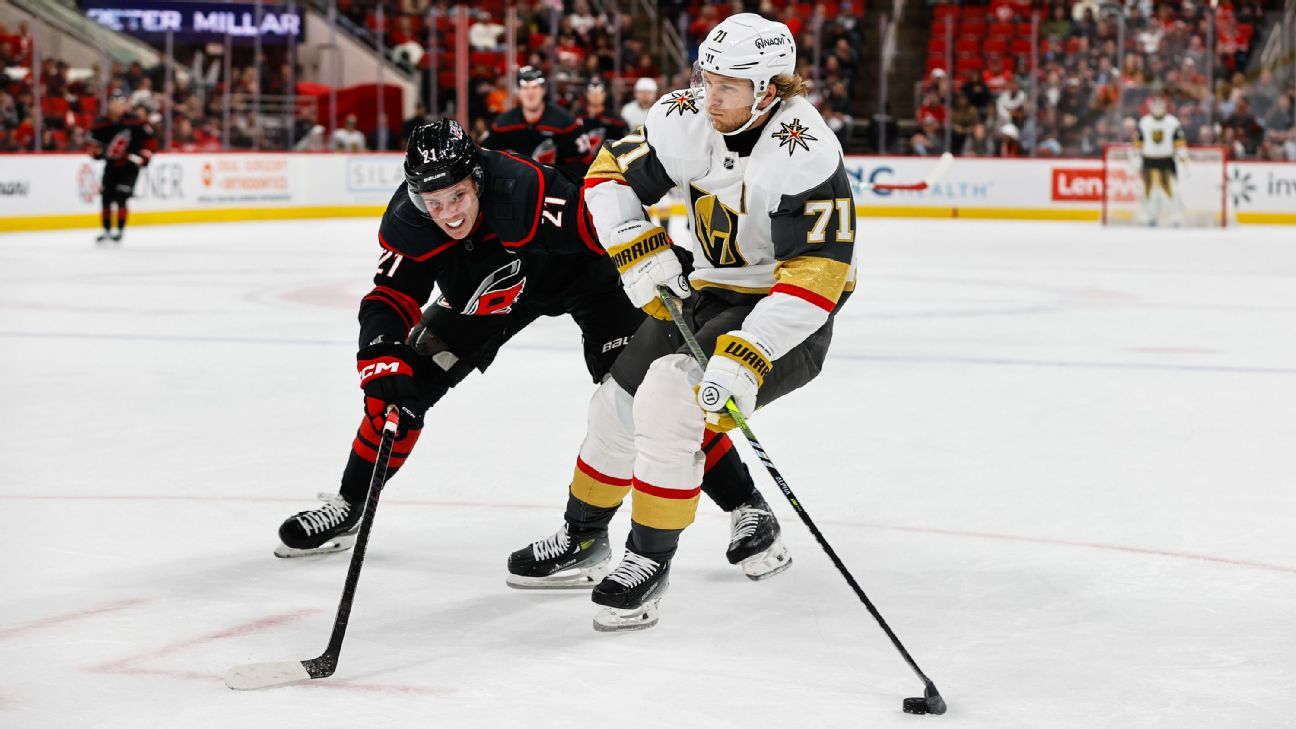
EmailPrintOpen Extended ReactionsRoster construction is a year-round process that really comes under the spotlight during the Stanley Cup Final. That's mainly because it provides an opportunity for the rest of the hockey world to see what the two teams that outlasted the other 14 did on their path to reaching the final series.The Carolina Hurricanes and Vegas Golden Knights have reached the 2026 Cup Final by establishing and following certain philosophies. The Canes use every possible avenue to improve their team, while the Golden Knights have adopted an aggressive, win-at-all-costs approach that has come to define their franchise.Carolina made eight straight playoff appearances while reaching the Eastern Conference finals four times in that span, including three of the past four. The Hurricanes have had two general managers in that time: Don Waddell and Eric Tulsky. Waddell, now the president of hockey operations and GM of the Columbus Blue Jackets, left Carolina in May 2024. Tulsky, who was an assistant GM, was promoted to become the architect who has guided the Hurricanes to their third Cup Final in franchise history.Vegas began its journey as an expansion franchise that reached the Stanley Cup Final in its first season in 2017-18. The Golden Knights have since made the playoffs in all but one season. Much like Carolina, it is also a franchise that has had two GMs in recent years, starting with George McPhee, who is now Vegas' president of hockey operations, and then Kelly McCrimmon, who was promoted from AGM to GM in 2019. McCrimmon created the roster that won the Golden Knights the Stanley Cup in 2023 and continues to be one of the more active GMs in the NHL.One significant difference between the teams has been their approaches to coaching. Carolina has had Rod Brind'Amour -- the third-longest-tenured bench boss in the NHL -- as the only voice throughout its eight consecutive postseasons. Vegas, on the other hand, now has John Tortorella as its fourth coach since 2017. Tortorella, who won a Cup in 2004 with the Tampa Bay Lightning, was hired in late March to replace Bruce Cassidy, who coached the team to its Cup win.Carolina's identity is built around a structure that allows it to control the puck more than any team this postseason. According to Natural Stat Trick, the Hurricanes lead the playoffs with a 59.39% shot share in 5-on-5 play, have allowed the fewest shots per game, and have a top-two penalty kill. Vegas has been comfortable playing without the puck, as its shot share is slightly above league average at 48.53%. But few teams have been as prolific in scoring goals as the Golden Knights. They are second in goals per game this postseason, and have a top-four power play and top-five penalty kill.The Hurricanes have relied on a blend of experience and youth. The Golden Knights have relied on the entirety of their roster this postseason, with Mitch Marner and Jack Eichel among the playoff leaders in points, while Pavel Dorofeyev and Brett Howden are tied for the most postseason goals. Of the 20 players who took the ice in the Western Conference finals, 19 scored at least a point.But how did these teams with different approaches arrive at the same place? Here's a player-by-player look at how they each built their roster:How the Hurricanes were builtThe homegrown talentBuilding through the draft has remained a priority for the Hurricanes during Brind'Amour's time behind the bench. In Carolina's first season with Brind'Amour in charge (2018-19), 17 players who were drafted by the club played at least one game. Some of those players -- including Justin Faulk, Warren Foegele, Brett Pesce and Nicolas Roy -- remain in the NHL, but are playing elsewhere.The Hurricanes have also prioritized obtaining as much draft capital as possible. That began with Waddell, who joined the Hurricanes in 2014 as their president with Ron Francis as the GM. Waddell would take over as GM in 2018,Jaccob Slavin (2012) was already in the system when Waddell arrived, but the team would later draft Sebastian Aho (2015) and Andrei Svechnikov (2018). Since 2019, they've had four draft classes in which they have had more than 10 picks. Pyotr Kochetkov (2019), Seth Jarvis, (2020), Alexander Nikishin, (2020) and Jackson Blake (2021) are among the players taken in that span.Jaccob Slavin, DHow he got here: Drafted No. 120, 2012Carolina's longest-serving homegrown player has emerged into one of the NHL's best shutdown defensemen. Since his second season, the two-time Lady Byng Award winner has finished in the top 20 in Norris Trophy voting every year. The 32-year-old is in the first season of an eight-year pact that is worth $6.396 million annually and has a no-movement clause for seven years with a no-trade clause in the final year.Sebastian Aho, CHow he got here: Drafted No. 35, 2015Aho has provided the Hurricanes with a legitimate top-six two-way center who can be trusted to play in every situation. He has finished with more than 20 goals in all 10 seasons of his career, with at least 30 in five of them. The Hurricanes have him signed to an eight-year contract worth $9.75 million annually that ends after the 2031-32 season. Aho also has a NMC until the final year, when it becomes a modified NTC.Andrei Svechnikov, LW/RWHow he got here: Drafted No. 2, 2018The imposing winger (6-foot-3, 200 pounds) is a top-six presence whose offensive output has fluctuated at times throughout his career. He scored a career-high 31 goals and 70 points in 2025-26, his sixth season with more than 20 goals. After this season, Svechnikov will have three years remaining on his deal worth $7.75 million annually, with a modified NTC in each of those seasons.Pyotr Kochetkov, GHow he got here: Drafted No. 36, 2019A lower-body injury brought his 2025-26 season to an end, but he's expected to have a place in the Hurricanes' future plans. The Canes have used a tandem to get through the regular season, with Kochetkov starting 89 games in total in 2023-24 and 2024-25. This fall he'll begin the final season of a four-year contract worth $2 million annually.Seth Jarvis, RW/LWHow he got here: Drafted No. 13, 2020Jarvis is another example of a young, homegrown talent who has become a crucial player for the Hurricanes both now and for the future. He's a top-six two-way winger who has posted at least 32 goals and 66 points in three straight seasons. That's why Tulsky signed Jarvis to an eight-year deal worth $7.42 million annually that has a modified NTC that runs from the 2028-29 season until the deal ends after 2031-32.Alexander Nikishin, DHow he got here: Drafted No. 69, 2020Hitting on prospects beyond the first two rounds is the hope for every team, but the reality is there's a good chance it won't come to fruition. The 24-year-old Nikishin spent the past three seasons playing for SKA St. Petersburg in the KHL before he arrived in the playoffs last season to set up his first full NHL campaign in 2025-26. Finishing with 11 goals and 33 points over 81 games could bode well for Nikishin, now that his two-year entry level contract is done; he'll be a restricted free agent this offseason.Jackson Blake, RWHow he got here: Drafted No. 109, 2021Another example of how Carolina found success with a player beyond the first two rounds. Blake gave them a 22-goal, 53-point top-six winger who appears to be the next homegrown talent capable of having a long-term impact. He was signed to an eight-year deal worth $5.117 million annually that begins next season, and he's second on the team in scoring heading into the finals.Veteran free agent signings/offer sheets/waiver additionsUnder both Waddell and Tulsky, the Canes have used a measured approach when it comes to free agency and waivers over the years.The Hurricanes have struck a balance when it comes to finding options, ranging from those who can instantly make a big impact to those who can provide help in other ways.Frederik Andersen, GHow he originally got here: Two-year contract, $4.5 million AAV in July 2021The most prominent free agent signing of the current group, Andersen has been a bit of a complicated figure. He won 35 of his 52 starts in his first season, but persistent injuries are one of the reasons the Hurricanes have had to rely on a two- or three-goalie rotation at various times. However, Andersen has been arguably their most valuable player in these playoffs, and he'll be a UFA this summer.Jesperi Kotkaniemi, CHow he originally got here: One-year, $6.1 million offer sheet in August 2021Once billed as a core, significant part of the Canes' future, Kotkaniemi could potentially be moved in the offseason. He went from four straight seasons of playing more than 66 games to logging only 42 in 2025-26. Furthermore, he hasn't appeared at all this postseason. He still has four years remaining at $4.82 million annually, the ninth-most expensive cap hit on the roster entering next season.Jalen Chatfield, DHow he originally got here: One-year contract, $750,000 in July 2021Prior to becoming a Cane, Chatfield spent most of his time in the AHL while getting an 18-game run with the Vancouver Canucks in 2020-21. The Hurricanes signed him to build more depth on the back end, but he has become a nightly fixture over the last four seasons. He has one more year on his current contract after this season, at $3.075 million.Sean Walker, DHow he got here: Five-year contract, $3.625 million AAV in July 2024There's been a noticeable difference between Walker, whom Tulsky signed, in the first year of his contract versus the second year. He had 16 points while averaging less than 17 minutes per game in 2024-25, which is below his career average ice time. But he bounced back to have the strongest campaign of his career in 2025-26, with 31 points while averaging 21:49 in ice time.Shayne Gostisbehere, DHow he got here: Three-year contract, $3.2 million annually in July 2024Technically, he arrived in a trade in March 2023. But he left in free agency later that year, before returning to the Hurricanes in 2024 when Tulsky signed him to that three-year pact. Gostisbehere is a facilitator on the back end and finished with 13 goals and 50 points in 55 games as part of a multifaceted defensive group.William Carrier, LW/RWHow he got here: Six-year contract, $2.15 million AAV in July 2024Sizable bottom-six forwards with a Stanley Cup on their rsums are always in demand, which is why the Hurricanes inked Carrier to a lengthy deal. That way, the Hurricanes have an experienced fourth-liner with a contract that should get better as the salary cap continues to increase.Eric Robinson, LW/RWHow he originally got here: One-year contract, $950,000 in July 2024What started as a one-year experiment turned into a four-year commitment worth $1.7 million annually, with Robinson having consecutive seasons of 12 or more goals. He has added three goals this postseason. Getting that type of production from a fourth-line player is the type of depth that other teams covet.Nikolaj Ehlers, LWHow he got here: Six-year contract, $8.5 million in July 2025Carolina felt like it was missing another consistent top-six option who could complement what it already had in place. Ehlers is Tulsky's signature free agent signing to this point, adding an eight-time 20-goal scorer to the roster and enhancing the belief the Hurricanes could win it all this season. Ehlers' first season in Raleigh was the ninth 20-goal season of his career, and he scored a career-high 71 points. He has nine points through 12 games this postseason, including a game-winning goal.Mike Reilly, DHow he got here: One-year contract, $1.1 million in July 2025Reilly played 42 games this season and offered a sense of stability for the Canes as they navigated injuries. His only activity this postseason came in the first two games of their second-round series while filling in for Nikishin, who sustained a concussion late in the first round.Brandon Bussi, GHow he got here: Claimed off waivers on Oct. 5, 2025Bussi signed a one-year contract with the Florida Panthers in the offseason before he was put on waivers just prior to the regular season. Claiming Bussi would become one of the most important moves the Canes made this season, with Kochetkov sustaining an injury. Bussi won 31 games and was rewarded for his efforts in February, with a three-year contract extension worth $1.9 million annually.The tradesThe Hurricanes have built much of their roster via the draft and free agency, but they have made significant additions via trades as well.Yes, there's always going to be the discussion about how they had Mikko Rantanen until they didn't in 2024-25, and traded him to the Dallas Stars. But the trades they've made, including what they received in return from the Stars in the Rantanen blockbuster, have had a significant impact.Jordan Staal, CHow he got here: From Pittsburgh Penguins, for Brandon Sutter, Brian Dumoulin and a 2012 first-round pick, in June 2012Carolina's captain and longest-serving player has seen everything including those days when a contract exceeded eight years, given Staal was on a 10-year deal worth $6 million annually until re-signing in 2023 on a four-year deal carrying a $2.918 annual cap hit. Staal has given the Hurricanes a reliable, two-way option down the middle, and he finished with 20 goals for the sixth time in his career -- and the first time in a decade.Jordan Martinook, LW/RWHow he got here: From Arizona Coyotes, for Marcus Kruger and a 2018 third-round pick, in May 2018Over the past four seasons, Martinook has become one of the most important players to the Canes' middle-six dynamic. He has finished with 12 or more goals in each of those seasons and was a point away from a fourth straight 30-point effort. The work he has done on his two-way game also reinforces why he continues to remain a fixture under Brind'Amour. Next season will be the final year of his contract worth $3.125 million annually.Taylor Hall, LWHow he got here: From Chicago Blackhawks, for a 2025 third-round pick, in January 2025Hall was the first of the five players whom Tulsky has acquired via trade, as the 2018 Hart Memorial Trophy winner arrived in the three-team deal that also involved Rantanen. In Hall, the Hurricanes got another veteran who could play a role in them winning now while also being a mentor to their younger players. He is the team's leading playoff scorer heading into the Stanley Cup Final.Logan Stankoven, CHow he got here: From Dallas Stars with four draft picks, for Mikko Rantanen, in March 2025Tulsky had to find a solution or potentially risk losing Rantanen for nothing when free agency arrived in the summer of 2025. Stankoven was part of the package he received from Dallas, which also included two first-round picks, with the belief he could show the Hurricanes why he had so much promise. Stankoven finished his first full season with the Canes with a career-high 21 regular-season goals and scored nine goals through the first three rounds of the playoffs, including three winning scores. Tulsky signed Stankoven, 22, to an eight-year contract extension worth $6 million annually that starts next season.Mark Jankowski, CHow he got here: From Nashville Predators, for a 2026 fifth-round pick, in March 2025Anchoring their fourth line with a 6-4, 200-pound center who scored 11 goals only adds to how the Hurricanes can rely on all their lines. It'll be that way for some time, as Tulsky signed Jankowski to a two-year deal worth $1.85 million annually.K'Andre Miller, DHow he got here: From New York Rangers, for Scott Morrow, a conditional 2026 first-round pick and a 2026 second-round pick, in July 2025Tulsky wasted little time getting a new deal completed upon trading for Miller, who signed for seven years at $7.5 million annually. Miller has shown he can handle the demands of being a top- or second-pairing defenseman, averaging a team-high 22:23 in the regular season while scoring eight points through 13 playoff games and skating 23:55 per contest.Nicolas Deslauriers, LWHow he got here: From Philadelphia Flyers, for a 2027 seventh-round pick, in March 2026Deslauriers was a depth move for the Canes' bottom six in the event of an injury or someone struggling to contribute. The 35-year-old has played only once this postseason and will be a UFA this summer.How the Golden Knights were builtThe expansion draftOnly a few faces remain from the team's original roster, when the Golden Knights used the expansion draft to create the group that advanced to the Stanley Cup Final in their first season.Now, it's about seeing if those original misfits can win a second title for the club.Brayden McNabb, DHow he got here: Drafted from the Los Angeles Kings, June 2017Stability has become one of McNabb's defining traits as a nightly fixture on the Knights' blue line whenever he's healthy. The partnership he has formed with Shea Theodore -- both in 5-on-5 play and on the penalty kill -- has made the 35-year-old quite valuable. He has two years left on his contract, at $3.65 million annually.William Karlsson, CHow he got here: Drafted from the Columbus Blue Jackets, June 2017Karlsson's nine years with the franchise have allowed him to become one of their most important players given his different responsibilities. Karlsson is a top-six, two-way center who can be moved to the wing if needed, and plays in every situation possible. The 33-year-old will have one year left on his contract next season, at $5.9 million AAV featuring a modified NTC.Shea Theodore, DHow he got here: Traded from Anaheim Ducks, June 2017Protecting Josh Manson -- and ensuring the Golden Knights selected Clayton Stoner -- meant the Ducks offered Theodore to Vegas in a trade. It led to the already promising Theodore emerging as one of the NHL's premier top-pairing puck movers and a franchise cornerstone. He is about to enter the second year of a seven-year deal worth $7.425 million annually. Theodore has a NTC in the first five years, before having a modified NTC in the final two seasons.The homegrown talentMaybe there will come a time when the Golden Knights have a roster that has been constructed around a young, homegrown core.Until then, McCrimmon has aggressively built a team that has moved on from many of the players it has drafted over the years (including Buffalo's Peyton Krebs and Montreal's Nick Suzuki). Although, there are a couple of exceptions.Kaedan Korczak, DHow he got here: Drafted No. 41, 2019The gradually developing Korczak has turned into a reliable third-pairing option, and he also adds to Vegas' profile of being a larger team (6-3, 206 pounds). He went from playing a total of 77 games over parts of four seasons to playing 78 regular-season games in 2025-26, and becoming a fixture on the back end in the Golden Knights' run to the Cup Final. In 2026-27, he will play the first year of a four-year extension worth $3.25 million annually.Pavel Dorofeyev, LW/RWHow he got here: Drafted No. 79, 2019Dorofeyev is going to be in line for a significant pay raise, as the 25-year-old top-line winger will be an RFA at season's end. His 10 goals entering the Stanley Cup Final are tied for the most in the NHL this postseason, as part of a rsum that has seen him become a consecutive 35-goal scorer while posting a career-high 64 points in the regular season. The fact that he's under team control should help in what could be another hectic offseason for Vegas; PuckPedia projects the Knights to have $4.625 million in cap space.Veteran free-agent signingsWhen it comes to this specific roster, free agency has been a mechanism that McCrimmon has used mostly to fill in around the edges; most of his work has been done elsewhere.But the Golden Knights have used the open market to attract players who have had some impact throughout their lineup over the years such as Alex Pietrangelo, who sat out this season while recovering from femur reconstruction surgery. Pietrangelo remains under contract, and has not ruled out a return to the NHL.Ben Hutton, DHow he originally got here: One-year contract, $750,000 in October 2021The role Hutton has etched for himself as the seventh defenseman is one that has been beneficial for both sides. He has played in more than 31 games in four of his five seasons with the Golden Knights at a cost that has been less than $1 million annually with the idea he'll be a UFA at season's end.Brandon Saad, LW/RWHow he originally got here: One-year prorated contract, $1.5 million in January 2025McCrimmon's moves at the 2026 trade deadline led to the bottom-six group becoming crowded. Saad, who will be a UFA in the offseason, has been battling for playing time. He has been a rotational player who has averaged a team-low 8:41 in ice time while having two points in five playoff games.Dylan Coghlan, DHow he got here: One-year contract, $775,000 in July 2025Coghlan began his professional career with the organization, moved on and then returned last offseason. Though he spent most of the season in the AHL, he has served as one more example of how Vegas has tapped into all parts of its roster on its way to the Cup Final. He has justified his place, with three points in four games in the Western Conference finals, including setting up the series-clinching goal in Game 4.Carter Hart, GHow he got here: Two-year contract, $2 million AAV in October 2025Vegas signed Hart once he was declared eligible by the NHL in October. He was one of the five 2018 Canadian world junior hockey players who was acquitted of sexual assault in July 2025. Reunited with Tortorella, who coached him when they were with the Philadelphia Flyers, Hart has played every minute of the Knights' postseason, posting a 2.22 goals-against average and a .924 save percentage.The tradesHere's where the "win-at-all-costs, no matter the cost" mentality that has defined McCrimmon, McPhee and the Golden Knights comes into play the most.An argument could be made that no team has done more when it comes to consistently finding ways to take their draft capital -- or whatever else is at its disposal -- to improve the roster with elite talent.That approach has led to Vegas executing what feels like at least one major trade per season. It has raised concerns about what the Golden Knights will do in future when they'll hypothetically need to rely on the draft. But until then? There's a reason why Vegas is always considered a potential destination when a player of significance could be moved in a trade.Keegan Kolesar, RWHow he got here: From Columbus Blue Jackets, for 2017 second-round pick, in June 2017It feels as if Kolesar belongs in the homegrown category given he has gone through the Golden Knights' system and played his entire career with the franchise. Kolesar has provided the Golden Knights a bottom-six anchor who consistently checks and has physicality -- all for the team-friendly price of $2.5 million annually for the next two years.Mark Stone, LWHow he got here: From Ottawa Senators, for Erik Brannstrom, Oscar Lindberg, 2020 second-round pick, in February 2019McPhee's trade for Stone was the first in what would become a near-annual tradition of the Golden Knights going all-in for a player. Stone provided Vegas with a legitimate two-way winger who would become team captain and a franchise cornerstone, leading the way to the Cup in 2023. Although injuries have hindered Stone in recent seasons, he remains one of the franchise's most vital players. This fall, he'll enter the final year of his contract worth $9.5 million annually.Brett Howden, LWHow he got here: From New York Rangers, for Nick DeSimone, 2022 fourth-round pick, in July 2021Entering the Stanley Cup Final tied with Dorofeyev for the most playoff goals only reinforces how much has changed for Howden over the past two years. He was primarily a third-line player who could be moved throughout the lineup. Yet his 23-goal season in 2024-25 -- along with his breakout playoff campaign this year -- makes his five-year deal worth $2.5 million annually an even bigger win for the Golden Knights.Jack Eichel, CHow he got here: From Buffalo Sabres, for Peyton Krebs, Alex Tuch, 2022 first-round pick, 2023 second-round pick, in November 2021Landing Eichel is arguably the biggest trade in team history. His arrival provided the Golden Knights with a legitimate franchise center who has shown why he was the No. 2 pick of the 2015 draft behind Auston Matthews. He tapped into his top-line center potential, becoming one of the best all-around pivots in the NHL. That led to Eichel -- who starts an eight-year deal worth $13.5 million annually next season -- being a key part of that Stanley Cup victory in 2023, along with another Cup Final run in 2026. He is second on the team in postseason points, while averaging more than 22 minutes.Adin Hill, GHow he got here: From San Jose Sharks, for 2024 fourth-round pick, in August 2022Hill will forever have a place in the franchise's history as the man who backstopped the Cup-winning roster in 2023. He has been overtaken by Hart this postseason, as he is about to enter the second year of a six-year contract worth $6.25 million annually.Ivan Barbashev, LWHow he got here: From St. Louis Blues, for Zach Dean, in February 2023Barbashev's 18 points in the Stanley Cup run of 2023 presented McCrimmon with a decision as Barbashev was approaching free agency. He signed the winger to a five-year deal that is worth $5 million annually. Barbashev has scored 23 goals in consecutive seasons, and his 12 points in 16 games this postseason again prove he is a critical player in his team's road to a third Stanley Cup Final.Noah Hanifin, DHow he got here: From Calgary Flames, for Daniil Miromanov, a conditional 2025 first-round pick, a conditional 2025 third-round pick and a 2024 fifth-round pick to the Philadelphia Flyers to retain 50% of Hanifin's salary in March 2024After the trade, McCrimmon signed Hanifin to an eight-year contract worth $7.35 million annually the following month, cementing his place within the Golden Knights' future. The Massachusetts native has given the Knights a trusted top-four presence, and upon being reunited with his old Flames defense partner Rasmus Andersson, has created a pairing that posed problems for the Avalanche during the Western Conference finals. Hanafin has a NTC through the first six years of his deal, and a modified NTC for the last two.Tomas Hertl, C/LWHow he got here: From Sharks, for David Edstrom, 2025 first-round pick, in March 2024Two days after trading for Hanifin, McCrimmon landed Hertl, who was recovering from left knee surgery at the time. In Hertl, the Knights added another player they'll have under contract for an extended period, as he has four years left at $6.75 million annually. On the ice, the seven-time 20-goal scorer has lined up with Colton Sissons and Stone on a third line that has continually created matchup problems this postseason.Akira Schmid, GHow he got here: From New Jersey Devils, for Paul Cotter, 2025 third-round pick, in June 2024The trade that also gave the club Alexander Holtz, who hasn't played since February, provided the Golden Knights with another option in net. The Golden Knights shuffled through four goalies this season, with Schmid -- who is a pending RFA -- winning 16 games.Reilly Smith, RW/LWHow he got here: From Rangers, for Brendan Brisson, 2025 third-round pick (via San Jose) in March 2025Smith is in this group with an asterisk: he's an original misfit who was traded away and then traded back. Smith re-signed last June on a one-year deal worth $2 million and had 16 goals and 26 points in 69 games but has played only six times this postseason.Jeremy Lauzon, DHow he got here: From Nashville Predators, for Nicolas Hague, 2027 second-round pick in June 2025Lauzon, who was injured in the first round, resumed skating a few days after the Golden Knights swept the Avalanche in the Western Conference finals. Before the injury, he added another dimension to the Knights' blue line, and was used on the penalty kill. He's slated to be a UFA this summer.Colton Sissons, CHow he got here: From Predators, for Nicolas Hague, 2027 second-round pick in June 2025 in the same deal as LauzonAnother player who arrived in the trade from the Predators, Sissons is now operating as the Golden Knights' third-line center between Hertl and Stone. The veteran had 11 points in 66 games in the regular season but has six points through 16 games going into the Cup Final.Mitch Marner, RWHow he got here: From Toronto Maple Leafs, for Nicolas Roy in July 2025McCrimmon got Marner, one of the best wingers in the sport, on a sign-and-trade that has the two-way playmaker under contract for seven more years at $12 million annually. Marner's creativity and versatility have given the Golden Knights another all-around threat who can play in every scenario imaginable, and he leads all postseason scorers heading into the Final, averaging more than 21 minutes of ice time.Rasmus Andersson, DHow he got here: From Calgary Flames for, Zach Whitecloud, Abram Wiebe, 2027 first-round pick, 2028 second-round pick in January 2026Since Andersson was reunited in his pairing with Hanifin, it has given the Golden Knights the sort of second duo that would be the top pairing for the majority of teams in the NHL. Andersson, who had 17 regular-season goals, has yet to score this postseason but remains effective in other areas. Where it gets interesting is figuring out how his next contract will work. Andersson is set to hit free agency, and the Golden Knights have less than $5 million in cap space.Cole Smith, LWHow he got here: From Nashville Predators, for Christoffer Sedoff, 2028 third-round pick in March 2026Adding the 6-3 Smith provided even more size to what is already one of the tallest teams in the NHL. His impact goes well beyond using his body, as Smith scored the series-winning goal in Game 4 of the Western Conference finals. He has three goals and five points in 16 playoff games, after only 12 points in 63 regular-season games. He'll also be a UFA this summer.Nic Dowd, CHow he got here: From Washington Capitals, for Jesper Vikman, 2027 third-round pick, 2029 second-round pick in March 2026The additions of Dowd and Smith allowed the Golden Knights to create the sort of depth that has come to define their forward dynamic. He has anchored a fourth line next to Kolesar and Smith that has provided tertiary offense coupled with a physical approach that has made them challenging to play against.