
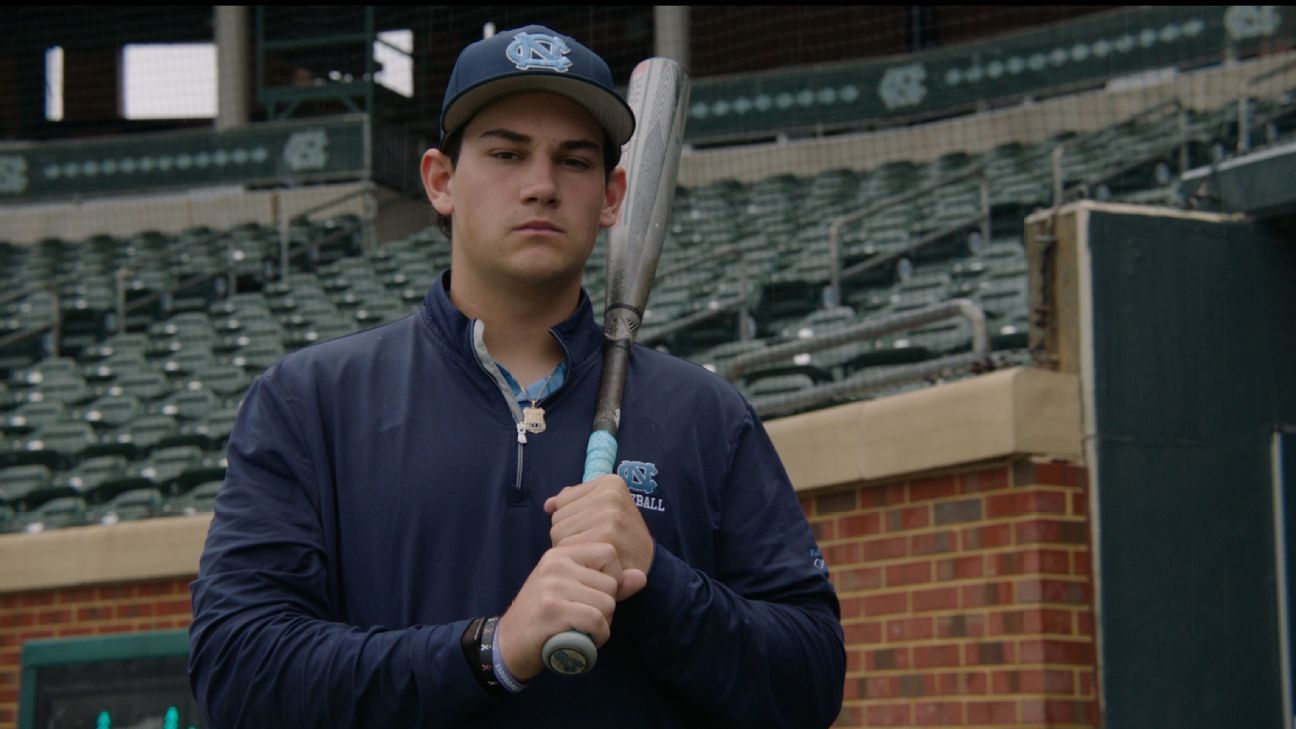
EmailPrintOpen Extended ReactionsCHAPEL HILL, N.C. -- Erik Paulsen Jr. wants us to know about his dad.The UNC Tar Heels first baseman's father died less than 11 months ago. Anyone who has ever lost a loved one knows that during every single day of that first trip through the calendar without them -- the first round of missed milestones, birthdays, holidays -- the grief of it is raw. Talking about them, using past tense about the person who was there for every step of life, can feel like gasping for air.But here the 21-year-old sits, dressed in Carolina blue, not sobbing, rather telling stories with a smile on his face. The way he carries on, you'd think Erik Sr. was still here. Heck, you'd think he was sitting outside, in the grandstand of Boshamer Stadium, waiting to watch his son play ball.Because Erik Jr. wants us to know about his dad."You would have loved him. Everyone did," Paulsen says excitedly, sitting in the home dugout of the ballpark that will host a cage match of a regional this weekend against Tennessee, East Carolina and VCU. "He loved baseball more than anyone I've known, or you've ever known, trust me. He was my hero. And he was an American hero."Erik Paulsen Sr. was a Long Islander and an NYPD detective, living in Massapequa and working in Brooklyn, New York. Everything he did away from the beat revolved around baseball. He played college ball at Misericordia University and Farmingdale State and was a staple of Long Island adult baseball leagues and a proud owner of two season tickets at Yankee Stadium.Paulsen was a veteran of the force when, on a day off, a Tuesday morning in September 2001, he received a call from downtown. A pair of planes had hit the Twin Towers at the World Trade Center. Every available first responder was needed."He didn't really like talking about it much," Erik Jr. says of his father and 9/11. "From the time he first got there, he was at ground zero for three days straight, digging through the rubble. He saw a lot of awful things, but he was just happy he was out there helping.""It was terrifying for our whole city, and it was heartbreaking knowing he was down there," says Christine Paulsen, Erik Jr.'s mother. "He spent 2 months at ground zero combing through debris. He was very proud of it, and he was never worried about himself. He was thinking about all the families this affected."Almost three years later, on Aug. 9, 2004, Erik Jr. was born, the second of four children. Dad was barely patient enough to let the kid learn how to walk before he started working on his game. Erik Jr. says he was taking cuts at the ripe old age of 2."As soon as Erik Jr. was able to pick up a bat, my husband taught him how to swing it," Christine says. "And from that point on that was one bond that was unbreakable."As much as Erik Sr. loved to play, he found his true hardball passion through coaching. Scroll through his phone, which Erik Jr. still has, there are dozens of videos of Junior and younger brother Cole perfecting their swings in batting cages, games and their Massapequa driveway. To better teach his sons and their friends the game that he loved so much, Erik Sr. founded a travel baseball program, the New York Longhorns. Hundreds of Long Island kids were coached up by Erik Sr. under the Longhorns banner. But his star was always Erik Jr."Even through high school, if I was struggling, I'd look at him and be like, 'Alright, what am I doing wrong?'" the son says. "Sometimes, I'd shoo him away. But ultimately, he was always right."That's what happens when your father is also a detective."Oh, it was awful," Junior says, laughing. "I couldn't get anything by him."When college baseball came calling, Erik Jr.'s decision of where to play was easy. Stony Brook University has been a Northeastern college baseball powerhouse for decades. Under the guidance of Matt Senk, the Seawolves piled up conference titles and NCAA tournament appearances. Their run to the 2012 Men's College World Series has become the stuff of Omaha underdog legend.Stony Brook is also only 30 miles from Massapequa. Dad had never missed one of his son's baseball games. Ever. That streak would stay alive."He'd still videotape every at bat, even though they were streamed. He loved to have them on his phone," Junior says. "Of course, we had no idea at the time of what a blessing being so close to home really was."In 2024, Erik Jr. hit .290 and led the team on the mound with six saves. He earned the Coastal Athletic Association's Rookie of the Year award along with multiple freshman All-American honors and then backed that up by hitting .321 in the New England Collegiate League. That same summer, Erik Sr. went swimming and afterward developed a sharp ear pain that he couldn't shake. For two months he tried to walk it off, but the pain became unbearable. Doctors took a CAT scan and found a tumor."He had throat cancer," Erik Jr. says. "Once they looked up the type of cancer it was, they were like, 'This was from 9/11.'"Paulsen Sr. was diagnosed with oropharyngeal cancer, a diagnosis shared by many 9/11 first responders, linked to toxic dust exposures during recovery efforts at ground zero. For months, Erik Sr. had climbed, dug and sifted through what was left of the towers. He and most of those with whom he worked alongside never wore any sort of respiratory protection.Says Christine: "I was scared to death and so was he. His first words to me were, 'I don't want to die. I have too much more to see, and too much more to live for.'"During his cancer treatments he lost 150 pounds. But that spring, he always figured out a way to see his son's games at Stony Brook. He received his treatment at Stony Brook University Hospital, a 4-minute drive from Joe Nathan Field. When Erik Jr. knew his dad was there, he would show up to sit with him during the long, lonely chemotherapy sessions. Erik Sr. would always tell him not to waste his time and get back across campus to either go to class or get back in the batting cage. When the 2025 season started, Junior would get to the ballpark extra early on game days to take a parking spot right next to the stadium with a clear view of the diamond. He knew his dad didn't like people to see him in such a frail condition, so instead he could watch the games from the safety of his son's truck.Paulsen Jr. hit .358 in his sophomore season. He was happy and he was also creating future MLB draft buzz. Then Senk announced that at season's end he was retiring after three decades at Stony Brook. Without the legend in the dugout, it became tempting for Paulsen to look for opportunities on bigger college baseball stages. But he also didn't want to leave his father's side.Dad was having none of that."He was like, 'Dude, hit the portal. Don't think about me,'" Junior says.Erik Jr. threw his name into the transfer portal, and the phone began ringing immediately. He set up visits throughout the Southeast, with the first stop being Chapel Hill, a place where Stony Brook had played early in the 2025 season."He was clearly their best hitter, and he's a big guy, so we kept our eye on him all season," says UNC head coach Scott Forbes. "We arranged to have him come down, and we knew his dad was coming with him."Although Erik Sr. was not physically up for the trip, he wasn't going to miss it. The Paulsens met with Forbes and his coaching staff and toured Boshamer Stadium."It was very obvious real fast that these guys really loved baseball," Forbes says, "and that they really loved each other."After all of the meeting and greeting was done, father and son sat together in Carolina's home dugout. They had other visits planned, including one the next day at South Carolina. Erik Jr. says they canceled those trips on the spot."I was like, 'Dad, this is where I want to go.' And he goes, 'So, commit,'" Junior recalls.So he did. The Paulsens went home for the summer, knowing that Erik Jr. would be moving more than 500 miles away in August. But before that, Erik Sr.'s health went into a steep decline. On the morning of July 4, 2025, he died at the age of 54 with his family in the room."The last thing that Erik Sr. told him," Chrstine says, "was, 'I cannot wait to see you in those baby blues.'"Erik Jr. donned those blues for his first game as a Tar Heel on Feb. 13, 2026, 225 days after his father's death. His new teammates, none of whom had suffered a sudden loss of a parent, did a tremendous job in the fall of keeping his mind on school and ball.But the reality of stepping onto the field that day was unavoidable. His family was in the stands, having made the trip from Long Island, but it was the first time in his 21 years that his dad wasn't present. Before the game, Christine gave her son a chain to wear around his neck. Attached to that chain was his father's NYPD shield.He stroked his first Carolina hit in that first game against Indiana. The next day, he launched his first home run out of the ballpark that he and his father visited together and made their joint decision about his future."Having this around my neck, I will never take this off," Erik Jr. says as his twists the necklace between his fingers. "It also helps that he was here. I sat in that dugout with my dad. Now, whenever I'm in that dugout, I think about that. It feels like he's here."That is why Eric Jr. wants us to know about his dad. Because if we all know the story about the man that Forbes says, "everyone would have liked," and a man whom we owe a debt of gratitude for what he did during one of his nation's darkest hours, an effort that ultimately cost him his life, then Erik Sr. will always be here.That's how the son is able to muscle the strength to smile as he tells this story. It is why he continues to work so tirelessly, even from so far away, to raise funds that will ensure that kids such as himself on Long Island can still learn and love the game of baseball playing for the brand his father created, the New York Longhorns.And that's why, perhaps more than any other college baseball player in the nation, the UNC first baseman wants to be playing for a national title in Omaha, Nebraska, three weeks from now, with Game 2 of the championship series scheduled for Father's Day."It does feel like he's sitting right here or that he might just walk in the door anytime," Junior says. "I would tell him it's really tough. I'd tell him it's tough that he's not here, and that I can't call him about any baseball questions I have. He sacrificed a lot for me to be in this position. And I'm so forever grateful for it."