
We're heading into NFL contract extension season, and every year around this time we like to predict where some of these big deals will land.
Will wide receivers such as Puka Nacua and Jaxon Smith-Njigba be able to push the market beyond Ja'Marr Chase's number? Can running backs Bijan Robinson and Jahmyr Gibbs crack the $20 million-per-year barrier? What should the Texans and Panthers do with quarterbacks C.J. Stroud and Bryce Young? And will Jerry Jones pay Brandon Aubrey top-dollar kicker money? Market factors -- including individual team budgets and a continually increasing salary cap -- play a part here, but sometimes we can look ahead and make solid predictions about what a player will be asking for and what a team might be willing (or unwilling) to do.
A lot of these situations are actually intertwined with others, so we're taking a close look at a few teams with interesting extension decisions. Obviously, there are plenty that aren't addressed below, but we picked five teams whose looming extension issues and the potential dominoes are worth discussing.
Jump to:
ATL | DAL | DET | HOU | LAR
Detroit Lions
The key extension candidates: RB Jahmyr Gibbs, LB Jack Campbell, TE Sam LaPorta, S Brian Branch
One of the problems with drafting as well as the Lions have lately is that eventually they have to make some decisions on which guys they can keep and which guys they can't. Last offseason, the Lions did extensions for Aidan Hutchinson, Jameson Williams and Kerby Joseph, three stars from their 2022 draft class who were extension-eligible for the first time. This year, they are looking at four stars from their 2023 draft class who are extension-eligible for the first time.
Can they extend them all? Sure, but the way they structure the contracts will be important. Hutchinson's deal is heavy on year-to-year option bonuses that keep his cap numbers low over the next few years, and part of that is because Detroit knew these other four extensions were coming. Hutchinson's extension, for example, pays him an average of $45 million per year, but his 2026 cap number is only $10.15 million, and his 2027 cap number is just $21.74 million.
So, you get the idea ... the Lions can keep extending these players as long as they're willing to build void years into the contracts and spread the cap hits out way into the future. Gibbs and Campbell were both first-round picks, which means the team holds fifth-year options on them for 2027. That likely suggests LaPorta and Branch will be the higher priorities this offseason, since the Lions can hold off Gibbs' and Campbell's free agency longer.
One thing working in the Lions' favor is that none of these four players plays a "premium" position such as quarterback, wide receiver or edge rusher that gets paid astronomically. Running back, tight end and safety carry some of the lowest franchise and transition tag numbers in the league -- ahead of only kickers and punters. And although the linebacker tag is one of the higher ones, that's mainly because the tag system lumps 3-4 outside linebackers (who are edge rushers) with 4-3 off-ball linebackers. The top of the market for the type of middle linebacker role that Campbell plays is Fred Warner's $21 million per year.
Campbell likely holds some decent leverage, then, because the Lions wouldn't want to franchise him next year if it costs more than $28 million. So, I'd predict they address his situation before they address Gibbs but after they see what they can do with LaPorta and Branch, who again don't have those fifth-year options. Campbell is coming off an 89-tackle, 5-sack season for the Lions. I doubt they'd be willing to go all the way to Warner's number for Campbell, but I could see him settling in around the same range as guys like Nick Bolton and Jamien Sherwood, who each got $15 million per year on their most recent extensions. Maybe he shoots for Zack Baun's $17 million-per-year average.
LaPorta, who will be coming off a season-ending back injury but has 20 TDs over 42 career games, is unlikely to challenge the top of the tight end market, where George Kittle and Trey McBride come in around $19 million per year. He likely lands closer to T.J. Hockenson (ironically, the guy he sort of replaced in Detroit) and his $17.5 million per year.
Branch is also coming off an injury (torn Achilles), but he is a super versatile, vital part of Detroit's defense. He has 29 pass breakups over his three seasons. And he will surely be looking for something in the range of $20 million per year -- especially since the extension fellow safety Kerby Joseph signed with the Lions last year averages $21.25 million, the second-highest average annual salary for a safety behind Kyle Hamilton's $25 million. Joseph's deal is heavily backloaded; the Lions can get out of it after 2026 having paid him a total of roughly $24 million over two years. Branch will be seeking a stronger front-end structure than that.
The Lions have some weight with LaPorta and Branch because they can threaten one of them with a 2027 franchise tag since it'll likely be affordable. They can't franchise both players, but they can try to play the two players off each other. If Branch signs first, the Lions can hold the franchise tag leverage over LaPorta -- or vice versa.
Then there's Gibbs, the electrifying running back the Lions selected with the 12th pick in 2023. He has averaged 5.3 yards per carry and 13 touchdowns per season over his three years in the NFL. Saquon Barkley's post-Super Bowl extension with the Eagles brings his average annual salary to $20.6 million per year, which provides a target for top-end running backs. Gibbs likely tries to beat Barkley's number, while the Lions will likely try to keep the number under $20 million. Whether this gets done this offseason could come down to which side digs in harder.
Again, the Lions have shown they can solve these issues with creative, bonus-heavy contract structures, so it might also be a matter of whether Gibbs is willing to agree to that. Vibes are generally pretty high in Detroit these days, so let's go ahead and predict the Lions get all of these done with low at-signing guarantees but option bonus structures that make future-year guarantees more attainable. That seems to fit the Lions' recent pattern.
Predictions
Gibbs: Four years, $80 million with $30 million fully guaranteed at signing
Campbell: Three years, $51 million with $22 million fully guaranteed at signing
LaPorta: Four years, $68 million with $24 million fully guaranteed at signing
Branch: Three years, $66 million with $28 million fully guaranteed at signing
Houston Texans
The key extension candidates: QB C.J. Stroud, OLB Will Anderson Jr.
Stroud, the second pick of the 2023 draft and that season's Offensive Rookie of the Year, is extension-eligible for the first time in his career. The same is true of Anderson, the third pick in the 2023 draft and that season's Defensive Rookie of the Year. Nice 2023 draft, Texans ... now it's time to pay up.
Anderson has been a bona fide star, right up through the Texans' disappointing divisional round loss to the Patriots, in which he had three sacks and two forced fumbles. The league's highest-paid edge rusher right now is Green Bay's Micah Parsons at $46.5 million per year, followed by Hutchinson at $45 million per year. The next two are T.J. Watt at $41 million per year and Myles Garrett at $40 million per year.
Anderson will surely try to top $40 million coming off the huge season he just had (12 sacks). Houston could hold the line there, pointing out that Garrett just set the single-season sack record. But during Nick Caserio's time as GM, the Texans haven't played hardball with their high-end players, and it's not hard to imagine them and Anderson working out a deal that lands him in that company.
Little bit of a different situation for Stroud, who didn't play as well in his second or third seasons as he did in his first and completely melted down in this season's playoffs. Toss in that he missed three games due to injury in 2025, and it's going to be tough for Stroud to ask for top-QB money and get it. The league's highest-paid quarterback right now is Dak Prescott at $60 million per year, and if Stroud tries to top that, the Texans would be better served to pick up his 2027 fifth-year option and ride this out for a while.
So, what's the sweet spot? Can Stroud top $50 million per year, a number that 11 current QB contracts exceed? Can he top $55 million per year, which is the number currently shared by Joe Burrow, Josh Allen, Jordan Love and Trevor Lawrence?
Houston is already scheduled to pay Stroud $5.697 million in 2026, and the fifth-year option number for 2027 is $26.53 million. So, the Texans have him for two more years at just over $32 million total (with the potential to franchise-tag him after that). That's a steal as long as he's even a replacement-level starter. They could tear up the final two years of his deal and replace it with, say, a new five-year, $250 million contract that ostensibly averages $50 million per year. But from the team's standpoint, that would average only about $43.6 million in new money once we take out that $32 million he's currently owed. That would follow the pattern the Texans set last year with cornerback Derek Stingley Jr., who signed his extension six weeks before the fifth-year option decision deadline and thus never had his option picked up.
Stroud's situation is one to watch carefully. Again, the Texans tend to be generous with their extensions, so we lean toward predicting they'll find a way to lock him up long term this offseason. But if this season has given them any pause, or if Stroud's demands come in too high, this could drag out.
It's also worth noting that Carolina quarterback Bryce Young, who was picked first in that same draft, is in the exact same situation with the Panthers. Young had a rough rookie season but has played better since and could make the case that his trajectory is more upward than Stroud's now. Young and Stroud will surely be watching each other's extension talks closely. And next year's extension-eligible crop of quarterbacks -- Caleb Williams, Jayden Daniels, Drake Maye and Bo Nix -- will be paying attention, too.
Predictions
Stroud: Four years, $224 million with $110 million guaranteed at signing
Anderson: Four years, $176 million with $121 million guaranteed at signing
Los Angeles Rams
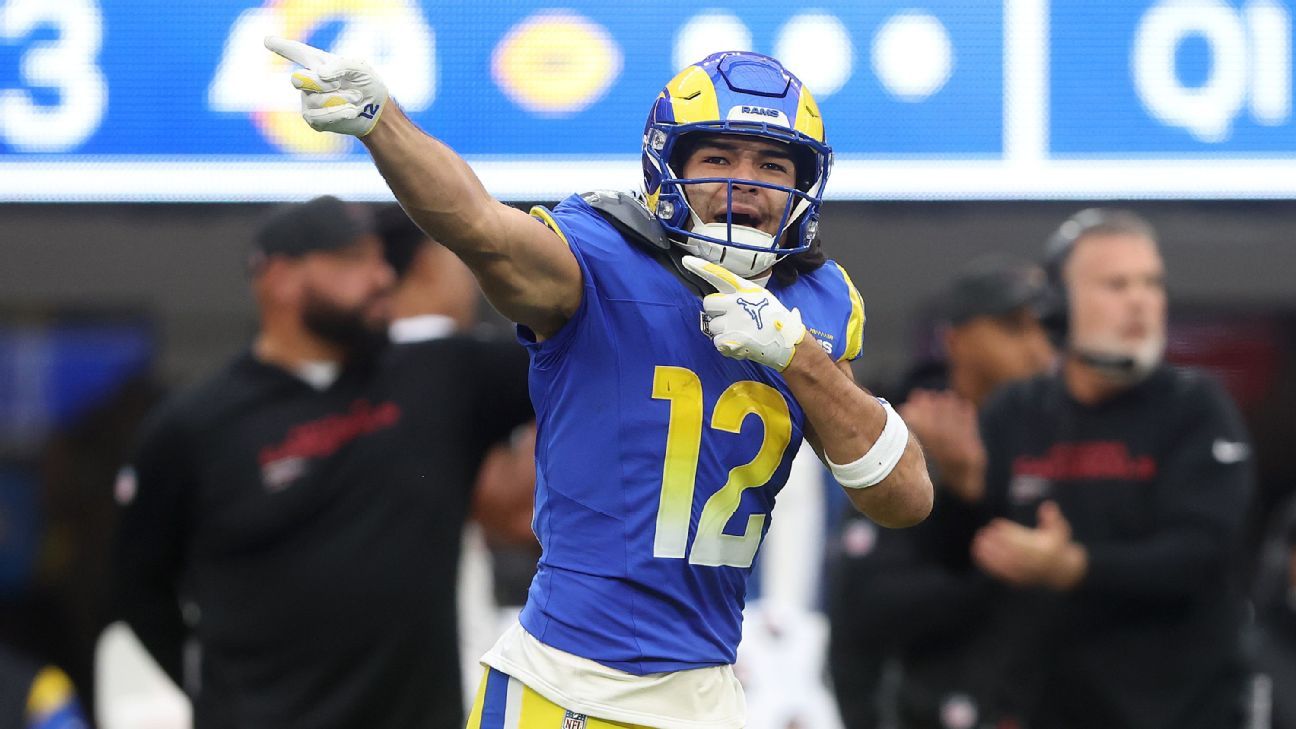
The key extension candidates: WR Puka Nacua, OLB Byron Young
Nacua and Young are both 2023 Rams draft picks, though neither was picked in the first round. So the Rams don't have fifth-year options on either of these guys, both of whom are free agent eligible after the 2026 season.
Nacua and Seattle wide receiver Jaxon Smith-Njigba are both coming off big years, and each is a candidate to reset the wide receiver market. (Seattle holds a 2027 fifth-year option on 2023 first-rounder Smith-Njigba.) Cincinnati's Ja'Marr Chase is currently the highest-paid wide receiver in the league at $40.25 million per year, but there's a sizable gap between him and the $35 million per year that Minnesota's Justin Jefferson makes as the second-highest paid wideout. So the two ways the Nacua and Smith-Njigba situations can go are:
One or both of them tops Chase, and the wide receiver market just keeps spiraling upward.
They settle in somewhere between Jefferson and Chase, and the wide receiver market starts to correct itself a little bit.
Nacua (129 catches, 1,715 yards, 10 TDs) and Smith-Njigba (119 catches, 1,793 yards, 10 TDs) are both wonderful, difference-making players. But there are so many impactful wide receivers coming out in the draft every year now that, at some point, more teams are going to say it's not worth paying top-15 QB money for a WR.
As for the Rams, Nacua and Young aren't the only extension-eligible players of note this offseason, just likely the most expensive to extend. Defensive tackle Kobie Turner and guard Steve Avila are both extension-eligible, as well, and what happens with those guys could factor into the Nacua and Young negotiations (and vice versa). And similar to the point we made in the Lions section, the threat of the franchise tag looms here. If Nacua does his deal before Young does his, then suddenly the Rams have the ability to threaten Young with the 2027 franchise tag, since they won't need to worry about using it on Nacua. (Same holds true if you reverse the names in that sentence.)
Young's case might be complicated by the fact that Jared Verse and Braden Fiske, the Rams' first- and second-round picks from the 2024 draft, will be extension-eligible next offseason. The team might have to make some decisions about which of its stellar young defensive front-seven players it can and can't extend. I'll make a prediction for Young -- who is coming off a 12-sack season -- but I cannot rule out the possibility that he ends up getting his extension from a different team. The people in the Rams' front office are extremely good at what they do, and I don't doubt their ability to keep the gang together if they want. But the salary cap makes roster building an exercise in resource allocation, and teams generally don't like to commit too much to any one position group at the expense of the others.
Finally, I'll point out that the Rams have another looming Matthew Stafford contract situation this offseason, and because he is turning 38, they know they're going to have to address the quarterback position in some other way at some point in the near future.
Predictions
Nacua: Four years, $156 million with $90 million guaranteed at signing
Young: Four years, $145 million with $72 million guaranteed at signing
Atlanta Falcons
The key extension candidates: RB Bijan Robinson, WR Drake London
If Jahmyr Gibbs has a case to crack the $20 million-per-year mark as a running back, Robinson has a case to top him. He has more rushing yards, more rushing attempts, more receiving yards and more catches since the two entered the league. Of course, we're splitting hairs here. These are both brilliant young players who will deserve their extensions, and if you told me you'd rather have Gibbs than Robinson, I wouldn't argue with you. But this is Robinson's case to make more than any other running back when he gets to the negotiating table, and it's a legitimate one.
Will the Falcons be willing to pay Robinson top-of-market RB money? Not every team likes to do that. Atlanta picked Robinson eighth in the 2023 draft, and he's the team's best player on offense, so maybe the Falcons are one of the exceptions. But they also have to think about a London extension, since he's heading into his fifth-year option season. They have looming extension situations with key players such as safety Jessie Bates III and offensive lineman Matthew Bergeron, too. And tight end Kyle Pitts Sr. is eligible for free agency.
The Falcons have a new head coach (Kevin Stefanski), a new president of football (Matt Ryan) and a new GM (Ian Cunningham). Previous organizational philosophies might not govern the decisions that are on deck. Pitts, London and Robinson all were top-eight picks, but that doesn't mean they're all guaranteed to be part of the Falcons' future. Pitts could be franchised (likely in the $16 million range), but that only delays the decision on him and how he fits into the salary cap picture. And quarterback Michael Penix Jr. is only one year away from being eligible for his own extension, and the team likely still doesn't know for sure what it has in him.
All of that is to say that predicting extensions for Robinson and London is a tricky exercise. Assuming the Falcons exercise the fifth-year option, they have Robinson under control for two more years at a total of about $18 million, which is certainly reasonable. That could allow them to wait if they think he's asking for too much. Robinson could also seek a shorter-term extension that allows him to hit the market a second time while still in his 20s. (Friday is his 24th birthday.)
London has moments where he looks and plays like a No. 1 wide receiver. He's also 24 years old and has the talent to be one of the best in the league. But he has gone over 72 catches in only one of his four seasons so far. Same for the 1,000-yard mark. That will all factor in.
Predictions
Robinson: Three years, $60 million with $25 million fully guaranteed at signing
London: Four years, $120 million with $35 million fully guaranteed at signing
Dallas Cowboys
The key extension candidate: K Brandon Aubrey
Full disclosure: Guys like linebacker DeMarvion Overshown are extension-eligible in Dallas, too, but this is really just an excuse to bring up the Aubrey situation, which I personally find fascinating. He's clearly a difference-maker at a position that's gaining value in the era of super-long field goals and the necessary precision of the revamped kickoff. He's also a restricted free agent, which gives the Cowboys a lot of leverage in negotiations.
If the Cowboys don't want to extend Aubrey, they could offer him a one-year restricted free agent tender. The options would be a first-round tender (likely around $7.8 million), a second-round tender (likely around $5.7 million) or a right of first refusal tender (likely around $3.5 million). If they use the first-round tender, another team offers Aubrey a contract and the Cowboys decline to match the offer, the team that signs Aubrey would have to give the Cowboys a first-round pick. If they use the second-round tender and the same thing happens, the team that signs Aubrey would have to give the Cowboys a second-round pick. But if they use the right of first refusal tender and the same thing happens, the team signing Aubrey wouldn't have to give the Cowboys any compensation at all.
What's interesting here is that the kicker franchise tag projects to be around $6.7 million, which would mean it would be cheaper to franchise Aubrey than tender him at the first-round level. The problem with that? Dallas seems likely to use the franchise tag on wide receiver George Pickens if it can't get an extension done with him. But the point is the Cowboys have a lot of options if they decide they don't want to make Aubrey the highest-paid kicker in the NFL.
Of course, they could decide to do just that. But these Cowboys contract extension conversations have a way of getting complicated, and we shouldn't assume an open-and-shut deal here. I'll still make a prediction, but I'm going to tone it down a bit because the Cowboys have so much leverage and have shown in previous negotiations with their own players that they aren't afraid to use it.
Prediction
Aubrey: Four years, $24.4 million with $12 million fully guaranteed at signing