
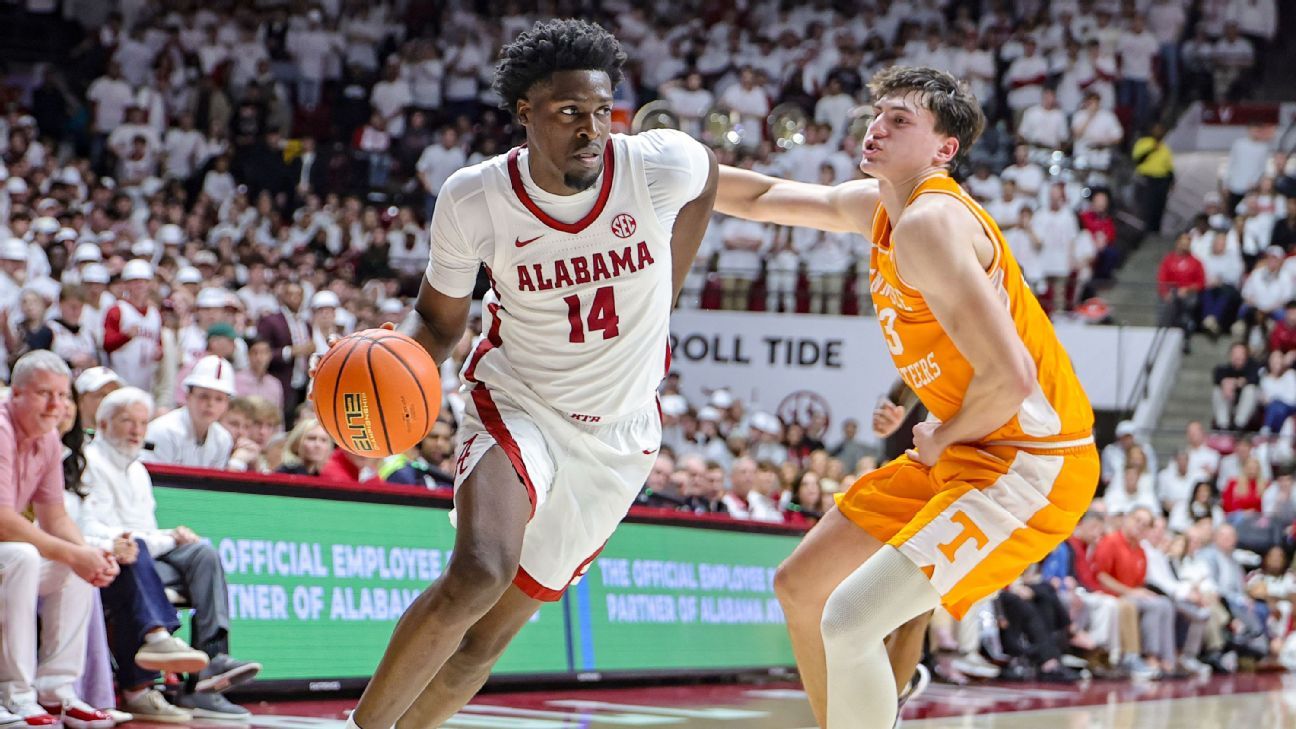
The understanding of college eligibility continues to be tested as men's basketball players with varying degrees of professional experience seek clearance through the NCAA -- and now through the courts.
The approval of requests from three former G League players -- Thierry Darlan (Santa Clara), London Johnson (Louisville) and Abdullah Ahmed (BYU) -- turned heads early in the season. Then the stakes were raised when the NCAA granted eligibility to former NBA draft pick James Nnaji (Baylor) in late December, drawing louder criticism from legendary coaches such as Tom Izzo and John Calipari and forcing the NCAA to release a statement that it "has not and will not grant eligibility to any prospective or returning student-athletes who have signed an NBA contract (including a two-way contract)."
Now we've reached an apparent boiling point, with Charles Bediako -- a former Alabama player who signed a two-way contract with the San Antonio Spurs -- suing the NCAA for denying his request and being granted a temporary restraining order that allowed him to join all Alabama team activities for 10 days.
Bediako did take the floor in Saturday's home loss to Tennessee, recording 13 points (including four dunks), 3 rebounds, 2 blocks and 2 steals in 25 minutes for the injury-riddled roster.
On Monday, the hearing for a preliminary injunction, originally set for Tuesday, was postponed, and the temporary restraining order was extended another 10 days after the original expiration date. The new date for the hearing has yet to be announced.
Here's what we know about Bediako's case, and other eligibility cases involving former pros.
Jump to: Charles Bediako | James Nnaji | G League cases | NCAA eligibility rules
What to know about Charles Bediako
How was Bediako granted eligibility?
Bediako sued the NCAA after Alabama's initial request for his eligibility was denied. He was granted a 10-day restraining order by a Tuscaloosa (Ala.) Circuit Court judge allowing him to immediately join Alabama on Wednesday.
In his lawsuit, Bediako cited multiple G League players who have recently been cleared by the NCAA, as well as Nnaji. His lawsuit stated that the NCAA has been biased toward international players with professional experience over American players who had also pursued professional careers at various levels. Bediako stated he would have stayed at Alabama had he known he could benefit from revenue sharing and NIL opportunities. He also pointed to injuries and his struggles to find a spot at the next level.
How long will Bediako be eligible to play college basketball?
The temporary restraining order was initially valid for 10 days, with a full hearing on Bediako's request for a preliminary injunction set for Tuesday, Jan. 27 at 9 a.m. ET.
However, on Monday, the court extended the TRO another 10 days, due to weather issues. The order is now valid for 20 days from when it was originally set (Jan. 21). The date for the hearing on Bediako's preliminary injunction has not yet been announced.
If granted, he will only be able to play through the rest of the 2025-26 season, as the NCAA requires athletes to finish their four seasons in a five-year window (he started his college career in 2021).
More: Bediako on his return to Alabama
What is distinct about Bediako's situation?
Unlike the other players, Bediako did previously play college basketball, at Alabama (2021 through 2023). He also signed a two-way contract with an NBA team, although he has not played in an NBA game.
He also sued the NCAA for the right to play, whereas others have been granted eligibility directly from the NCAA.
More: Alabama's Oats on Bediako's return to college basketball
What is the NCAA's response to Bediako's waiver?
The NCAA is sticking to its original decision to not allow eligibility to any player who has signed a two-way contract with an NBA team. But, as it has in other cases, the NCAA has also acknowledged the limitations of its authority in a fluid landscape.
"These attempts to sidestep NCAA rules and recruit individuals who have finished their time in college or signed NBA contracts are taking away opportunities from high school students," the organization said Wednesday. "A judge ordering the NCAA to let a former NBA player take the court Saturday against actual college student-athletes is exactly why Congress must step in and empower college sports to enforce our eligibility rules."
Read more: Florida's Golden responds to Bediako eligibility
What to know about James Nnaji
How was James Nnaji granted eligibility?
The NCAA cleared Nnaji to join Baylor in late December.
How long will Nnaji be eligible to play college basketball?
Nnaji, who had never played college basketball, was granted four years of eligibility. Through six games with the Bears so far, he is averaging 1.7 points and 3.7 rebounds in 12 minutes.
What is distinct about Nnaji's situation?
Nnaji is the first former NBA draft pick to be allowed to play college basketball. He was selected 31st in the 2023 draft, though ultimately only played in summer league games (2023 and 2025). He never played an official NBA game.
Like other former European pros who have joined the college ranks, Nnaji also spent the past five years playing overseas for FC Barcelona.
Read more: Who is James Nnaji?
What was the response to Nnaji being granted eligibility?
Michigan State's Izzo told the media "shame on the NCAA" for clearing a drafted player. Arkansas' Calipari was critical of the NCAA for allowing players with any professional experience to play at the college level. And UConn coach Dan Hurley tweeted "Santa Claus is delivering mid season acquisitions...this s*** is crazy!!"
Their criticisms took aim at Nnaji's background as a draft pick, experience in the EuroLeague and midseason timing of his signing. It collectively elicited a response from NCAA president Charlie Baker, who released a lengthy statement clarifying players who had signed an NBA contract were not considered eligible by the NCAA.
G League players
How were former G League players granted eligibility?
The NCAA cleared Darlan in September, Johnson in October and Ahmed in November.
How long will they be eligible to play college basketball?
Darlan and Johnson were each granted two years of eligibility based on their ages and years removed from high school. Ahmed was reportedly granted three based on the same formula.
What is distinct about their situations?
The NCAA does not consider having played in the G League to be the same as having played in the NBA. These three players also participated in the G League Ignite, a special program for younger pro prospects that dissolved after the 2023-24 season due to new NIL rules in college sports that minimized its talent pipeline and were not contractually attached to any NBA teams.
Darlan has appeared in every game for Santa Clara as of this writing. Ahmed played in five of the first six games BYU has played since making his debut in mid-December. And Johnson is redshirting this season at Louisville.
What was the response to them gaining eligibility?
Izzo was vocal in the wake of Johnson's eligibility decision, telling the media "the NCAA has got to regroup."
NCAA eligibility rules
The NCAA's eligibility rules state a player...
Cannot have previously enrolled in college
Cannot have played in an official NBA game, signed an NBA contract or two-way contract
Must be within a five-year window of their high school graduation