
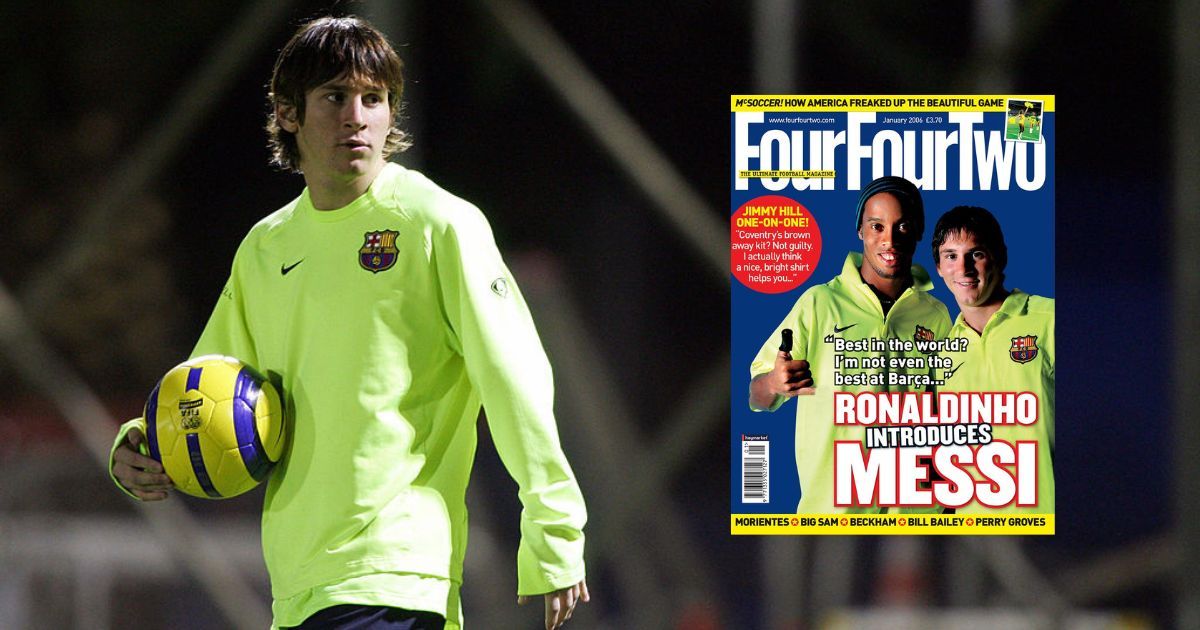

At the time, he was the latest 'new Maradona'. The most exciting teenager in world football, the star shining brightest in a Barcelona team that had begun rivalling Real Madrids Galacticos status.
Who said so? Maradona, ranked at no.3 in FourFourTwo's list of the greatest players of all time, for one. In 2005, Messi was not simply the flavour of the month, an over-hyped tabloid creation set to fade away as quickly as hed risen to prominence. One more Diego double who fails to match expectations.
Hes different to the rest, insisted the original (and the best). Hes different to Pablo Aimar, Juan Roman Riquelme or Andres DAlessandro. I see myself a lot in him. Six months prior to our meeting, Messi was just another hopeful playing for Barcelonas B team in front of crowds of 2,000 fans at best.
Below is the original interview feature from the January 2006 edition of FourFourTwo, believed to be the first in-depth interview the great man ever gave to an English publication.
Meeting Messi, 20 years ago
Although he featured in seven first-team league games in 2004-05 and became, at only 17, the youngest player ever to score for Barcelona, Messi was on the field for a total of just 77 minutes.
Then, in June, he travelled with the Argentina squad to the Under-20 World Youth Championship in the Netherlands.
As Argentina lifted the trophy, Messi was unquestionably the star of the show, top-scoring with six goals from his seven games at the tournament. Bara had always known they had a potential star in their cantera, but the speed with which club president Joan Laporta hot-footed it to the Netherlands to improve Messis contract suggests that even they didnt realise quite how good he was.
With Real Madrid, Inter, Rangers and Milan all showing interest, Messis reserve-team contract of around �100,000 a year was upgraded to one worth �3 million a year. The deal runs until 2014 and contains an implausible �100m buyout clause thats the same amount as Ronaldinhos.
A first-team fortune means first-team fame, but Messi cuts a very different figure to Baras other superstars. For one, he still walks to training from his home just around the corner from the clubs famous Camp Nou, eyes partially hidden behind a mop that wouldnt look lost in a Beatles tribute band.
Last autumn, as he made his way to work one morning, he heard what he thought was an Argentinian voice calling out to him: Che, boludo (hey, mate). He turned around to discover a smiling Ronaldinho, his best Argentine accent to the fore, waiting to introduce himself.
The pair have become inseparable ever since Ronaldinho calling Messi my little brother. The Bara dressing room is L-shaped, the regulars taking one half, and the new boys the other.
Messi used to change in the quieter section with the rest of the new first-teamers, until Ronaldinho insisted that his protg sat alongside himself, Deco and Xavi. I get on well with all the Brazilian players, Messi tells FFT when we meet deep within the bowels of the Camp Nou.
Ronaldinho gives me a lot of advice and praises me permanently. Hes a phenomenon. We have fun in every training session.
And the really cool thing is when they invite me to the Brazilian table in the hotel or at the training ground while were eating, he adds, warming to the subject.
They always joke, Hey, kid, youre the only Argentinian well put up with, but I know that they are my friends. Sylvinho is a special guy and Deco, what a player he is.
Ronaldinho is world-class, and hes got an ability to control the ball that makes me jealous. At any moment during a match, he can do something special to win it thats what I must aim to do too.
Born and raised in Rosario, Messi moved to join La Masia, Barcelonas esteemed youth academy, at the age of 13. Its now the stuff of local legend that when he sat on the bench, at just 4ft 8in, he was the only player whose legs werent long enough to reach the floor.
He had been taking hormones since growth problems were first diagnosed aged 11, injecting himself every evening for two years. For a year, the social security paid for his treatment, but then things got more complicated, recalls father Jorge. It was very expensive about $1,800 every two months.
At the time, Messi was affiliated to Newells Old Boys, but the clubs refusal to pay for his hormone treatment would cost them dear. There was an approach from River Plate, but Messis family had both Italian and Catalan roots on a visit to see his cousins in Spain, his life took a whole new direction.
Alerted to Messis potential by one of their Argentinian scouts, Barcelona invited the youngster for a trial he impressed and was invited to sign a napkin as a symbolic contractual bond. Then Messi and his family returned to Argentina and made plans to move to Catalonia.
I remember when we left our neighbourhood in Rosario, all the neighbours and our friends came out to say goodbye, he recalls quietly. Everybody was on the street with us.
My mother and father, and my two brothers and sister were all getting ready to go in a taxi to the airport, all of them crying. It was one of the first times that Id ever been on a plane.
When we arrived, we went straight to the Camp Nou. It was so impressive that it felt as though we had made the right decision to go through so much sadness and pain.
"Everyone told me that Barcelona would look after us, but I was worried that it would turn out to be a lie. It was February and it was cold, which didnt help us to settle in and we knew nothing not even that Barcelona was by the sea. In Argentina, I lived near a river, but the beach was an amazing discovery.
As Messi settled into Catalan life, his younger sister, Maria Sol, had a hard time adjusting to her new school. She was only five and struggled to integrate, so my mother, sister and brother Matias went back to Argentina, he says. I miss them a lot.
Bara paid for Messis treatment, and he grew a centimetre each month for almost three years, reaching 5ft 6in.
By then, other major clubs had spotted his talent, including Arsenal. A man introduced himself as an assistant of Arsene Wenger, recalls father Jorge.
He said, If you suffer any problems here, remember Arsenal are very interested, but we preferred Bara. The Spanish football federation also came knocking for Messi.
I couldnt play in certain youth tournaments as they were Spanish only, he recalls. Then, one day, a man asked if I was interested in playing for Spain. That man was Gines Melendez, the Spanish U16 team coach.
For a 15-year-old, he was the best Id ever seen, says Melendez. But unfortunately, we couldnt call him up because he still hadnt obtained Spanish nationality.
Besides, Messis dream was to play in the Under-17 World Championship for Argentina not that his countrymen knew. Exiled in Barcelona, Messi was out of sight and very much out of mind.
Then he received a call from Argentinas bestselling sports magazine El Grafico, who wanted to write a story about him. Seeking an independent opinion of this unknown wonderkid, the journalist assigned to the piece phoned Hugo Tocalli, the Argentina U17s boss, asking what he knew.
Someone gave me some video footage of him, replied Tocalli, indifferently. But for this competition, were working only with players born in 1986, and he was born in 87.
Yet when Tocalli arrived at the World Championships, he soon came to realise hed made a terrible mistake. Spanish journalists bombarded him, incredulous that Argentina could afford to leave out such a prodigious young talent.
Spurred into action, the Argentinian FA swiftly arranged an under-20 friendly purely as an excuse to call up Messi. With that, his Argentinian future was secure.
In July 2005, a second phone call then turned Messis world upside down: for any Argentinian footballer, this was the equivalent of a Papal blessing. Inspired by Messi, Argentina had just knocked Brazil out of the World Youth Championship when the man of the match was handed a mobile phone and told that Maradona was on the line.
He thought it was a practical joke at first, until he heard the voice on the line say, Hello monster [an Argentinian term for a big, big player], this is little Diego. As I held the telephone, I looked in the mirror and saw my eyes were full of tears, so it was difficult to speak, even when I regained my composure a little bit, recalls Messi, still visibly starstruck.
To Messis amazement, Maradona then invited him to be a guest on his TV show La Noche del 10. Messi accepted. I was more nervous than in any football match, he remembers.
Until a door opened and Maradona was standing there. Be cool, he said, but I felt as if my chest was going to explode.
Maradona had plenty of advice to give the young prodigy. Dont pay attention when journalists are comparing you with me, he said. Ive already seen what youve done playing in the World Youth Championship. Just hang on in there, and keep on playing as youre playing.
Messi is already a hero of Barcelonas discerning crowd. Meeesssi, Meeesssi, they holler whenever he takes the field. Only Ronaldinho, Samuel Etoo, Xavi and Henrik Larsson command such vocal affection from the match-going socios.
What staggers most is his development as his confidence grows. They see him improving month by month and gasp at his sublime, raw talent.
His debut goal against Albacete on May 1, 2005 was a chip following a Ronaldinho assist. It was taken with such nonchalance that most of his peers stood laughing, shaking their heads.
Messi ran to his brother in the seats. He made me climb on his back in front of the entire crowd, he recalls, slightly embarrassed.
Hes not overly worried about the new Maradona tag, though. Its an honour to be compared to Maradona, but Ive never enjoyed getting those kind of comparisons and Id rather not get involved talking about it, says Messi.
His own lifestyle shares few of the lavish indulgences that blemished and ultimately curtailed Maradonas own career. Messi will happily sit alone at home for hours playing video games at no point did Maradona go on record extolling the virtues of playing Manic Miner on the ZX Spectrum.
Like many of Baras B team players, he lives in a modest rented flat in Les Corts, a middle-class barrio, close to the Camp Nou with his oldest brother Rodrigo, 25, who works as a cook in a Barcelona hotel and recently became a father. We use a webcam to talk to our family back home in Argentina, Messi explains.
Even my mum has learned how to do it. I know that every time she sees me playing football on the television, she cries, but every day we talk, and that keeps her happy.
I look after baby Agustin when my sister-in-law is making lunch. The club tells me that I need to get a good sleep in every night, which is a little difficult with the baby crying, but I pretend that I dont lose any sleep.
Messi also doesnt care to join his team-mates and Barcelonas beautiful people at the citys buzzing hotspots, such as Buddha-Bar or Danzatoria. No, I dont go out much, he says.
I enjoy being alone at home. I listen to music, watch TV, use the internet, sleep some good siestas or play PS2 on the sofa.
When Pro Evolution Soccer 4 first came out, Id play the entire day against my brother. I played as Barcelona and put myself in the team, then I tried to go past everyone without passing the ball.
"It sounds strange, but it gave me some confidence to be playing in the first XI, even though it was a computer game. Mind you, if the games became difficult, I took myself off. I still cant believe that Im in a computer game alongside Ronaldinho or Etoo.
Ronaldinho has since invited him to play with Barcelonas other video-game obsessed superstars. Hes good, but I beat him often, says Messi, cheekily.
Thats a total lie, grins Ronaldinho. Hes not that bad, but he hasnt got a chance playing against me.
This article originally appeared in the January 2006 issue of FourFourTwo
TOPICS