
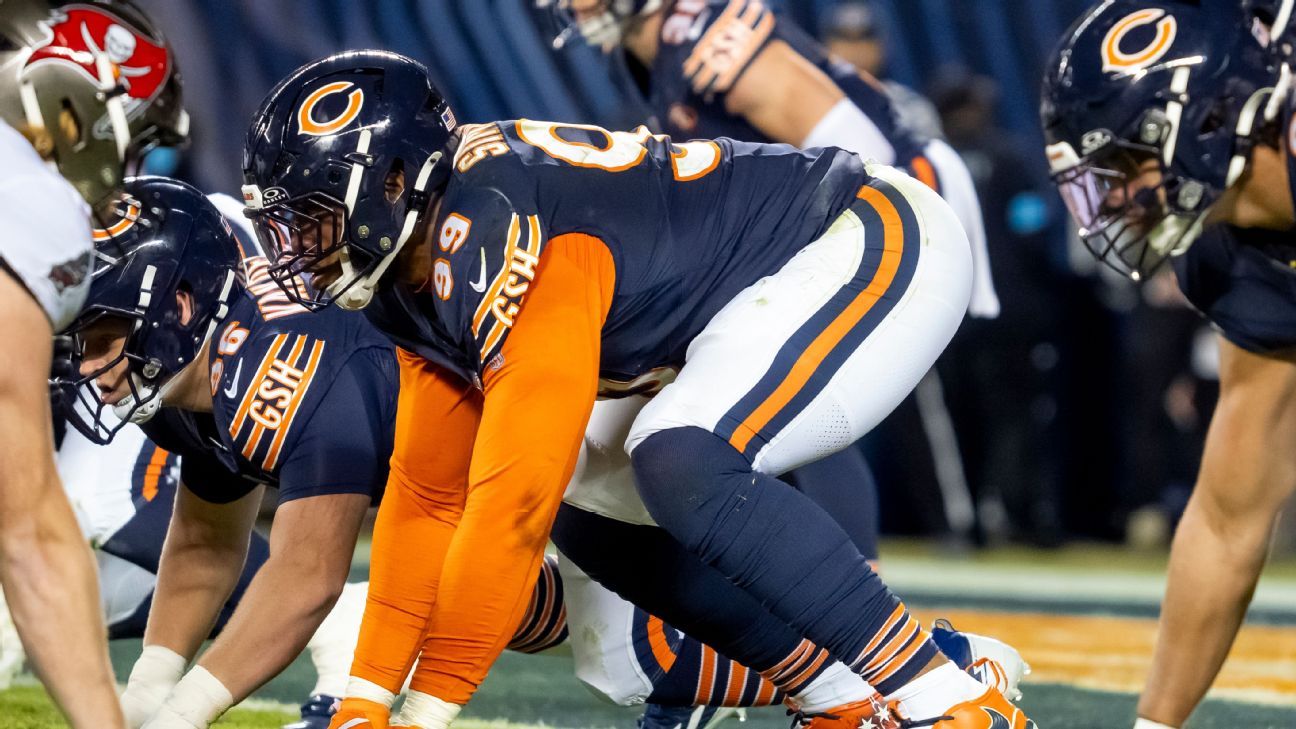
EmailPrintOpen Extended ReactionsBears defensive tackle Jeffery Simmons was the subject of controversy during Chicago's win at Detroit on Thanksgiving day, after Lions center Juice Scruggs false started on back-to-back plays, which forced Detroit to punt.CBS analyst and former NFL defensive end JJ Watt called out Simmons for causing the false starts, which could be the infrequently called 15-yard unsportsmanlike conduct penalty for "disconcerting signals" and after the game, Lions left guard Christian Mahogany also accused the Bears of "simulating the snap count. They're using - they find out the snap count of the quarterback and they use it, and that's it. They use the words."Mahogany also said that he wears a microphone during games, and so does Lions right guard Tate Ratledge, so "they're going to be able to hear and they can investigate themselves on what was said."According to a league office officiating department video sent to all 32 clubs on November 4, and obtained by ESPN, the league office was aware of Simmons' potential rule-bending well before the Thanksgiving day game.Per the video, which showed a short-yardage play from the Titans Week 7 game vs. the Cleveland Browns, Simmons' final game as a Titan before he was traded to Chicago, NFL officiating and rules analyst Walt Anderson singles out "the actions of number 98" with a red arrow pointing to him.In the play, Simmons appears to move quickly just before the snap.Anderson says the league does not have access to the audio of the film, which means Mahogany's assumption that the league could access the audio from the microphones the guards wear is likely incorrect. That audio is typically collected by the broadcast network and not shared with the NFL. The league office did not provide a comment in response to whether they have the ability to review the audio from the Lions game."We can't put this on video because we don't have audio," Anderson says, "but if there's any cadence that is made by the defense that simulates in any way the cadence of the offense, disconcerting signals would be the proper call. We can't tell that on this play, but it's certainly suspicious, and we are going to make officials aware of this tendency, either by teams or by individual players."Under Rule 12 (Player Conduct), Section 3 (Unsportsmanlike Conduct), the NFL rulebook includes a long list of "prohibited acts." Letter (i) of the (a)-(v) list reads: "Using acts or words by the defensive team that are designed to disconcert an offensive team at the snap. An official must blow his whistle immediately to stop play."As of last September, per the NFL, the penalty hadn't been called since 2017. The penalty was a topic of conversation early last season, in 2025, when Eagles left tackle Jordan Mailata accused the Chiefs defensive line of using the tactic to prevent the tush push.ESPN rules analyst Russell Yurk told ESPN last season that an unsportsmanlike conduct penalty for disconcerting signals is the least likely penalty to be called. "It's only a foul if the defense intentionally mimics the quarterback cadence to try to draw the offense into a false start," Yurk said. "That's very hard for officials to know, especially when they are 12-15 yards away from the line."Officials generally don't want to call such a subjective foul based only on what they hear because it's hard to show on tape, it's hard to justify it."A source with direct knowledge of the league's officiating department told ESPN last September that disconcerting signals was not a point of emphasis for NFL officials or clubs, nor would it become one last season, because it is too difficult for officials to hear through the crowd noise from their positions on the field to call the penalty.The league office did not respond to whether disconcerting signals has become an actual point of emphasis this season but in the teach tape sent to clubs on Nov. 4 ,Anderson suggested an adjustment for officials, so that they might be able to hear better what defensive linemen like Simmons are saying before the snap."Officiating might need to, especially on these short yardage type situations, where it looks like we're attempting to run the push play, we may end up having to adjust the positions of officials just to be able to better hear any potential sound that might be made," Anderson said.During the Lions game, the CBS broadcast showed referee Shawn Hochuli speaking to Simmons. After the game, Simmons told reporters that Hochuli told him as long as he's talking to his teammates and not saying the opposing quarterback's cadence, he's okay. "First off, I have no reason to say 'hut,'" Simmons said. "They don't even go on 'hut,' it's 'white-18, white-18.'"Simmons maintained his innocence. "As a defensive lineman, if the quarterback checks, I'm allowed to say, 'He checked into a run.'" Simmons told reporters. "... I mean, it's not my fault that your center jumped. I think that's literally the only time that I said something."On Nov. 8, the Sunday after the league's video landed in teams' inboxes, Buccaneers quarterback Baker Mayfield also called out the Bears defense for "barking out the cadence, which, you can't do that," on one of the Buccaneers five false start penalties in a 27-24 loss at Chicago.