
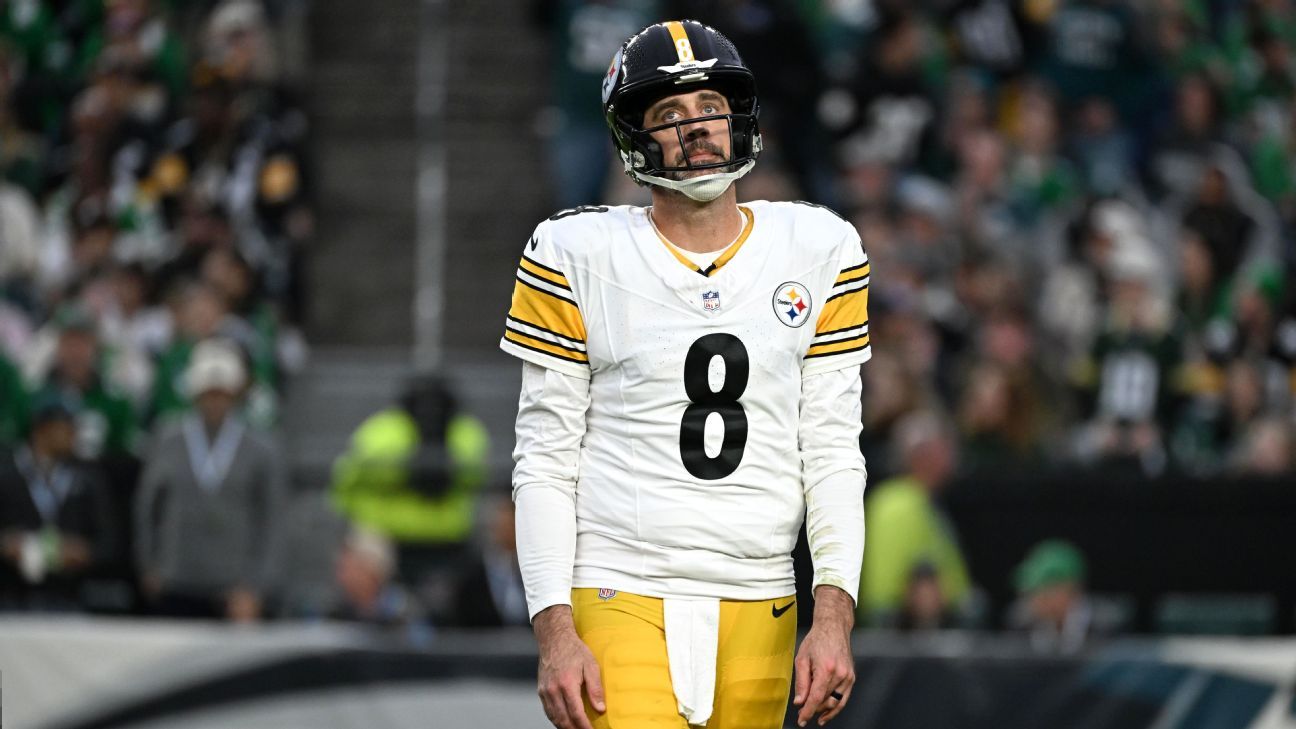
EmailPrintOpen Extended ReactionsSo many of the great quarterbacks in NFL history end their careers in dramatically disappointing defeats. Though Peyton Manning won his second Super Bowl in his final NFL start, Tom Brady went out as the quarterback of an 8-9 Buccaneers team with a 31-14 loss to the Cowboys in the wild-card playoff round. Dan Marino lost 62-7 to the Jaguars. Drew Brees couldn't move the ball in a 30-20 playoff loss to the Vikings. Brett Favre and Steve Young were knocked out of starts by injuries and never returned.For Aaron Rodgers, one of the greatest players in the history of the sport, the end might have come in much more mundane fashion. In Rodgers' 267th career start, the Steelers lost 19-16 to an Eagles team with little to play for on a day when most of the headlines were devoted to ejected Steelers wideout DK Metcalf. Two days later, the Steelers revealed in a late-night social media post that they were benching Rodgers for backup Mason Rudolph and deactivating the future Hall of Famer for Friday's game against the Broncos.Subscribe: 'The Bill Barnwell Show'Even given the struggles the Steelers have faced on offense this season, this has to qualify as a stunning turn of events. At 6-4, Pittsburgh is still in the thick of the playoff picture, with a 70.7% chance of advancing to the postseason per ESPN's Football Power Index. The Steelers don't appear to be rebuilding. They appear to be suggesting that they're better off with Rudolph in the lineup than Rodgers.There are a few questions that stand out from the story, and I want to touch on them here. There's one that I keep coming back to as I try to understand what's happening in Pittsburgh.Jump to:Why did the Steelers do this now?How does the offense change?Why Rudolph over other options?Is this really it for Rodgers?Why now?This is, of course, the part that seems so difficult to understand. Yes, there are issues with the Steelers' offense. Yes, Rodgers is not playing as well as the Steelers would hope. And yes, there are limitations on the offense that are very clearly a product of Rodgers' own limitations as a 42-year-old quarterback who turns 43 in a couple of weeks.But none of those issues are new. The Steelers were limited by Rodgers in 2025, when he got rid of the ball faster and threw shorter passes than anyone in the NFL -- a strategy to keep one of the oldest starting quarterbacks in league history from taking too many hits. He was a sitting duck in a playoff loss to the Texans, producing 100 net yards and an interception on 37 dropbacks. The Steelers failed to score a touchdown in 11 drives.The departure of coach Mike Tomlin and offensive coordinator Arthur Smith gave the Steelers a chance to rebuild and retool -- or at the very least reconsider their quarterback situation. But they did nothing of the sort. They brought back Rodgers on a one-year, $22.5 million contract and hired Mike McCarthy, Rodgers' former coach in Green Bay, to take over in Pittsburgh. Though I'm sure general manager Omar Khan might have hoped for some sort of renaissance in the reunion, there couldn't have been any realistic expectation that Rodgers was going to be significantly better at 42 than he was at 41.Instead, Rodgers has slipped a little bit across the board. Metrics such as QBR and precise pass rate suggest that Rodgers is playing at an almost identical level to where he was a year ago, accounting for the fact that he is throwing deep more often than he did in 2025.But those deep shots aren't hitting very often, and they're coming with more painful results. Rodgers' sack rate is up; he has already taken more sacks in 2026 (31) than he did in 2025 (29). His success rate as a passer is down, and though Rodgers averaged nearly 11 yards per attempt on deep shots a year ago, that's down to 7.1 yards per deep throw so far this season, which is a little over half the league average of 12.3.On the other hand, Rodgers and the offense did get remarkably conservative in the first half against Philadelphia. Rodgers averaged just 0.5 air yards per throw in the first half, a previously unprecedented level of dink-and-dunk football. As CBS's Doug Clawson noted, that 0.5 air yards mark was the shortest average air distance of any quarterback with 20 attempts or more in the first half of a game in the past 20 seasons.Rodgers did start 16-of-17 passing against the Eagles on Sunday, and he made a couple of nice throws on deep shots to Roman Wilson and Max Hurleman later in that game, the latter for a 20-yard touchdown. He threw a couple of speed outs that were a little dangerous and didn't have the sort of quintessential Rodgers zip needed to be thrown off a back foot and completed, but Rodgers' arm isn't in appreciably worse shape than it was a year ago. He was probably too hot on a swing pass to Jaylen Warren, who was set up for one of the swing screens that seem tagged to every Steelers pass concept since Rodgers' arrival, as he tried to fit the ball around Cooper DeJean. (You could also argue the pass bounced off of Warren's fingertips.)He finished the game with a 40.7 Total QBR, his 17th-best performance in 26 starts with the Steelers.Rodgers took five sacks in the loss, but I'd pin some of those concerns on the blockers. Running back Rico Dowdle leaked out on a play on which he probably was responsible for a blitzing defender for an untouched sack. Guard Spencer Anderson, filling in for injured Mason McCormick, appeared to set to the wrong player and allowed a free rusher through the A-gap for one sack and was athletically overwhelmed by Byron Young for another. The Eagles, for whatever weaknesses they have elsewhere in a lost season, still have a deep, talented defensive line. It's not necessarily a surprise that they would give Rodgers problems.Instead, I suspect that this is more cumulative frustration with Rodgers, who took a thinly-veiled shot at the front office when he was asked about Hurleman's breakout game against the Eagles. Rodgers isn't exactly known for playing his cards close to the vest. He can be visibly frustrated with his coaching staff and get into ruts when he wants to focus on one receiver if that's the player he trusts. And when the Steelers get near the goal line, Rodgers wants to have the football in his hands; the Steelers throw the ball nearly 73% of the time inside the 10-yard line, the highest rate in the league by eight full percentage points.Again, though, why should any of this have been surprising to the people running the Steelers? Rodgers left the Packers and Jets on rough terms after wearing out his welcome. His impatience with young receivers is the stuff of legend, although it should be noted that Rodgers has regularly gone back to Germie Bernard after a frustrating drop led to an interception in Week 2. And over the course of his career, Rodgers has dropped back 64% of the time inside the 10-yard line in a league that typically shades right around 50-50. That has generally been a positive for his teams as opposed to a negative.If the relationship between McCarthy and Rodgers has broken down or grown untenable, well, it wouldn't be the first time. They were seemingly at odds for years before the Packers finally fired their longtime coach in 2018. Time heals all wounds, and I'm sure the relationship had been repaired some when McCarthy was hired, but it was always odd to cast this re-pairing as a return to happy times when Rodgers won back-to-back MVPs after McCarthy was replaced by Matt LaFleur.Was Sunday Rodgers' best start? No. Was it his worst? Not even close. Rodgers struggled the week before against the Bengals, but he has generally mixed good and middling games this season. During Pittsburgh's four-game winning streak, Rodgers posted a 91.3 passer rating and turned the ball over twice. One of those interceptions was a deep shot to an open Metcalf that the wideout dropped into the arms of Denzel Ward for a pick. I'm not sure two mediocre performances should be enough to bump one of the league's most accomplished players to the bench.Instead, McCarthy might be envisioning a different sort of offense to the one the Steelers have been running. And though there's not some dominant attack brewing, it's fair to wonder what might happen next for Pittsburgh.What does the post-Rodgers offense look like?It's more fluid. During his time in Dallas, McCarthy's offenses grew more modern than what ran in Green Bay. One way that manifested was in how often the Cowboys used pre-snap motion, a trend that has increased dramatically leaguewide over the past 20 years. Offenses use motion to try to gain pre-snap tells on what sort of coverage they're about to face, force defenses to communicate and pass off route combinations on the fly, change leverages of coverage, and create better angles for their blockers in the run game. The Cowboys ranked between 11th and 17th in motion rate in each of McCarthy's five years with Dallas.The Steelers do not move much at all. They use motion before or during the snap at the lowest rate of any offense in the NFL at 47.7%. That's a Rodgers preference. As a veteran, Rodgers backs himself to read defenses and wants them to reveal themselves against a static offense with their own pre-snap movement. There's nothing inherently wrong with that, but I'm not sure the Steelers get more out of that than they would from leaning more heavily into motion to create easier passing opportunities.Despite operating what has been a surprisingly stout run game for most of the season, the Steelers also use play-action at one of the lowest rates in the league, incorporating a play fake just over 19% of the time. Again, Rodgers prefers to keep his eyes forward and observe defenses post-snap without turning his back. That shouldn't be news to McCarthy, but given that play-action passes are some of the most efficient and effective concepts in football, the Steelers should be able to create more explosive plays with their passing game if they do lean into more play-action without Rodgers.I also wonder if we just get a more run-heavy approach altogether. The Steelers haven't been a particularly pass-happy team this season, but they do rank 20th in neutral pass rate on early downs. Warren and the rest of the rushing attack rank fourth in the NFL in EPA per designed rush attempt, and third in explosive play rate on designed runs. Warren excelled as the lead back while Dowdle was injured, but between the two, there's plenty of opportunity for the Steelers to lean more on the ground game.They'll also surely run the ball more often inside the 10-yard line, which should create some extra efficiency for a team that has struggled to score touchdowns. The Steelers have made it into the end zone on just under 54% of their goal-to-go situations this season, which is the worst mark in the NFL. The league average is over 73%. Some of that can be subject to variance in a small sample, but given how efficient they've been as a running team on the whole and how much of an outlier their pass rate was before the benching, I suspect just sticking to the run inside the 10-yard line will be a better path forward for the Steelers' offense.Will the passing game be better? More play-action should help, but there's another problem with the Rodgers benching that I'm struggling to understand ...Why Rudolph?Well, I suppose that this is a period of time when we shouldn't be counting out any quarterback based on their past history. Sam Darnold just won a Super Bowl with the Seahawks, something that would have seemed shocking to anyone who watched him play with the Jets and Panthers. Players such as Baker Mayfield and Geno Smith have revitalized their careers in new landing spots. Past performance doesn't always indicate future results.With Rudolph, though, how much can the Steelers really hope to see that they weren't seeing from Rodgers? Rudolph is 31 and has thrown 742 passes as a pro. He has gone a respectable 9-9-1 as a starter, but many of those starts came with an excellent Steelers defense in support, including a 2019 team that forced 23 takeaways across Rudolph's eight starts while he filled in for injured Ben Roethlisberger.Rudolph has more flaws than strengths. He throws too many picks, with his 3.0% interception rate double what Rodgers has posted across his time in Pittsburgh. The only quarterbacks with 500 attempts or more since Rudolph entered the league who have thrown interceptions more often are Kyle Allen, Sam Howell, Nick Mullens and Jameis Winston. Rudolph has also been strip-sacked nine times in that span, a lot for what is essentially just over a full season's worth of dropbacks.That's a lot of potential turnovers for an offense whose job has generally been to end drives with a kick over the past decade in Pittsburgh, trusting its defense to win games. For whatever weaknesses Rodgers has at this point, he might be the best quarterback in NFL history when it comes to avoiding interceptions and protecting the football, which was why he made sense for the Steelers and how he helped get them to the postseason in 2025.Though Rudolph doesn't take sacks at a particularly high rate and has a solid arm, he's not the quickest of operators. He has drawn a pressure rate of nearly 42%, fourth highest of any quarterback. That rate translated from the Steelers to the Titans, as Rudolph ran pressure rates north of 40% in both places. League average is about 34%, and though Rudolph doesn't turn those pressures into sacks at a particularly high rate, quarterback efficiency craters once the passer is under duress.Even if you believe that this is more about benching Rodgers than trying to upgrade, it has to be a bit of a surprise that the Steelers are turning to Rudolph. After all, the Steelers have younger quarterbacks on their roster. McCarthy and Khan used the third-round pick they received from the Cowboys for George Pickens on Penn State quarterback Drew Allar. They also carry a fourth signal-caller in 2025 sixth-round pick Will Howard. With the Steelers already announcing that Rodgers will be inactive against the Broncos, either Allar or Howard will be elevated into the No. 2 role in Week 12.Going for Rudolph over Allar suggests one of two things. One is that Allar isn't ready, which could be the case given that he completed just under 56% of his passes and averaged 6.5 yards per attempt against backups during the preseason. McCarthy was famously conservative with Rodgers as a prospect -- Rodgers spent the better portion of three years on the bench in Green Bay before taking over for Favre after the latter briefly retired. Rodgers quickly looked the part and earned a contract extension before midseason. That same model, of course, worked well for Jordan Love as the replacement for Rodgers under LaFleur in Green Bay.The other is simply that the Steelers see themselves as playoff contenders and think that Rudolph's chances of winning games right now are more solid than the benefits of getting Allar (or Howard) real reps against NFL defenses over the rest of the season. That's par for the course for an organization that has spent its time after a post-surgery Roethlisberger came back as a shadow of his old self treating nine- or 10-win seasons and first-round playoff exits as successful campaigns.The Steelers have shown no desire to rebuild or retool and actively dismissed the idea after Tomlin's departure. Their one attempt to make a significant investment in a young quarterback over the past decade, Kenny Pickett, quickly went up in smoke. They've mostly stuck with retreads and low-cost additions since then. In that vein, it's no surprise that they would prefer a relatively mediocre known quantity in Rudolph over beginning to find out what they have under center in Allar or Howard.Is this really it for Rodgers?I suspect Rodgers' public reaction to this news might go a long way in deciding whether the Steelers permanently close the door on his time as the starting quarterback in Pittsburgh. I also don't think he's going to suit up for another team this season. The trade deadline has passed, and I'm not sure the Steelers would be willing to cut Rodgers and allow him to go elsewhere, especially in an AFC where the Patriots, Ravens and others would see him as a potential upgrade at the moment. Rodgers has already said 2026 would be his final NFL season, so there's no tomorrow for him somewhere else in 2027.Could Rodgers end up back in the starting role before the end of the season in Pittsburgh? Well, I'd refer you back to the player I mentioned at the very beginning of this column. In 2015, a struggling Peyton Manning was also benched in the middle of November. Manning had played much worse than Rodgers, throwing at least one interception in each of his first 10 starts that season, culminating in a 29-13 loss to the Chiefs in which Manning had gone 5-of-20 for 35 yards with four picks.Brock Osweiler came in and won his first three starts with the Broncos, but in Week 17, Gary Kubiak went back to Manning in relief of Osweiler in a 27-20 win over the Chargers. And as the Broncos entered the postseason, despite Manning's struggles, Kubiak gave the future Hall of Famer back the reins of the starting job. He wasn't great in the playoffs, but Manning turned the ball over only three times in three games during the postseason, while the defense dominated and led the Broncos to Manning's second and final Super Bowl victory.I'm not sure that sort of dramatic sendoff is in the cards for Rodgers, but there's certainly a scenario in which the Steelers turn back to him down the stretch. This organization really does value making it to the playoffs, and if it doesn't think Allar is ready to step into the fire in late December, Rodgers would probably be the one to step in for an injured or ineffective Rudolph. He might not be appreciably better than the version of Rodgers we saw earlier this season, but that version might still be an upgrade on Rudolph.In the big picture, though, the train has almost pulled into the station. Rodgers has been in steady decline since that fourth MVP season with the Packers. He fell from first in the NFL in Total QBR in 2021 to 26th in 2022, then tore his Achilles in 2023 and missed virtually the entire season. He came back and was 25th in his lone full season with the Jets in 2024, was 23rd with the Steelers a year ago and was 26th before his benching. The only question is whether Tuesday's announcement was the beginning of the end or the actual end of the Rodgers era.