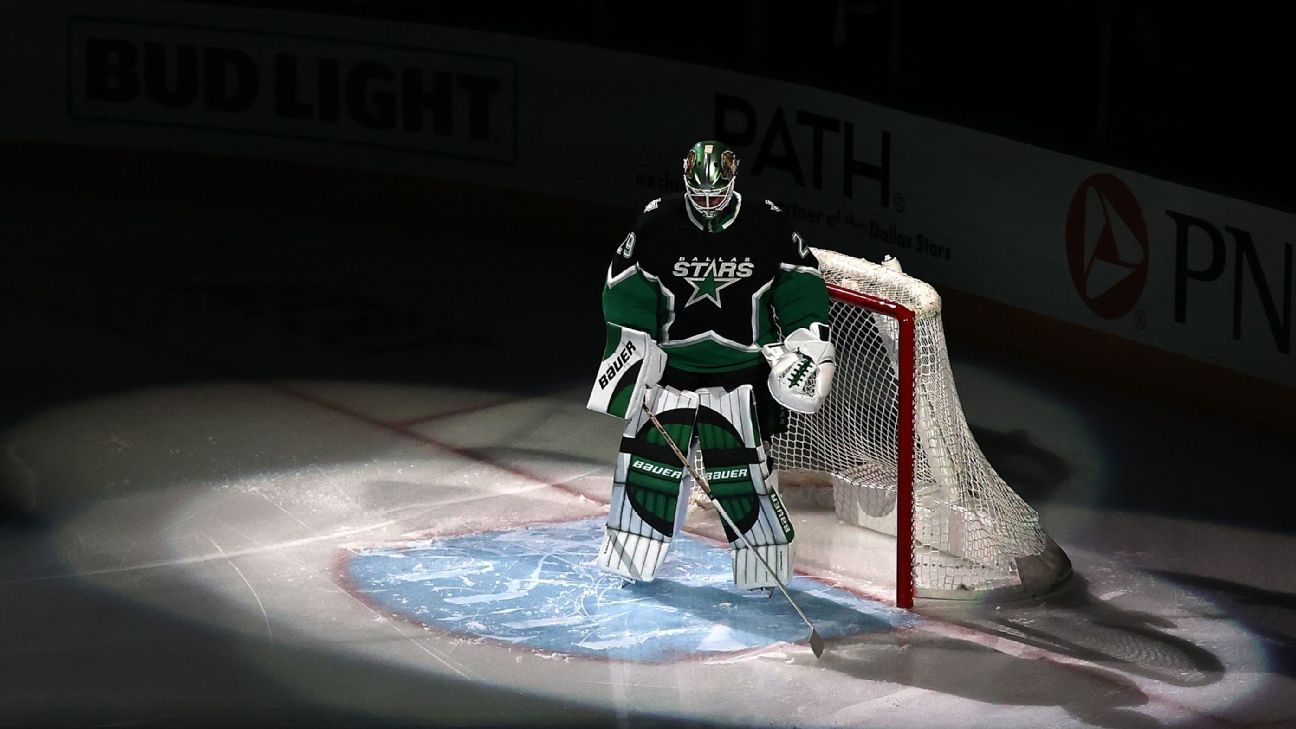
EmailPrintOpen Extended ReactionsOne of Alex Nedeljkovic's teammates was quick to note how his pads were dry after a morning skate, jokingly suggesting that the San Jose Sharks' veteran goalie didn't work hard.It's actually quite the opposite."I've got guys giving me crap all the time about not going down at practice," Nedeljkovic said. "It's not not trying. It's just you have to temper things a little bit. That's the other thing. We face a lot. Our guys don't notice it, a lot of people don't notice it."For years, NHL front offices have used various methods in an attempt to solve the riddle of how to develop a great goaltender. Some teams use first-round picks, while others wait for later rounds. Some teams make goalies their highest-paid players, while others are more frugal given the salary cap. There's also blending traditional stats -- goals-against average, saves, save percentage -- with newer metrics such as expected goals against, goals saved above average and goals saved above expected.As teams seek every possible advantage when it comes to goaltending, there appears to be another avenue worth exploring, with Hawk-Eye tracking technology in every NHL arena.Tracking movements at practice, morning skates and games could provide more clues as to how much work goes into playing the position. Goalies have always moved on the ice, but a contemporary NHL goalie moves much differently because there are more figurative and literal moving parts involved. The movements add up in the course of a regular season and postseason -- and impact a goalie's body, too."I always laugh. We chose this position and you're like, 'What are we doing?'" Boston Bruins goaltender Jeremy Swayman said. "That goes into a lot of the off-ice training. How am I going to manage the wear and tear?"Goalies in every era have faced challenges unique to their specific time. Today's netminders are encountering a level of competition that is the most physically demanding of any era. There's the punishment they take from battling with skaters at the net front, in addition to the movements that are greatly impacting their hips, knees and ankles. Goalies are also physically bigger than ever before.That has led to more teams amplifying how they consciously think about the workload for their goalies. It's why goalies have expressed gratitude that the new collective bargaining agreement requires every team to employ an emergency backup goalie, also known as an EBUG."It's a heavy amount of work goalies do before they even see a shot or they do all this work and might not even see a shot," Dallas Stars goaltender Jake Oettinger said. "I remember watching a sequence of [Sergei] Bobrovsky. It was a 45-second end zone clip, and I don't even think he got a shot. But he went in and out of the post, up and down like 100 times."Could a new wave of tracking movement data result in improved scouting of goalies -- and better usage of them once they are under team control?A goalie's workload is far greater than what shots faced can measureMovements allow goalies to see and stop pucks -- or at least be in a position to do so.So what defines a movement?"I know I do a lot of movements," Carolina Hurricanes goalie Brandon Bussi said. "I don't even know how you'd calculate that number to be honest. There are so many little things like glides. It's not quite like taking a stride because there are so many things that a goalie does."Some goalies, such as the Stars' Casey DeSmith, described movements as any time he moves his body. For instance, if DeSmith moves his head while tracking the puck, he considers that to be a movement. Oettinger subscribes to a similar philosophy, estimating he does up to 5,000 movements in a game. That includes pregame warmups and media timeouts.Others such as Swayman describe a movement as something that requires a goalie to use his whole body.Sharks goaltender Yaroslav Askarov described it in iceberg terms."People can only see the top, but pretty much all of it is underwater where people can't see," Askarov said. "You have a lot of movements. A lot of vision work, a lot of thinking and doing everything you can to make sure those movements are routine."Hurricanes goalie coach Paul Schonfelder said there's now more attention around those movements because of how much the game has changed.As the game has become increasingly more east-and-west rather than north-south, it has gotten much faster and created a need for goalies to be better and more consistent with their lateral movements.Being adept at quick lateral movements and able to hug the post and repeatedly hit your knees are just some of the skills needed for goaltending. Schonfelder said dealing with shots on goal, while important, explains only a fraction of the work.One of the items that makes the defending Stanley Cup champion Hurricanes perennial contenders is how they perform in the defensive zone. They're allowing 25.9 shots on goal per game since the 2020-21 season, the fewest in the NHL in that time. They've also led the league in shot share within that same window, meaning nobody holds on to the puck more than the Hurricanes.Naturally, this creates the perception that the Hurricanes' goalies aren't facing that much stress."People look at the shots and go, 'He only saw five shots in the first period. He's not very tired,'" Schonfelder said. "That's basically not the case. If the puck is in your zone and the goalie is moving, it is a direct result of the workload they're having."Modern goaltending is increasingly taxing on the bodyAt 6-foot-6 and 225 pounds, Oettinger is the second-tallest goalie to appear in an NHL game this season, and he is tied for the fifth heaviest. That also makes him one of the most physically imposing goalies the league has seen. He is tied as the sixth tallest and 15th heaviest among netminders in NHL history.Like many current NHL goalies, Oettinger is built like an NFL quarterback. He is the same height and weighs five pounds more than Jacksonville Jaguars quarterback Trevor Lawrence, who is tied as the tallest passer in the NFL this season.Yet goalies are required to move their bodies in unnatural and complex positions."Back in my era, if you were under 5-10 or over 6-3, you really had to be an exceptional athlete to play goal. Most of the goalies fell in that range," said Bruins goalie coach Bob Essensa, who played 446 games over 12 NHL seasons. "Nowadays, the guys who are 6-4 and 6-5 move like the guys who were 5-10 did 20 years ago. It's because the goalie coaches have become so good and the skating has become so much better. The big boys can beat the pass more so than they could a while back."Stars goalie coach Jeff Reese, who played 174 NHL games over 11 seasons, explained how much size plays a role in those movements. In addition to Oettinger, he has DeSmith, who is 6 feet and 188 pounds. That's a difference of six inches and 37 pounds."Casey is probably moving more and playing a little more aggressive, whereas Jake is a little deeper and efficient," Reese said. "That's why [the number of movements] would be a tough thing to gauge. Does a guy play aggressive? Does a guy play back? Because a guy that plays aggressive isn't moving as much."Schonfelder said there could be a couple of movements or even something like up-downs while in a butterfly that isn't a natural movement for a regular person."The way your body is set up, it creates strain on your hips, your knees and your ankles," he said. "Not only have goalies been doing those movements since training camp but a lot of them have been doing it since they were 7. I don't know the exact number, but if you're doing this from the time you were 7 to the age of 25, that's a pretty big number. Unfortunately, a lot of these movements that they're doing are the best way to stop the puck."Boston University goalie Mikhail Yegorov said that he was told from an early age that he needed to stretch with an emphasis on his hips and groin.Yegorov, a New Jersey Devils prospect, said his father was also his strength coach growing up as a child in St. Petersburg. He joked that from the day he was born, his father encouraged him to do the correct movements and not develop poor habits."I always heard hips and knees are the areas that usually suffer from a goalie position," Yegorov said. "My dad is also a sports doctor who was working with athletes, hockey players specifically, because he worked with many teams. I know that working the lower back is important because it can be very tight."Throughout the season when there's a high workload -- especially going to school, I start feeling it. I have to make sure I go to my athletic trainer and we work on that."Preventing the wear and tear is one way in which emergency backup goalies have helped.EBUGs are having the most meaningful impact at morning skates and practices. Prior to mandatory EBUGs, goalies and goalie coaches would be on the ice at least 20 minutes before the rest of the team on a practice day. They would do drills, receive a quick break and then go through practice with the rest of the team.EBUGs allow for flexibility. They can come in and give those goalies on the active roster a break when needed while also sharing the workload to reduce wear and tear. They also make it easier for a coaching staff to give a goalie a day off because there's already someone who can fill in for them without salary cap or roster considerations."It's unbelievable because now Jake and Casey can focus on what they need to focus on and keep good habits instead of when you get tired, you're just standing there," Reese said. "When you're standing there, you're getting into bad habits. You're not tracking the puck. You're not going down."Now, they get a little rest if they need it. They can skate out, get a little break and pop right back in."Essensa said the playoffs are when the addition of EBUGs is really going to have its strongest impact."They're going to make sure a starter gets his rest," he said. "During my tenure here in Boston, we've had goalies that have played 60-plus games, and maybe that wasn't ideal. We were trying to constantly monitor scheduling and give them the rest that they need."They are like quarterbacks, but you also have to have a quality backup quarterback."Why goalie movement tracking could be revolutionary -- and what comes nextNearly everything about goaltender movements, defining those movements and the impact those movements have on the most unpredictable position in hockey clearly has enough interested parties -- front offices, coaches, fans and the goalies themselves."I think it would be good in the long haul in terms of knowing how to prepare all of our bodies throughout a long season and make that process even better," Bussi said. "I think most goalies are in tune with their bodies and what they need to work on and what to rest."We do have a very unique position in which we're expected to do things that are not generally done by the average person. ... It would be a good stat to keep track of and how monitoring can help careers go longer."Turning a conversation into hard data to make decisions appears to be the challenge.Or is it?NHL teams already use technology to track workloads and certain movements, such as up-downs, so they know how to navigate potential injuries.Being able to track every goaltender move could provide the most complete picture possible of their workload.Yegorov is a math and economics major at BU who announced in August he had created a website that tracks his own metrics."It's important to put going laterally and up and down as movements, because those have the most tear on the body," Yegorov said. "If you classify a movement, you have to have that. Stretching is also a demanding movement, and many injuries or lingering injuries come from that. If a goalie stretches out too much, they have the potential to develop groin problems."He also wonders if hand and head movements should be part of the trackable data."Even right now as I talk to you, I am talking with my hands and moving my head," he said. "I wouldn't really consider that a movement because that is something every human can develop with their hands and their heads. Can we consider it a movement? I would mostly focus on the lower body and skating."John Frantzeskakis has given all of this extensive thought. He's not a goalie. But he is the NHL's senior vice president for technical operations, and his team is responsible for tracking data throughout the NHL.Two years ago, the NHL began partnering with Hawk-Eye on an optical system that tracks players, the puck and the sticks. Frantzeskakis said that every NHL arena has Hawk-Eye technology, which has allowed the league to develop and fine-tune that system for hockey. Every player has 29 identifiable points on their body that are trackable, along with six of those points on a player's stick and the puck.The current tracking system in place allows the NHL to collect data on up-downs, how many times a goalie moves into their net and out of their net, along with lateral movements."As we know, our sport is a little different than traditional sports which involve running and an open field," Frantzeskakis said. "We wear pads and everyone is kind of gliding on their skates. It's a whole different movement when it comes to hockey. In particular when it comes to goalies, they're crouched down, huddled over and doing all these moves like the butterfly and splits."Frantzeskakis said the traditional approach has been to identify where the play happened, but the NHL is working on tracking how plays unfold. That means the actual movement of the players, where their feet were, where they're moving and even details such as where they were looking by tracking their eyes.The goal is to better understand individual players while also tracking metrics that the sport has never seen."One of the areas is obviously the goalie," Frantzeskakis said. "A lot of people are trying to figure out, 'How do we do it similar to the NFL with the quarterback's QBR rating? Do we do a goalie rating?' Now that we have this opportunity to understand how goalies actually perform on the ice in the game, it's fascinating what the technology will allow us to do."Every NHL arena has a designated statistics crew that tracks metrics. Adding more people to track goalie movements could make it a sizable undertaking.Frantzeskakis said the league would likely rely on Hawk-Eye's expertise with skeletal movements and biomechanics. The NHL also would work closely with teams and stats crews already in place at each arena.He said a "movement" likely would be defined by the NHL's hockey operations. He compared it to the process of what would be considered a shot or a pass.The realistic timeline for such advancements? Frantzeskakis said it's within the next two years."Some of these guys are obviously absolutely amazing at what they do and their craft," Frantzeskakis said. "We want to highlight that through these advanced analytics and stats that we hope to create with this technology."