
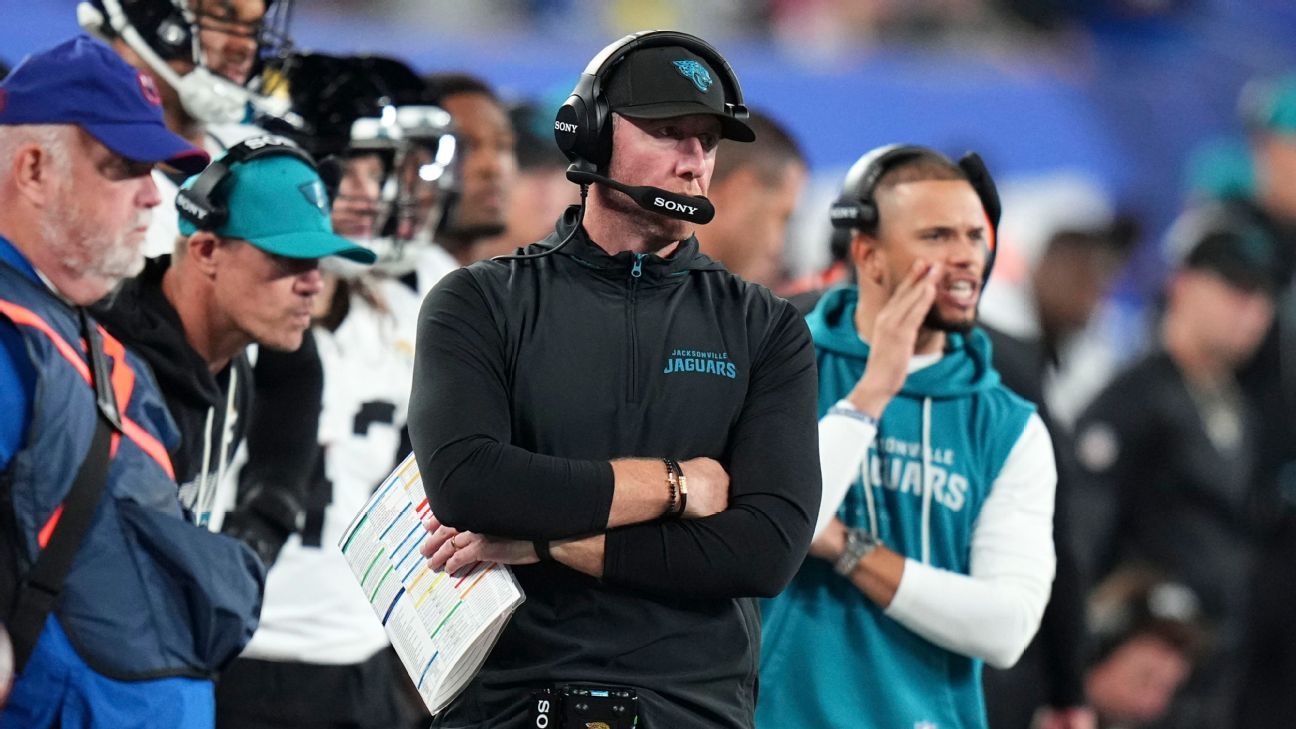
EmailPrintOpen Extended ReactionsThe Jaguars made two controversial game management decisions in the fourth quarter of their 23-18 loss to the Giants on Sunday -- going for two down eight points with 6:39 left and then attempting a field goal down eight with 3:40 left.Did they make the right calls? According to ESPN Analytics, the first was a no-brainer ... and the second was a knife's edge decision in which either choice would have been acceptable.Let's break them both down and make some sense of what happened.Decision No. 1: Attempting a two-point conversion down 23-15 with 6:39 left following Brian Thomas Jr.'s touchdown catchThis is a standard "down eight, go for two" scenario. We've written about it at length in the past, but the abridged version is that this sets the Jaguars up for a better situation after their next touchdown as they try to come back. If they convert the two-point attempt, then they can kick a PAT to take the lead on the next touchdown. If they fail the two-point attempt, then they can go for two and still have a chance to tie on the next touchdown.In this case, the Jaguars increased their chance to win the game by 1.4 percentage points by going for two. They needed just a 35% chance of conversion to justify going for two, and the league average is 48%.Of course, the Jaguars failed to convert the two-point attempt, but that doesn't change our evaluation of their decision. Kicking the PAT would have been a clear-as-day error.Decision No. 2: Attempting a field goal on fourth-and-goal at the Giants' 8-yard line still down 23-15 with 3:40 leftESPN Analytics' model had both options -- kicking the field goal or going for it -- as yielding almost identical win probabilities for the Jaguars at that point: 13.7% either way. In other words, either choice was reasonable.This will likely catch many people off guard; I'm sure most people figure the Jaguars should have gone for it down one score late in the fourth quarter. Had the Jaguars gone for it, they would have needed to convert (our model estimates a 32% chance) and then convert the ensuing two-point attempt to tie.That last word is the key, and I think it's where the disconnect occurs. We can't equate taking the lead and tying the game, because they are very different. By kicking the field goal, the Jaguars were taking the risk that they might not get the ball back -- which is what happened. But by reducing the deficit to five points, they also gave themselves the chance to win the game with a touchdown if they did get the ball back.That's not to say kicking was preferable. But it's the reason why it was about the same as going for it.Were the decisions connected?Yes. Had the Jaguars been down only seven points instead of eight (as would have been the case if Jacksonville had kicked the PAT), that would have changed the calculation on the fourth down. But ... had they been down only six points instead of eight (as would have been the case if Jacksonville had converted the two-point try), that also would have changed the calculation.Does that mean they made a mistake by going for two earlier?It does not. When we talk about going for two down eight, we simplify the scenario down to when the trailing team scores again and the leading team doesn't. But our model is not making those same simplifications in making its recommendation. And it comes back with the same conclusion: Going for two down eight late (starting around halfway through the third quarter) is virtually always worth it.