
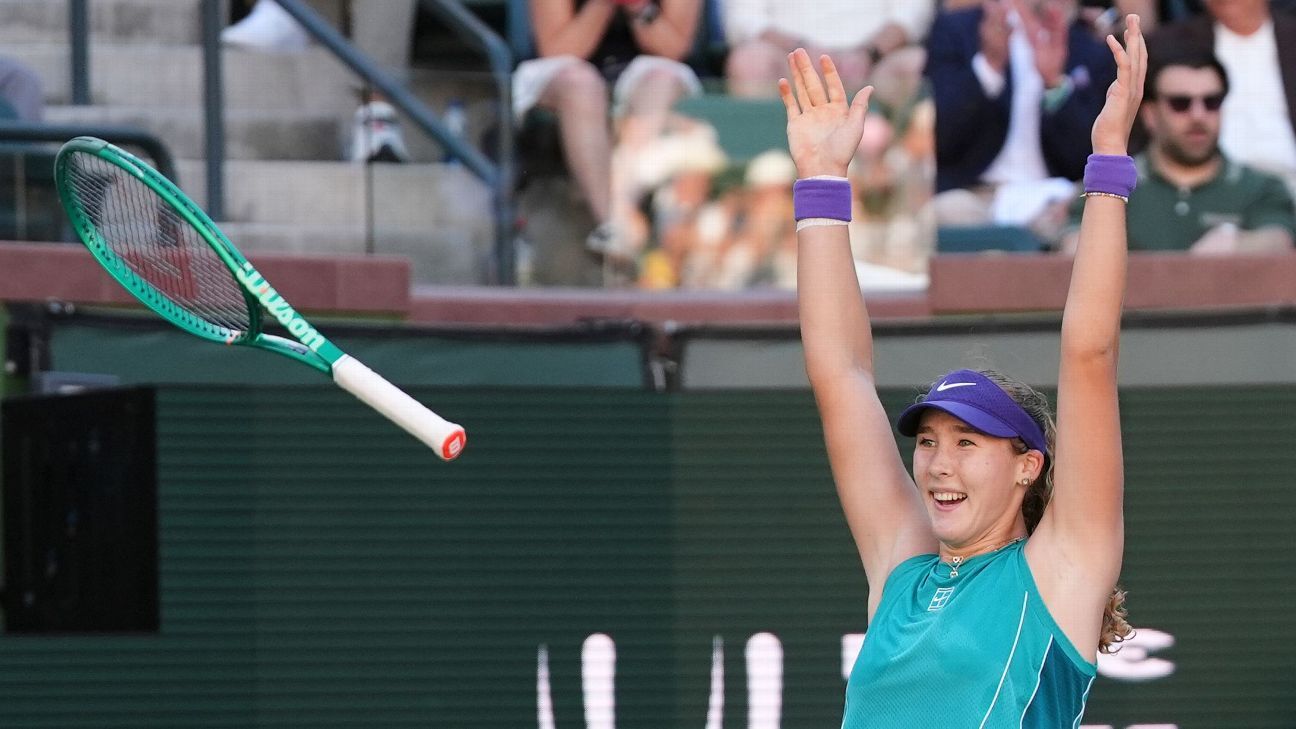
EmailPrintOpen Extended ReactionsThe WTA's announcement in July that it would be moving its year-end championships from Riyadh, Saudi Arabia, to Indian Wells, California, was met with a mixed reaction."The saga of the WTA Finals continues," world No. 5 Jessica Pegula said at Wimbledon. "It's like we can't catch a break, and I don't necessarily think it's our fault."The last-minute move came after the WTA requested to vacate its three-year deal with the Saudi Tennis Federation one year early. There had been concerns about safety due to the ongoing military activity in the Middle East, in addition to lingering criticism about the country's controversial human rights record. But the change, even to a familiar site like Indian Wells, marked the WTA Finals' sixth host city in the previous seven stagings of the event, and there were questions about how the late relocation would affect ticket sales and marketing.But as the 2026 WTA Finals came to a close Sunday, with Mirra Andreeva winning the singles title and Katerina Siniakova and Taylor Townsend claiming the doubles trophy, the tournament had arguably one of its best showings in recent years, with a sellout crowd on its opening day."I thought it was awesome," Pegula said Saturday after losing to Andreeva in the semifinals. "I do think the fans were amazing, and you know, we're playing at a different time of year, and I think everyone was a little bit worried. But I don't think there was any reason to be worried. I think we've had great crowds."I think it turned out very ideal. I think the [players] are comfortable here. They come here a lot. It's a beautiful place to play. So I think it worked out as well as it could have."And now, as the WTA begins to prepare for the start of a new three-year deal which will see the event held in Charlotte, North Carolina, the organization feels as if it has finally turned the corner with its signature event -- and is ready to make it bigger and better going forward."It's been phenomenal," WTA chairperson Valerie Camillo told ESPN. "And with more runtime, because obviously we moved the event here on our compressed schedule, and more ability to be creative, I think you're going to see an even bigger lean in with our collaborations, our retail offerings, everything really, in Charlotte."It wasn't just the location that changed for the 2026 WTA Finals.While that was what garnered the most headlines, equally noteworthy was the WTA's decision to take back operational control of the event. For the past 20 years, the organization had used a licensing fee model for its year-end championships, essentially allowing outside groups to determine how the tournament was marketed and promoted. In Riyadh, that agreement allowed for record prize money, but the crowd was often sparse and it did little to grow women's tennis in the Middle East or elsewhere.Camillo, who took over the job in November 2025 following high-level positions in other professional sports leagues and organizations, knew that taking back direct control for the WTA Finals was crucial for the long-term financial health and success of the WTA."Yes, we had voice and we had an ability to participate and we had great partners, but it wasn't our event," Camillo said. "We weren't running and controlling and setting the budget and responsible for every ticket sale and responsible for every sponsor. There's just a different level of commitment in that sort of arrangement. We said, 'Look, if we want to control our own destiny for this event, we've got to control the event.' It's a tentpole asset."I come from other sports leagues, NBA, NHL, Major League Baseball, they own and operate [their biggest events], and they would never dream of letting their biggest expression of their brand be controlled by someone else. And so the women should have that ambition too."Camillo said that decision became a priority for her soon after taking the job. She spoke to other organizations, including at the ATP and F1, about the "journey" of reclaiming ownership and the investment needed to do so. Moving the 2026 WTA Finals with just months to go was a monumental financial risk, and not one the organization had originally planned to do. But when the conflict in the region escalated -- jeopardizing even the ability to hold the event -- the WTA knew it needed to act quickly to ensure the tournament would be played. (The choice proved to be the right one. The Six Kings Slam exhibition, originally slated to be held in late October in Riyadh, was ultimately postponed.)While sooner than anticipated, the temporary and sudden move to Indian Wells kickstarted the WTA's long-term vision for the event. Camillo and her team set out to secure new partnerships and sponsorships, adding deals with Hello Kitty and Mercedes, among others, in addition to taking advantage of the media opportunities provided with a Southern California location.Camillo was encouraged by what she witnessed firsthand in Indian Wells."We're so excited about the Finals and the unbelievable crowds, first day sellout, our retail sales are off the charts, which is a blessing and a curse because we didn't really know how to forecast it," Camillo said. "We're having to replenish inventory with desperate and drastic measures, but it gives us great confidence for our ambition around our retail product. I wish we had slightly shorter lines for our fans as they're queuing across the concourse, like hundreds deep, but we'll have a better setup for next year with the knowledge of what this can be."Having to get out of the deal in Riyadh early wasn't without consequence. In September, the Telegraph reported the WTA was expected to reach $23 million in operational losses this season and would have only $15 million on hand by year's end. Camillo called it a "transition year" on a media call soon after."We are doing the normal belt-tightening you would expect of any business, while also absorbing the unexpected cost of relocating the WTA Finals to Indian Wells," Camillo said. "What's most important to know is that we have a clear path to deliver consistent sustainable financial performance in 2027 and beyond supported by strong revenue and audience growth."But it made the need to finalize a new host city more crucial than ever. Camillo said the agreement with Charlotte came together in less than six months. Charlotte had been trying to break into the tennis space for some time -- including a recent attempt to poach the 1000-level joint WTA and ATP Cincinnati Open -- and its pitch for what Camillo describes as a "really unique public-private partnership" was exactly what the WTA was looking for."It was serendipity for the WTA, for the ambition we had, for the compressed timeframe we had to try to pull this together," Camillo said. "It was literally an unexpected blessing."As part of the deal, the WTA will move its headquarters from St. Petersburg, Florida, to Charlotte -- specific date to be determined -- to have as much presence in the city as possible. It will also allow the WTA to have boots on the ground as it prepares for the next three years, and possibly beyond, of the WTA Finals.Such permanence is a far cry from the recent era of the event. Following a five-year run in Singapore, which ended in 2018, the event has in some ways become a punch line. A 10-year deal had been in place to hold the tournament in Shenzhen, China, but the tournament was cancelled in 2020 due to the COVID-19 pandemic and then temporarily relocated in 2021 to Guadalajara, Mexico, due to remaining travel restrictions. It was relocated again in 2022, due to concerns about the safety of Peng Shuai, a former player who accused a Chinese government official of sexual assault. It was then held in Fort Worth, Texas. With little time to promote the event, pictures and videos of the near-empty arena went viral. It was moved yet again in 2023 to Cancun, Mexico, where a temporary venue was built in a hotel parking lot and players complained about the conditions and unpredictable weather.The announcement that the event was to be held in Riyadh for three years, starting in 2024, was met with criticism from many former players, including Chris Evert and Martina Navratilova, and fans. The WTA and some of its players said it hoped having the WTA Finals in Saudi Arabia could help grow the game in an underutilized market and inspire young girls in the area.Leaving after two years was an anticlimactic end to an underwhelming chapter of WTA Finals history.But Indian Wells provided a dress rehearsal of sorts of what's to come, what can be -- and even what doesn't work.The 2026 WTA Finals was far from perfect. The prize money was significantly less than what was offered in 2025 -- the total purse was $10 million, compared to $15.5 million last year -- and about 63% of what the players' male counterparts are making this week at the ATP Finals.A hot mic incident, which captured Pegula calling Andreeva a "diva" after a practice session during a livestream, dominated much of the conversation before the tournament got underway. Pegula called it an "unfortunate situation" in an interview with ESPN, and Camillo publicly apologized to Pegula and all involved, citing "several breakdowns" in the organization's livestream execution.There was also some dissatisfaction that the tournament was held at Indian Wells' Stadium 2, the venue's second-largest arena, and not Stadium 1, the traditional center court during the annual 1000-level event. Stadium 1 holds over 16,000 fans, prompting speculation that the WTA was concerned it wouldn't be able to fill it."With a condensed planning timeline following the announcement of the WTA Finals' move to Indian Wells, our priority was to create the best possible experience for players and fans alike," Fabrice Chouquet, the tournament director, told Front Office Sports of the decision to play at the 8,000-seat court. "Stadium 2 offers a world-class setting that brings fans closer to the action and creates an electric atmosphere for the season-ending championship. We worked closely with the Indian Wells team to ensure the venue and overall event experience reflect the prestige of the WTA Finals."Camillo believes many of the problems will be worked out for 2027. To play at the 19,000-seat Spectrum Center, home of the NBA's Hornets, the format will be changed, and the schedule will be reduced from eight days to five, but it will provide the "traditional indoor showcase" many of the players have expressed that they want. The new location also puts the tournament back in the Eastern time zone -- a benefit for television and for relevancy among the American market -- and there are plans to create a fan fest near the arena as well as potentially hold professional conferences for those in tennis and women's sports at large.Perhaps most importantly for the WTA, the move allows the organization the space and ability to develop the event it wants and believes best represents the sport and its broader place in the global landscape."We've been describing it as 'the Super Bowl of women's sports,'" Camillo said. "We came up with that idea when we were talking about how we could elevate it, make it incredible, and more than just a competition in an arena, and it just captures what we want to do."We've stuck with that to just paint the vision because when you say that, people understand it's aspirational, it's visionary, it's something you build to, you don't get there in Year 1, and that we're trying to take this to a level that is not something that's ever existed before."