
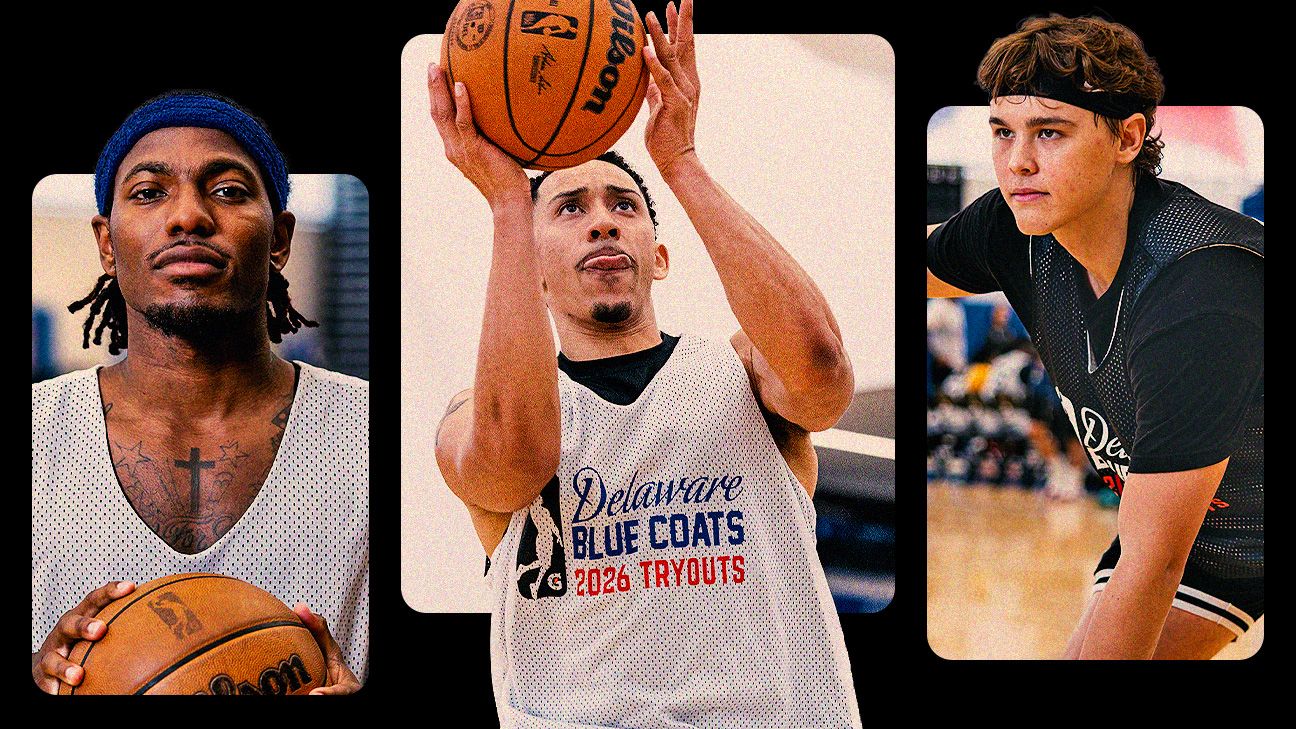
EmailPrintOpen Extended Reactions"AIN'T NO WAY," I muttered to myself. If the social media post on my timeline was to be believed, everybody and their cousin could try out for the G League.The real kicker? It would only cost them $200.That realization sparked a question: How hard is it to actually make the NBA's G League?When I posed the question to my editors, they hit me with a challenge: Why don't you find out?An idea was unlocked. I would participate in an open tryout for the G League. I was up for the challenge. After all, it wouldn't be the first time I took part in this type of experiential journalism. (Last October, I took a trip to Diamond Gym to put my mental and physical endurance to the test by working out at the "Most Dangerous Gym in America"). The assignment would also allow me to tap into a childhood dream.The game is something that has always been in my DNA. My grandfather ran recreational centers around Kansas City, Kansas. He held winter and summer leagues that I started playing in at the age of 5. Summers consisted of playing in AAU tournaments against some of the nation's top programs with ranked talent like three-time Nike Peach Jam champion MOKAN Elite and KC Run GMC, while winters were for high school basketball. But once high school was over and scholarships for other opportunities outside of basketball poured in, my hoop dreams ended. I would still play in adult leagues (and toast my competition), but if I wanted to be pro-ready, I needed pro advice.My uncle Earl Watson, a retired 13-season NBA veteran and former NBA head coach, was the person I called for coaching advice on what they might look for in a prospect."They want who wants it most and plays the game with respect," Watson said.Watson saw firsthand where a paid open tryout could lead. He began his coaching career with the Austin Spurs, San Antonio's G League affiliate. That's where he coached Jonathon Simmons, who paid $150 to try out alongside 60 other players and earned a roster spot in what was then the NBA Development League. Simmons signed his first NBA contract with San Antonio in July 2015 and went on to land a three-year, $20 million deal with the Orlando Magic.Watson likened the tryout process to the Jordan Peele-produced psychological horror movie "Him" and the needed mentality to a notable line from the film: "What are you willing to sacrifice?"THE NEXT ORDER of business was finding a tryout. As fate would have it, the Delaware Blue Coats, affiliate of the Philadelphia 76ers -- and coincidentally the same team my NBA 2K27 MyPlayer plays for -- were hosting an open tryout in a couple of weeks. Maybe this was a sign.According to Blue Coats head coach JP Clark, every year the team holds an open tryout to give talent exposure to Delaware's front office and staff, as well as 76ers scouts.As for what he looks for in said tryout?"What we're looking for is just talent, right? Just talented players that are good people, good character, that can bring value to our team," Clark said. "Generally we're looking for versatility and just good guys with skill that can play a multitude of positions for us."Delaware's Oct. 4 open tryout would draw 140 players, the most in team history. At $200 per player, that meant the team would collect $28,000 in nonrefundable registration fees. Clark said those funds go into giving their rostered players a better lifestyle during the season."We try to put on a first-class product for our players and we want them to be as well taken care of as possible," Clark said. "It all goes towards maybe we can have an extra team dinner or maybe we can take a better preferred route or stay an extra night in a hotel. ... We want to try to replicate as much of the Philadelphia 76ers experience as we can here in Delaware."Clark also mentioned that adding size was the top priority for Delaware's 2026-27 roster."There's more guards than bigs. So any big with size that can come in, bring some physicality, set some screens, play with some toughness is definitely something that was at the top of our list," Clark said.In the 2025-26 season, the Blue Coats finished 18-18 in the regular season and were the league's fifth-best rebounding team, grabbing 47.7 boards per game. But they placed 25th in the league in allowing second-chance points and second-to-last in points in the paint.WHEN I RECEIVED the green light to be part of the at-capacity Blue Coats open tryout, I was in the process of training to run a half-marathon. My workouts quickly shifted from long runs to speed and intervals, while also getting in the gym to get shots up and find my shooter's touch.On the Friday night before my trip to Delaware, I spent four hours in the gym working on my conditioning, ballhandling and shooting with countless shooting drills -- including the well-known "Auburn drill" -- with my colleague Dre Waters. I shot so much that night my toes were bleeding by the time I took off my shoes. But that didn't matter to me; the only thing that did was that I was ready to compete and not back down from anything that stood in front of me.I called my dad on the drive to Wilmington on Saturday. By the time he finished his pep talk, I felt like I was a kid in the passenger seat on the way to a Pop Warner game again. "Just play hard and play your game. You know what to do," he said. That was all I needed to hear. My next call was to Watson to decide what my evening plans should entail before the tryout."You need to run -- do sprints to keep yourself in rhythm. Then do some stretching and foam rolling after to keep your body loose," he told me.My night was set.After a four-hour commute to Delaware, I dropped my luggage off at the hotel and marched straight toward a treadmill. The workout was 2 miles split into four quarter-mile sprints and recovery runs to keep my legs fresh.To fuel for the next day, dinner was a carb bowl with chicken and vegetables. My soundtrack? Jill Scott's "Dreamin'" to help me remember the hoop dreams I once had."Live for the dream, follow the dream, beautiful dreamer," the Philadelphia native sang before lights-out at 10:30 p.m.AS I CROSSED the bridge on Judy Johnson Drive just before pulling up to the facility at 6:30 a.m., a large "76" emblem adorning the wall caught my attention.A line was already forming when I approached the doors, with at least 20 participants in hoodies chattering among themselves, sizing up their competition.I overheard one attendee, Brandon Hall, tell another player he'd taken a red-eye from Los Angeles, landed at 5 a.m. and headed straight to the fieldhouse.Players began to come in bunches. Some tall, some short, a handful were content creators, and some were die-hard Sixers fans."Did they think wearing Sixers gear and the newest LeBron James jersey would put them ahead of the pack?" I said to myself.Hall started a conversation with another player, asking a player in a white hoodie if he'd ever been to a tryout. He replied that he previously tried out for the Texas Legends, the Dallas Mavericks' G League affiliate, where he said some players "weren't good" and he had to "teach them in the tryout.""YouTube, we got this in the bag," one attendee said to a cameraman wearing a Sixers jacket.Among the 140 players in attendance was Brandon Dwyer, full-time content creator from Newark, Delaware, who had always dreamt of playing in the NBA. He was a walk-on at Florida Gulf Coast, where he scored his first points in his fifth year. Now, he was chasing a new dream: playing in the G League.The G League, formally known as the NBA Development League, launched its inaugural season in 2001-02. Its basis is to help develop players, coaches and front offices to eventually transition to the NBA, while acting as the league's "research and development laboratory."Oftentimes, players on NBA assignment or two-way contracts remain tied to that same one franchise. But players whose NBA rights aren't held by a team are considered free agents in the NBA and can be called up by any NBA team, regardless of which G League team they play for. Through its first 25 seasons, the G League recorded 1,173 NBA call-ups. The first came in 2001, when the Denver Nuggets signed Chris Andersen from the Fayetteville Patriots. He went on to play 15 NBA seasons.So if you can make it to the G League, there is, in fact, a way to make it to the NBA.NBA G League president Shareef Abdur-Rahim told ESPN in a Zoom interview the idea of the open tryouts help build and involve community for each respective team while giving underdogs the opportunity to get their shot."For our teams and the development aspect of it and identifying talent, it's historically been a way for teams to identify talent and find guys that may have fallen under the radar," Abdur-Rahim said. "We've had a pretty good amount of success."Two players who paid to compete in open G League tryouts scored in the 2026-27 NBA preseason. John Ukomadu, who played two seasons at Eastern Kentucky before trying out for the Motor City Cruise in 2024, scored for the Detroit Pistons. Philip Wheeler scored for the Phoenix Suns after making his NBA debut with the Philadelphia 76ers in 2025. Wheeler had no college playing experience when he tried out for the Rio Grande Valley Vipers in 2021. The Vipers cut him but brought him back as an unpaid practice player, and he eventually earned a contract."I think that is what makes that aspect of our league really special; that you get a guy that pays his own way and goes to an open tryout. It's interesting because you're like weekend warriors in combination with real serious basketball players," Abdur-Rahim said."What kid doesn't want to play in the NBA?" Dwyer told ESPN. "The fact that I got a jersey on with an NBA affiliate team on there, I gotta give it a shot, I gotta try, so I think it's just chasing that childhood dream."Mekhi Young, 26, had already played professionally overseas in Madrid in 2022-23. His dream was to defeat odds."I've been playing ball since I was a kid and I've been overlooked; they haven't looked my way, pushed me out," Young said.Christian Lyons' path led him to try out for the past three years. From making his first high school roster his junior year, to years of injuries keeping him off the court, he found his way back to basketball through playing in smaller leagues and games on YouTube. He'd already attended a Blue Coats tryout in September at Rowan University. By the time he showed up in Wilmington, the staff knew him."This year felt different. God was inspiring me and leading me to get there, to try out and perform," Lyons told ESPN. "They knew me, so it was kind of like a bigger sign. They felt like I was too familiar."THE DOORS OPENED at 7:37 a.m. and I was the sixth man to enter. The smell of fresh popcorn hit me as I made my way through two check-in stations: one to validate my registration and another to pick up my jersey for the day.A reversible black-and-white mesh jersey with the No. 42 called my name along with an assignment on Court 2. I found a seat, laced up my Nike G.T. Zoom Cut 2s, and put on the jersey.It was time.Participants slowly trickled in the gym over the next hour while I went through my normal warmup routine, starting with stretches and moving on to form shooting.As the courts filled, players started pulling up for 3s, dunks and acrobatic finishes. Lyons was jumping out of the gym and had the rims rattling early, putting his athleticism on display. I opted to reserve my legs and arms for when it's time to compete. On the west half of Court 1, the center court, the warmup had already turned into full-contact one-on-one. Players on the other courts kept an eye on it between shots."I need to find a way to get on that court and compete, I need to be seen," Dwyer said as he walked by.Like for Lyons, this wasn't Dwyer's first G League tryout. In September, he tried out for the Orlando Magic's G League affiliate, the Osceola Magic, where he says there were far fewer attendees."The main difference between this one and the Magic was there was way more people here. That's probably the LeBron [James] effect," Dwyer told ESPN.Lyons welcomed the bigger crowd. "A lot of eyes were on me," he said.Moments later, Blue Coats assistant general manager CJ Marchesani and assistant coach Reggie Redding called us to center court. The message was simple: If you wanted a shot at training camp, make the right play and trust your teammates."Blue Coats on three: 1... 2... 3... Blue Coats!" echoed in Chase Fieldhouse.Following the group warmup, Redding called us back to demonstrate the first drill, which focused on transition offense, decision-making and defense. It started as a 3-on-3 in transition and turned into a 4-on-4 as a player from each side sprinted to touch half court and joined the play. The coaches wanted to hear us talk on defense and see who could get a stop.My plan was to be aggressive and play smart. On my first rep, I snuck up behind the ball handler and stripped him, a move my dad and I had practiced over and over when I was a kid. He would've been proud. I'd barely broken a sweat, but that steal made it sink in: I was really here.About 20 minutes in, we'd had more scrambles for loose balls than clean looks at the rim. The coaches stopped the drill to remind us to space the floor and talk on defense, then sent us for water. I wasn't ready for what came next.DAN DUNNE, A former Seton Hall big and the owner of Full Court International, was seeking players of Puerto Rican descent. During the water break, the 6-foot-10 coach approached me and asked me about my nationality. I told him of my Black and Hispanic roots.He said he could connect me with agents to play professionally in Mexico if I wanted, and told me to meet him after the tryout for more information. He also relayed the same information to Young.Is this part of my life where my hoop dreams start to come true? I try not to think too highly of it because there's still more to go through in the tryout.Redding and the other Blue Coats assistants showed us three offensive sets we'd be running, then sent us back to our courts and split us into teams. There were six teams total on my court -- I landed on team No. 3 with a great group of guys. We were small -- the tallest person standing about 6-foot-4, and at 6-foot-3 I was the second-tallest -- but mighty.Each team had a two-game guarantee of one eight-minute quarter per game.While we waited for our first game, I watched a guy who seemed to make everything in warmups step out of bounds on three straight possessions under pressure. When the coach subbed him out, he walked over to his bag, changed clothes and left -- midgame.We had an example of what we didn't want to do.Our team goal was to win... and to make each other look good while doing it. In the first game, we ran the right plays offensively and played hard defense.I helped create multiple forced shots, dead balls and even some turnovers.Young, our 5-foot-7 point guard was everywhere. He collected steals, made off-ball plays and finished at the rim amongst the trees. He had heart."They still overlook me because I'm small -- my height," Young said. "Because I'm small doesn't mean I can't play."Young reminded me of former Delaware point guard Aquille Carr with his craftiness and how well he came off ball screens.We won our first game.In between games, we acted as a team that knew each other before the tryout. Friendships were created, basketball intellect was shared and we continued to scout our next opponent.AS WE WATCHED on, a participant on one of the black jersey teams, maybe about 5-foot-7, stuck out as an obvious Sixers fan wearing throwback oversized 76ers shorts, a Sixers undershirt with red shoes. Every time he caught the ball, he wanted a good look at the rim but couldn't because his defenders were taller and more aggressive, so he passed to the next open man.But a couple of possessions later, he stood just outside the wing and shot without hesitation or worry about how good or bad his form looked. The shot ended up going in and with excitement, he ran down the court doing a bow-and-arrow celebration as other participants laughed on.We were itching to get back on to the court.Our second opponent featured a big who stood about 6-foot-9, 230 pounds and Dwyer, who was shooting from Stephen Curry range in his first scrimmage. I knew I would match up with their big, and as one of the tallest on the team, it was a chance to show my defensive aggression again.Surprisingly, we won the jump ball. And in the first play of the game, I caught the ball at the top of the key and instantly recognized my mismatch.In triple-threat position, I gave my defender a jab step to see if he'd bite. In my mind, I tell myself, "If he goes for it, go at him. No remorse."He bit. A crossover and hesitation made him backpedal just enough for me to rise up for a jump shot at the top of the key, flicked my wrist and released it -- it felt great leaving my fingertips.Back iron and the bottom of the net contacted the basketball to score the game's first points.Immediately, I got back on defense and fought through a string of screens before a hand up just in time to contest a shot from the wing, causing the shooter to miss.I was fired up.A few trips up and down the floor later, it felt like someone had poured hot sauce into my lungs.I'd been training to run a half-marathon in Hartford the following weekend, and here I was trying to catch my breath in an eight-minute scrimmage.Watson's voice echoed in the back of my mind about being in "basketball shape." I considered calling for a substitution, but I wanted that training camp invite. I took a deep breath and moments later, my second wind kicked in.After about four minutes of going up and down the court, preventing fast breaks and steals, the buzzer finally sounded with the score tied at four. No overtime.And just like that, our tryout was done. My only thought was whether I'd shown the coaches enough."You were hooping today, bro," Hall told Young. "Man, I appreciate it -- you can go too fam," Young replied.Hall shook my hand after a similar exchange. "Bro, you can hoop for real. You nice," he said to me. I thanked him and told him how impressed I was with his play.Young also met with Dunne, who was impressed with his tryout performance. He gave us his contact information and reiterated that he could connect us with agents and coaches in Mexico if we wanted to play professionally."We might get that Mexico bag together!" Young told me in excitement.We sat together again as a team to watch the final game on Court 2. After a turnover, a point guard lit into his teammates for failing to run the play the coaches had called."These motherf------ can't hoop, bro!" the player screamed."He can't be doing that out here, this ain't LA Fitness," Hall said to us.After the game, the point guard came over and sat down next to our team, still frustrated. I walked over and crouched down to remind him that NBA, G League and other professional scouts are looking at his every move and his composure."I appreciate it, bro. They just ain't doing what the coach is telling them, and that s--- is killing me because I can't do much," he replied.My response? "Worry about what you can control here, which is your game."ABOUT 30 MINUTES before 11 a.m., Marchesani gathered all campers remaining at center court over the Blue Coats' emblem for a speech.He and Clark thanked everyone for coming out and expressed their gratitude for the effort they saw before going over the next steps that would leave some hoop dreams either derailed, fulfilled or still with hope.Marchesani read off a list of 16 players for one final game -- an all-star game of standouts.The gym grew quieter with every number. I listened for mine, but it wasn't called. We broke one last huddle with a shout of "Blue Coats" and watched the final scrimmage, which was filled with rim-rattling dunks.Before participants-turned-teammates and friends went our separate ways, players spent about 10 minutes fellowshipping before coaches told them to clear the facility.Hall sat down, took out his iPhone, and snapped a photo of the gym before posting it to his Instagram story. The red-eye flight was worth it.Once I left Chase Fieldhouse, my body immediately ached. When I took off my shirt the cause was revealed -- a bruise that turned the entire inside of my bicep black and purple, along with bruises along my ribs that stayed for over a week.A Blue Coats spokesperson said players who earn a training camp invite get a call a week after the tryout. Three players got that call. Dwyer, Young and I didn't.For Lyons, the tryout brought him closer to the dream he'd come to Wilmington for.He told ESPN the Blue Coats said they wanted to see him again, potentially as a practice player."I just made my statement," he said.I left with a better sense of what it takes to earn a G League roster spot through an open tryout. And for the next week, every time I lifted my arm, I could still feel what it took to try.I'd spent the night before listening to "Dreamin'" and thinking about the hoop dreams I had as a kid. For three hours in Wilmington, I got to find out what it felt like to chase one again.