
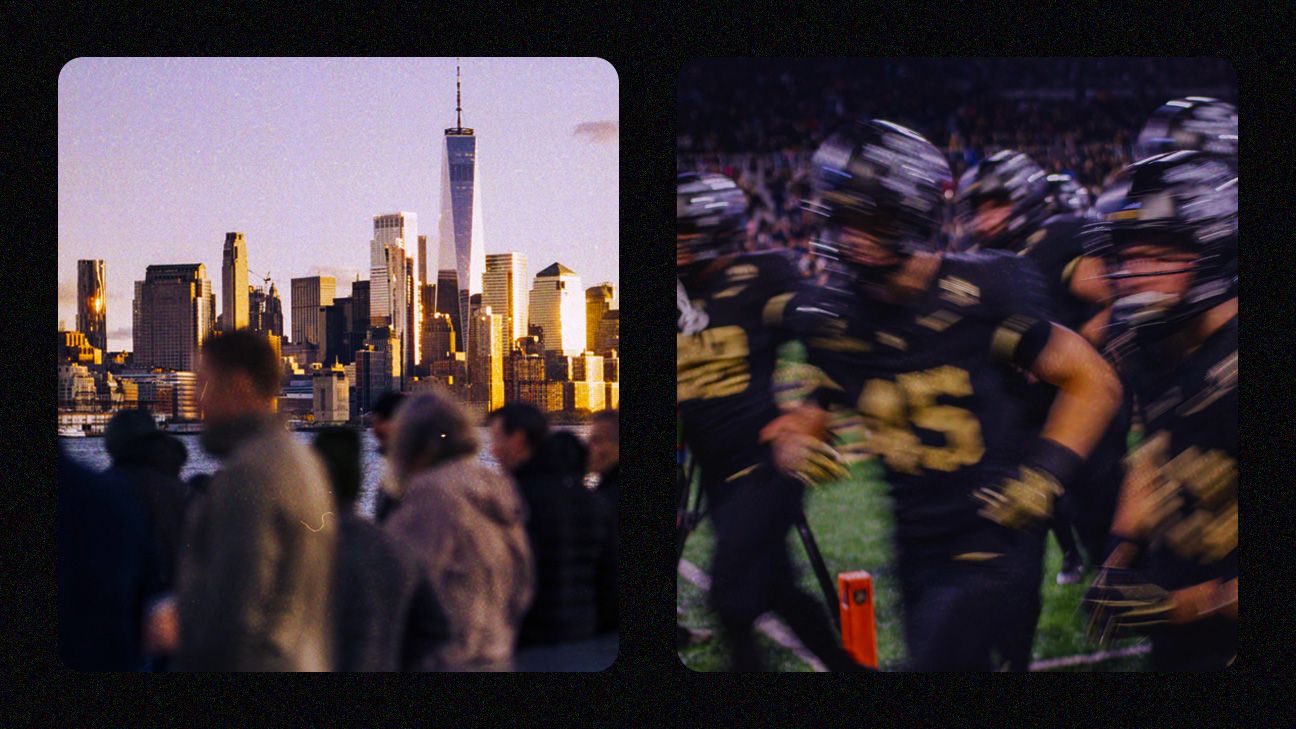
EmailPrintOpen Extended ReactionsNEW YORK -- On a raw October Saturday morning in The Battery, empty beer cans, paper napkins and even the best-coiffed heads of hair are no match for the wind gusts aboard the top deck of the Seastreak Highlands. Army's afternoon kickoff with Florida Atlantic is still several hours away. But, as the 140-foot catamaran begins its voyage up the Hudson River a little before 9 a.m., the best college football tailgate you've probably never heard of is already in full swing.There are finance bros downing drinks with war veterans and middle-aged dads, Manhattan attorneys and Catholic school presidents renewing yearslong traditions and travelers checking off bucket-list items. Below, on the first deck, a healthy line is forming at the full-service bar. Soon, we'll have views of the luxurious fall foliage lining the banks of the Hudson, too. After that, an FBS football game on the longest continuously occupied military post in the nation.Welcome to the West Point game-day ferry."It's not your typical SEC game day or anything like that," said Cannon Kearney, a Brooklyn-based lawyer and an Army veteran. "But where else across the country do you see people from Bum-Nowhereville, Arkansas, and posh Madison Avenue tailgating in one place?"West Point, home to the United States Military Academy, was built to keep things out.Recognizing that control of the Hudson River would be crucial to the outcome of the Revolutionary War, General George Washington considered the site to be the most important strategic post in America. Under his direction, in 1778, American Continental Line soldiers built Fortress West Point on the riverside plateau to defend against invasions from British troops and warships. Washington formally moved his wartime headquarters there a year later.West Point's stance on foreign vessels has softened somewhat in the nearly 250 years since. Enough, at least, that during every Black Knights home Saturday, after stops in New Jersey and Lower Manhattan, a high-speed passenger ferry spills as many as 505 passengers onto base for the singular experience of Army football, blending centuries-old history with a modern concept: ferrygating."This place is about preserving tradition. But it's also about building for the future," Army athletic director Tom Theodorakis told ESPN. "I don't think we have to choose between both. The things that we do here at West Point, in many ways, are just timeless."So who actually rides the boat and why? On the two-hour journey from Manhattan to West Point before Army's Oct. 17 visit from Florida Atlantic, I found out. Tradition, patriotism, a taste of FBS football for fans marooned in the Northeast, anyone with an affinity for history, pageantry, day-drinking and/or the fall leaves of the Hudson Valley; there are lots of reasons to rise early and pony up $104.52 for this ferry, and the opportunity to do so attracts all kinds.Tickets for this particular Saturday morning's cruise were sold out weeks in advance. At 8:56 a.m., we set sail with Wall Street traders, college football die-hards, sports-junkie attorneys, military veterans, several internationals, a stock broker turned state-title-winning offensive coordinator, some Navy fans and at least one very on-theme bachelor party running something they call "the triple speed option." "One beer, then another beer and another after that -- that's the game plan" explained Tom, a commercial real estate developer and one of several passengers who declined to share their last names for this story.Below deck, Craig Palmer, a 65-year-old educator and Army football enthusiast from Middletown, New Jersey, is nursing an early-morning bourbon and in no rush at all.It turns out that's part of the beauty of the West Point Ferry. At its core, the boat can be a vessel for whatever you want it to be; a veritable college football "choose your own adventure" packaged into a 52-mile boat ride up the Hudson. "We could drive and get there quicker," Palmer said. "But why would you want to?"8:22 a.m.Maritime Building Slip 5 is located a half-mile south of the New York Stock Exchange on the southernmost tip of Manhattan. The Staten Island Ferry docks next door at Whitehall Terminal. Fraunces Tavern, the historic pub where Washington delivered an emotional farewell address to his officers at the close of the war in Dec. 1783, is steps away.This slice of Lower Manhattan is an admittedly unlikely launching pad for an obscure, if burgeoning, college football tradition. But, on the short walk from the Bowling Green subway station, there's an energy in the air, the same kind you have on a Saturday morning stroll through a Big Ten or SEC campus, when the anticipatory feeling is still working its way up to full-throttle game-day mania. Headed toward the 117-year-old terminal, there are fans in Army gear and a handful more repping Notre Dame, Texas and Texas A&M, but most bear no college affiliation at all.Some carry iced coffees; others 24-can cases of beer. "Are you ready to rumble?" a 20-something-year-old in a Waste Management Open quarter-zip with a Miller Lite in each hand asks his friends as we approach. To the tourists searching for the Staten Island Ferry and the weekenders here for one of the many fall foliage cruises, the scene must be a curious sight.8:33 a.m.Roughly 30 minutes after its initial departure from New Jersey's Atlantic Highlands Marina, the Seastreak Highlands pulls into Maritime Building Slip 5. When a line to board the ship forms, I jump on it behind Andrew Sterling, Arjun Pasricha and James Bennington.They all live nearby and work in finance, but none of them are from here. Sterling and Pasricha hail from Toronto; Bennington is from London. As a trio, they're generally aware of the Army-Navy rivalry. Past that, none holds a particular interest in college football. "They had an extra ticket, so I was just down to come," Pasricha said. "I figured it'd be cool to jump on a boat."As it turns out, Sterling, Pasricha and Bennington are here for the same reason I am."We saw a guy do this on Instagram and we've been wanting to try it," Sterling explained.That guy is Nick Watts, a social media personality who has filmed videos documenting his journey on the West Point ferry each of the past two seasons. In them, sipping a beer in a waxed fall coat and a freshly purchased Army hat, Watts makes a pitch for the idyllic combination of a Hudson River boat ride and convenient access to FBS football from Manhattan: "Fall foliage. Beers. College football. Heavy artillery. Inject it into my veins," he says in one clip.8:56 a.m.I also discovered the West Point ferry from Watts while scrolling Instagram. Over the next two hours, I learn that Sterling, Pasricha and Bennington and I are far from the only passengers here today, at least initially, because of a video that appeared on their social media feeds.As the boat prepares to curl around the southern edge of Manhattan, the Statue of Liberty fills the backdrop and the top deck is filled with young men in Barbour jackets crushing breakfast sandwiches and 24-ounce beers."It's Saturday football with the gang," said Ben, a banker sporting a Masters baseball hat. "Hanging out, drinking beer with the boys. What else do you need?"9:06 a.m.Texas A&M's football season isn't going well. Still, Beth, a recently graduated Aggie from Houston who lives in SoHo, is missing the feeling of a proper college football game day. "So we decided to take the ferry and planned a day around it," she said. It's her first time riding the boat. Back by the stern, Mike Jones, 62, is leading his 12th West Point ferry trip.An attorney who lives in Stuytown on the east side of Manhattan, Jones first came upon the boat to West Point through a social group of fathers to sons at Fordham Prep, the Jesuit school in the Bronx. That trip died off, but Jones kept one of his own going. In Year 12, his group consists of sons, brothers, nephews, neighbors, a former New York Post writer, friends Jones once coached little league baseball with and former colleagues from the New York State Liquor Authority. All in, the annual trip from Lower Manhattan is simple and unfailingly worthwhile."This part is just gravy," Jones explained, gesturing to our view of the Manhattan skyline and lifting his drink toward the sky. "Personally, I like the bar, too."A vast majority of the fans who typically fill Michie Stadium on fall Saturdays tend to come from New York's Hudson Valley, and the surrounding New York and New Jersey suburbs. But Army football and the broader allure of West Point draw from all corners of New York City, as well.According to internal data provided by the academy, the Black Knights sell an estimated 9,210 tickets within the five boroughs each fall, accounting for roughly 7% of all ticket sales. Some come by car; some come by train. And, as Seastreak president James Barker estimates, somewhere between 400-500 ticket holders travel to West Point by ferry every home Saturday.The Seastreak Highlands boat is one of 10 high-speed ferries in the company's fleet. As a company, Seastreak's primary business lies in a commuter ferry that shuttles more than 2,400 passengers between New Jersey and Manhattan five days a week. In the summertime, the company operates boats servicing the Jersey Shore and the islands of Martha's Vineyard, too. Further down the company's catalog, however, you can find a wide array of specialty Hudson River tours: fall foliage excursions, wine tours, trips to apple orchards, Broadway matinees and the US Open tennis. Few, if any, are more reliable than the West Point game-day cruise."We've been doing it for at least 25 years and we still sell out almost every trip," Barker said. "It's had better longevity as a service than almost anything else that we've done."9:16 a.m.As the boat works its way up Manhattan's West Side, three generations of Mattinglys occupy several rows of seats in the middle of the second deck. Grandfather, fathers and sons traveled from Nashville for a weekend in Manhattan and rode together to West Point."It's been a long time coming for us," said Mark Mattingly, sitting with his dad and two sons.As the story goes, Mattingly's older brother visited West Point as a prospective student nearly 20 years ago, then returned with their father for a game a few years later. A trip back to Army has been on Mattingly's bucket list ever since. Now, here they are, floating toward Michie Stadium. "My boys are big college football fans," said Mattingly. "What a cool way to tailgate."9:23 a.m.Fathers and sons are everywhere on the boat. A few rows over from the Mattinglys, Palmer and his son Christian stare out a window as we approach the George Washington Bridge.The West Point ferry isn't filled with die-hard fans who can rattle off names like Doc Blanchard, Pete Dawkins, Mike Mayweather and other Army greats of the past. Fewer, likely, know the name Ryan Bucchianeri, the Midshipman kicker who missed an 18-yard goal with two seconds remaining in the 1993 Army-Navy game, preserving a Black Knights win at the Meadowlands."I couldn't believe he missed that field goal," Palmer. "That was my first Army-Navy game and I just totally dove into [Army] headfirst from there."Palmer made his first voyage on the West Point ferry more than two decades ago. Like Jones, he leads an annual trip; today, Palmer is here with a dozen friends from New Jersey. But the fascination with Army football and West Point he describes clearly runs 365 days a year.The son of an Army veteran, Palmer reads books such as John Feinstein's "A Civil War: Army vs Navy -- A Year Inside College Football's Purest Rivalry." He knows about the granite benches that surround West Point's cadet parade ground -- The Plain -- representing the 12 core virtues of West Point. On fall Saturdays, he juggles a split fandom between the Black Knights and Notre Dame, and he has attended another dozen Army-Navy games since his first 33 years ago this fall.Even when Palmer left Wall Street in the 1980s for a substitute teaching gig and an eventual 40-plus-year career in education, Army wound up finding its way into that story, too.In 1992, Palmer landed a teaching job along with an offensive coordinator role at New Jersey's Keansburg High School, his alma mater. Naturally, his offense ran Army's zone blocking scheme.So, Palmer reached out to the Black Knights. Eventually, he secured an invite for himself and a fellow coach to attend spring practices with former Army coach Bob Sutton and his staff."Perfect time to watch and ask questions," Palmer said. "They also let us watch game film and spend time with different assistants."Over the next 11 years, Keansburg won five division titles and two state championships. For Palmer, this latest ferry ride is simply an extension of a lifelong passion."You breathe in the atmosphere [of West Point] and you realize there's just nothing like this place," Palmer said. "The tradition, the pageantry, the discipline; I almost can't put it into words sometimes. But I think people who have a connection to it really have a forever connection to it."9:37 a.m.Not everyone is here because of football, at least not primarily. On the second deck, Anne Jackson sits with her parents. "It's our fourth time," she explained. "It's a great millennial parent activity." A few rows over are Sandra Gugliuzza and Gina McCann of North Arlington, New Jersey. They took a guided tour of West Point with their husbands earlier this year, then purchased tickets for the Oct. 17 ferry the next day. "I'm excited to see the cadets, the uniforms, the marching and how they celebrate," McCann said.Army's isn't the only nautical game-day attraction across Division I college football. At Tennessee, the Vol Navy Boat Docks host an armada of mini-yachts, house boats and motor boats of all sizes on fall Saturdays. Baylor offers dock parking and a game-day cruise on the Brazos River. In Washington, Husky Harbor welcomes an estimated 3,400 fans every game day.Part of what distinguishes the West Point experience is that newcomers and seasoned ferry-goers alike are here for so much more than an Army run game that will carve FAU for 479 rushing yards in a few hours' time. Because so much of the magic exists far away from Michie Stadium.Where else, on a college football Saturday, can you see a full-dress cadet review? Where else can you walk past statues of Ulysses S. Grant, Dwight Eisenhower, George S. Patton and Douglas McArthur? Where else can you hear the bagpipes of the U.S. Corps of Pipes and Drums or see players slap the Marshall Plaque as they run onto the field or watch the West Point Parachute Team glide in from the sky to deliver the game ball or take in the "Tsunami," a coordinated pregame dance explosion of bouncing cadets set to an electronic song of the same name by DVBBS & Borgeous.It helps explain why so many, irrespective of rooting interest or affinity for football at all, keep coming back."We like to say West Point is a place you can feel," Theodorakis explained. "When people come to post here and they meet these cadets, see what's going on here, they usually leave feeling very good about the future of our nation. When people come here, West Point is undefeated."9:49 a.m.Black, gray and gold -- the colors of the United States Military Academy -- are, of course, a frequent combination on the ferry. Gold paired with navy? Less so. Spotting them paired with Bill the Goat, the mascot of the Naval Academy, prompts further investigation.Indeed, Mark and Michelle Nicholson, sitting on the first deck, are from Annapolis, Maryland.Mark is a Navy grad who spent 21 years in active reserve duty. He spent most of that time operating on guided-missile destroyers. He also has season tickets to Midshipmen football and regularly attends the Army-Navy game. But for all the passion he holds for Navy and the fierce rivalry between the service academies, there's an itch he has spent years waiting to scratch."I've always wanted to check out West Point," he said. "Our daughter lives in New Jersey, so we spent the night and jumped on the boat this morning. I like the idea of showing up there on a boat."10:03 a.m.The line for the bar at the center of the first deck now stretches all the way to the boat's stern. As mimosas and bloody Marys pass by, Michael, a veteran of the British Army from East London, offers another interesting perspective.He's wearing a black-and-gold Black Knights football jersey, one of the few I see on the boat all day."When I immigrated to the U.S., I had to pick a college team," Michael explained. "Who's it going to be apart from Army, right?"American college athletics were initially foreign to Michael. But the concept of an Army-Navy game, or at least some version of it, was not. In England, the Army-Navy game is an annual rugby union match between the British Army and the Royal Navy. It takes place at London's Twickenham Stadium. "The British sort of version is more of a Guinness Fest," Michael said. "Just gangs and gangs of men drinking endless Guinness."He explains another distinction, as well.The British edition of Army-Navy is an "all-rank" affair, enjoyed equally by members at every level of the respective branches. "Army West Point is an officer school, so to support West Point Army, you're supporting the officer school team," he said. "I wonder how many enlisted men across the Army would actually support the Black Knights. Surely not all of them?"10:18 a.m.As the boat crawls closer to West Point, the foliage gets more vibrant, the boat gets louder and I run back into Mike Jones, the Manhattan attorney leading his 12th ferry trip.He isn't a dedicated college football fan. "I went to Georgetown and St. John's ... not exactly football powerhouses," Jones said. But he cannot be described as anything other than a sports junkie. Forget season tickets to the New York Yankees (which Jones has), Jones gets into everything, from professional bull riding and curling events in person to rock skipping, axe throwing and cherry pit spitting on ESPN The Ocho. During the Super Bowl, he texts friends about Brazilian soccer.Jones lives to experience all the oddest, best and most niche sporting events he can get his hands on, and he has seen more of them than most people. Yet, each fall, he always comes back to the West Point ferry."People pay good money for these rides just to see the leaves," Jones said. "I tell everybody in Lower Manhattan, whether or not you're a sports fan, you've simply got to try this."10:35 a.m.It's standing next to Jones, as the Gothic facades of West Point enter view, that I meet Kearney. A fellow lawyer, he met Jones working at the New York State Liquor Authority. They forged a bond, unsurprisingly, when Jones took Kearney, 42, to a New York Knicks game.It's difficult to imagine someone who understands all angles of the West Point ferry better.Kearney is a native of Little Rock, Arkansas, and a lifelong Razorback. His mother Lydia attended the University of Arkansas in the 1970s, Kearney grew up tailgating in Fayetteville. When his brother Julius emerged as an offensive tackle prospect in high school, former Razorbacks coach Houston Nutt made his recruiting pitch in their living room."It's all Woo Pig Sooie, c'mon," Kearney said. "[At Arkansas], everyone is rooting for the same team. It's so much camaraderie in one place."So, Kearney understands the meaning of a big-time college football game day. He also understands the gravity of the place to which we're headed. After high school, Kearney enlisted and served, from 2005-06, in the U.S. Army in Southern Iraq as part of Operation Iraqi Freedom."I didn't go to the academy, but I have a lot of pride in the Army," he said. "I have a lot of reverence and respect for the people here."10:51 a.m.The ferry pulls into West Point's South Dock. There's a little more than an hour until kickoff. Michie Stadium sits a five-minute drive away, up the winding roads of West Point.Upon arrival, an announcement over the boat's public address system reminds passengers to be prepared to present their IDs. It's easy to forget over the course of the two-hour cruise up that you are, in fact, about to land at an active military base. Nearby, a uniformed officer informs a woman that her freshly cracked can of kombucha will not be allowed off the boat.As we prepare to depart the boat and part ways, I ask Kearney what this experience is like for him; riding the ferry, mingling with a crowd that includes friends, fellow veterans, slightly overserved passengers of all ages and everyone in between, then stepping off the boat onto West Point?He brings up the upcoming midterm elections, just two-and-a-half weeks away. "Did you hear anyone talking about who they were voting for on the boat?" he asks.Kearney isn't invoking the oft-overworked, catch-all cliche of sports as a distraction or an escape from everyday life. The ferry ride and the broader West Point game-day experience are not either of those things."Army football is different than any other game you can go to across the country," he said. "There's camaraderie here. But it isn't about the team, really. The camaraderie comes from an appreciation for the people serving our country and there's commonality in that. It's refreshing."