
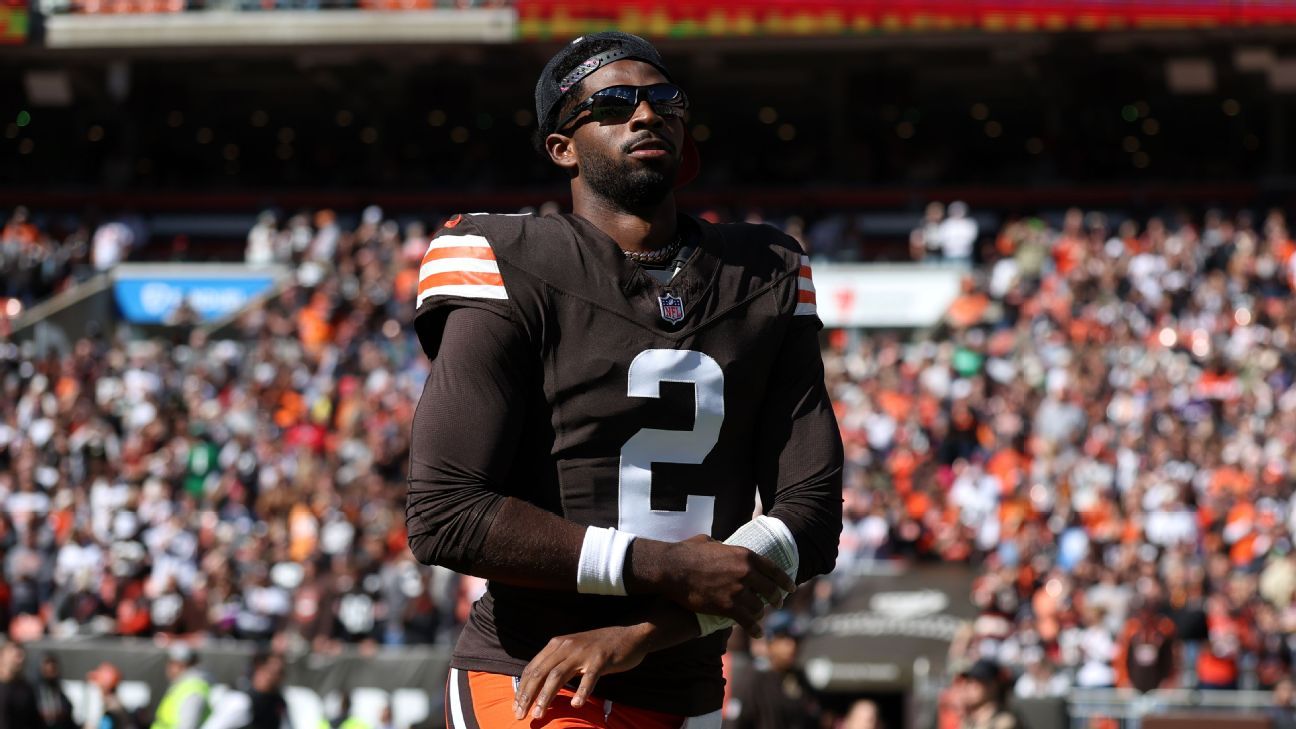
EmailPrintOpen Extended ReactionsBefore Cleveland Browns coach Todd Monken announced on Aug. 24 that he was naming Deshaun Watson the team's starting quarterback over Shedeur Sanders, he spoke with Sanders in his office about his forward-looking approach.Ten weeks later, Sanders is poised to make his first start of the 2026 NFL season Sunday at the New Orleans Saints (1 p.m. ET, CBS) as Watson remains sidelined in the NFL's concussion protocol."He's very diligent and he likes to play football, has a natural confidence about him," Monken said Friday. "Just like any young player, they've got to play. ... Where he's improved is his footwork, his drops, his mechanics, understanding where to go with the ball, sense of urgency in terms of working through his progressions, protections. There were so many things he needed to work on, and he's done that like any young player. Any young player has a lot to work on, especially at the quarterback position."And you can see that from the moment we got here and that's why we opened up the competition and we split the reps was because of his ascent."Sanders' first start of the season comes at a critical time. The Browns are 5-3 after a Week 8 road loss to the Pittsburgh Steelers that knocked Cleveland out of first place in the AFC North. ESPN Analytics gives the Browns a 16.5% chance of making the playoffs. A win against the Saints would increase their odds to 25.4% ahead of four straight home games.Sanders made seven starts as a rookie last season and went 3-4 in those games, but he posted a 19.0 Total QBR, the fifth-lowest mark among 696 quarterbacks with at least 200 pass attempts in a season in the QBR era (since 2006). He has spent the first eight weeks of the regular season as the backup, getting minimal practice reps, but he has familiarity with the starting offense after splitting reps with Watson in the quarterback competition during training camp."I'm just excited to see him go play and hopefully let it rip, which I think he'll do," Browns offensive coordinator Travis Switzer said this week. "He did it [Wednesday] in practice. Go lead, be in command, which I think he's grown tremendously in that area, really since we got here."And I think Monk[en] mentioned this the other day, but when you're going through training camp, and we were splitting, and really all the spring, we were splitting a lot of those reps as we were going through all the installs, and we were able to see him in a lot more reps than probably a typical backup would be, because obviously we were finding out who our quarterback was going to be. So, hopefully he can review back to some of those things if it were to be him, and yeah, let it rip. Play with confidence."Coaches and teammates have praised Sanders' growth in recent months. In New Orleans, he will get the opportunity to display that progression and lead a struggling offense that ranks 29th in points per game (17.4).Here are the three ways Shedeur Sanders can showcase his progress:Playing within structureThe tendency for Sanders to hold on to the ball has been a talking point since his time at Colorado. Sanders has acknowledged he tends to hold the ball in efforts to make a big play -- sometimes to his own detriment. As a rookie, Sanders averaged 3.24 seconds to throw, the slowest among 38 quarterbacks who made at least six starts in 2025.In August, Monken highlighted Sanders' growth in striking a balance between playing within structure and also making plays by holding on to the ball."Being able to check the ball down and get it out of his hands; he's such a playmaker that that's hard for him," Monken said. "For a guy that is always looking to make a play, super competitive, that is a win. Trying to get super competitive quarterbacks to understand that throwing the ball away and eliminating lost yardage plays is a win."In 25 dropbacks across two games in the preseason, Sanders had an average time to throw of 3.10 seconds, according to NFL Next Gen Stats. The Browns have the fifth-most yards after catch in the NFL (1,019) this season.Getting the ball to pass catchers in the flow of the offense plays a big role in that. It also helps to prevent sacks. Watson has taken the most sacks in the league (33), in part because he has held the ball for too long at times.Taking care of the ballSanders threw 10 interceptions from Weeks 11 to 18 last season, which led all quarterbacks in the league during that time frame. Not every pick was the result of a bad decision or throw; some were caused by dropped passes or batted balls.But at times, Sanders played a risky brand of football that lent itself to turnovers. He had four dropped interceptions from Weeks 11 to 18, twice as many as the next-closest quarterback during that same time span, according to ESPN Research, and tied for the most by any player all of last season.This season, Watson has only thrown three interceptions, but he has seven fumbles, which leads all quarterbacks, and has lost three fumbles.Pre-snap operationA major point of emphasis for Monken during the quarterback competition was the pre-snap operation. Monken heaps plenty of responsibility on his QBs to get the offense in and out of the huddle properly, make the correct adjustments at the line of scrimmage, use cadence correctly and limit pre-snap penalties.The latter has been an issue for Cleveland through eight games. According to ESPN Research, the Browns have five delay of game penalties, tied for the fifth most in the league, as well as five illegal formation penalties, which are tied for the fourth most. Not all of those infractions fall on the quarterback, but it is largely their responsibility to take control of the pre-snap operation and "eliminate anxiety," in the words of Monken.When asked to assess Sanders' brief three plays against Pittsburgh while Watson was checked for a concussion, Monken alluded to "a couple plays he could have helped us out with a check" but added that it was unfair to grade Sanders with such limited practice reps.A raucous environment at the Caesars Superdome will provide a tough test for Sanders, but coaches have said they don't anticipate needing to adjust the game plan or pre-snap operation with Sanders under center."The more anxiety that we can relieve pre-snap, which usually comes down to the play clock, just having as much time as possible before the play clock to allow us to operate and relieve that anxiety, I think that's going to be huge," Switzer said."As far as the snap count goes, when we're in the gun we'll be in silent [count], and we've been in silent every road game this year. So that part I don't think is really a whole lot different, but certainly just trying to put a premium, like we always do, but especially this week with them being indoors and it being a loud place, we talk about the four twos. Our pre-snap, in and out of the huddle. Shortening calls as a staff as much as we possibly can."Monk[en] will talk about getting the play in as fast as possible, which he always tries to do. All those things are certainly at a premium when you play at a place like that," Switzer said.