
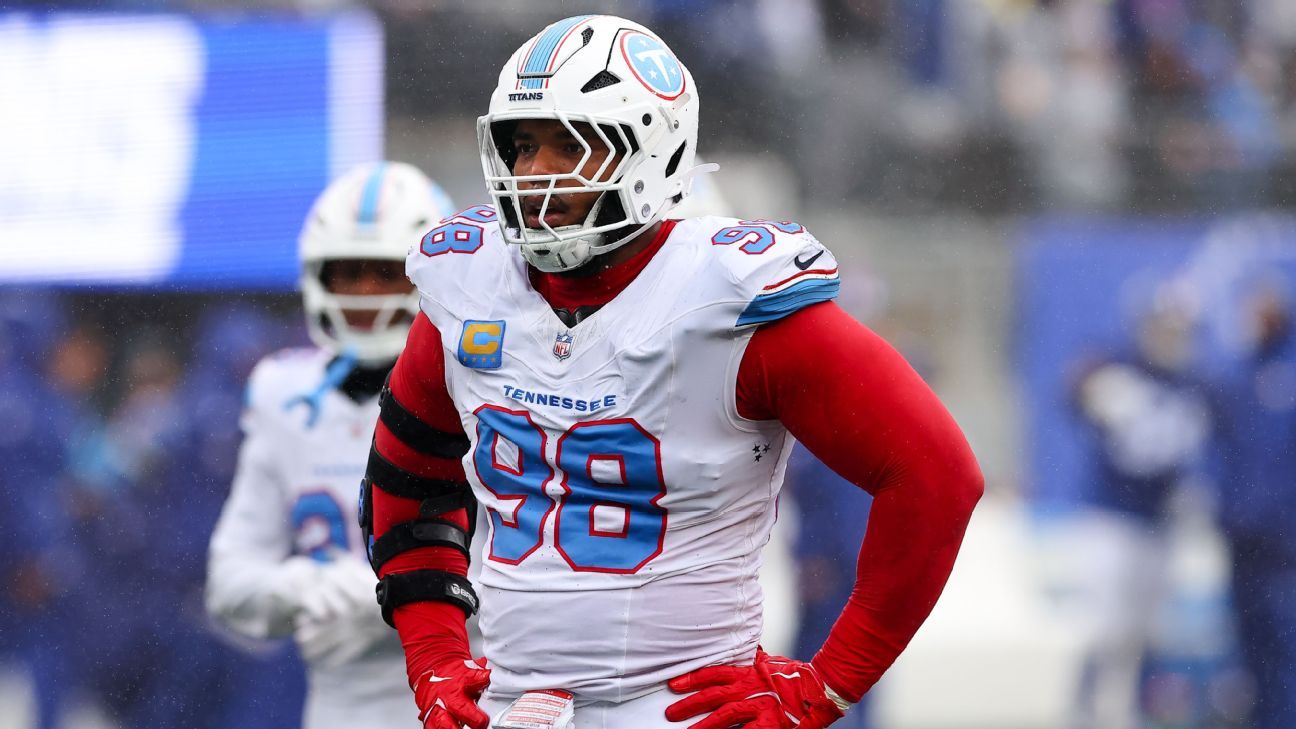
EmailPrintOpen Extended ReactionsOn the day an NFL team trades two first-round picks for a superstar player, there is only one winner. Fans are thrilled. Most (but not all) NFL observers are excited. Getting a sure thing at a position of need for some unsure, abstract things that aren't even due until the future feels great. It should!The Bears trading two first-round picks for Jeffery Simmons makes a lot of sense. Chicago has a great offense and a defense that could use some help. Simmons is a true shop-wrecker, the sort of pass-protection magnet that coordinator Dennis Allen and the Bears didn't have and had sought for years. There's no question that the 2026 Bears are better with him in the lineup.In the big picture? The hit rate on these deals in the modern era isn't great. Success isn't a binary thing, but there's more risk in these deals than it might seem at first glance. The sure thing isn't always a sure thing. Those picks that feel guaranteed to land in the bottom-half of the first round don't always fall there. And the significant investment a team makes in one star limits what it can do elsewhere, which often creates hidden restrictions as it tries to build a successful roster in the years to come.That shouldn't preclude the Bears from making a move for a star player, but it should inform how confident we should be that the deal will end up working out. Simmons was the highlight for anybody who was willing to put on Titans tape over the past couple of years, but he wasn't able to single-handedly elevate a defense that ranked 31st in DVOA before the trade. Can he be enough of a difference-maker for the Bears to justify this sort of trade?Subscribe: 'The Bill Barnwell Show'And likewise for the Titans, this is an acknowledgment that they're not close to winning with Simmons in the fold, but does this haul transform their team? Is there any reason to believe that they can take advantage of this sort of trade to find the next Simmons in the draft? Does this deal portend that they're about to restart their rebuild?Let's take a balanced perspective on this deal. Does this shift the balance of power in the NFC toward Chicago? Was it already there? Will we look back at this move as the one that pushed the Bears into the Super Bowl? It's entirely possible. We might also see it as the latest in a series of overly-aggressive in-season trades from Chicago general manager Ryan Poles that didn't land the difference-maker he wanted. But let's go through history to get some perspective.Jump to:Have similar trades worked?Will the Simmons trade work?The (modern) history of the two-first-round-pick tradeThe Bears, of course, were the ones who kicked this all off. When the league moved to its current slotted draft structure in the summer of 2011 and drastically increased the value of first-round picks, we saw teams really hoard Day 1 selections. Teams used first-rounders to move up and down the board for rookies during the draft, of course, but there were only a handful of deals where a team traded even one first-round pick for a veteran player -- and they were almost all disasters.No, really. The Raiders traded one for Carson Palmer, who was there for 25 games. Darrelle Revis lasted one season with the Bucs. Percy Harvin caught 23 passes for the Seahawks (although he did return a kickoff for a touchdown in the Super Bowl while Seattle was already up by multiple scores). Trent Richardson lasted two seasons with the Colts. Sam Bradford started 17 games for the Vikings. Jimmy Graham tore his patellar tendon and wasn't as impactful with the Seahawks as he had been with the Saints, who landed a more impactful veteran in Max Unger on the other side of the deal. Brandin Cooks was dealt away after one season with the Patriots and then spent two years with the Rams before being shipped off for second- and fourth-round picks. Those trades were all messes.That didn't stop the Bears from making a massive trade just before the start of the 2018 season. Hoping to land Vic Fangio a franchise defender, general manager Ryan Pace authorized a massive outlay for a superstar in the prime of his career. The Bears sent a package of picks highlighted by their first-round selections in 2019 and 2020 to the Raiders for Khalil Mack. That's kicked off a flood of trades with teams sending multiple first-rounders (or the draft capital equivalent) for franchise players.How have those moves worked out? Let's run deal by deal to see. Keep in mind, though, that evaluating these trades isn't as simple as looking at the players each team landed. There's an enormous cash difference between the two sides, with the team adding the star both paying a top-level talent and foregoing the ability to add cost-controlled talent around that player in the draft. The team getting the picks doesn't get a sure thing, but given how much less those picks cost over the next four years of their pro careers, the hit rate doesn't have to be quite as high. Those teams also get extra money to spend elsewhere on their roster in free agency.And from each team's perspective, once the trade is done, what the other team's players do doesn't matter. The Titans obviously want these picks to land as high as possible, but if they land a franchise quarterback with one of these selections, they won't care what the Bears do. If Simmons struggles in Chicago, it won't suddenly be a good trade for the Bears if the players the Titans draft with the picks bust, too. And we obviously don't know who the Bears would have picked (or what other veterans they could have used the picks to acquire) if they hadn't made the deal.We have to evaluate these trades from each side relative to what their expectations should be at the time of the deal. In this case, we're evaluating from the perspective of the team that shelled out the draft capital to land the superstar. I'll mention the players, though, and I'll try to plausibly guess where the team getting the draft picks might have invested their savings in free agency.Khalil Mack to the Bears (2018)Bears got: Mack, second-round pick, conditional late-round pickRaiders got: Two first-round picks, third-round pick, sixth-round pickBears picks became: TE Cole Kmet, OL Arlington HambrightRaiders picks became: RB Josh Jacobs, CB Damon Arnette, WR Bryan EdwardsSurplus Raiders cash became: OT Trent BrownWhy the deal should have worked: Mack was the sort of superstar that doesn't come available in free agency. A 27-year-old edge rusher who hadn't missed a game as a pro, Mack had been a first-team All-Pro twice and won Defensive Player of the Year two years before the trade. He was coming due for a new contract, and new Raiders coach Jon Gruden didn't think Mack was worth the largest deal in football for a non-quarterback, a contract Mack quickly landed as part of the trade with Chicago.Why it shouldn't have worked: The Bears weren't the sort of team that could feel confident that they were a superstar edge rusher away from being Super Bowl contenders. They were coming off a 5-11 season and had just hired Matt Nagy as their new coach. They were excited about Mitchell Trubisky, of course, but the QB had spent most of his rookie season on offensive training wheels. Pace couldn't count on those picks landing in the bottom half of the first round.Did it work? In Year 1, yes. Mack's best game with the Bears was his first, as he absolutely terrorized Aaron Rodgers and the Packers on national television, forcing a fumble and producing a pick-six. The Bears blew a late lead in that game, and Mack missed three matchups over the rest of the season, but his 12.5 sacks were good enough to earn him another first-team All-Pro nod and finish second in the Defensive Player of the Year balloting. At 12-4 and with Mack leading one of the best defenses in the league, it felt like an easy victory.Things sort of steadily declined from there. Mack lasted three more seasons in Chicago and battled injuries, including a foot injury that cost him 10 games in 2021. He was a good player but didn't make it back over 10 sacks or earn a first-team All-Pro nod. The Bears eventually sent him to the Chargers for a second-round pick, which became safety Jaquan Brisker.It would be tough to say that Mack lived up to the expectations Bears fans had when they initially made the trade (and especially after what they saw from him in his Bears debut). Those missing draft picks made it harder to build an offense around or replace Trubisky, who ended up not being the long-term solution in Chicago. The Raiders didn't do much with the picks and cash they saved beyond adding a useful running back in Jacobs, which has more to do with Gruden's talent evaluation than where the picks landed. Overall, this leans closer to disappointing than successful.Jalen Ramsey to the Rams (2019)Rams got: RamseyJaguars got: Two first-round picks, fourth-round pickJaguars picks became: Edge K'Lavon Chaisson, RB Travis Etienne Jr., LB Jordan Smith (via trade)Surplus Jaguars cash became: LB Joe SchobertWhy the deal should have worked: Like Mack, Ramsey was a young superstar entering his prime seasons. At 25, Ramsey had already been a first-team All-Pro on a great Jaguars defense. And in a similar vein to the situation the Bears are currently in with Ben Johnson and Caleb Williams, the Rams felt great about their offense, which was led by a brilliant young head coach in Sean McVay and a very good quarterback on a rookie deal in Jared Goff.Why it shouldn't have worked: Ramsey was a very good player, but cornerback isn't necessarily a premium position in terms of scarcity. It's easier to find cornerbacks than it is to find players at wide receiver, left tackle and edge rusher, which is why those players cost more to retain and acquire when they do hit the open market. The Rams had already struck out with their prior move at cornerback when they traded second- and fourth-round picks to the Chiefs for Marcus Peters. And given that Ramsey had publicly forced his way out of Jacksonville, it was fair to wonder if things would end poorly in Los Angeles.Did it work? This is the sort of scenario every fan hopes to see when their team trades a haul of draft picks. The Rams were good for most of Ramsey's time in Los Angeles, so the picks ended up being relatively late in the first round, even if the Rams surprisingly missed the postseason in Ramsey's first year with the team. The Jaguars didn't land much with their selections and used the cash they saved on Schobert, who lasted one year in Jacksonville.And Ramsey was excellent after settling in with the Rams, earning back-to-back first-team All-Pro nods in 2020 and 2021 while helping lead the team to a Super Bowl victory the latter year. His tenure in Los Angeles lasted only 3.5 years, as the Rams dealt him to the Dolphins after the 2022 season for a third-round pick and tight end Hunter Long, but the Rams got what they wanted from this deal. It's an easy victory.Laremy Tunsil to the Texans (2019)Texans got: Tunsil, WR Kenny Stills, fourth-round pick, sixth-round pickDolphins got: CB Johnson Bademosi, T Julien Davenport, two first-round picks, second-round pickTexans picks became: OT Charlie Heck, QB Ryan Finley (both partially via trades)Dolphins picks became: CB Noah Igbinoghene, G Solomon Kindley, WR Jaylen Waddle, WR Tyreek Hill, LB Channing Tindall, Edge Bradley Chubb, S Jevon Holland (several via trades)Surplus Dolphins cash became: Used to pay Hill's new contractWhy the deal should have worked: The Texans found themselves in a very similar situation to the one the Bears are in right now. Bill O'Brien had found his quarterback of the future in Deshaun Watson, who had led the Texans to the playoffs while making a Pro Bowl during his second season in the league. Heading into Year 3, O'Brien had struck out in attempts to find a left tackle for his star quarterback and wanted to get the sure thing.Tunsil, like Mack, might have seemed like the sort of opportunity that wouldn't come around any other way. Tunsil wasn't as accomplished as Mack, but 25-year-old left tackles with Pro Bowl upside are rare. The Texans were getting the prime of Tunsil's career, although they would have to pay him a significant contract along the way. And with Watson in the fold, O'Brien figured, the Texans would be sending two late first-rounders to the Dolphins for the privilege of acquiring Tunsil. Why it shouldn't have worked: Watson was coming off a promising second season, but the Texans were paying a massive premium to acquire a left tackle who hadn't even made a Pro Bowl through three years. They also had no leverage in negotiating a new deal with Tunsil, who used that to eventually join the Bag Hall of Fame at the negotiating table. Watson's injury history also made it possible that the Texans could send better picks than they might have expected.Did it work? Tunsil generally held up his end of the bargain, making five Pro Bowls in his six years with the Texans. Representing himself, Tunsil badly out-negotiated O'Brien on his first deal, which helped create an excellent second and third contract before the Texans dealt him to the Commanders, where Tunsil negotiated a player-friendly fourth deal. Maybe he should be a GM.The circumstances that justified the trade, though, ended up disintegrating quickly. The Texans made it back to the playoffs in Tunsil's first season with the team and beat the Bills. Up 24-0 on the Chiefs at Arrowhead, they proceeded to allow 41 consecutive points. They started 0-4 the following year before O'Brien was fired from his dual role as head coach and personnel executive. And Watson requested a trade after the season, which we'll get to in a minute.The Dolphins ended up landing the third overall pick in the 2021 draft from the Texans as part of this deal, which they then sent to the 49ers for three first-round picks. The Tunsil trade ended up scattering superstars around the NFL, as the picks involved in the Tunsil trade and the subsequent deals that followed ended up including the selections that were used on Jordan Love, Micah Parsons, Waddle and others. But it's very clear that the Dolphins were able to use the Tunsil trade to build up the core of their next good football team.This was a disaster for Houston, although that had nothing to do with the player they acquired.Jamal Adams to the Seahawks (2020)Seahawks got: Adams, fourth-round pickJets got: S Bradley McDougald, two first-round picks, third-round pickSeahawks pick became: S Coby BryantJets picks became: G Alijah Vera-Tucker (via trade), WR Garrett WilsonSurplus Jets cash became: Edge Carl LawsonWhy the deal should have worked: Adams didn't play a premium position, but the 25-year-old safety looked like a special player. The Seahawks were acquiring a first-team All-Pro who had racked up 6.5 sacks and 10 tackles for loss over the prior season with the Jets. Adams was seen as less of a safety and more of a hybrid disruptor, something that excited Seahawks coach Pete Carroll, who saw him as a difference-maker in the middle of the field.Besides, how much would the Seahawks really miss the picks? With Russell Wilson in the fold, the Seahawks were perennially picking in the bottom half of the first round, where GM John Schneider would perpetually either pick a disappointing player or trade down for more selections. Adams was better than any player the Seahawks were likely to pick with their first-rounders, even if he required a record-setting contract for his position.Why it shouldn't have worked: Adams was stretched in coverage in a division where Kyle Shanahan and Sean McVay loved picking on defenders who were limited as cover defenders over the middle of the field. There wasn't really a track record of defensive backs racking up sacks the way Adams did before his arrival in Seattle. And frankly, it was unclear whether any safety was worth this sort of draft haul or capable of moving the needle the way the Seahawks needed to compete for a title.Did it work? No. Adams actually managed 9.5 sacks in his debut season with the Seahawks and was a second-team All-Pro, but he was a liability in coverage. Injuries prevented him from playing a full season in Seattle, as he missed 33 of 67 possible games over four years with the Seahawks. Ironically enough, the fourth-round pick the Seahawks landed in the deal ended up producing a better safety in Bryant.And when Wilson got hurt in 2021, the Seahawks fell to 7-10, handing the 10th overall pick in the 2022 draft to the Jets, who used it on Garrett Wilson. The Jets used the other first-rounder as most of the draft capital to trade up for Vera-Tucker, with the Vikings using the pick they left behind for a franchise left tackle in Christian Darrisaw. This was a devastating trade for the Seahawks, but Schneider redeemed himself with his next big deal (Russell Wilson to the Broncos, which we will hit in a moment) and the draft picks that followed.Matthew Stafford to the Rams (2021)Rams got: StaffordLions got: QB Jared Goff, two first-round picks, third-round pickLions picks became: DB Ifeatu Melifonwu, WR Jameson Williams, RB Jahmyr Gibbs, TE Sam LaPorta (via trades)Surplus Lions cash became: Used to pay GoffWhy the deal should have worked: The Rams had clearly fallen out of love with Goff by the end of the 2020 season, with McVay clearly concerned that his now-expensive quarterback was unable to create out of structure. Targeting Stafford, who had toiled on frustrating Lions teams for over a decade, was an all-in swing from a team that had gotten close to a Super Bowl without ever landing their goal.Why it shouldn't have worked: Stafford was entering his age-33 season and had taken plenty of hits over his career. He'd missed eight games two years earlier with a fractured tailbone. And while Stafford had a strong arm and consistently moved the ball during his time with the Lions, he was never regarded as one of the best quarterbacks in football with Detroit. Moving on from Goff was one thing, but the Rams were risking two first-round picks for what might not be much of an upgrade.Did it work? Stafford led the Rams to a Super Bowl in his first season and won an MVP award in his fifth year with the team. That's all you can ask for with this sort of trade. Of course, the Lions did just fine, too. Goff re-emerged as a useful starter, and when the Rams dealt with an injury-riddled 2022 season, they ended up sending the sixth-overall pick to the Lions, who turned that into Gibbs and LaPorta. A win-win!Russell Wilson to the Broncos (2022)Broncos got: Wilson, fourth-round pickSeahawks got: QB Drew Lock, TE Noah Fant, DL Shelby Harris, two first-round picks, two second-round picks, fifth-round pickBroncos pick became: DT Eyioma UwazurikeSeahawks picks became: OT Charles Cross, Edge Boye Mafe, CB Devon Witherspoon, Edge Derick Hall, LB Tyreke Smith, WR Dareke YoungSurplus Seahawks cash became: Edge Dre'Mont Jones, QB Geno Smith, S Julian LoveWhy the deal should have worked: The Broncos had wandered in the wilderness for years after the retirement of Peyton Manning, cycling through the likes of Trevor Siemian, Case Keenum, Paxton Lynch, Joe Flacco, Teddy Bridgewater, Lock and others at quarterback without landing a solution.Wilson was about to play his age-34 season, but the nine-time Pro Bowler had consistently been both healthy and effective for the vast majority of his NFL career. He had missed three games in 2021 with a finger issue, and the Seahawks had posted a losing record with him under center for the first time as a pro, but Wilson was excellent down the stretch, posting a 104.7 passer rating across his final seven starts. Wilson was obviously closer to the end of his career than the other players who had been traded for two first-round picks, but it seemed reasonable to think that the Broncos were trading for a quarterback with a high floor over the next several seasons.Why it shouldn't have worked: The Broncos were coming off a 7-10 season, so while they might have felt like Wilson's acquisition came close to guaranteeing success, could they really feel confident that they were going to be sending late first-rounders to the Seahawks? Quarterbacks always command a premium, but Wilson was well on the wrong side of 30 and played with a style that might not age well.Did it work? Well, you don't need much from me here. Wilson cratered after arriving in Denver and was never the same player the Broncos hoped to add. The Seahawks kept the picks and turned them into cornerstone pieces of a team that won the Super Bowl.Deshaun Watson to the Browns (2022)Browns got: Watson, sixth-round pickTexans got: Three first-round picks, third-round pick, two fourth-round picksBrowns pick became: WR Jerry Jeudy (partial trade compensation)Texans picks became: G Kenyon Green, WR John Metchie III, LB Christian Harris, RB Dameon Pierce, Edge Will Anderson Jr., WR Tank Dell, CB Kamari Lassiter, WR Stefon DiggsSurplus Texans cash became: Diggs, Edge Danielle Hunter, LB Azeez Al-ShaairWhy the deal should have worked: The Browns had finally made it to the playoffs in 2020, going 11-5 with Baker Mayfield at quarterback. Mayfield played through an injury in 2021 and struggled, leading the Browns to wonder if they wanted to commit a significant second contract to their 2018 first-round pick. Having acquired so much draft capital in prior years via the team's decision to tank and focus on acquiring draft picks, the Browns were already stocked with young, cost-controlled talent on both sides of the ball.Watson was seen as a major on-field upgrade. While he had sat out the entire 2021 season while hoping to be traded, Watson's last season with the Texans saw the quarterback throw for a league-high 4,823 yards and 33 touchdowns. Having made three straight Pro Bowls and yet to turn 27, Watson looked like the sort of franchise-altering player that never comes available via trade. The Browns were willing to turn a blind eye to the dozens of allegations of sexual misconduct pending against Watson to outbid several other teams for the quarterback, handing him a massive fully-guaranteed contract in the process.Why it shouldn't have worked: In addition to the moral concerns of trading for a player in Watson's situation, the spread, RPO-heavy style of play Watson leaned on in Houston wasn't a great fit for the under-center, play-action attack Kevin Stefanski preferred with Cleveland. The Browns were coming off a disappointing season and really hadn't been all that good during the playoff year. And while Watson had been fantastic on the field during his last season with the Texans, the fact that Houston went 4-12 that season was a reminder that even great play from Watson wasn't enough to guarantee success.Did it work? Even with Watson vaguely approximating below-average starter play this season with the Browns, this is arguably the worst trade in NFL history. Let alone Mayfield, the Browns would have been better off sticking with you or me under center, given that we would have played for much less money and wouldn't have cost multiple first-round picks. The selections were traded all over the place, but the Texans used this trade to slingshot their way back into contention, building a dominant defense in the process.Micah Parsons to the Packers (2025)Packers got: ParsonsCowboys got: DT Kenny Clark, two first-round picksCowboys picks became: Edge Malachi Lawrence, CB Devin Moore, DT LT Overton, 2027 first-round pick TBDSurplus Cowboys cash became: Used to pay DT Quinnen Williams (acquired via separate trade), S Jalen ThompsonWhy the deal should have worked: Parsons had almost as good of a rsum through four years as any other player in NFL history, making it to four straight Pro Bowls and winning two first-team All-Pro nods. He had racked up 52.5 sacks over his first four years in the league. At 26, he was entering or already in the prime of his career. And given how aggressively the Packers had been at building a young roster under Brian Gutekunst, Parsons was already surrounded by plenty of cost-controlled talent. This was the big swing after all of the singles and doubles Gutekunst had hit in the draft.Why it shouldn't have worked: I couldn't fault the Packers for taking a big swing, but between the surplus value of the lost draft capital and a record-setting deal for Parsons, Green Bay was going to be paying more than $65 million per year for Parsons, which was essentially quarterback money. With Jordan Love already on a significant deal and Gutekunst leaning into free agency to shore up parts of the roster, things could get thin quickly if Parsons wasn't available.Did it work? Still to be determined, but we've seen both sides of the coin here. Parsons was generally brilliant when available for the Packers, racking up 12.5 sacks and 27 knockdowns in 14 games in 2025. But he also tore his ACL late in the season, and without their star defender, the Packers collapsed, losing their final five games. Parsons is yet to return from the injury, although that should come in the next few weeks.We've also seen the impact of paying Parsons. The Packers let go of veterans like Elgton Jenkins, Rashan Gary and Dontayvion Wicks this offseason, and they're far thinner throughout the roster than they have been in years past. The offensive line is a real liability, with Gutekunst being forced to sign veterans out of sheer desperation after injuries hit the Packers early in the season. The defense has also been surprisingly effective without Parsons in the fold.Sauce Gardner to the Colts (2025)Colts got: GardnerJets got: WR Adonai Mitchell, two first-round picksJets picks became: TE Kenyon Sadiq, 2027 first-round pick TBDSurplus Jets cash became: Edge Joseph Ossai, LB Demario DavisWhy the deal should have worked: Gardner wasn't playing his best ball at the time of the deal, but he was still only 24, already signed to a reasonable extension and had been arguably the best cornerback in football over the first two years of his career. A Colts team that was 7-2 seemed likely to make the playoffs, and Gardner addressed one of its biggest positions of need, both then and in the years to come.Why it shouldn't have worked: That 7-2 record was built on a brilliant half-season by Daniel Jones, who had no track record of playing at an MVP level as a pro. Trading two first-round picks took away potential draft capital that the Colts could use for a quarterback, essentially locking them into Jones, a pending free agent at the time, as their quarterback of the near-future. And Gardner hadn't really been playing all that well since Robert Saleh's firing in New York, with his propensity for missed tackles creating frustration for Jets fans.Did it work? Even before the Jets make their final first-round pick, we can say this one was a fiasco. Jones tore his Achilles shortly after the trade, and the Colts went from competing for the top seed in the AFC to missing the playoffs entirely. Gardner also missed significant time with a calf injury that has come back to linger in 2026. When on the field, he has been a liability for the Colts; it's telling that Commanders third-string quarterback Athan Kaliakmanis was repeatedly going after Gardner with deep shots to try to move the ball in London earlier this season.Gardner has a big contract, and that's without considering the value of the picks the Colts sent to New York. With Indy shedding veteran talent and launching into a rebuild after the firing of general manager Chris Ballard, it's exceedingly likely the Jets will land a top-10 and even a potential top-five pick from the Gardner trade. Sadiq, an interesting tight end prospect who flashed earlier this year, only helps matters.Simmons makes it 10 trades involving two first-round picks for veteran players since the Mack deal in 2018. The hit rate is ... not great? It has been good for the Rams, who have two clear success stories in Ramsey and Stafford. But Adams, Gardner, Wilson and Watson were all disastrous trades. Mack didn't sustain his prior level of play in Chicago. Tunsil was very good, but the circumstances that made the trade logical for the Texans didn't hold up. The result of the Parsons deal is still unclear.I'd argue that the teams making these trades have gone two for eight (the Parsons deal is still TBD). You would hope to have more success when trading for what feels like a sure thing in adding a star veteran to your roster. And outside of the quarterbacks, these players were either entering or in their prime of their careers. Simmons is a great player, but he turns 30 next season. This would have been a massive overpay on its face as recently as two years ago.There are four other moves that might qualify as recent honorable mentions that directly relate to the Simmons trade. They weren't for two first-round picks, and they're realistically too early to evaluate, but these deals directly informed how much the Bears had to pay for Simmons:Quinnen Williams was dealt to the Cowboys last year for first- and second-round picks, with the Jets retaining language that would give them the better of Dallas' two first-round picks in the 2027 draft. Like Simmons, Williams was a great player stuck on a bad team who hadn't been able to singlehandedly rouse their defense to competence. Williams has been good to very good during his time in Dallas, but after a brief run against subpar offenses after his arrival, the Cowboys have continued to be a liability on defense. Between Parsons' departure and Williams' arrival, the Cowboys ranked 31st in points allowed per possession and EPA per play. In 15 games after trading for Williams (and making significant other investments on defense), the Cowboys rank ... 31st in points allowed per possession and EPA per play. I don't blame that on Williams, but he hasn't been able to fix what's wrong in Big D.Maxx Crosby was briefly dealt to the Ravens for two first-round picks, only for the trade to be annulled after Crosby failed his physical. Crosby plays on the edge as opposed to defensive tackle, but as a star defensive lineman entering his age-29 season, it was reasonable to imagine that the Titans used this as a reasonable comparison in the Simmons negotiations.Dexter Lawrence II was dealt from the Giants to the Bengals for the 10th overall pick. While that's only one first-rounder, the fact that the Giants already knew it was going to be such a high selection makes it more valuable than your typical first-round pick. It's not wild to think that a team might trade the 10th pick for two future first-rounders under the right circumstances. Lawrence also turns 29 this year, and while the Bengals' run defense has struggled after a hot start, he has been great for a 4-2 Bengals team, racking up four sacks in his first six games.Myles Garrett was dealt for a massive package, including first-, second- and third-round picks, as well as a talented young edge rusher in Jared Verse, all of which adds up to more than two first-round picks of trade value. But he went on injured reserve after one game, so it's obviously too early to gauge what he has done there. With all due respect to Simmons, Garrett is the best defensive player of the past decade; even given that he's two years older than Simmons, it's no surprise that Garrett would cost more via trade. We'll see how that works out for the Browns and Rams in the years to come.Given the hit rates on these trades and Simmons' age as a player approaching 30, my inclination is to believe that this was an overpay by the Bears. It's unlikely to be a disaster, and Simmons is a phenomenal player, but he has played one complete season in eight years as a pro. Are there reasons to think that he could exceed my expectations? Of course. Let's run through five arguments for why it might work.How can Simmons be worth two first-round picks?1. The Bears have a cheap, young offense right now and can afford to fit Simmons in their lineup. Of the arguments I'm about to lay out, I think this is the best one. The Bears certainly spend a lot of money in certain places on their roster, and they've invested a lot of cash to build a very good offensive line, but this is the least-expensive passing game in the league.Williams is on a rookie deal. So are Luther Burden III, Colston Loveland, Rome Odunze, Kyle Monangai and Ozzy Trapilo, who has just returned from his torn patellar tendon at left tackle. Even after this trade, the Bears 23rd in cash spending, although that's going to jump next season, especially if we assume Williams gets a massive extension.Cap space isn't really a big concern at the moment given how aggressively the league's limits are rising on an annual basis. And while the Bears are nearly $42 million over the projected cap next season, we already know they're going to be making moves. Poles will likely move on from Dayo Odeyingbo and Grady Jarrett up front, which would free up nearly $28 million in cash and cap space. Restructures for the likes of Joe Thuney and Jonah Jackson would create room. Simmons feels like an expensive addition now, but he'll be the cash replacement for players the Bears were already going to be cutting after the year up front.Naturally, acquiring Simmons comes with an opportunity cost. The Bears won't be able to put the money they would have freed up by releasing Jarrett and Odeyingbo elsewhere, and they'll have to find ways to fill the holes on the roster that would have otherwise been occupied by those two first-round picks. But if they were going to acquire Simmons, doing so while Williams is still making peanuts is the right time to get him.2. Simmons' deal won't be that expensive because the Titans already paid part of the deal. On paper, this is also true. The Titans just signed Simmons to a three-year, $105.9 million extension this offseason, paying him $25 million in the process. In doing so, they indirectly and eventually bought themselves extra draft capital, given that they were likely able to command more from the Bears by virtue of having paid some of Simmons' deal up front.The Bears will pay Simmons just under $8 million for the rest of 2026. His deal already guarantees $27 million in 2027 and has practical guarantees for $29.8 million in 2028 and an additional $10 million of the $28 million he's owed in 2029. Leaving aside 2026, the Bears are essentially on the hook for a two-year, $56.8 million deal, or a three-year, $84.8 million contract.That's a meaningful discount on what Simmons would command on a new deal. Jalen Carter's new contract is worth $38 million per year, while Quinnen Williams' extension with the Cowboys was for $35.3 million per season. If the Bears are getting the Simmons we expect, they're paying about $28 million per year for a player who might get a deal closer to $38 million per season.Of course, Chicago also had to pay to acquire Simmons, and those picks have their own value. If we take a conservative approach and assume the Bears hand the 24th pick to the Titans in each of the next two drafts while the Titans send an early fifth-rounder back to the Bears in 2028, we can estimate what those picks might be worth. Using Ben Baldwin's draft chart and Spotrac's 2027 estimated cap figure, we can say that the difference between the picks the Bears are sending and the one they receive is worth about $21.9 million per season for each of the four years on those rookies' respective contracts.That puts Simmons at somewhere around $50 million per year, which is where Will Anderson Jr. landed on his extension with the Texans that made him the highest-paid non-QB in football. (If we include surplus cost, as I mentioned earlier, Parsons would be closer to $60 million per year). It would also make Simmons the highest-paid defensive tackle in the league by a considerable margin. Can Simmons be worth that figure? Never say never, but he'll have to be the best defensive tackle in the league for 17 games year after year to come close to justifying that pricetag. It's a lot to ask.3. The Bears can make this move because they can be all-in in 2026 given the quality of their offense. I'm certainly not doubting that the Bears are great on offense. Caleb Williams currently leads all quarterbacks with a 79.6 Total QBR, placing him narrowly ahead of Brock Purdy. With Williams on the field this season, the Bears have averaged 0.1 EPA per play, which would be the fifth-best mark in the league. And even with Case Keenum and Tyson Bagent on the field for nearly half the season, the Bears on the whole rank 12th in that same metric through seven games.Here's my question, though. Why are the Bears going all-in now? Williams is 24. He shouldn't be going anywhere for a long time. Ben Johnson is 40 and one of the most valuable coaches in football. The young core on offense will get more expensive, but the Bears should have a great unit for years to come. As Joe Burrow said last season, "The [championship] window is my whole career." Are the Bears, who are in a dogfight in the NFC North and sixth in Super Bowl odds heading into the day, per ESPN's Football Power Index, really better positioned to compete now than they will be in a few years?I can see the argument that Williams' relatively cheap contract allows the Bears to build a better team now, but there's a major difference between spending more while you have a quarterback on a rookie deal and using draft picks to acquire expensive talent in the same situation. And that's even more significant when you consider that Williams is likely to become the highest-paid player in NFL history next offseason, with a deal that could be in the ballpark of $70 million per season.When you do pay a quarterback, hitting on those draft picks and using them to find cheaper starting-caliber talent around that passer becomes more essential. There's a reason why Russell Wilson, for example, made it to the Super Bowl twice on his rookie deal with Seattle and never really came close to making it back. The same is true, so far, for Burrow. The only second-contract quarterbacks to win a Super Bowl in the post-2011 CBA era are Patrick Mahomes (whose Chiefs never made this sort of all-in move and even traded away key players like Tyreek Hill along the way) and Jalen Hurts (whose general manager stockpiled draft capital as opposed to dealing it away, with the A.J. Brown trade coming during a year where Howie Roseman already started with multiple first-round picks).This move increases the Bears chances of winning a Super Bowl in 2026, which is fine. It just also decreases their chances of winning a Super Bowl in the years to come. And if anything, given his growth as a quarterback under Johnson, Williams projects to be better over the next five years than he is right now.4. The Bears desperately needed a dominant pass rusher. I've argued for the past few years that Poles needed a difference-maker up front. The move to acquire Montez Sweat landed the Bears a good two-way edge rusher but not the sort of player opposing offensive coordinators would be nervous about stopping on every single snap. It also came with a premium contract that paid Sweat like a legit No. 1 edge rusher, which he hasn't been during his time in Chicago.Poles has gone into free agency for players like Jarrett and Odeyingbo (who is again on injured reserve after tearing his Achilles last season) without much luck. He also made a misstep in trading away Gervon Dexter Sr. for a fifth-round pick and cornerback Clark Phillips III, who has played 27 defensive snaps, before the season. Dexter has been productive and earned a new contract with the Falcons. He would have been a good value for the Bears as a rotational tackle at $1.6 million.Simmons can be that player on the interior. His 26.6% pass rush win rate leads all defensive tackles in 2026. When lined up as a defensive tackle, Simmons' 25 pressures is tied for the most in football, while his seven quick pressures are tied for fifth. Dexter, for what it's worth, has 23 pressures on 24 fewer pass-rush opportunities than Simmons, so their pressure rate and quick pressure rates on a per-opportunity basis are almost identical.It's just tougher for anyone short of a generationally-athletic defensive tackle to create the sort of production we associate with dominant edge rushers. Last year was Simmons' most productive pass-rushing season by a considerable margin, and he produced 11 sacks and 21 knockdowns across 15 games. That's a down season for someone like Parsons. Simmons is a good run defender, and he'll create more opportunities for other rushers with his gravity, but I still think the Bears are facing a world where they could stand to add another edge rusher. Simmons will occasionally line up outside, but it's not where he's best.And frankly, if they were going to make a major trade for a star, you could argue that left tackle or cornerback might have been bigger needs. The Bears have been able to piece together a solid pass rush this season, as they rank third in sack rate and 11th in pressure rate. Dennis Allen has blitzed at the fourth-highest rate this season, and the addition of Simmons will alleviate some of the pressure on the secondary by allowing Allen to blitz less often and drop seven into coverage. But there are still real holes on both sides of the ball and questions about how they'll be filled, both now and in the years to come without those first-round picks.5. Simmons is going to play at this level for years to come. I'd be nervous here. Again, Simmons has not been able to stay on the field for full seasons. While he has missed only 11 games during his career, we don't typically see players who struggle to play out 17-game seasons in their 20s start doing so in their 30s.I'd argue that Simmons has been an underrated player for a while, and he was the best defensive tackle in football to my eyes a year ago. But 2025 is a clear outlier relative to the rest of his career, both in terms of pass-rush production and postseason honors.Simmons had averaged just over six sacks per 17 games before his 11-sack performance in 2025. He had been a second-team All-Pro twice and received a total of 14 first-team All-Pro votes (out of 350 potential votes) as a pro before earning his first-team All-Pro nod a year ago. The Bears are valuing Simmons as the best defensive tackle in football over the next three years by making this trade. He hasn't really been that caliber of player for very long as a pro, even if I think he's there now.And of course, even great defensive tackles can't necessarily count on playing at a high level into their mid-30s. Aaron Donald wasn't as productive after he won Defensive Player of the Year as a 29-year-old, although he was obviously still impactful. Chris Jones has slowed down in his early-30s. Very good tackles like Fletcher Cox and Ndamukong Suh retreated a bit as they hit 30, while injuries shortened the careers of players like Gerald McCoy and Kawann Short. Cameron Heyward might be the exception to the rule here, but counting on any defensive tackle to be as good at 31 and 32 as they were at 27 and 28 is typically a bad bet to make.Like anything, price matters. If the Bears had paid a premium to sign Simmons in free agency, this would be a great bet to make. If they were giving up a lone first-round pick, it would be an aggressive move, but it would be a pretty reasonable bet. By giving up two first-round picks, though, the Bears are basically betting that they're going to the Super Bowl this year and acquiring a superstar who won't dip beyond truly elite-level play in the years to come. That's typically too much to ask.