
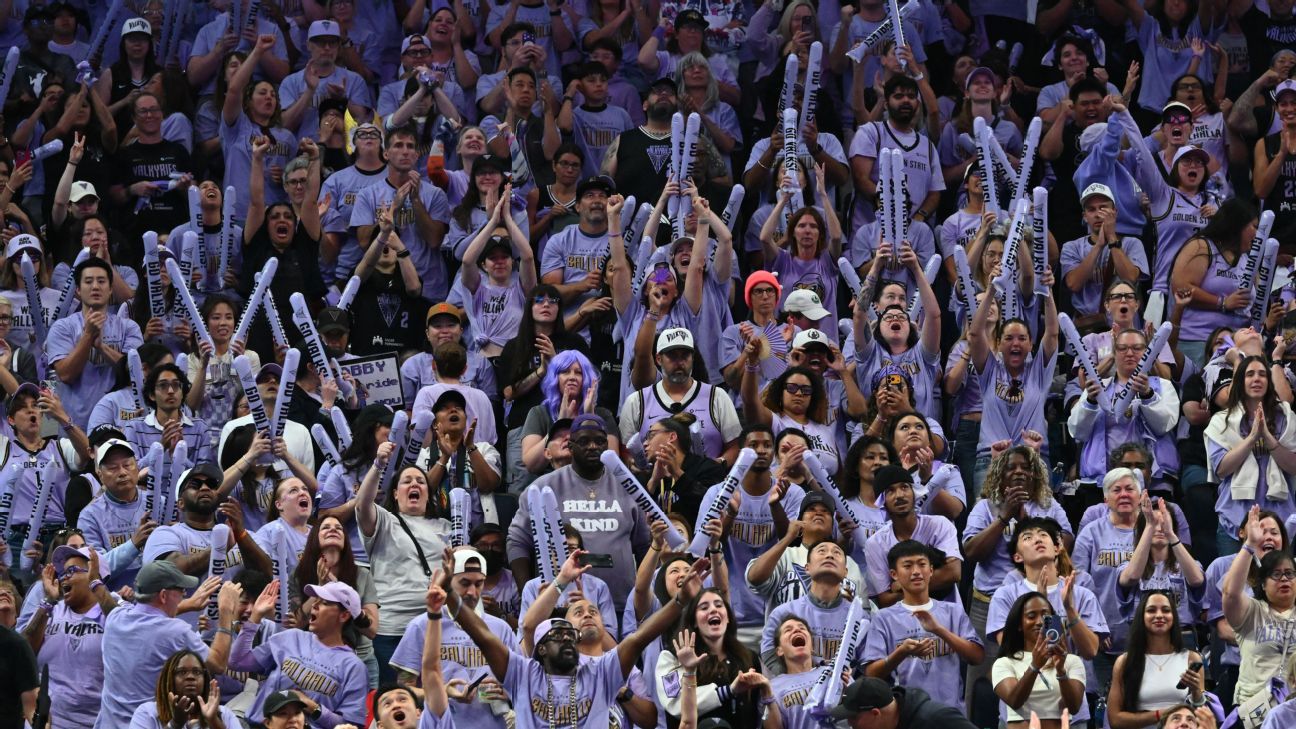
EmailPrintOpen Extended ReactionsSAN FRANCISCO -- Things happen inside Ballhalla -- the moniker given to the Chase Center for Golden State Valkyries games -- that don't happen anywhere else.The song "Blow the Whistle" seems to be the unofficial theme song inside the building, playing before games, during them and at almost at any moment. During one break in play during Game 2 of the WNBA Finals, the most famous line from the song comes over the speakers. "What's my favorite word?!" recording artist Too Short, an Oakland native, asks. In unison, it feels like the entire sellout crowd of more than 18,000 responds with his Bay Area drawl: Bi-ah-tch!Even Too Short chuckles at the development."The best part is how generational it is," Too Short told ESPN. "That the senior citizens, the moms and dads, and the kids, everybody knows it. I laugh at the kids who know they got a pass. This one time, this one time you're not going to get in trouble if you say Too Short's favorite word. I've seen it ... the parents: 'You can say it, you can say it, you can say it.'"It's a Too Short song that is family friendly -- in quotation marks."Ballhalla -- so named as a play on Valhalla, in Norse mythology the resting place for great warriors who died in battle -- has become famous for having the most raucous environment in the league -- and during two WNBA Finals games so far, it has lived up to that reputation. It has sold out for every home game in the franchise's existence, and the Valkyries became the first team in WNBA history to average an attendance of over 18,000 per game.And as the Valkyries return home to San Francisco for Game 5 of the WNBA Finals with the series against the Atlanta Dream tied 2-2, they know their fans will show up big again. During Games 1 and 2, fans were already on their feet during pregame warmups, erupting every time a close-up of a player was shown on the big screen. (There's a particular obsession with 2025 third-round pick Kaitlyn Chen, who receives the loudest roar of any player any time she takes a shot or is shown on the screen.)"I did feel a different roar," coach Natalie Nakase said after Game 1. "I was excited. They were really screaming when they got announced."Peer pressure, typically frowned upon in the real world, is happily accepted in Ballhalla. Violet T-shirts were placed on every seat before Finals games for fans to put on when they arrived. If they didn't -- beware. There was a point during both home Finals games when cameras scanned the crowd, and any fans not wearing the T-shirt could wind up being shown on the videoboard and playfully berated by the in-arena host. Even if fans were already wearing a Valkyries jersey or some other piece of team merch, the host and other fans demanded they put the T-shirt on. The shaming was real.The noise is also real.It's like a constant roll of thunder that starts even before player introductions and rarely takes a lull, even when the team is struggling. The league put together a video post of decibel measurements during Game 1: A Gabby Williams corner 3-pointer reached 114.5 dBA. A Chen triple hit 114.7. The game-sealing free throws from Williams got to 112.1 on the meter.According to decibel scales, a measurement of 100.0 is comparable to a motorcycle, a subway train or a helicopter. A measurement of 110.0 compares to a chainsaw, industrial noise or a rock band. The National Institute on Deafness and Other Communication Disorders states that long or repeated exposure to sounds at or above 85 dBA can cause hearing loss.The only time Ballhalla quiets down is when the Valkyries are shooting free throws, and then the arena becomes so eerily quiet that you can hear the footsteps of people walking around. Even after a Game 2 loss, fans stood and cheered until the entire team had left the court."Probably the best basketball game I've ever been to, honestly," San Francisco 49ers wide receiver Mike Evans recently told reporters. "I've been to the Finals games. ... Went to a lot of games, playoff games, and it's hard to beat that atmosphere last night. I knew it was going to be lit, I knew it was going to be a great environment, but I didn't know it was going to be the best I've ever been to."Team president Jess Smith was the organization's first employee, tasked with creating the brand, hiring the rest of the staff and essentially building the entire organization from scratch. She had basically one edict from fans: They just wanted it to be cool."One of the main groups of folks that have come out and supported this team are women's sports fans, and they have been underserved for a really long time," Smith said, "They are watching everything on TV. They are buying the merchandise they have access to, or they're supporting the players. Every single thing that they do, they're hyperaware of what that means, and yet, there hasn't necessarily been a property that's matched that energy."I think so often, as folks were building in women's sports, there was often kind of this lens of like, 'OK, how do we make this something that doesn't fail?' But, in turn, what it was doing, it wasn't making it big and bold enough to draw people into the capacity that they wanted to invest."In San Francisco, they wanted to go big. That included high-end amenities. VIP clubs with sushi and champagne. One of the best dance teams in the league -- the Violet Vibes. A sassy mascot named Violet. A hype squad labeled The Flock.But a unique, high-quality experience is a common goal for sports organizations across the world, let alone in the WNBA. So what makes Ballhalla different?"She is relentless in how she's wanted to create this one inclusive organization," Valkyries general manager Ohemaa Nyanin said of Smith. "It is a Golden State ethos, but she embodies it on a day-to-day basis."The success of Smith's plan in San Francisco seems driven by the perfect combination of several factors. The Bay Area is a market that has genuine interest in women's sports. The locale has an affluent, diverse and technology-driven community. The WNBA is currently at the height of its popularity. And the organization actively incorporates the community into everything it does. Music by Too Short and other local artists is played regularly. Bay Area rappers LaRussell and Larry June performed at halftime of the first two Finals games. Before the fourth quarter, there's an activation to "Get Hyphy," an Oakland term for getting hype. Partnerships include companies that invest in women's sports. The Valkyries house a full-time store for team merchandise at time when league merch has sometimes been difficult to purchase.Smith and the Valkyries have another advantage that many other organizations don't: Their ownership group also owns the Golden State Warriors, a franchise that has won four NBA titles since 2015 and has developed one of the strongest brands in the NBA. That connection brought to the Valkyries institutional knowledge, resources and trial-and-error experience. The Warriors' history also informed a willingness to invest in a robust staff in a way not all other organizations are willing, or capable, of doing."This region is very special in the world's landscape," Smith said. "One, it's where people look to see what comes next, whether it's how you treat people or what innovations are going to come next. But when you're here, what you realize is that that's just part of the culture of ethos of belief, and we don't wait for something to be proven. We want to prove it to the world."I think when we came out and did the right things, when it was building the brand, letting people know what this would mean, signaling to them that we were going to set a standard together for the future of women's sports and what that meant here, and what that means for the future investment, of course, this region was all-in."Players throughout the league appreciate what has been built. The noise is loud and constant, but in a good way. Lately the league has dealt with the issue of fans who cross the line from good-natured opposition to hateful and, at times, racial aggression. That hasn't been the experience inside Ballhalla."Even though they're against you, they're still respectful," Dream guard Allisha Gray said. "That's what I like about Ballhalla. ... When they go on a run, it does get really, really loud in there."Valkyries guard Tiffany Hayes added, "The way that they support is not any negativity. They don't have to talk bad about other players. They don't have to talk bad about fans that come in from out of town to show support for their team. ... That's why our crowd is unique."Too Short hasn't missed a single playoff game this season. Before Game 2 of the Finals, he stood on the court as a giant drum with the letters GSV printed on it was wheeled out. Wearing a Valkyries jersey, he took the oversized drumstick and banged as the crowd chanted "G-S-V! G-S-V!"From the entertainment to the building to the fanbase, the Bay Area represents in Ballhalla."I'm from here, man, and we just really have that pride," Too Short said. "So the fans, in return, they take to it and they have the same pride. ... It really is like a family."