
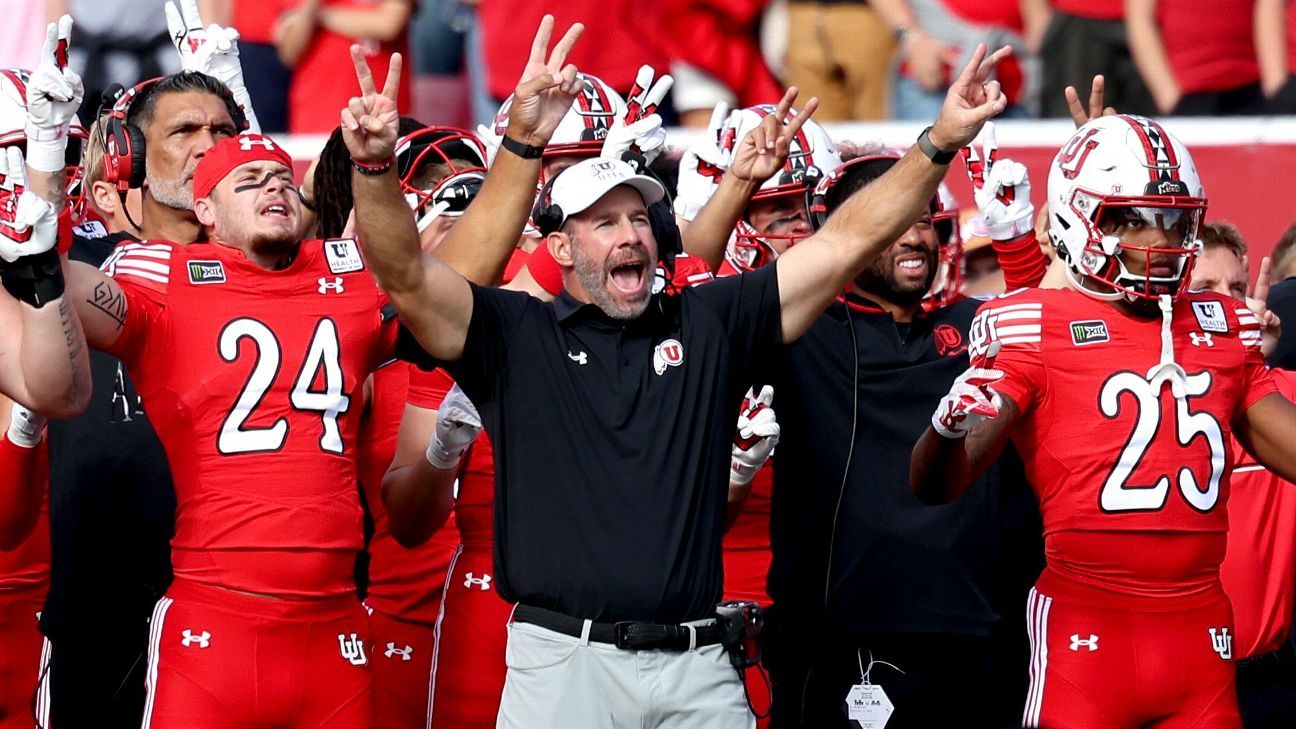
EmailPrintOpen Extended ReactionsSALT LAKE CITY -- Every Monday during the University of Utah's team meetings, there's a new wrinkle to the Utes' film sessions.The Utah staff shows "Culture Clips" from the previous game. The staff doesn't showcase circus catches or bone-crushing sacks, but rather the types of plays that offer a window into why No. 10 Utah has emerged as a prime College Football Playoff contender in Morgan Scalley's first year as head coach.In a win over Kansas earlier this month, Scalley highlighted the giddiness of three key rotation wide receivers -- Larry Simmons, Kyri Shoels and Creed Whittemore -- celebrating wildly on the sideline when fellow receiver Ricky Johnson secured a 2-yard touchdown grab.When defensive end Ethan Day holds the edge that sets up a Rabbit Evans sack against Arkansas, Day gets shouted out. When all five offensive linemen converge to pick up star quarterback Devon Dampier? That's one of Scalley's favorite scenes."I wish I had a still shot of it, just a picture of those guys pulling up the quarterback," Scalley told ESPN in his office last week. "I'm just like, 'Dude, guys, this is it. This is team football. This is what wins championships.'"With Utah (6-0) undefeated and facing its first ranked opponent Saturday when No. 14 Houston visits (10:15 p.m. ET, ESPN), it offers an inflection point to highlight some culture clips from the rookie coach who typically chooses them.Scalley took over after Kyle Whittingham's 21-year tenure ended following the 2025 regular season and immediately evolved the program through a simple philosophical shift. Scalley took every aspect of the generally successful Utah program -- from schemes to operations to strength/nutrition -- and focused on improvement. That's a tall task for a program that won nearly 67% of its games under Whittingham, including a jump from the Mountain West to the Pac-12."He looked at everything," longtime Utah operations director Adam Frye said of Scalley, "and asked, 'Are there ways we can do it better?'"Under Scalley, Utah has become an incubator of offensive ingenuity, with a two-quarterback system devised by coordinator Kevin McGiven that has social media film junkies abuzz. The Utes have modernized training, which has exponentially cut down on games lost to injury by starters by 80% compared with last year and 95% from 2024, per data provided by Utah. Scalley believes togetherness is even more of a weapon in this transfer portal era, and he fosters that with his leadership North Star: "I believe love is stronger than fear."Scalley overhauled the practice playlist, veering distinctly from Whittingham's 1970s rock to more Outkast, Prince and Endor to bring energy to the players. "I dance every day," Scalley said.He rides around the office occasionally on a motorized scooter/suitcase, which he bought online after star quarterback Devon Dampier joked with him he'd never get one.For Scalley's 47th birthday earlier this month, support staffers made everyone on the football coaching staff wear purple party hats and sing to Scalley. Scalley is from Salt Lake City, starred on Urban Meyer's great Utah teams and has coached only at the school. Those in the program say he's emanating the joy of a coach living out his dream."The new kids on our team, they're like, 'You don't see head coaches doing stuff like that -- walking down the hall, singing, dancing, telling people how much they love them,'" defensive coordinator Colton Swan said while laughing.As the program has more reflected Scalley's personality, he has kept the same toughness and accountability that put Whittingham on a Hall of Fame trajectory."They also know that we can have fun, but it doesn't affect the grind," Scalley said. "The grind's the grind. When you're out there on the field, you are competing and working, and there's no wasted time."I'm about efficiency and our culture, but when it's time to have fun, we're going to have fun. Fun is winning and playing in January."Can a new twist on an old formula push Utah to the school's first CFP? A win Saturday would keep Scalley on his track to the ultimate fun -- meaningful January football.Utes' balance, depth and consistencyUtah has the country's No. 8 scoring offense, No. 11 scoring defense and a star quarterback in Dampier. Unblemished at the midway point of the season, the Utes have shown the balance, depth and consistency to last deep into the season regarding the CFP conversation.Scalley cautions that he needs to see his team play stiffer competition before making any grand proclamations about Utah's ceiling. After all, the Utes haven't faced an opponent with a winning record yet.But the program's evolution has been obvious. Utah's offense, which resembled a revolving door of coordinators in Whittingham's 21 years -- double digits over that time -- is considered one of the most innovative under McGiven, whom Scalley hired from Utah State.Swan, who was elevated to defensive coordinator and playcaller, has Utah playing its familiar brand of salty defense -- with a new flair that includes one of the country's most disruptive secondaries."I had really high expectations for what Morgan could do leading the program," Utah athletic director Mark Harlan said, "and it's been far better than anything I imagined."The improvement is linked to connection, as players say Scalley has shown he can lead with love."He knows every single one of us," veteran safety Nate Ritchie said. "He knows our birthday and names and cares about all of us. Asks us question about how he can improve. He's a service-led leader and asks, "How can I be better?'"Within the roster, there's a blend of old and new. Perhaps Utah's top NFL prospect is left tackle Zereoue Williams, a sixth-year senior in his first year as a full-time starter. Williams waited his turn behind the two Utah tackles who went in the first round last year -- Caleb Lomu and Spencer Fano.Williams, who is 6-foot-8 and 305 pounds, didn't start his first career game until the Las Vegas Bowl at the end of last year. He has surged up draft boards, as multiple NFL scouts have predicted he could be a Day 2 pick in the 2027 NFL draft.Along with a sturdy offensive line, Utah has a familiar dynamic run game. Dampier and fellow quarterback Byrd Ficklin pose threats, and Scalley calls star tailback Wayshawn Parker (11 TDs, 6.7 yards per carry) "one of the best running backs I've ever seen here." Scalley also says the receivers room, long a roster weak spot, is the "best we've ever had."Led by a ballhawk secondary that boasts 35 pass breakups and eight interceptions, Utah has thrived under Swan with all the same core beliefs that Scalley employed while building one of the country's most consistent defenses during his eight years as a coordinator.Part of the explanation for why Utah has thrived in this transition comes from the philosophies that Scalley fostered on defense. Things such as the acronym RSNB -- Relentless, Smart, Nasty and Ballhawks -- are now reverberating through the offense."He took what we were doing on the defensive side, which was so culture-driven, and turned it into a team-wide deal," Swan said. "I think the offensive side has really bought into it. Maybe just as much as the defense."Optimizing the offenseThere are two distinct pivot points in Scalley's effort to transform Utah's offense from two decades of general mediocrity to one of envious ingenuity. And, yes, more fun.The first came with the immediate and decisive hire of McGiven, who coached everywhere from Louisiana Tech to Oregon State before returning to his home area. It haunts Scalley that no Utah quarterback has been drafted since his former teammate, Alex Smith, after the 2004 season. And when former coordinator Jason Beck left for Michigan this past offseason, Scalley knew what he wanted in a replacement. He saw Beck revive the Utah offense after two years in the statistical gutter in 2023 and 2024, and Scalley wanted more creativity, explosion and focus on quarterback recruiting and development.The second key move came at quarterback, where Scalley made clear that success starts there with how roster-building finances are dedicated. Utah retained Dampier, who proved dynamic as the 2025 starter, and Ficklin, the backup who exuded raw talent and athleticism in his cameos as a true freshman.After Utah finished an average of No. 100 nationally in scoring offense in 2023 and 2024, Beck and Dampier started the overhaul by leading the Utes to a No. 4 offense (41.1 ppg) last year, averaging 18 more points per game than the previous two seasons. Utah went 11-2.That set the table for McGiven to take the next steps by deploying a philosophy based on relentless stress. The Utes constantly change formations to put defenses on their heels and feature pre-snap movement more than 75% of the time, according to McGiven."It was very clear and evident that outside of the culture and the way we play, that it didn't have to look like what Utah football is used to looking like," McGiven said. "And even going through the portal recruiting process and bringing in some wideouts and guys that you want to distribute the ball to in different ways, it became pretty evident that was going to be the approach."Ficklin is considered one of -- if not the -- highest paid backup quarterbacks in college football, as he's making seven figures. And McGiven and Scalley have made sure defenses are being taxed accordingly by using Ficklin in every game.Soon after arriving, Scalley gave McGiven some Louisiana-Monroe tape from 2012, when ULM famously featured one left-handed quarterback and one right-handed.McGiven loved the freedom to work on building something unique. Scalley wanted fun, innovation and something to stress defenses. Scalley's plan has been simple -- letting McGiven and quarterback coach Ryan Gunderson conjure their own magic with a righty (Dampier) and lefty (Ficklin) roaming the backfield.Scalley covets on offense what he views as the biggest pain to defend. He also didn't want to sacrifice any of the traditionally sound and structured tenets of Utah football.So, McGiven went into his lab.The result has been spectacular, as Utah has run 55 plays this season with Dampier and Ficklin on the field together. Sometimes, Ficklin is a decoy; sometimes, he takes a snap. He often lines up at receiver or tailback. There's always the threat of a trick play given that Ficklin is an elite thrower and brings slot-receiver-level dynamism to run or catch the ball downfield.Utah averages 7.9 yards per play with both on the field, up from 6.6 with just Dampier. It delights Scalley knowing opposing defensive coordinators sleep fitfully."This kid has a lot of God-gifted talents and a great skill set," Scalley said of Ficklin, "and [it's about] how can we incorporate that and lining him up in some different spots and then create the conflict that you have with two quarterbacks."The formation names are suitably fun -- "Bryd" for when he enters in 11 personnel, "Hawk" if he's playing the U-position (hybrid tight end) and "Talon" if he's in at running back. Utah is practically auditioning for Noah's Ark, as the Utes also can go super-sized and feature a Rhino package with extra tight ends. There's even a "Void" package, where no one lines up under center to start the play, and the defense has to guess which player -- Dampier, Ficklin or maybe the tailback Parker? -- will go in motion and take the snap.Scalley says there's nothing gimmicky or cute about the wrinkles. "We're actually just doing stuff that puts fear into defensive coordinators," he said.The creative packages are also a compliment to Dampier, one of the Big 12's best quarterbacks who welcomed Ficklin back and encouraged coaches to involve him more. The result has left everyone energized."The culture and the vibe [Scalley] has fostered here, I think it's created growth in all of us," McGiven said, "because of the creative freedom and the autonomy he gives us."Scalley's sports scienceOther than the offense, Utah's evolution under Scalley has been most distinct in the strength program. After Scalley's first spring, he made the difficult decision to move on from strength coach Greg Argust, whom he had elevated upon his hiring.Scalley then installed Steve Saunders in the role, a veteran NFL strength coach who has overhauled the rhythms and reasoning behind Utah's approach without losing its gritty edge.Saunders has emphasized sports science and position-specific training plans, working in concert with Utah sports scientist Anna Cruse. Scalley gave an example of Utah studying the physical output of defensive tackles."How many plays can a defensive tackle go before you see a drop-off in production?" Scalley asked. "And so we have this data on each of our defensive tackles, and some defensive tackles can go six plays in a row without significant drop-off."Some defensive tackles are going three, and then all of a sudden, BAM, significant drop-off. It's understanding, if I'm going to sub, when do I need to sub? Subbing for this dude is going to be a little bit different than subbing for this one."Scalley, Saunders and Cruse helped work up tailored workout sessions by position. If wide receivers and defensive backs are asked to do different things in games, why would they train the same way?"Why train aerobic when football's an anaerobic sport?" Scalley said. "It was about joint preservation and how I need you to become better football players, stronger football players -- not better weightlifters."The other big practice adjustment came amid the periods that featured heavy workloads for the players. They've separated those periods into different parts of practice to keep bodies fresher. As Scalley put it, "We're not just bang, bang, bang and all of a sudden, 'Oh, this guy is...' well, no kidding. We've been at it for 20 straight minutes."There's also data kept, so anytime players fail to hit 90% of their maximum velocity, they have a period when they sprint to reach that goal. All in the name of "soft tissue tear preservation," Scalley said.The results have manifested on the field and in the injury report. Per data provided by Utah, the Utes have played only two games without a starter all season: offensive lineman Keith Olson (undisclosed) against Idaho in the opener, and guard Kelvin Obot (ankle), who won't play against Houston on Saturday.In 2025, there were 25 cumulative games missed by Utah's starters. In 2024, there were 50."We are approaching everything with a different lens," Frye said. "Are there better ways to do it? If so, why aren't we trying to do it that way?"He said the coaching staff, support staff and Utah's players have a bigger voice and the autonomy to pitch ideas. "If people feel valued, they're invested. And the level of investment from everyone right now, it's just different. Not saying it wasn't there before, but it's just different. There's a different vibe behind it now."And six games in, that has made Scalley and Utah successful."It's been incredibly gratifying to watch Morgan do his thing," Harlan said. "He trained for years. Grew up here and starred here. That enthusiasm for Utah is so infectious."It's a jump in my step. It's a jump in everyone's step."Now, it's time for the competition to jump this weekend. But based on what Scalley has done so far, the foundation has been built one Culture Clip at a time.