
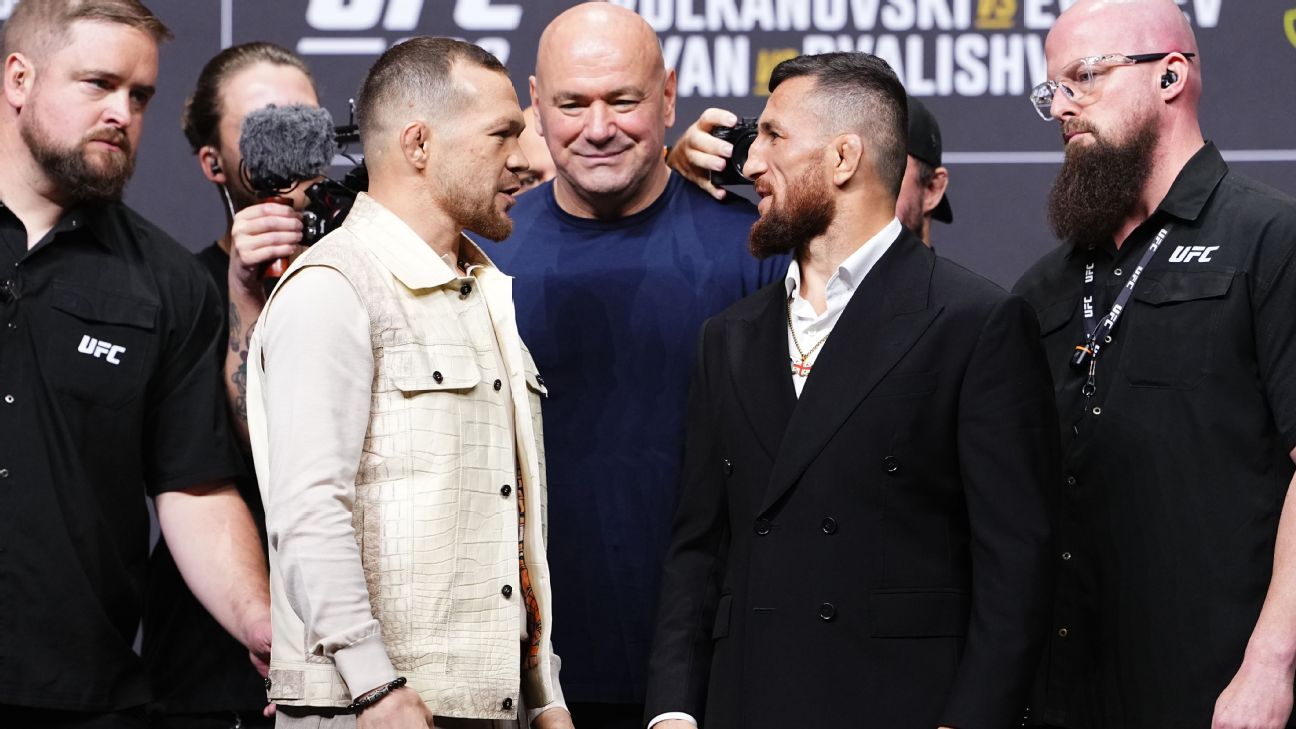
EmailPrintOpen Extended ReactionsLAS VEGAS -- The UFC Performance Institute is nearly empty as Merab Dvalishvili wraps up his final round of sparring on a Saturday afternoon. He has been going for hours, switching among three partners after each five-minute round. Except for Dvalishvili's team, the place is deserted -- not because it's a slow day, but because it's technically closed. UFC staff was meant to clean and lock the doors 30 minutes ago, but Dvalishvili's workout is running long (as they tend to do). At this moment, though, the session appears finished. Coaches have turned their backs to the cage, and teammates are packing up their bags.Then suddenly, a bell sounds and Dvalishvili walks out for another round of work. His seventh."I don't even know," says head coach, John Wood, when asked the maximum number of rounds he's ever witnessed Dvalishvili spar at once. "Just the other day he did 10, and I swear he could have done five more. We're not talking fluff rounds, either. We're talking 10 rounds, hard as f---."I really don't know who does that."It could be that no one else does that. It's fair to wonder whether sparring 10 rounds at a time -- impressive as it might be -- is even a good idea. Such is the predicament of Merab "The Machine" Dvalishvili.Dvalishvili pushed the limits of MMA history in 2025. He successfully defended the UFC's bantamweight championship three times in a span of 10 months, then attempted an unprecedented fourth title defense in a single calendar year in December. Dvalishvili ultimately fell short, losing his belt to Petr Yan in a five-round decision at UFC 323. Dvalishvili (21-5) will seek to recapture the belt when he faces Yan (20-5) for a third time Saturday at UFC 333 in Abu Dhabi, UAE.No UFC fighter has ever defended a title four times in a year, and none had even tried before Dvalishvili -- for good reason. To even attempt it, Dvalishvili had to walk a fine line between ambitious and foolish. He cut weight twice in 63 days for the December fight and concealed a significant knee injury from members of his team after UFC physicians told him he should consider withdrawing from the bout."Everything went bad," Dvalishvili admitted to ESPN. "I had the worst game plan, worst camp, worst training of any championship fight. But it's no excuse. I have no excuses. Yan beat me. I thought I could win and I took the fight, no regrets."Dvalishvili's seemingly limitless capacity for work, pain and adversity has defined his career and endeared him to UFC fans. But that relentless drive can at times make the incredibly difficult sport of MMA even more challenging.Dvalishvili's longtime training partner, former UFC bantamweight champion Aljamain Sterling, told ESPN he admires Dvalishvili's pursuit of history last year -- but he never thought it was a sound idea."I knew we were in trouble coming out of the gate," Sterling said. "I didn't have a good feeling about it. I honestly wasn't even as involved in that fourth camp, because I didn't think we were taking the fight. I had scheduled a few other commitments because I thought we were done for the year."You try to be as positive as you can be, but you're also like, 'I don't want to see my friend get hurt because we jumped into something we shouldn't have jumped into.'" Of course, it's impossible to determine beforehand how much is too much for someone such as Dvalishvili.Wood, who has been in Dvalishvili's corner for more than five years, was certain it was too much in January 2025, when Dvalishvili was set to fight then 18-0 fighter Umar Nurmagomedov at UFC 311. A deep cut on Dvalishvili's leg developed staph infection during training camp, leading to what Wood described as one of the most unhealthy fight preparations he has ever been involved in. But Dvalishvili still went out and defeated Nurmagomedov in a five-round performance that earned him a fight of the night bonus. Dvalishvili rallied in the championship rounds to claim a decision."That's the fight I actually considered pulling him out of," Wood said. "He was so damaged in multiple ways for that one, and then went out there and performed like he did. Once he did that, he convinced me to really never question him again. In my mind, I was like, 'Oh s---, this guy really can do anything. He really is just a machine.'"Dvalishvili's loss to Yan hasn't prompted a complete overhaul of the approach. He's still sparring 10 rounds in a single session, but it has refocused the camp in some ways.Dvalishvili has said he needed a better game plan going into that fight. Perhaps, he said, the team overlooked Yan while in the midst of a 14-fight win streak that spanned eight years and included a physically dominant unanimous decision victory over Yan in their first career meeting. Dvalishvili logged a UFC record 49 takedown attempts in that March 2023 win.The circumstances surrounding Dvalishvili and Yan's two fights combine for a complicated backdrop to the third meeting. They have spent 10 rounds together in the Octagon, but few conclusions can be drawn because of the opposite outcomes. After the first fight, both bantamweights said they competed through injuries, but Dvalishvili was the clear winner. Yan decisively won the second bout -- claiming four of five rounds on two judges' scorecards -- but Dvalishvili was presumably compromised. Ahead of the trilogy, Sterling said the team has worked on improving Dvalishvili's ground control, allowing him to use his notorious gas tank more efficiently."I don't feel like there was a lot of emphasis on that in his last few camps," Sterling said. "I think we've done a better job at tightening up his wrestling base. If he can do half of the things I do when it comes to controlling guys once he gets them to the floor, it's going to be scary, because then you've got that infinite amount of cardio on top of it. That's a dangerous combination."Yan, who spent the first half of this year recovering from back surgery, said tactics and mental preparation -- more than any physical improvements (or better health) -- will decide Saturday's contest.On that front, Yan considers he and his team to have a distinct edge. After the last fight, his coach, Kairat Nurmagambetov, unveiled a digital strategy tree he built that outlined a detailed plan for nearly every potential scenario Dvalishvili might try in the Octagon. In a recent interview, Yan revealed that Nurmagambetov has expanded the playbook for the trilogy fight."This fight will be decided by fight IQ, mental strength and which fighter makes better decisions," Yan told ESPN, through a translator. "The second fight, I beat him. In the third, I will do the same."It's a simple, interesting way to put it: Which fighter will make better decisions?For Dvalishvili, that's always a loaded question. His questionable decision-making has been well-documented over the years -- at times hilariously so and often in ways that seem specific to him. Is sparring 10 rounds a good decision? Is hiding an injury from your own team? Is jumping into a frozen lake head first, as Dvalishvili famously did in 2021?The answer for Dvalishvili might be relative when compared to other fighters. Dvalishvili's mindset about work and his willingness to fight injured are unlikely to change, but the loss to Yan did make him rethink certain strategies.Over the course of Dvalishvili's title reign, he shocked much of the MMA world by choosing to spar five rounds at full speed on the morning of his championship fights. He did so in December, before losing to Yan. When asked if he expects to continue that tradition, Dvalishvili admitted that is one specific quirk that is likely retired for good."I'm not going to spar this time," Dvalishvili said. "Especially against Petr Yan, I need all of my energy. When I did the five rounds before our last fight, that was probably a mistake. But I learned and now I will fix it. I felt good doing it, but I think there is a smarter way."