
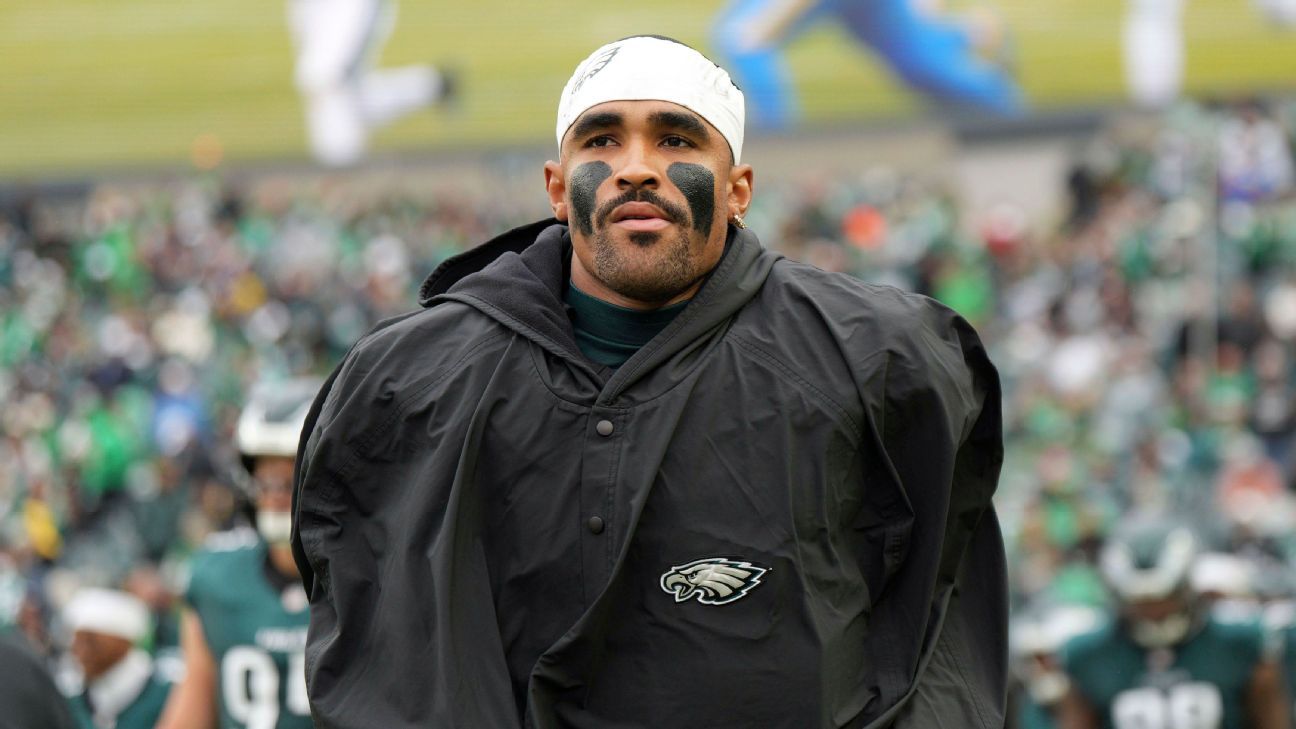
EmailPrintOpen Extended ReactionsPhiladelphia Eagles quarterback Jalen Hurts is expected to miss the rest of the season after doctors discovered multiple blood clots in his lungs, sources told NFL Network's Ian Rapoport and ESPN's Adam Schefter.Hurts will undergo treatment involving blood thinners that is expected to sideline him for at least three months, sources informed of the diagnosis told Rapoport and Schefter.Hurts' agent, Nicole Lynn, and the Eagles released a statement Monday detailing Hurts' condition. Lynn and the Eagles said Hurts has deep vein thrombosis and bilateral pulmonary emboli, meaning a blood clot traveled from his legs to his lungs.Hurts was originally diagnosed with having a superficial blood clot, according to a team statement released on October 15, which was discovered following an ultrasound in London before the Eagles' game against the Jacksonville Jaguars. It was deemed that mobility was important and Hurts could safely play in the game, per the statement. A follow-up ultrasound last Wednesday showed the blood clot had moved, the team said. Hurts was subsequently ruled out of Sunday's game against the Panthers and has since been put on injured reserve.ESPN spoke with Dr. Jordan K. Schaefer, associate professor of internal medicine at the University of Michigan specializing in disorders of hemostasis and thrombosis, for a better understanding of causes, treatments, and outlook for those with blood clots. Dr. Schaefer has not treated Hurts and is not involved with the Eagles.The conversation has been edited for brevity and clarity.Jalen Hurts is going to have to go on anticoagulants because he has deep vein thrombosis and bilateral pulmonary emboli. What should we know about that?About one out of four people presenting with a superficial vein thrombosis, which is a blood clot that is in the veins closer to the skin of the leg, will also have a deep vein thrombosis, which is in the deeper vein system.When we're initially evaluating a superficial vein thrombosis, we will often do an ultrasound to look at a few things with the superficial vein thrombosis. The things that we're really looking for is there a deep vein thrombosis at the time that you're diagnosing the superficial vein thrombosis? What is the size of the superficial vein thrombosis, and how close is that superficial vein clot to the deep vein system? And that kind of lets us know the risk of the superficial blood clot and how to approach the initial management. We'll also be talking to patients about symptoms that could suggest a pulmonary embolism, and a pulmonary embolism occurs when a blood clot travels through the bloodstream and into the pulmonary arteries of the of the lung. The reason we are cautious about superficial blood clots is they can extend into the deep vein system, where they're then at higher risk for traveling to the lungs and causing a potentially serious event of a pulmonary embolism. Deep vein thrombosis and pulmonary embolism are the feared things that can kind of go along with a superficial vein thrombosis in a small percentage of patients.The risk of developing a deep vein thrombosis or pulmonary embolism depends on that individual's characteristics of the superficial clot and the characteristics of that particular individual.Sometimes athletes may not be as symptomatic with a pulmonary embolism because they are so fit and healthy. They're kind of often a lower risk group because of their fitness.What is the timeline for anticoagulant treatment typically?The standard for patients with a deep vein thrombosis and pulmonary embolism is at least three months of anticoagulation, and then they are reassessed to determine the long-term plan.Contact sports are generally avoided [for patients on anticoagulants] due to the risk of bleeding.Based off the statement the team initially released, the doctors decided after the discovery of the superficial blood clot in London that activity was important and also that it was safe for him to play football. Do you usually recommend activity if superficial thrombosis is the diagnosis?A small, low-risk clot that's far from the deep vein system is often treated with warm compresses, elevation, sometimes compression stockings, and in kind of symptomatic treatment, sometimes like things like ibuprofen or nonsteroidal, what we call nonsteroidal anti-inflammatory drugs.If there's a higher-risk situation where we're more worried about the clot going into the deep vein system or traveling to the lungs and causing pulmonary embolism, instead of doing that conservative treatment, we would do anticoagulation treatment, which is commonly referred to as a blood thinner.Is movement recommended?It used to be that bed rest would be suggested for blood clots. However, immobility or not moving around is a known risk factor for blood clots, so there's been more of movement towards what we call early ambulation or early activity after a blood clot to kind of promote blood flow.There are reports that after initially being diagnosed with a superficial blood clot in London, Hurts was told not to sleep as a precaution. Is avoiding sleep is a necessary precaution in in these cases?Not commenting on this specific case, but recommendations to avoid sleep are not typical in the management of a superficial vein thrombosis. I can't comment on the specific case or the details surrounding that recommendation. However, a recommendation to avoid sleep is not a common recommendation for patients with superficial vein thrombosis alone. When I'm seeing a patient with superficial vein thrombosis, I typically don't make any specific recommendations regarding their sleep, I guess would be more appropriate.How about in terms of flying? I have heard flying can either create the blood clot or make it worse, is that accurate?Yes, long-distance travel is a known risk factor for blood clots.According to the team statement, the blood clot was initially discovered while overseas. What's typically your recommendation in terms of how to proceed with getting home?I think that's individualized to the individual patient. That depends on the characteristics of the blood clot, the patient, and then the treatment plan.Is there a rhyme or reason for why a superficial blood clot turns into deep vein thrombosis? The risk of superficial blood clot progressing to a deep vein thrombosis and/or a pulmonary embolism can vary depending on the risk factors of the individual, and especially the risk factors of the clot. So, how long the clot is and where it is anatomically, how close it is to the deep vein system. All of these superficial blood clots have some degree of risk of progressing to a deep vein thrombosis or pulmonary embolism, and that's why the follow up is so important to monitor people over time and assess for clots that start as superficial vein thrombosis and turn into a deep vein thrombosis and or pulmonary embolism.Understanding there are individualized cases, what is your recommendation generally in terms of playing a sport with a superficial blood clot?I think it depends on the individual. I think there's always risks and benefits to different choices. It's a combination of the individual patient's clotting risk, the characteristics of the blood clot, the type of sport that's being considered, and what the treatment plan is. If somebody's on anti-coagulant drug, though, there are certain sports that can't be safely performed due the bleeding risk of the of the sport.