
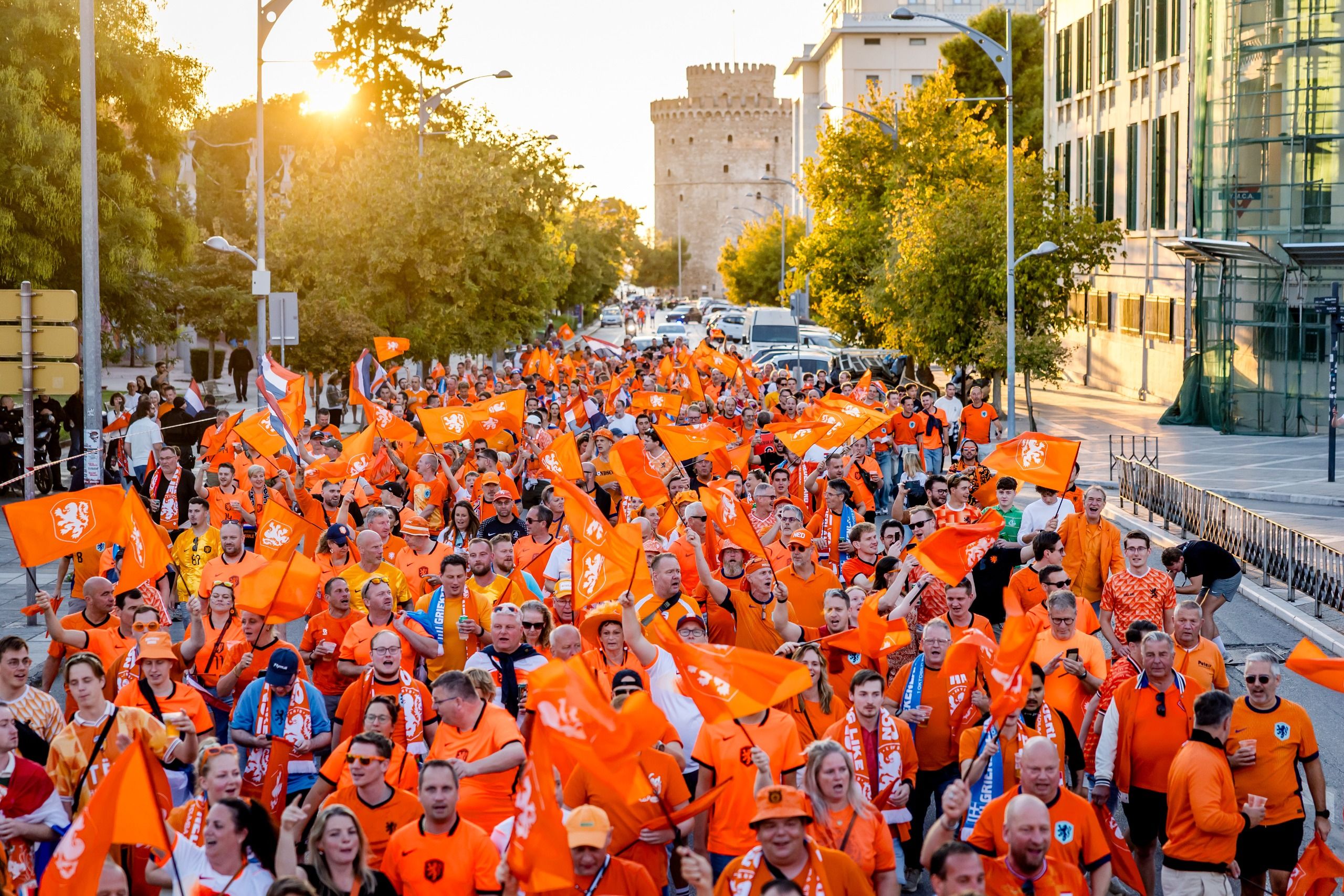
Copy linkFacebookXPinterestEmailShare this article 0Join the conversationFollow usAdd us as a preferred source on GoogleNewsletterSubscribe to our newsletterFollowing the Netherlands football team looks like a pretty fun undertaking, from the outside.Bright orange shirts, famous names., Van Basten volleys, Cruyff turns, Robben curlers and flying Van Persie headers. Then there's not really having to deal with the pressure of being a tournament favourite. Even the recent viral supporter dance, a sea of colour dotted by giant heads of legends past.But, scratch beneath that orange facade and there has been a tension at the heart of Dutch football for many years. And its not simply that a country famed for producing so many brilliant players still has only one international trophy to its name, something that induces national hysterics every two years in England. The conflict which frequently dominates debate about the Oranje, particularly when they are dumped out of a tournament, is about identity.A clash of ideasApart from Brazil, is there a country that has been associated with a specific style of play as much as the Dutch?When we think of the Netherlands, we conjure images and nostalgic appraisals of Total Football, in particular the magical Johan Cruyff team that under Rinus Michels reached the 1974 World Cup Final. Or the side of Ruud Gullit and Frank Rijkaard et al who won Euro 1988 with the same coach. They played in a fluid way that was focused on space, intelligence and individual improvisation, based on the concept that players should be able to have freedom to interchange positions within an existing structure. You may like Can I shock you? Roberto Martinez never underachieved with Belgiums golden generation Germanys Jurgen Klopp dream could be over before it begins but luckless Liverpool man will hope otherwise Virgil van Dijk lashes out at Dutch reporter amid suggestions he sabotaged Ronald Koeman So far, so good, right?Wrong. For many years theres been an alternative interpretation - stemming from the same school of thought - that the structure should actually enable collective, rather than individual, intelligence, where individual expression is somewhat curtailed at the altar of the greater good. Rather than thinking about where the space is and how to create an extra man for an overload, this philosophy is all about where everyone should be, keeping width, ensuring passing lanes are open and that space is being covered in case the ball is lost. The finest example would be Louis van Gaals Ajax side of the 1990s, as opposed to Cruyffs Barcelona - incidentally the two men who fell out at Ajax in 2011 when they were brought in to overhaul the club and return it to its famed Ajax way.Get FourFourTwo NewsletterThe best features, fun and footballing quizzes, straight to your inbox every week.Contact me with news and offers from other Future brandsReceive email from us on behalf of our trusted partners or sponsorsBy submitting your information you agree to the Terms & Conditions and Privacy Policy and are aged 16 or over.At times the latter approach has been effective - see Van Gaals run to the World Cup semi-finals in 2014. Yet, after the shock of failing to qualify for Euro 2016 and World Cup 2018, in the last four major tournaments the Dutch have played predominantly defensive formations with back fives and wing-backs.Rather than excitement, thrilling improvisation and creativity, its been more about structure and positioning. Control on steroids. The tipping point came last summer when Ronald Koeman, after finally discovering how to remove the handbrake, reverted to type as soon as a major opponent arrived in Morocco, playing Tottenham Hotspur centre-half Micky van de Ven as a left wing-back. Going back further, even memories of the brilliant 2010 World Cup run have been tainted by the negative Dutch tactics in the final against Spain and Mark van Bommels standout submission for the worst tackle never to receive a red card.It has hardly amounted to an homage to Cruyffian principles. What to read next How do Spain produce so many exceptional young players? FourFourTwo visited the Canary Islands to meet the country's wonderkids How to watch Netherlands vs Germany for FREE: TV info Jurgen Klopp weighs in on Virgil van Dijk war of words ahead of Nations League clash The Xavi curveball And it is this context that makes the arrival of Spain and Barcelona great Xavi Hernandez in September on a four-year contract one of the most intriguing international hires in years.On paper, combining arguably the finest ball-playing midfielder to have played the game in one of the sports greatest-ever sides, with a country historically associated with exciting front-foot, possession-based football is an ideal philosophical match.Yet following the initial surprise, questions about why the KNVB decided now was the time to bring in their first foreign coach since 1978 with no previous international experience quickly followed. Although prominent voices like Rafael van der Vaart were positive about such a big name appointment, others like Pierre van Hooijdonk were highly critical, questioning Xavis credentials and why a Dutch coach such as Peter Bosz at PSV Eindhoven or Erik ten Hag were not considered.It certainly wasn't helped by Technical Director Nigel de Jong admitting that Xavi was 3rd choice for the role, despite also espousing the links between his football education and how the KNVB wanted the national team to play.Has the KNVB finally seen the light and brought in someone with the understanding and experience to both live up to these stylistic demands and deliver a long-awaited trophy? Or, have they merely let themselves be swept up by a philosophical fealty that has acted as an unnecessary weight on Dutch football for 50 years?Cruyff, Van Gaal or a mix of the two?The fascinating feature of the Xavi appointment is that despite being Spanish - and even the winning captain in that 2010 final - he is in a sense a product of the Dutch game. A lot of his greatest football came under Pep Guardiola, who himself was influenced immensely by Cruyff as a player. Before Guardiola it was Frank Rijkaard. And the coach who gave him his Barcelona debut? One Louis van Gaal.After van Gaal and Koeman were accused of abandoning traditional Dutch footballing values, the expectation in the Netherlands is that Xavi - who won La Liga in his first season managing Barcelona - has been brought in not just to get the Oranje competing again but playing in an attractive style to boot. The comments at his unveiling about being influenced by Cruyff and Michels, and being a son of Dutch football, have hardly tempered potentially unrealistic expectations.However, those expecting a Spanish-style Cruyff tribute act will likely be left slightly disappointed. This is not due to Xavi ignoring those football principles but simply because his way of playing in theory connects the two contrasting styles that have been at loggerheads in the Dutch psyche for so long, combining the need to maximise space but also maintain structure.Quotes from the press conference before his opening match - a deserved draw against Germany - were telling: You need possession to win the matchbut you need the right positions. You need perception to see what is happening around you and understand the game.Likewise his comments after his first win away to Serbia combined demands for moving the ball faster and attacking spaces better with a need to make the pitch wider and press as an organised unit.The early evidenceIf the proof is meant to be in the pudding, then the early signs are relatively sweet for those hoping to see Xavis Netherlands do well - even if there was only one win in the first three matches.Across the games they average 22 shots per match and the larger share of possession in all three, accumulating a total of over 1,500 passes and an average Expected Goals (xG) total of 2.32. That suggests a team that doesn't just keep the ball for the sake of it but does so with real attacking purpose in mind.Interestingly, not only did they dominate Jurgen Klopps Germany in an attacking sense but they were superior defensively too, winning 50 duels to their opponents 30 and recovering the ball eight more times.Against Serbia, where they enjoyed two-thirds of possession, the Dutch won more duels, showing how hard Xavi wants his players to win the ball back - and quickly. Remind you of anyone?Going two goals down to Greece showed the defensive frailties that have been clear this international break, but the way they persisted meant the draw was the least that was deserved.The ease in which Xavi switched formations across the two fixtures, from playing with an orthodox No. 10 to then an emphasis on wide players in a 4-3-3, aligns with the coach's belief that his players are already comprehending how he wants them to play.The pool of evidence is a shallow one, but it also points to Xavi looking to give youth a chance. At Barcelona he didnt hesitate to drop old teammates Gerard Pique and Jordi Alba, whilst giving Lamine Yamal, Pau Cubarsi and Fermin Lopez their debuts. Even if Yamal is a generational talent, it still takes guts throwing a 15 year-old into the fray at one of the worlds biggest clubs. For the Oranje, players such as Memphis Depay and Wout Weghorst have already been cut, with the likes of exciting winger Ruben van Bommel and striker Mexx Meerdink being given a chance to stake their claims. The latter has certainly done that, notably impressing Xavi as much for his hard work and understanding of the system as his two goals against Serbia. The talented Feyenoord midfielder Gjivai Zechiel was also given his debut and is definitely one to watch.The importance of having midfielders capable of proactive and accurate line-breaking passes was also evident, with Joey Veerman, the now Borussia Dortmund man who wasn't even picked by Koeman for the World Cup, starting against Serbia after coming off the bench in Amsterdam. One would think that sought-after talent Kees Smit - currently in the Under-21s - will soon get his opportunity. The thought of how a fit again Frenkie de Jong might do in this setup is a tantalising one, too. Likewise with Xavi Simons once he returns into the attack.Meanwhile, its clear that if youre a direct wide forward, youre going to have a good time under Xavi, with Cody Gakpo and Crysencio Summervile looking like they will be getting a lot more freedom than before.Finding the balanceThere is an incessant debate in football about how much a coach should balance winning matches with implementing a clearly defined style of play. Some coaches would even rather lose their jobs than change (Hello there, Ruben Amorim).Whether Xavi can find this equilibrium will be one of the intriguing subplots to international football as we gradually creep towards Euro 2028. Not merely winning but reconnecting a famous football nation with a traditional identity is an almighty task.After so many years of Dutch coaches heading to Barcelona, maybe seeing one go in the other direction will prove the catalyst for success. And after all the talk about two opposing ideals, bringing in Xavi was arguably never designed to be a return to the past. Perhaps it is simply a shrewd and pragmatic fusion of those differing styles to better equip the Netherlands for the future.TOPICSJohan CruyffMarco van BastenXaviJoe BakerSocial Links Navigation