
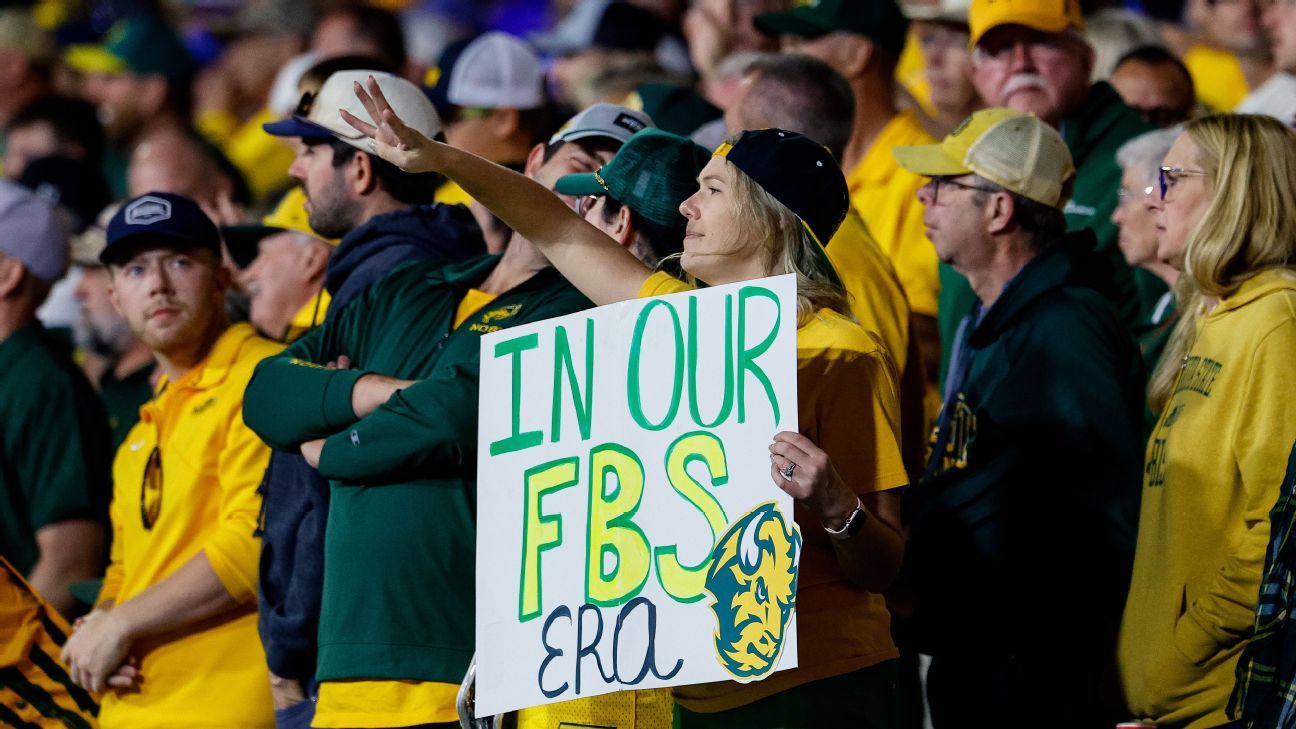
EmailPrintOpen Extended ReactionsFARGO, N.D. -- On the eastern edge of North Dakota, pressed against the Minnesota border and surrounded by hundreds of miles of flat, open prairie, Fargo has long existed in relative seclusion, known for its punishing winters.But over the past 20 years, it has become home to college football's most dominant dynasty.Beginning in 2011, North Dakota State won 10 FCS national championships in 14 seasons under four different head coaches. As the Bison rose, the Fargodome -- an 18,000-seat indoor stadium that opened in 1992 -- became one of the loudest and most intimidating environments in the subdivision.Eventually, all that winning came with a cost.The Bison became so good that FBS teams were increasingly unwilling to schedule them. During the summer, coaches would run into fans around town already talking about their next trip to Frisco, Texas -- site of the FCS national championship game -- as if another appearance were inevitable.Winning too much isn't a typical path to apathy, but over the past few years crowds at the Fargodome had thinned. It had all become routine. NDSU had outgrown the level it had spent years dominating.At the same time, other FCS programs kept moving up. Recent offseasons brought new rounds of speculation about when the Bison would do the same. For most of the 2025 season, there was little reason to think the immediate future would be any different.NDSU went unbeaten during the regular season before a stunning 29-28 playoff loss to Illinois State. Then came the usual roster churn: players left, others arrived and another recruiting class had signed.Then, on Feb. 6, reports surfaced that NDSU was close to joining the Mountain West.Quarterback Nathan Hayes was skeptical."We're kind of reading those Tweets like, this is just the same old thing," he said.Then came a text calling the players to a Sunday team meeting.Inside the Fargodome, athletic director Matt Larsen and coach Tim Polasek confirmed it: North Dakota State was moving to the FBS."It was a big uproar," Hayes said. "Everybody was on their feet jumping, clapping, just thankful for the opportunity."The move was the culmination of two decades of growth at NDSU and a college football landscape that had shifted in its favor. It also created a test: Whether the culture and developmental model that made the Bison the FCS standard can survive at a more expensive, more volatile level of the sport.NORTH DAKOTA STATE had made this kind of leap before.Long before the FCS dynasty, the Bison were already one of the dominant programs in small-college football. NDSU was voted the NCAA College Division national champions in 1965, 1968 and 1969, then won five Division II playoff titles between 1983 and 1990.By the early 2000s, though, university president Joe Chapman wanted more.He wanted to raise NDSU's national profile and believed athletics could help. Moving the athletics department from Division II to Division I became part of that vision, with football playing in what was then Division I-AA, now referred to as the Football Championship Subdivision.There was plenty of skepticism about whether NDSU was ready to make the jump."People up in the upper Midwest, they're hardworking, modest people," said Craig Bohl, who arrived as football coach in 2003, just as the transition was beginning. "But the double-edged sword is sometimes they become so modest they don't know what they can become. And so the challenge was convincing the naysayers that we're capable of making this transition."Even Chapman had moments of uncertainty.Chapman came to see Bohl the night before NDSU played at Montana. Montana was an established FCS power, and Bohl remembered the president being "white as a ghost.""Can we just keep this thing close?" Chapman asked him.Bohl had a different idea."Well, Joe, we're fixing to win this deal," he told him.NDSU did, beating the Grizzlies 25-24.Under the NCAA rules in place at the time, NDSU was ineligible for the FCS playoffs during its reclassification period."It was five years," Bohl said. "It was purgatory."Without a postseason, that transition period made it difficult for the fans to fully embrace the move."Our fans used to come to the Fargodome. It was like a Lutheran church," Bohl said. "It was quiet. They'd sit down, it was half full."Then, in 2006, the Bison made the 240-mile trek to Minneapolis and nearly beat Minnesota, losing 10-9 when a potential winning field goal was blocked as time expired. Thousands of NDSU fans traveled to Minneapolis and watched their team go toe-to-toe with a Big Ten opponent. When they returned to Fargo, Bohl said, something had shifted."It was a cultural change that we can seek higher ground," Bohl said.NDSU finally reached the FCS playoffs in 2010, its third season of postseason eligibility. A year later, the Bison won their first FCS national championship -- and winning quickly became bigger than any one coach.Most college football dynasties are built and maintained by one or two coaches, but at NDSU, the wins kept piling up despite the coaching changes. Bohl won three straight titles before leaving for Wyoming. Chris Klieman won four more, then left for Kansas State. Matt Entz added two and is now the head coach at Fresno State. Current coach Tim Polasek won another in his first season, in 2024."A lot of us coaches were along for the ride with some phenomenal players," Klieman said. "It was a player-driven program. I think that's the secret sauce at North Dakota State."That model also held up when NDSU played above its level.From 2010 through 2016, the Bison won six straight games against FBS opponents -- Kansas, Minnesota, Colorado State, Kansas State, Iowa State and then-No. 11 Iowa. After the Iowa win, NDSU was 9-3 against FBS competition. The Bison would not play another FBS opponent for six years.By then, NDSU had spent years proving it could beat teams from the level above. The question was whether it could find a way to join them.NDSU ATHLETIC DIRECTOR Matt Larsen's introduction to the school came in 2013. He was the athletics director at Stony Brook and consulting on the side when NDSU hired his firm to conduct an FBS feasibility study. He spent much of the next year working with university officials on what a move would require.Then NDSU athletic director Gene Taylor left in 2014. Larsen applied for the position, got the job and went from studying the question as a consultant to being responsible for answering it.His initial conclusion was straightforward: NDSU wasn't ready.The football program had shown it could compete with FBS teams, but Larsen believed the facilities, staffing and infrastructure needed to catch up. Over the next decade, NDSU invested in those areas, culminating in a new indoor practice facility and performance center.By roughly 2023, the calculation had changed."We're ready to do this now," Larsen recalled thinking. "If there's an opportunity, we need to start being a little more aggressive."NDSU officials had explored various possibilities over the years, but moving up required an invitation from an FBS conference that made sense geographically, financially and institutionally.Conference realignment dominoes had been falling for years, but they finally tipped toward Fargo in the fall of 2024. That's when Boise State, Colorado State, Fresno State, San Diego State and Utah State announced they were joining the Pac-12, forcing Mountain West commissioner Gloria Nevarez to rebuild her league.NDSU was an obvious school to consider.But initially, the Mountain West was reluctant to consider schools moving up from the FCS.Nevarez said there were political headwinds within college football against adding more FBS schools. New members affected CFP revenue distributions, and the NCAA was still reviewing its reclassification rules. Plus, the fee to move up had jumped from $5,000 to $5 million.NDSU and the Mountain West had preliminary conversations roughly two years before the move ultimately happened. The Mountain West had nine football-playing members and wanted an even number. And in November 2025, Nevarez reached back out."From my perspective, North Dakota State was always on the board," Nevarez said.Around the same time, Larsen gave Polasek a deliberately vague update about how conversations were going. NDSU was undefeated and chasing another national championship while, behind the scenes, the possibility of leaving the FCS was becoming increasingly real.Still, Polasek put the odds at only 5 or 10%. NDSU had been linked to FBS conferences before, and he didn't want to assume anything.The Bison looked well on their way to FCS title No. 11 when they were shocked by Illinois State. There was almost nothing positive about the loss for Polasek, but it gave him and Larsen a chance to rally their biggest financial supporters about an FBS move.NDSU had been spending roughly $7 million to $8.5 million annually on football. Larsen estimates the FBS version will cost about $13 million to $15 million -- when scholarships, additional staff and player revenue sharing are included.Over a few weeks in December and early January, Larsen said NDSU received enough money in donations and pledges to confirm the transition was viable."It just kind of reaffirmed that, 'Hey, this is the right decision. It's the right time,'" Larsen said.But Polasek was drawing interest from other schools. Larsen remembers the two of them sitting in a Fargo pizza place talking through what Polasek's contract might look like if NDSU remained in the FCS -- and what it might look like if the Mountain West deal happened.At one point, Larsen made his pitch."I want you to bet on NDSU," Larsen told him.If NDSU wasn't in the FBS a year later and that was ultimately where Polasek wanted to coach, Larsen told him he would help him get there.Polasek stayed.By the middle of January, Larsen thought the MW move had become more likely than not. But negotiations were still moving back and forth over issues such as the conference entry fee, media rights distributions and whether NDSU would begin FBS play immediately in 2026 or wait another year."There were days where, 'Oh, this isn't going to happen,'" Larsen said. "And then the next day I'm like, 'All right, I think we're getting closer.'"Ultimately, both sides had the same motivation."They wanted us and we wanted them," Larsen said. "How do we find a way to make this work?"NDSU agreed to pay the Mountain West a $12.5 million entry fee, with $7 million due up front and five annual payments of $1.1 million after that, with other provisions to ensure NDSU remained suitably financially committed. That was in addition to the $5 million NCAA reclassification fee required to move from FCS to FBS.NDSU made the decision with the expectation it would not immediately be eligible for the postseason.Four months later, the rules changed.In June, the NCAA eliminated the postseason waiting period for teams reclassifying from the FCS to the FBS, making NDSU immediately eligible for bowl games and the College Football Playoff.For this transition, there would be no purgatory.THE MOUNTAIN WEST that NDSU joined barely resembles the conference that existed a few years earlier.Its 10 football members -- Air Force, Hawai'i, Nevada, New Mexico, North Dakota State, Northern Illinois, San Jos State, UNLV, UTEP and Wyoming -- give the league a footprint that stretches from DeKalb, Illinois, to Honolulu, Hawai'i.For NDSU, that represents a dramatic expansion of its football world and, with that, an unfortunate trade-off.North Dakota State and South Dakota State have played 118 times, making the Dakota Marker one of the best rivalries in the FCS. With NDSU moving to the Mountain West, the series -- along with regular games against North Dakota and South Dakota -- is on hiatus.Larsen said NDSU plans to schedule an FCS opponent most seasons and would be open to bringing back one of its former Dakota rivals, though those games would likely have to be played in Fargo. (FBS teams almost never play road games against FCS opponents.)If the loss of familiar opponents was one cost of the move, the increase in exposure was one of its clearest benefits.Last season, the Bison had one regular-season game on national television. This year, 10 of their 12 games are scheduled for national television."I think we all thought that there would be an uptick in just visibility," Larsen said. "But the level at which it has been, I think, has been exponential."The first month suggested the football transition itself might not require much of an adjustment period.In its FBS debut, NDSU hosted Jacksonville State, a program that made the same move three years earlier, and won 33-7 in front of 18,573 at the Fargodome.Two weeks later came a more meaningful test.NDSU went to Colorado Springs for its first Mountain West game and beat Air Force 38-32. The Bison led 35-13 in the second half before holding off a late Air Force rally, giving NDSU its first conference win as an FBS program.Then came a game that illustrated how differently the road to the FBS can look.NDSU and Sacramento State are the only two programs transitioning from the FCS this season. But while the Mountain West pursued NDSU, it passed on Sacramento State, which eventually landed in the MAC as a football-only member.On Sept. 19, NDSU and Sac State met at Hornet Stadium, and the talent gap was tough to miss.NDSU scored touchdowns on its opening drive and on a fumble return four plays later, led 21-0 after the first quarter and eventually won 31-10. The Bison left California 4-0 and are already considered a Group of 6 playoff contender.Hayes, a fifth-year senior in his first season as the Bison's starting quarterback, has noticed the difference just by opening his phone."It is kind of a hard thing when you go on your phone and you're getting a bunch of notifications from Twitter or Instagram and seeing things, big names in the media world kind of tweeting about us," he said.That exposure is part of what NDSU wanted. The FBS label can open recruiting doors that were harder to push through before. National television puts the program in front of more recruits, fans and potential donors. And the Bison now have a direct path from winning their conference to playing on college football's biggest stage.But that visibility cuts both ways.The foundation of NDSU's dynasty was built around finding players bigger programs missed and developing them. An offensive lineman might arrive too light to play immediately, spend two or three years adding weight and strength, then become an all-conference player -- or even an NFL prospect.That model is harder to sustain now. NDSU's best players will have more exposure against FBS competition, they can transfer without sitting out and staying in Fargo could mean turning down significant money elsewhere once they prove themselves."When a really good offensive lineman or a defensive lineman or somebody has that chance to go make a seven-figure deal and go into the transfer portal and go somewhere else, that's what worries all of us in college athletics right now," Klieman said.And the better NDSU performs, the more complicated it could become."Unfortunately now the college game is about who can win the race to maturity year by year and who can win the race to maturity the fastest," Polasek said. "Where we used to just be -- we still are -- we used to just be an engine of development ... and that's being challenged daily in college athletics."Polasek remains committed to recruiting high school players and developing them internally, while using the portal more selectively to replace departures or fill immediate needs. But even the type of developmental prospect NDSU recruits may have to change. As an example, Polasek said a 235-pound lineman who once could have been given a few years to grow might now need to arrive at 250.NDSU outgrew the FCS. Now it is time to find out if the model that got it there can evolve fast enough to keep pace with an ever-changing FBS.NDSU'S FIRST MOUNTAIN West home game will bring its past and future together.The Bison will host Wyoming on Saturday (3:30 p.m. ET, CW) for homecoming, a matchup that has already picked up a nickname around the league: the "Bohl Bowl."Bohl built the foundation of the modern NDSU dynasty, winning three straight national championships before leaving Fargo after the 2013 season to become Wyoming's coach. He spent the next 10 seasons in Laramie before retiring after the 2023 season.Bohl's connection to both programs remains personal. He still lives in Laramie, and his son is on the Wyoming staff."Both programs are near and dear to my heart," Bohl said. "The fabric of the people in the two states are very similar and culturally football is important to both institutions."Bohl arrived in Fargo as NDSU was making its first move up and helped prove the program could succeed at a higher level.More than a decade later, Wyoming will enter the Fargodome as one of NDSU's conference peers.The coach who helped prove NDSU was capable of its last leap will be watching from the stands as the Bison begin the next one.