
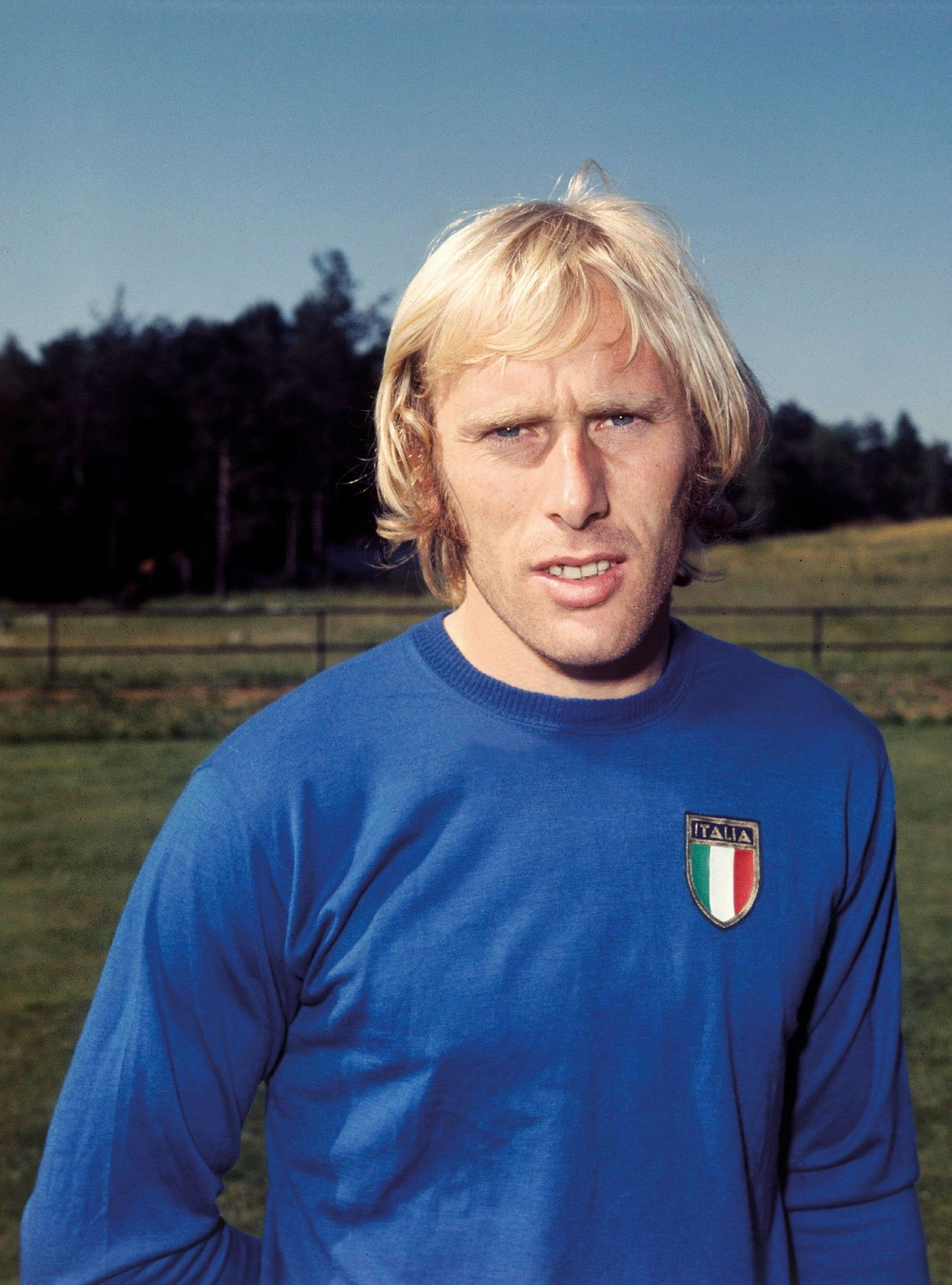
Copy linkFacebookXPinterestEmailShare this article 0Join the conversationFollow usAdd us as a preferred source on GoogleNewsletterSubscribe to our newsletterThe evening of January 18, 1977, Rome carried the sort of winter bite that makes the Eternal City's cobblestones glisten under the street lamps. The Lazio midfielder Luciano Re Cecconi, known throughout Italian football as l'Angelo Biondo (the Blond Angel) was walking along Via Flaminia Vecchia with team-mate Pietro Ghedin and their friend, the perfumer Giorgio Fraticcioli. They were on familiar ground, a short stroll from the jewellery shop of an acquaintance, Bruno Tabocchini, a man they'd visited many times.That's where everything went wrong. Fraticcioli slipped into the shop first, to deliver bottles of perfume to the owner. Waiting outside, Re Cecconi and Ghedin exchanged a mischievous glance before pulling their jackets up over their faces. Hands thrust into their pockets as if they were gripping pistols, the pair burst into the jewellers and shouted, Mani in alto! Questa e una rapina! (Hands up! This is a robbery!)What they didn't know was that Tabocchini's store had been robbed previously. Traumatised, suspicious and determined not to be a victim again, he had started keeping a pistol under the counter and immediately reached for it. Ghedin's hands went skyward, but Re Cecconi kept up the prank. Tabocchini, trembling, did not hesitate. He pulled the trigger.The shot slammed into Re Cecconi's chest at point-blank range. As he collapsed onto the tiled floor, he gasped: Era uno scherzo solo uno scherzo. It was a joke only a joke.Luciano Re Cecconi died 30 minutes later at Rome's San Giacomo hospital. He was 28 years old. You may like "When we heard Andres Escobar had been killed, everyone kept silent for the whole morning" How the Colombia star's murder was felt back home The epic story of England's 1950 nemisis Joe Gaetjens Our World Cup final loss didnt sink in for decades that was the opportunity of a lifetime Italy goalkeeper Gianluca Pagliuca on losing the 1994 World Cup final The death of Re Cecconi stunned Italy. An energetic box-to-box midfielder, he'd been an integral part of a Lazio side that emerged from years in the doldrums and, under the tutelage of inspirational coach Tommaso Maestrelli, claimed the club's first ever Scudetto in 1973-74.Amid the carnival of egos in that Lazio team, Re Cecconi stood apart. He was the calm in the madness, the humour in the gloom, the heartbeat of a fractured dressing room that somehow, through talent and turmoil, managed to conquer Italian football. But Re Cecconi was never the star. To Lazio he was something far rarer. He was the soul.Get FourFourTwo NewsletterThe best features, fun and footballing quizzes, straight to your inbox every week.Contact me with news and offers from other Future brandsReceive email from us on behalf of our trusted partners or sponsorsBy submitting your information you agree to the Terms & Conditions and Privacy Policy and are aged 16 or over.Re Cecconi was born in December 1948 in Nerviano, a blink-and-you'll-miss-it town 10 miles north west of Milan. Its only real brush with national history came when King Victor Emmanuel II stopped there in 1859 after the Battle of Magenta, during the Second Italian War of Independence. As a gesture of gratitude to the town, he permitted residents to incorporate Re', or King', into their surnames.Nearly 90 years later, that's how little Luciano inherited his name, although nothing about his early life was remotely royal. He grew up in a working-class family and worked wherever he could: in a grocer's shop, a shoemaker's and a metal-beating workshop.Football came only after work was done, but he was good. Very good. After starring in local leagues, he signed for Serie C side Pro Patria in 1967, making his debut the next spring. His tireless running, robust tackling and indomitable energy quickly caught the attention of his future Lazio boss Maestrelli, then the manager of Foggia. Within months, Re Cecconi was on his way to the club, playing Serie B football under the man who would transform his life. What to read next Scottish football club sporting director has had arguably the maddest career in history The incredible adventures of Romario and Stoichkov in Barcelona Ranked! The 100 best football players of all time He helped them ascend to Serie A, and although they went straight back down, Maestrelli's reputation soared. Within a season, he was head coach of Lazio. Before long, he summoned Re Cecconi to join him.When Re Cecconi arrived at Lazio in 1972, he stepped into one of the most chaotic dressing rooms in football history a team so wild Wimbledon's Crazy Gang looked like altar boys by comparison.The squad was infamously split into two bitterly opposed factions. On one side were the flashy, combustible personalities led by forward Giorgio Chinaglia a man who adored fast cars, loud suits, political provocation and being at the centre of every storm. He'd later play alongside Pele at New York Cosmos.Chinaglia's group leaned hard into right-wing politics, and their love of firearms was legendary, with many carrying pistols like others carried wallets. When Lazio were away and bored at their hotels, they used to hang out of their windows and use birds as target practice. Former Roma full-back Sergio Petrelli used his gun to scare off angry fans of his old club, who had gathered outside the team's rural hotel before a derby game. Supposedly, he also once shot the light bulb out in his room because he couldn't be bothered to get up and use the switch. On another occasion, the pilot of the team plane flying them to an away fixture refused to take off unless those players with guns left them behind.Chinaglia, a man you wouldn't want to meet in a well-lit, heavily policed alley, let alone a dark one, took to carrying a gun because, as a self-confessed fascist, he decided it was the best course of action, in case anyone actually decided to follow through on one of the many death threats he routinely received.Ironically, Re Cecconi never carried a gun. Instead, Cecco' was one of the quieter northerners', alongside his closest friend Luigi Martini they were known as the twins' for their inseparable bond. Despite Re Cecconi's insistence that he knew nothing about politics, he was often painted as a fascist by association more a reflection of Italy's toxic political climate at the time than anything he ever said or did.The factions refused to speak. They changed in separate dressing rooms. Training games resembled cage fights. Some players wore shin pads only for training, not for league matches, due to the level of brutality.And then there was the manager, Maestrelli the peacemaker, a man of immense humanity trapped inside a pressure cooker. Somehow, impossibly, he forged them into Serie A champions. Maestrelli put together players who were virtually unknown or had a limited football pedigree and gave them an idea of football that, at that time, nobody else had in Italy, explains Simon Basten of the Lazio Stories blog. Lazio played like the Dutch had been playing in the early 1970s. It was a joy to watch.Lazio's 1973-74 Scudetto remains one of the most extraordinary titles in the history of Italian football.The squad was dysfunctional and the atmosphere often poisonous, but Maestrelli was the steady hand on the tiller. Having fought in the anti-fascist resistance during the Second World War, he knew how to manage conflict. He treated players as sons, not soldiers. He always said the right thing at the right time, Basten says. Those players would have gone to war for him.On the pitch, Chinaglia hit 24 league goals, including the penalty against Foggia that clinched the title. Goalkeeper Felice Pulici produced career-defining performances. Skipper Giuseppe Wilson, born in Darlington to an English father and Italian mother, marshalled the defence. In midfield, binding everything together, was the tireless Blond Angel.Re Cecconi was the glue; equilibrium in a Lazio team built on imbalance. He covered absurd distances, won tackles, initiated attacks and stitched together a side that could easily have torn itself apart. He wasn't flamboyant and rarely scored, but he was indispensable.The fans loved him all the more for it.Save for a couple of players, none of the Lazio team hailed from Rome. Drawn from all corners of the country, they arrived in the Italian capital as supporters of provincial clubs, but everything changed when they played for Lazio, and when they played for Maestrelli. They became fans.Like so many before and after him, Re Cecconi was soon entranced by Lazio, despite, or maybe because of, the chaos that surrounded him. During their title-winning season, Lazio were beaten 6-4 by Ipswich in the second round of the UEFA Cup, but only after giving the Tractor Boys an almighty scare, nearly levelling the tie despite losing the first leg 4-0 at Portman Road. Ipswich felt Lazio's tactics in the second leg were intimidatory, and home fans then rioted, causing the Biancocelesti to be banned from the next season's European Cup.Tragically, the greatest despair was still to come. Maestrelli was diagnosed with cancer in 1975 in December 1976, he died aged 54. Utterly devastated, Re Cecconi helped to carry his coffin, as did Chinaglia, who flew back from his new life in the US with the New York Cosmos.Just 47 days later, though, Re Cecconi too would be dead. For a team always seemingly on the brink of collapse, it was a blow few could comprehend.For all his importance to the Lazio side, Re Cecconi's international career amounted to just two caps scant reward for his quality. He had made Italy's squad for the 1974 World Cup, but didn't play a single minute.That tournament was a catastrophe as Italy failed to escape the group stage. Chinaglia famously swore at manager Ferruccio Valcareggi on live television after being substituted against Haiti. When Valcareggi was replaced by Fulvio Bernardini, and later Enzo Bearzot, the competition for midfield places was overwhelming Marco Tardelli, Giancarlo Antognoni and Romeo Benetti were all vying for spots and Re Cecconi slipped out of the Azzurri picture.Lazio fans didn't mind. For them, he was the embodiment of everything that they admired: humility, honesty, dedication and humanity.In the weeks after the shooting, Italy was a nation consumed by shock. The newspapers were blunt. The following morning, Tuttosport screamed: RE CECCONI UCCISO (Re Cecconi Killed).The case went to trial quickly. Presiding over it was judge Severino Santiapichi, who would later oversee the trial of Mehmet Ali Agca, the hitman who attempted to assassinate Pope John Paul II in the Vatican in 1981.Pick the ultimate 4-4-2 line-up from players in FourFourTwo's definitive Top 100 ListSantiapichi ruled that the shooting was an unfortunate accident, absolving Tabocchini of any criminal responsibility. It remains one of the most debated sporting tragedies in Italian history. Many fans have never forgiven the jeweller; others argue he acted in fear, shaped by the violent times in which he lived, during Italy's tumultuous years of lead'.Certainly, Re Cecconi's son Stefano has long questioned the official version of the tragic events. He even published a book on the topic in 2008, called Lui Era Mia Papa (He Was My Dad') in which he tried to address some inconsistencies and, ultimately, reshape the public's perception of his father as a prankster, rather than a serious, passionate man dedicated to his family and profession. But the truth died with Cecco.Re Cecconi left behind a wife and two young children. Stefano, only two years old at the time his father died, grew up embraced by Lazio's supporters, who treated him as family. He later played for his local team Nervianese, at a stadium named after his father.Today, a street in a Rome park also carries Re Cecconi's name, and in the Stadio Olimpico's Curva Nord, a giant flag with his face appears at every Lazio home match. His grave in the Cimitero di Nerviano is modest but still moving. The inscription reads simply: Luciano Re Cecconi: Footballer, 1948-1977. To Lazio fans indeed, to anyone who knows his story he was so much more.TOPICSLazioItalySerie AGavin Newsham