
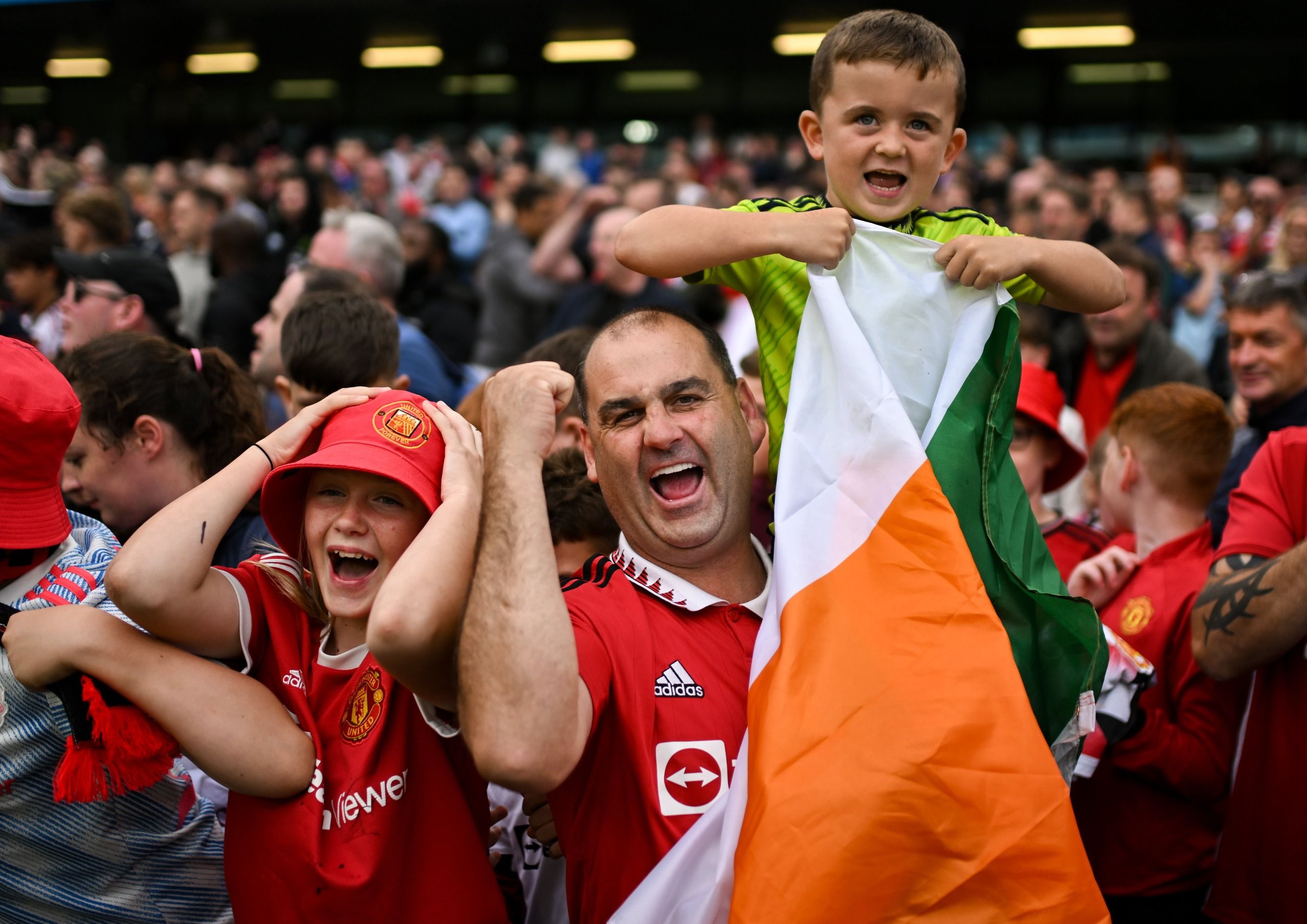
Copy linkFacebookXPinterestEmailShare this article 0Join the conversationFollow usAdd us as a preferred source on GoogleNewsletterSubscribe to our newsletterManchester United are undoubtedly one of the biggest football clubs in the world and may just be the most famous. Their fanbase stretches all over the globe, but outside of the North-West of England, their greatest stronghold is situated across the Irish Sea.Ireland both north and south of the border has contributed as much to the club as any country outside of England. Four of the top 15 appearance makers. The joint-fifth all-time goalscorer. Three club captains. The most successful skipper, the incomparable Roy Keane. And to many, the greatest player to ever wear the United shirt, George Best.So, what is the genesis of the connection between the green of Ireland and the red of Manchester United?Manchester CelticThe troubled and tumultuous history between Great Britain and Ireland is well-known at surface level, but 800 years of occupation cant be covered in 800 or so words.Migration to Britain was commonplace over the centuries, but particularly during the Great Famine and dawn of the Industrial Revolution, with Manchester becoming one of the most represented areas. Irish immigrants helped build the city, and several railway workers were among those who formed the original Newton Heath in 1878. When the club faced closure 24 years later, it was saved by a group of investors and renamed Manchester United, although Manchester Celtic was also suggested. You may like 'Im a lone campaigner for Everton and Celtic being the true and original partnership. I struggle with Liverpool and Celtic's 'You'll Never Walk Alone' love-in' Proud Toffee Andy Burnham reveals home-and-away Evertonian roots Manchester United bordered on challenging under Michael Carrick, but can the now permanent manager prevent the Red Devils from their usual backslide in his first complete season? Manchester United 2026-27 season preview How Manchester United finally fixed their transfer strategy While Irish players played for Heath, the first-ever Manchester United player from the island was Mickey Hamill, who joined from the now-defunct Belfast Celtic. Patrick OConnell followed soon after, a football icon who should be far more well known.Other players came and went either side of the World Wars, but the club we know today was truly born the day Sir Matt Busby walked through the doors of Old Trafford. His first captain was from Ireland. Dubliner Johnny Carey had played for United before and during World War II, when he remarkably served in the British Army.Get FourFourTwo NewsletterThe best features, fun and footballing quizzes, straight to your inbox every week.Contact me with news and offers from other Future brandsReceive email from us on behalf of our trusted partners or sponsorsBy submitting your information you agree to the Terms & Conditions and Privacy Policy and are aged 16 or over.Busbys impact and Uniteds growth as a powerhouse in the English game was reflected in an FA Cup win in 1948, Carey lifting the famous trophy at Wembley.Carey retired soon after as a youth movement took over at the club in the shape of the iconic Busby Babes. Back-to-back league titles came with United being the first English side to play in the European Cup.The 1957-58 season will always be the saddest and most significant in the clubs storied history, but their continental campaign started in Dublin. Shamrock Rovers were the first Irish side to play in the competition, losing 6-0 to United at Dalymount Park. What to read next Return of the Cosmos: New York's original club are back and looking to build on the World Cup and the legends of Pele, Franz Beckenbauer and Raul Exclusive: Diego Forlan discusses the role Sir Alex Ferguson's brother played in his Manchester United transfer "Jack Charlton used to tell us off for drinking Coke. He said we should drink beer because it would help us sleep better" Tony Cascarino on being part of Irelands 1990 and 1994 World Cup journey Liam Billy Whelan was one of the true stars of the side of the decade, and fittingly scored twice on his return to his native city.A life and career on the cusp of greatness was tragically cut short in Munich, where he passed alongside seven of his teammates and 15 other passengers. The outpouring of grief was worldwide, and Dublin stood still as Whelans funeral took place. It was the moment United became Irelands team.It was helped further by the heroic Harry Gregg of Derry, who survived the crash and pulled people from the wreckage.From the ashes of Munich, United somehow rose. Busby built his third great side which, of course, included players north and south of the border.Another FA Cup was won in 1963, Corks Noel Cantwell this time walking up those hallowed steps. The legendary Johnny Giles started in what was his final game for the club, as well as fellow Dubliner Tony Dunne, who played an Irish record 535 games for the club.All three, as well as goalkeeper Pat Dunne, were spotted by the legendary Billy Behan, a former goalkeeper turned scout. He was joined by Bob Bishop, who spotted talent north of the border, most notably the one and only George Best.As Uniteds near-fictional European odyssey concluded with their first European Cup in 68, Best became the sole Irishman to win the Ballon Dor. The starting lineup in the final included the Belfast Boy as well as Irish full-backs Dunne and Shay Brennan.Busbys retirement a year later kickstarted a sharp decline. His successor was Corks Frank OFarrell and the likes of Frank Stapleton, Paul McGrath, Gerry Daly, Ashley Grimes, Jimmy Nicholl and others were all features of the cup-winning sides in the years to come.The 1985 FA Cup final win over league champions Everton is famous for several reasons. Dubliner Kevin Moran became both the first man to be sent off in the final and the only to win the cup and the All-Ireland Gaelic championship. Belfasts Norman Whiteside scored the stunning winner in extra time.Sir Alex Fergusons arrival a year later changed the course of football history with two of his very best players, Corkmen Denis Irwin and Roy Keane, crucial to so much of his success.Irwin is in the top 10 appearance makers, while Keane was the on-field driving force behind the glory of the 1990s and early-2000s, lifting by far the most trophies for the club. His display in the 1999 semi-final second leg at Juventus rivals Bests in Benfica 66 as the best in Uniteds European history.The 1990s also saw English football utterly transform with the dawn of the Premier League and the Bosman ruling, which reflected world changes as capitalism and globalisation took charge. It saw United eventually look elsewhere rather than Ireland for talent, as well as for pre-season games.John OShea and Jonny Evans are the last Irish players to significantly contribute to the clubs success, with OShea continuing the trend of an Irish player in all three of Uniteds European Cup-winning squads. Darron Gibson and Paddy McNair played smaller roles.Evans' unlikely return to the club in 2023 ended an unwanted seven-year wait for an Irish player either side of the border, although it has not stemmed the flow of fans making the weekly pilgrimage across the sea to support the team. A report this year by Mancunian Matters revealed Ireland is the overseas country with the most season ticket holders at Old Trafford (1,616). Ireland has nearly twice as many holders as the next country on the list (Norway with 837). That means at least 2% of the 74,000+ crowd are Irish on any given matchday.United were the obvious choice for the first club football game at Croke Park, just as they were to open the newly-developed Aviva Stadium in 2010.If the prophecy of United needing an Irish player to be truly successful is true - all of Busby and Fergusons combined 18 titles had a shade of green - Troy Parrott may be the best bet as his career continues to go from strength to strength.That is unless the hugely promising JJ Gabriel decides to play for Ireland. Unknown to many, his father Joe OCearuill made two appearances for the national team on the ill-fated tour of the US in 2007, playing at the Giants Stadium like Keane and McGrath 13 years prior.With both United and Ireland hopefully coming out of their self-inflicted down years, the off-field connection will hopefully be mirrored again on the pitch. Until then, United will continue to be the most followed English club in Ireland.TOPICSPaddy McNairManchester UnitedIreland RepublicRepublic of IrelandShamrock RoversPeter FitzpatrickPeter writes freelance for FourFourTwo and has previous experience at Evening Standard and Football365 among several others. He now works for us alongside OneFootball, the Sporting News and Stats Perform. One of the very few Irish people living in London and even fewer to support Manchester United, he spends time away from football rewatching TV shows and attempting to play tennis.