
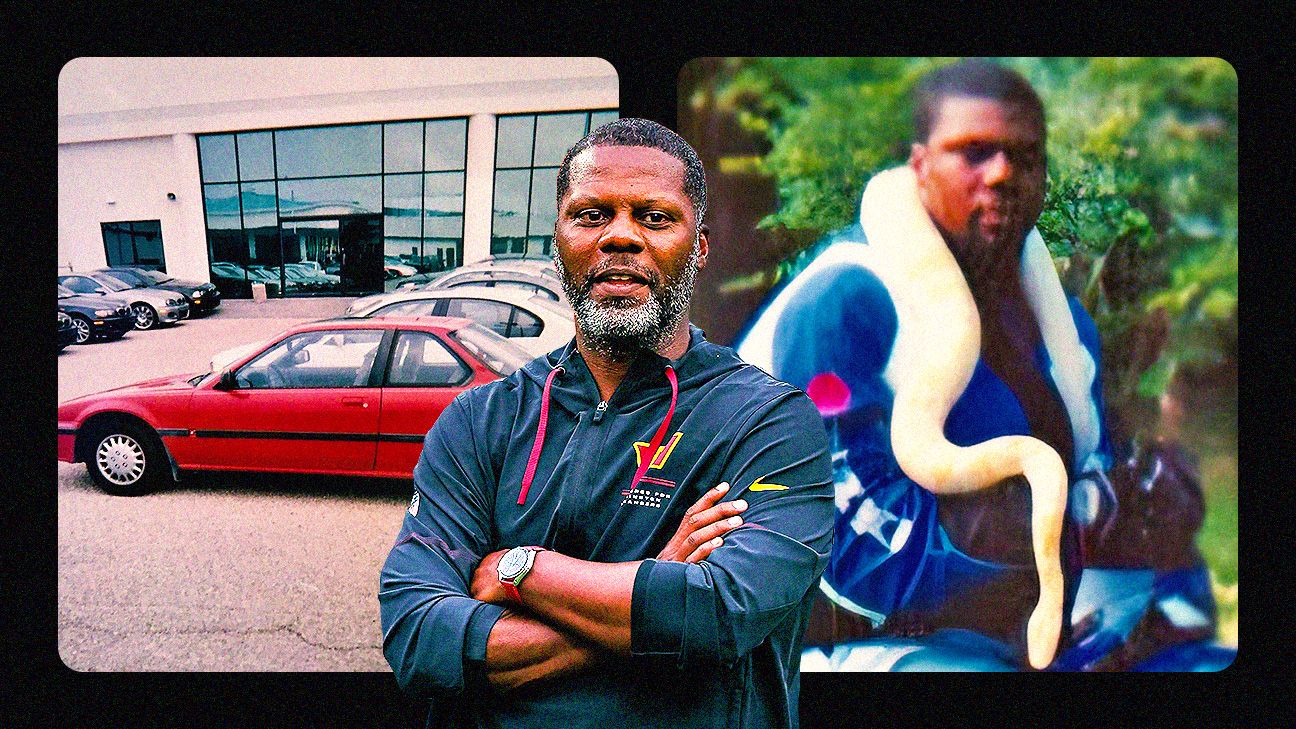
EmailPrintOpen Extended ReactionsASHBURN, Va. -- The gale-force Chicago wind shook Daronte Jones' car and rattled his nerves. It did not blow the future Washington Commanders defensive coordinator off his path, but it made him question his life choices.It was March 2002, nearly three weeks after Jones landed a job at Division III North Park University on the city's northwest side, and he was sleeping in a red 1988 Honda Prelude.He endured a night that ended up steeling his resolve as winds reached 50 mph. At around 11 p.m., he called his aunt Lisa Simmons in Maryland."She picked up thinking it was an emergency, which it really wasn't, but it could have been, mentally," Jones said. "The car was rocking side to side."I remember calling home and naturally the family was like, 'Just come home. What are we doing?' That was a moment where you really had to think about how much you're willing to sacrifice, and is it worth it?"Jones didn't go home.That was the first decision in a long list of sacrifices the first-time NFL defensive coordinator had to make early in his coaching career. He lived out of his car for two months in Chicago. Then, in 2010, while a grad assistant at UCLA, he slept in the cornerbacks' meeting room for most of his year with the Bruins. Two years after that, as a University of Hawaii assistant, he slept in his office for a year before moving into an alumnus' pool house.Along his journey -- often with his pet python, Goldie Gambino, living in his book bag -- he also coached high school for two years and nearly left the profession twice -- attending law school at one point, and applying to the U.S. Capitol Police at another in hopes of becoming a Federal Air Marshal. However, like on that frigid night in the Windy City, he always resolved to stick it out."It was like, 'Is it ever going to end?'" Jones told ESPN. "I was like, 'Maybe it's not for me.'"The big breaks finally came, which have led Jones, who is a native of Anne Arundel County in Maryland, to Washington, where he has been entrusted with improving a defense that was arguably the worst in the NFL last season. His background could be a good match for the task ahead.A turbulent start to his career helped him develop a deep appreciation for future opportunities -- and for finally reaching this point in his career. It taught him patience; it taught him humility."It's very easy to see when someone has been through it to get to where they're at," safety Jeremy Reaves said. "He went the route not a lot of people go for. How he is on the field is what you'd expect: the sense of urgency. He understands what an opportunity means. He understands opportunities are few and far between, so when you get one, you have to take advantage."BEFORE ARRIVING IN Washington, Jones had held 14 different jobs during his coaching career, from Division II to Division I-AA, high school, the Canadian Football League to multiple Division I stops and stints with three NFL teams.But one of the most formative roles isn't included on his rsum: North Park University.Jones spent six months at the tiny school in 2002, but left before coaching a game.When he arrived at North Park as a defensive assistant, Jones, fresh off a graduate assistant role at Lenoir-Rhyne University in Hickory, North Carolina, was told he could sleep on a couch in an apartment with other coaches. Jones didn't trust the couch, which, he said, had looked like it had been pulled off the street -- so he slept in his Prelude.He spent his first two months at the school sleeping in the car. He kept a suitcase in his locker but other clothes in the Honda -- along with his nearly 3-foot pet Albino Burmese python. Jones said he would park his car near the facility in a different spot each night. On cold nights, he said he'd crack the windows for airflow, turn on the heat and try to stay warm.Simmons often lent him money when she could. But she said Jones told her, "'I'll just work it out; I'll stay in the car.' He said, 'All I need you to do is call me and wake me up.' So I would get up early and call him, 'Daronte, it's time to get up.' We really wanted things to work out for him, and he was willing to make the sacrifice. We would support him the best we could."Simmons never wavered. Every morning at 4 a.m., Jones would receive a call from his aunt, then head to the facility to shower before others arrived.Throughout this time, Jones said he had been telling the other coaches on staff he was living in a hotel. When some found out he wasn't, they offered him the pantry in their apartment, which was on the porch and attached to the kitchen with screens that needed fixing. Jones said the room was full of boxes and was so narrow, his double mattress couldn't lie flat -- it was curled on the outside because it wouldn't fit.His grandfather told him how to fix and seal the screens, and Jones bought a space heater to keep him and Goldie Gambino comfortable. "I'd sleep in jeans, sweats, a hoodie, leather jacket to stay warm," Jones said. "But it was better than the car."Four months later, he accepted a restricted earnings job at Nicholls State. Though the opportunity at North Park might have seemed to be a waste, having never coached a game for the Vikings, the sacrifices Jones made in Chicago became a key theme throughout the rest of his journey.JONES NEARLY DROPPED out of coaching -- twice.The first time occurred in 2004 when he was 25 and coaching defense at Jeanerette High School in New Iberia, Louisiana. It was his first year at Jeanerette but second year coaching high school in Louisiana. Jones had given himself a deadline: become a college Division 1 position coach by age 26 or quit.He took the LSAT with plans to attend Southern University's law school with an Omega Psi Phi fraternity brother. Then, Mike Lynn, who was Jones' former position coach at Morgan State, where he played offensive line, became the head coach at Bowie State. Their connection led to a job offer. But Jones said he wasn't sure that he wanted to accept. He could continue teaching in high school, then attend law school classes at night.Zeb Simon, Jones' boss at Jeanerette, told him it was a no-brainer and issued him an ultimatum."I'm going to give you a choice," Simon said. "Either you go or I'm going to fire you.'"Jones went."It took me about a couple weeks to make that decision," he said.Five seasons into his stint with the Bulldogs as assistant head coach and defensive coordinator -- the last of which saw his defense ranked No. 1 in Division II -- Jones reached another crossroads. The move to Division I wasn't happening. So, after the 2009 season, he applied for a job with the U.S. Capitol Police, hoping to become a Federal Air Marshal. He had received an offer, and they were in the process of doing a background check when UCLA called."Maybe it's time for me to look at something else because now I'm in my 30s, and I was like: 'I've got to do something,'" Jones said he was thinking at the time.The Bruins offered him a graduate assistant's job. It meant going from a salary of $64,000 a year to $1,000 per month while living in the Los Angeles area. He first consulted Damon Wilson, his boss in 2009 at Bowie State, about the UCLA opportunity. But it was longtime advisor Lional Vital, who spent part of four seasons in the NFL and also served as a scout and executive for 30 years, who convinced him."You've already been homeless," Vital told him.Unable to afford the cost of living in Southern California, Jones made his "home" in the UCLA cornerbacks' meeting room, where he spent most of the year sleeping on an air mattress alongside another graduate assistant, Chris Polizzi -- now Iowa's special teams coordinator -- who slept on a futon. The arrangement disappointed Wilson."He felt like I shouldn't have to do that," Jones said of his UCLA living conditions. "'You've accomplished some things in your coaching career at Division II level. You shouldn't have to go from there back to [when] you were 20-something years old.' In my mind, it was like I'll take a couple steps back to go a couple steps forward."Jones spent the next year as the defensive backs coach for the Montreal Alouettes before being hired to coach the secondary at the University of Hawaii, where he slept in his office the first year before moving into an alumnus' pool house for his final two seasons on the islands."Hawaii had no money," said Norm Chow, Hawaii's head coach at the time. "I [told him] it doesn't pay well and it's expensive to live there. But he wanted to go. He made it work."As he had at North Park, Jones never let his living circumstances get in the way of opportunity."Perseverance is the best word that describes him," said Morgan State coach Damon Wilson, Jones' boss at Bowie State. "He's had to endure a lot of things to get to where he is."THE COMMANDERS HAVE felt the results of Jones' experiences. Commanders coach Dan Quinn said he has sat in on meetings run by Jones, listening to him ask questions of his position coaches -- "What could have been done better in this scenario?" -- almost like a teacher."When you go through difficult circumstances, there's a resiliency that gets developed," Quinn said. "And one of the other things I love about him, there's not one step that he's missed in the coaching journey. He's got remarkable teaching; he's got perspective."Jones' players, such as Reaves, see it, too.All of which is why, at his introductory news conference in February, he took a moment to reflect on his road to D.C. -- not the big-time stops, such as being the defensive coordinator for a season at LSU; nor did he go right to any of his three NFL stints (Dolphins, Bengals and Vikings) before Washington."If you think back to sleeping in the car at 23, it's different than sleeping in the car at 33," Jones said, "which I experienced both of those to try to strive to be where I'm today. So, perseverance and then trusting in God."He ditched the Prelude years ago. He now drives a 2020 Porsche 911 and lives in McLean, Virginia, a wealthy suburb of Washington, D.C. But that's not what motivates him, nor is it how he measures success. He once was a lowly defensive assistant sleeping in his car; now he's here.His experiences along the way have helped him appreciate any success he has had, while knowing perhaps the reason he's in this job now is because of what the path that brought him there revealed about himself."You have to pay your dues, and no one tells you what those dues look like," he said at his news conference, "but when you're out there and you want something that you want to accomplish, what's holding you back? You have to choose your hard."So, it's either the hards of failures or the hards of success. I'm sleeping in my car, and it's hard. I can have it the easy way, right? And now I got to face the hard of 'How do I handle success if it comes too early?' You've got to pick your battles."