
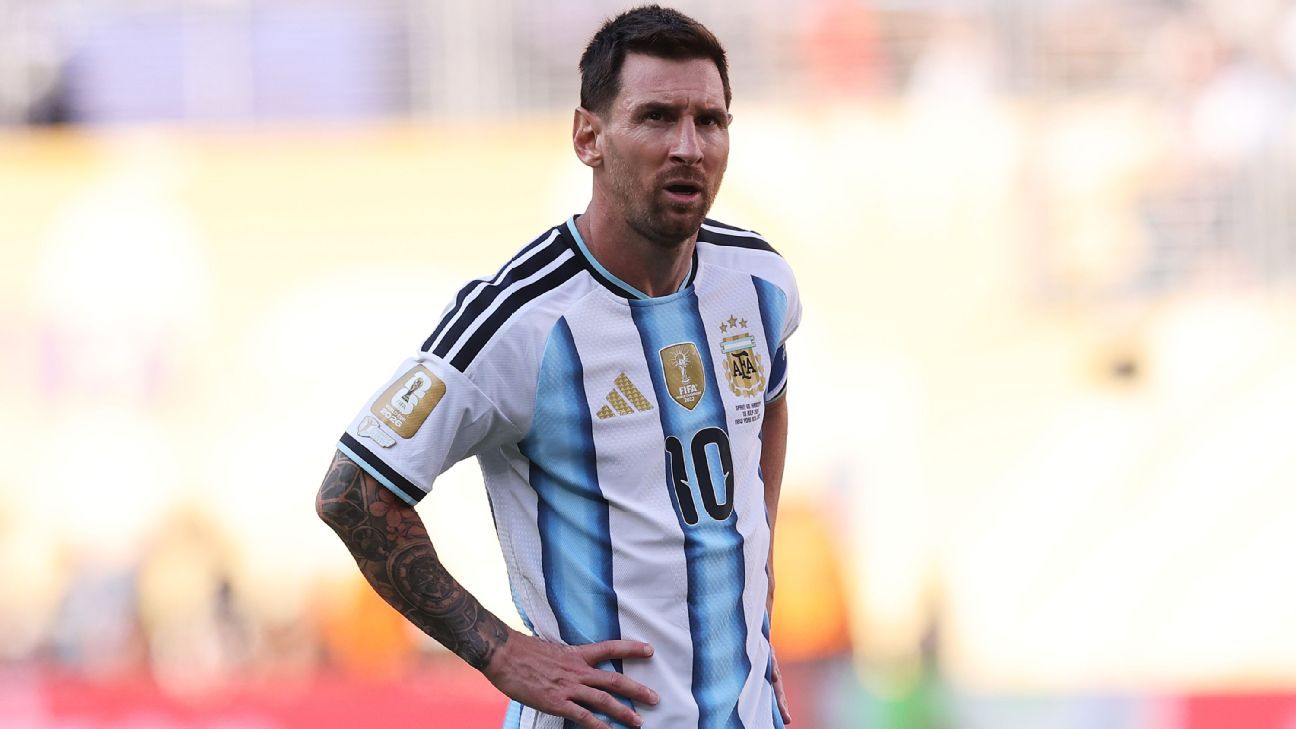
EmailPrintOpen Extended ReactionsIn pure soccer terms, there is probably no argument. The best of Lionel Messi came in the twice-weekly recitals of his genius in a Barcelona shirt between 2005 and 2021. During this marathon spell, Messi was at his sporting and athletic peak, operating in an environment made to measure for him. Few sights in the history of the sport have been finer.But it could be argued that there was something even more glorious in these last few years with Argentina. Why is this? It might be because playing for a national team can hit deeper, and the emotional burden of representing a soccer-mad country like Argentina inevitably adds weight.But it is also because Messi's international career is much more than a tale of natural talent. Instead, it is a story of one man's quest to overcome obstacles and change things within himself in order to dribble around frustration and achieve lasting success.More than 21 years have passed since Messi first wore the Argentina shirt in a competitive game. He was called up for the South American Under-20 Championships, held in Colombia at the start of 2005.At this point, even Argentina did not know a great deal about him. He had already been based in Barcelona for four years, had appeared in a few games for the first team, and there were rumors of something special. Spain wanted him, and that was enough to spur Argentina into action. They got their man -- or at the time, boy.He was 17, two years younger than everyone else and seemingly half as high. Messi cut a most unimposing figure. But once he got out on the field, it was soon apparent that the rumors were not only justified, but that they had undersold the talent.Two things stood out. One was the way that the ball was glued to his left foot, the way it was part of him, an extension of his will. The other -- the ability which enabled him to play such a magnificent World Cup at the age of 39 -- was his appreciation of space, his awareness of where to go and when to go there in order to hurt the opposition. He was clearly a phenomenon, and, together with his great friend Sergio Agero, a few months later he took Argentina to triumph in the FIFA U-20 World Cup in the Netherlands.By now, he had quickly become the new great hope, and he was fast-tracked into the senior squad. His debut came away to Hungary in Aug. 2005 -- by a strange quirk of fate, the very opponents that Diego Maradona, the person he would always be compared to -- faced in his first international game.Maradona had a 5-1 win to celebrate. In Messi's case, he was introduced in the second half, looked instantly at home and surged at the Hungarian defense. A defender clung on to him. Messi tried to shake himself free and the referee, ludicrously, deemed that he had thrown an elbow and sent him off. Messi's international debut lasted less than five minutes.It was a moment that would play on his mind. At one point he -- very briefly, as it turned out -- retired from international soccer, declaring that he was a jinx. There had been an accumulation of frustrations. In the 2006 FIFA World Cup he stayed on the bench when Argentina fell on penalties to Germany in the quarterfinals.Four years later, same opponents, same stage, and a 4-0 defeat, when coach Maradona's insistence on selecting Carlos Tevez unbalanced the side. And then the three lost finals in three years -- losing 1-0 to Germany in the 2014 World Cup, a defeat on penalties to Chile in the 2015 Copa Amrica, and then the same result a year later in the special centenary version of the same tournament.In the shootout, Messi had blazed his shot over the bar. It was after the game, in the very same New Jersey stadium where it was all to end a decade later, that Messi called time.He was soon back, but things got worse before they got better. The low point was the shambles of the 2018 World Cup, where Argentina drew with Iceland, were thrashed by Croatia, and went down to France far more emphatically than the 4-3 scoreline might indicate. At this point, Messi, already past 30, had never even scored a goal in the knockout stages of a World Cup.His lack of success with the national team was the main dart thrown at him in bar discussions all across the planet. Would he even bother trying again?No one would have predicted that Argentina were about to embark on the most successful spell of their history -- not least because the new coach, Lionel Scaloni, had no senior experience and was handed the job mainly because he was cheap.But Scaloni and Messi diagnosed the problem and sought to come up with a solution. By now, with the challenge of Tevez seen off, Messi was the undisputed star name. Many of the younger players were in awe of him. All they wanted was to be noticed by Messi, to be praised by Messi. And Messi, self-contained, reserved, in his own little world, said little -- and what he said was often to his old friend Agero.Scaloni was initially reluctant to pick Agero, and he wanted to coax Messi out of his shell. And Messi proved happy to be coaxed. It probably helped that by this time his relationship with Barcelona was turning sour. It seems clear that he declared the national team to be his number one priority. The Argentine public felt the change, and so did his teammates.The key was the 2019 Copa Amrica in Brazil, Scaloni's first tournament. Argentina started badly, and began to move towards a more coherent tactical idea during the course of the competition. They finished third, but really they were the long-term winners. Scaloni emerged from the Copa with a team, in the plenitude of the word. Journalists who covered Argentina were amazed at the change in Messi. Now it was hard to shut him up.He had forced himself to become the vocal, encouraging leader of the pack. It was not a role that came naturally, but he had identified the necessity and worked to mold himself into a new shape."I like this Messi," said ngel Di Mara to the Argentine press soon after the competition -- leaving it understood that it had taken more than a decade for their relationship to flourish. The team was now Messi and his fan club. They loved him, and would do anything for them -- because it was reciprocated.And after going without a senior title since 1993, Argentina began to rack them up -- the Copa Amrica in 2021, followed by the Finalissima and then the big one, the 2022 World Cup. Then came another Copa Amrica in 2024 and commanding first place in South America's 2026 World Cup qualification campaign, which took them to the final of the tournament a few weeks back in New Jersey.The prevailing mood in Argentina this week appears to be one of gratitude. And perhaps we should all be grateful. Messi could have turned his back on the international game in 2016 or 2018. But he stuck it out and left us with half a decade of wonderful memories, the product of both extraordinary natural talent and an immense will to work at his weak points.