
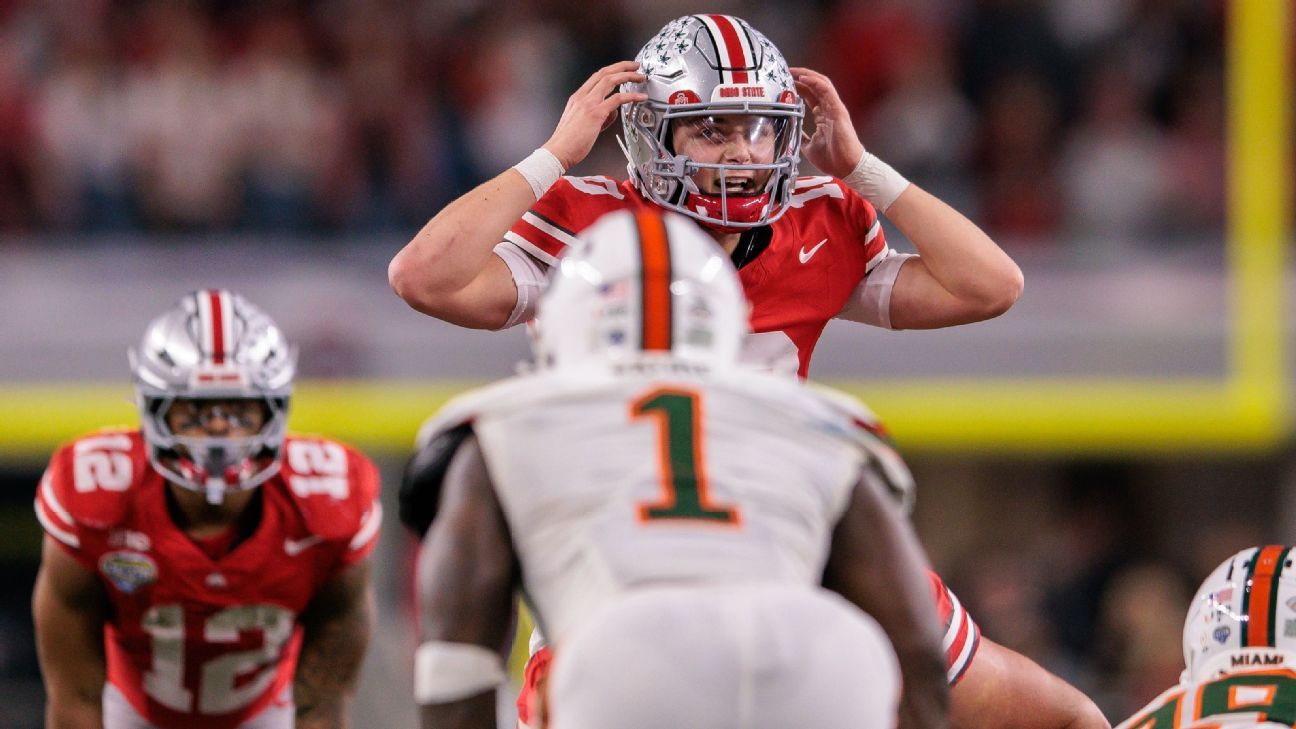
EmailPrintOpen Extended ReactionsOhio State lined up at Miami's 22-yard line, poised to answer the Hurricanes' first score with one of its own in a College Football Playoff quarterfinal matchup at the Cotton Bowl.A 59-yard Jeremiah Smith reception -- his longest against an FBS opponent all season -- had moved Ohio State into the red zone. Even after a sack, the Buckeyes were well within scoring range. But then Miami's Keionte Scott stepped in front of a Julian Sayin swing pass and raced 72 yards to the end zone.The Buckeyes suddenly trailed 14-0, a significant deficit but not an insurmountable one. Nearly 12 minutes remained in the first half. Ohio State came in averaging 3.5 points per drive, which ranked in the top five of the FBS. College football's history is rich with furious comebacks on the biggest stages, and the Buckeyes seemed capable of delivering another.As the game unfolded, though, Ohio State's rally mission grew bleaker, and the game-flow changes in college football became clearer. The Buckeyes logged three more possessions before halftime, the final two beginning inside their 10-yard line. They only had three drives in the second half before taking over with 55 seconds left, trailing by 10.Ohio State scored two touchdowns in the second half but consumed 11:14 of clock in the process. Miami scored just 10 points after its pick-six but exceeded five minutes on each scoring drive and ate up 9:37 on three nonscoring possessions. The Hurricanes never lost the lead and prevailed 24-14. The Buckeyes could never really catch up.The Miami-Ohio State game was a microcosm of several trends in a sport that is evolving with analytics, technology, longer seasons and closer ties to the NFL. Offenses are as efficient as ever: FBS teams averaged 2.24 points per drive in 2025, the most of the last decade. But overall scoring is down nearly 8% since 2016, from 28.4 offensive points per game to 26.2. Why? Because teams are averaging 7% more time between plays and 11% fewer drives per game.Clock rules changes, longer seasons, slower offensive tempo and a surprising factor -- fourth-down success -- have converged to produce longer, slower drives. And in 2025, it gave even a hypertalented offense such as Ohio State's less time and fewer opportunities to dig out of holes."It comes down to efficiency," Ohio State coach Ryan Day told ESPN. "I remember back when we used to run no-huddle all the time, and [mentor Chip Kelly] and I used to always talk about, 'When you're running 85 plays, you don't have to be as efficient because you get 85 calls.' It was all signal-based. You didn't have coach-to-player communication, and the seasons were shorter. Now, the seasons are longer, roster-building is different, maybe we're not going to have as much depth as we used to have. All those things come into play."As the 2026 season approaches, we took a closer look at four trends in the sport that impact game flow, what coaches and the numbers are saying about them, and why they're important to understand when things kick off in a few weeks. Here's your chance to study up on sequencing, fourth-down decisions, timeout usage, how longer nonscoring drives are impacting games and more.The tempo era is overIn 2016, FBS offenses averaged 25.1 seconds per play; it was the last year in which you could see the direct effects of what you might call the tempo revolution in college football. In 2012, Alabama coach Nick Saban had famously asked, "Is this what we want college football to be?" in response to the proliferation of no-huddle attacks, and while the answer in the following years was a resounding "Yes," defenses, as always, began to adapt. By 2023, when rule changes allowed the clock to continue running after first downs outside of the final two minutes of each half, average seconds per play had already risen to 26.2. It jumped to 26.9 in 2023 and has remained there each year since.In 2015, 16 teams averaged under 22 seconds per play, but FBS offenses as a whole averaged just 2.11 points per drive. As the tempo has slowed, efficiency has picked up: By 2025, only two teams averaged under 22 seconds per play -- Florida Atlantic (21.3) and South Florida (21.8) -- but average points per drive had risen by 6%."Games have become shorter, there's less possessions, there's less plays, and you've got to maximize your opportunities," Texas coach Steve Sarkisian said. "It's very similar to an NFL-style game right now. The clock is running more, people are huddling more, and so you're not seeing teams running 100 plays anymore, 105 plays. That era of college football has passed, and we've shifted now."You're seeing teams run 50 plays, 55 plays, and so you better be efficient when you have your opportunities."Both Miami and Ohio State fell below their season averages for plays in the CFP quarterfinal game, as the Hurricanes had 63 (4.6 below their average) and the Buckeyes had 59 (5 below). Ohio State averaged a yard more per play (5.6) than Miami but just didn't get many chances.The Buckeyes were also in no rush. Their season average of 31.4 seconds per play ranked second slowest nationally, and in their three primary drives in their second-half comeback attempt against Miami, they averaged 33.5 seconds per play. Miami, meanwhile, averaged 32.3 seconds per play and ate up large portions of the clock with two long scoring drives."There's going to be some games where you want to play keep-away and you want to take a little bit of air out of the ball, and make sure that you limit the number of possessions," Miami coach Mario Cristobal told ESPN. "There's a way to beat everybody, right? That happened to be a slugfest: Two teams, a lot of high-level players, really physical."The slow-down strategy can work in individual games, like Miami-Ohio State, and also apply to entire seasons and especially the possibility of longer postseasons. Coaches aspiring to reach the national championship game with mostly healthy rosters must assess just how much pounding their players can take during stretched-out seasons.Indiana and Miami, which met for the national title, both ranked in the top 11 nationally in most time of possession per play, both averaging more than 30 seconds."There's a real awareness of the fact that if you're going to snap the ball 100 times a game, and you're going to play 17 games, you're going to, at some point, run out of steam," Vanderbilt coach Clark Lea said. "There's an understanding that winning games is enough, so how do we build leads? How do we shorten the game? And how do we get to the next game healthy?"Matt Rhule, who led the Carolina Panthers in between college coaching stops at Baylor and now Nebraska, said the college game has gotten much closer to the NFL in how it flows."We used to practice so much in the Big 12 versus tempo -- I mean, fastball after fastball after fastball, and that's kind of gone," Rhule said. "Games are shrinking down, which I think is a good thing."Not every coach, however, is actively turning down the tempo. First, there's a math element to the issue: If you have talent and per-play advantages, there's an easy case to be made that you should want more snaps and more drives to exacerbate those advantages. Shrinking games can also shrink the opportunities you have to maximize your superiority.There's also a philosophical argument. Auburn's Alex Golesh, who last year coached a South Florida team that ranked second nationally in seconds per play (21.8), still advocates a maximum possessions approach, saying, "The more possessions you have, the more chances you have to score." Golesh thinks the SEC will maintain a degree of tempo with coaches such as Tennessee's Josh Heupel, LSU's Lane Kiffin, Mississippi State's Jeff Lebby and himself directing offenses.Still, up-tempo teams are becoming national outliers. Coaches are recognizing the benefits of huddling, from keeping signals from being stolen by opponents to giving quarterbacks more play options from which to choose. Indiana led the FBS in snaps from the huddle with 1,024, while Miami ranked third with 954. Twenty-three teams logged more than 700 plays from the huddle in 2025, up from just five in 2023."The average snap time is down, not by choice but by operation," said Illinois coach Bret Bielema, a longtime proponent of huddling on offense. "More teams are huddling now than ever before."Timeout usageIt makes plenty of sense that teams have (or choose) to move more slowly these days, but it's still best if you can move quickly when you need to. And knowing how and when to use your timeouts at the end of a given half can buy a few precious seconds and make an enormous difference.Case in point: The end of the second quarter of the Ohio State-Miami game.With Miami up 14-0 late in the first half, the Hurricanes converted a fourth-and-2 to the Ohio State 30 with 2:19 left. The Buckeyes allowed the clock to run down to the two-minute timeout, then used timeouts after Miami's next two plays after the timeout. When Carson Beck threw an incomplete on third-and-20, Miami was forced to punt with 1:42 left.Had Ohio State used its timeouts before the two-minute break, third down would probably have happened with between 2:00 and 2:05 left. Day cost himself at least 18 seconds by keeping those timeouts in his pocket. In their ensuing drive, they got to the Miami 31 with five seconds left before Jayden Fielding missed a 49-yard field goal. With another snap or two, they could have driven into better field goal range.Knowing how to deploy timeouts late in a half -- and understanding how important it is to save those timeouts for late in a half -- can make or break a team in a big game. The arrival of the two-minute timeout in 2024, much like the NFL's two-minute warning, has added a significant wrinkle."It's a huge change," NC State coach Dave Doeren said. "That game management piece, that was my whole offseason project. At the end of the day, you want to have as many in your pocket as you can in the second half. I tell our staff that I don't mind losing timeouts in the first half, but in the second half, it's nonnegotiable. We can't burn one because you got 12 men on the field, right? Or 10. I'll take the penalty."Many coaches assign support staff members to assist with timeout usage. Utah first-year general manager Joe D'Orazio, for example, handled those duties for USC in 2025. He and others subscribe to the belief that burning timeouts to prevent delay-of-game penalties, other than in extreme situations, is not worth it."There's no worse feeling than a delay-of-game penalty -- it's like the cringe of cringe," Washington coach Jedd Fisch said. "But sometimes you look at the down and distance, and you see you're at second-and-12 [after the penalty], and you're like, 'All right, there's X percentage chance that we're going to convert this. I don't need to use the timeout.' But my philosophy is the first half, the timeouts are for offense. The second half, the timeouts are for defense."Tempo-based offenses such as Oklahoma State's under new coach Eric Morris are less concerned about conserving timeouts because of how quickly they typically drive the ball. But Morris recognizes the importance of maximizing the "middle eight" -- the final four minutes of the first half, and the first four of the second half, where teams can sneak in extra possessions -- and will cling to timeouts when he can.Timeouts are ultimately tied to game circumstances, but coaches say the focus on them has sharpened."You look at the NFL, the margin of error is really small, and I think in college that's becoming more and more the case," Oregon coach Dan Lanning said. "When that happens, people take moments like that way more seriously, and probably put in a lot more time and effort and thought. [Timeouts] certainly always depend on the situation. Are points in jeopardy or not?"But 40 seconds is valuable, and we want to do everything we can to save those."Fourth-down attempts are way upIn a lot of sports, analytics and stat-driven decision-making have created frustrating outcomes for fans. Baseball has fewer stolen-base attempts and general chaos and more of a strikeouts-or-homers approach in part because it's a more statistically efficient way to play. Basketball analytics quickly determined that a distilled 3s-and-layups approach maximized efficiency, seemingly hurting offensive variety in the process.Football seems to have an advantage in that, (a) analytics have long suggested that teams aren't going for it enough on fourth down and (b) fourth-down attempts are fun and exciting. Those attempts have increased dramatically over the past decade: Teams went for it just 19.6% of the time in 2015, 33.5% in opponents' territory, but those numbers surged to 27.1% and 41.3%, respectively, last season. Fourth-down conversion rates improved at the same time, too, which suggests that efficiency hasn't yet been maximized in this area."You get a few less plays and less possessions, and I think more people are OK being aggressive," SMU coach Rhett Lashlee said. "It's almost like analytics gives people cover to be more aggressive than it used to, when really, you should always be pretty aggressive. And you can keep possessions that way."In 2020-21, Lane Kiffin's Ole Miss shifted the fourth-down conversation into overdrive by going for it 45.8% of the time; the Rebels were one of only two teams over 40% in that regard and one of 20 over 30%. In 2025, 45 teams were over 30%, nine were over 40% and three were over 50%: Baylor (51.0%), Army (54.4%) and Florida Atlantic (57.9%).The increase in fourth-down attempts has frequently come in high-leverage situations, too. Under what you might call normal circumstances -- three or fewer yards to go, under 60 yards from the end zone and an FPI in-game win probability between 20% and 80% -- the national go rate in 2015 was just 50.2%, with eight teams at 100%, 50 under 40% and nine at 0%. In 2025, the go rate in those circumstances was 72.2%, a massive increase. Sixteen teams went for it every time in these situations, and only eight (Auburn, Fresno State, LSU, Missouri State, North Carolina, Ohio State, Old Dominion and Toledo) were under 40%."On fourth downs, there are definitely more teams pushing the envelope," said Michael McRoberts, founder of Championship Analytics (CAI), the company that was behind the early open-mindedness of coaches such as Kiffin and Army's Jeff Monken and now works with about 80% all FBS programs and 90% of the Power 4. "Florida Atlantic was at 62 attempts last and 41 makes last year! But just as important, the number of teams that are reflexively kicking on every fourth down is dwindling fast."Fisch admits he's an outlier in not relying heavily on fourth-down analytics."I don't use the book at all," said Fisch, who calls the Huskies' offensive plays. "I think I'm the last man standing. If I want to go for it, we'll go for it. If it's fourth-and-1, it's hard for me not to go for it, and if it's fourth-and-6, I don't really love going for it. I don't know why a book needs to tell me that. It's been 26 years of coaching football, and in a lot of my jobs, I've been making those types of decisions."Increasing the number of high-leverage plays in a given game is an exciting development, but it comes with an unexpected cost: Successful fourth-down attempts extend drives, and those drives were already taking more time on a per-play basis. FBS teams averaged over 13 possessions per game as late as 2016, but when combined with the clock rules referenced above, these longer drives have helped that national average to sink below 12 possessions per game for each of the past two seasons. And fewer drives means fewer points and fewer wild-and-crazy track meets."This is all good news for the pro-parity crowd," McRoberts said. "Fewer possessions coupled with fourth-down variance can swing some seasons one way or another pretty fast."Defenses are also catching on, coaches say, and their success at stopping fourth downs could stem the trend."I don't know if everybody's reaping the benefits of it anymore, as much as we were in the past," Sarkisian said. "So are we going to see people punting the ball more now, when you're pinning people deep, playing defense again. It'll be interesting to see if that comes back, kicking field goals again, instead of always going for it. And it takes big moments to break trends. I think about the Broncos and [coach] Sean Payton, the amount of criticism he got for going for it on a fourth down [in the AFC Championship] when he didn't kick a field goal, right? Is that going to help break a trend?"Your coach's new favorite word: sequencing!The first step is accepting that you live the fourth-down lifestyle. The second step is embracing it. While converting on third down remains optimal against the alternative, understanding how many yards you need to put yourself in go range on fourth -- and, therefore, putting yourself in position to go for it -- is an increasingly necessary playcalling skill. Offensive coordinators now know that there are two important lines on third down: the line to gain and the line to go for it.Maybe this produces an increased willingness to run the ball on third-and-5 or so. Or maybe it means being a bit more willing to throw the ball to a receiver short of the line to gain: In 2019, quarterbacks threw short of the sticks 43.0% of the time on third down, but in 2025 that average had risen to 48.5%."People are going for it more on fourth down, that has definitely become a trend," Lashlee said. "So when that happens, you're not as worried as much about third-down conversion percentage as you are about, 'If I'm thinking four downs, then I'm more likely on third-and-6 or 7 to run the football. And it does put the defense in a tough spot. It's a totally different mindset."The increases have shifted how coaches and playcallers view down-and-distance situations that used to be considered more rigid."[Coach] Marcus [Freeman] is pretty aggressive with allowing us to go for it on fourth down, depending on where we're at on the field," Notre Dame offensive coordinator Mike Denbrock said. "So it just opens up. You can really call third down like second down. Quite frankly, we've been able to take advantage of that. When we broke down our third downs from last year, there were as many runs on third-and-medium as there were screens. So it just gives you an opportunity to be a little more multiple, where it's not just always quarterback in the pocket."Along with the rise in fourth-down attempts, use of the word "sequencing" has become far more common. Say you're facing a second-and-10: Instead of needing 10 yards in two plays, you might only need seven or eight. Fourth down proliferation means that there are fewer genuine must-pass situations, and you can play it safer when you do pass. Both of those things create inherent offensive advantages."Sequencing, which a lot of people are talking about, may have even happened on first down," Virginia Tech coach James Franklin told ESPN. "You tell your coordinator, 'We're in four-down territory right now,' so a third-down distance that typically would be a passing situation in most years previous, now opens the playbook to the offensive coordinator to call, maybe an unusual call, a run on third-and-long, get to fourth-and-manageable, or pop it, especially depending on who the running back is."USC coach Lincoln Riley remembers crowds booing after he called third-down runs, thinking the offense had "conceded" the series. But Riley views third down as a best-play down, not necessarily one to call a run simply to set up a fourth-down attempt."Sometimes it is, sometimes it isn't, but more people are doing it now because they can hide under the, 'Oh well, we were going to go for it on fourth,' or 'We're sequencing now,' which obviously makes sense," he said. "I just think defenses are evolving to that, too, where on third down they're giving themselves a bit more run support."Certainly all the sequencing is causing both sides to evolve."Sequencing is inherently tied to field position. Teams view the area from just inside the 50-yard line to the 30- or 25-yard across midfield as one that opens up different possibilities, some determined by what analytics are telling them. Maryland's Mike Locksley is among the coaches who has a staff member close by on the sideline before offensive drives, mapping out where two-down territory begins, so he can relay it to his offensive coordinator to shape playcalling strategy."Instead of making pooch punts or long field goals, teams are assessing and saying, 'OK, it's third-and-6. Why not give my offensive coordinator two downs to run it and get a first down, rather than kicking this 48-yard field goal?'" Bielema said. "It's not that the calls have changed; it's just the awareness. ..."When you see raw point and yardage totals are both down, it's easy to quickly conclude that defenses have pulled one over on offenses. At best, however, that's only partially true. FBS offenses are as or more likely to score on a given drive than they ever have been, but they probably have to take their time to do it."Every drive is becoming more and more important," Oklahoma coach Brent Venables said. "Where you might have been out there 13, 14 drives, and you could afford to have a couple of bad drives, the less drives there are, the less room for error. And it's on both sides of the ball. People are just being more efficient than ever, and making their opportunities count."If you're looking for the next great offensive innovation, it will likely involve heavier use of tempo again, but perhaps in a selective and varied way. Maybe you can't floor it at all times anymore and expect to win 17 games and a national title, but having that club in their proverbial bag sure would have helped Ohio State in last year's postseason.