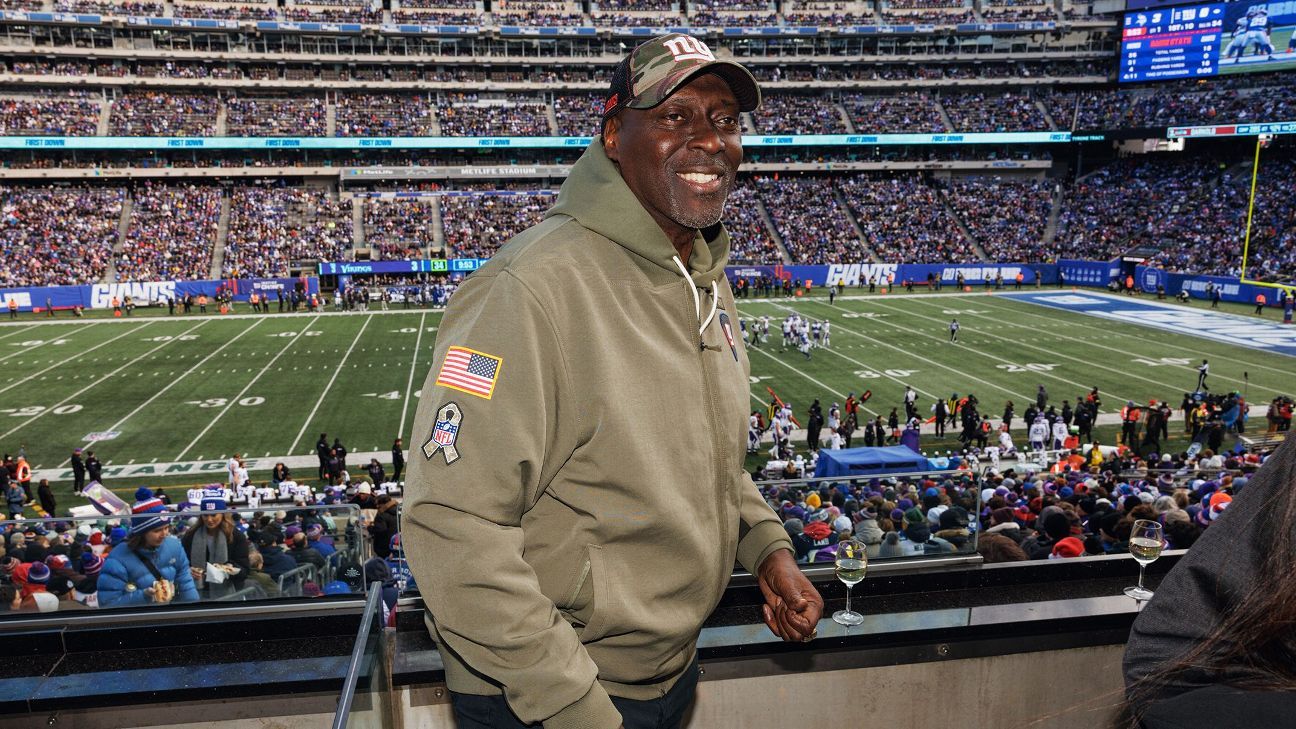
EmailPrintOpen Extended ReactionsI TRY NOT to feel slighted when the MVP of Super Bowl XXV doesn't hug me on a chilly December afternoon at MetLife Stadium, but it isn't easy.Ottis "O.J." Anderson, you see, is not stingy with hugs: former teammates, stadium buffet station chefs, New York Giants executives, fans too young to have seen him play, fans old enough to never forget seeing him play -- if there's reasonable justification, the 69-year-old Anderson will wrap his still oak-tree-strong arms around you.But not me, not yet anyway. I'm at MetLife for a game against the Minnesota Vikings, there to hang out with Anderson. Not long after he shakes my hand upon arrival, we're sitting at a high table in the Giants Legacy Club with another retired Giant, Rodney Hampton.Hampton was a rookie in 1990, Anderson's 12th season in the league, and he explains that the veteran running back was asked by head coach Bill Parcells to inform him when Hampton was "ready." Taking that mandate as seriously as he did everything in his long career, Anderson mentored the player destined to replace him as a starter through a very productive campaign. "To most people that was the season he helped us win a Super Bowl," Hampton says. "But for me that was the season he taught me how to be a pro. He was everything to all of us in the [running backs] room: dad, uncle, big brother, mentor -- call him anything you want."Well, anything except Hall of Famer.Hampton and Anderson are sometime ambassadors for the Giants, paid to turn up at games to shmooze with fans, especially the kind who tend to watch the action from suites. Both men are naturals, quick with a selfie smile, game memory or insight about the current squad. They hug it out before departing to make their rounds, me trailing Anderson as he runs into another longtime acquaintance."My man," Roger Goodell says as he and Anderson clap backs in the Commissioner's Club, another of MetLife's many exclusive seating areas. After a brief chat, Anderson moves on to greet other patrons, but I hang around to explain to the commissioner why I'm there. It's a longish story -- and fingers crossed you'll finish! -- but the tl;dr version is that I persuaded ESPN to let me write a "Trojan Horse story": In theory, I tell Goodell, I'm using my sports world connections to make a case that Anderson, a hero of my youth, deserves to be voted in as a senior candidate to the Pro Football Hall of Fame in Canton, Ohio."That would make a lot of people happy," the commissioner says.But hidden inside that familiar sports writing trope, I continue, is a desire to answer a more profound question: Why, exactly, as a 64-year-old supposedly well-adjusted human, do I care so much about this?"Maybe you want to be rewarded for your loyalty," Goodell suggests.I respond by saying that I believe it might run deeper than that, and Goodell nods while looking at me with what seems like concern, before shaking my hand and walking away.So, yeah, this is a story about the Canton-worthiness of Ottis Jerome Anderson -- not to mention the psychological underpinnings of sports fandom.I will also be discussing "The Wizard of Oz."WE SHOULD PROBABLY deal with this quickly: The Hall of Fame case for Ottis Anderson is comically easy to make.Start with the numbers. When Anderson retired, after the 1992 season, he ranked among the NFL's all-time leaders in rushing yards (eighth), rushing touchdowns (seventh) and yards from scrimmage (ninth). He remains, somewhat astonishingly, outside Canton despite sitting squarely among -- and often ahead of -- players who are comfortably inside.And that's before we get to context, which is where Anderson's rsum becomes even more compelling. He wasn't just productive; he was often dominant. His rookie season in 1979 remains one of the great debuts in NFL history: 1,605 rushing yards, Offensive Rookie of the Year, first-team All-Pro. Over his first five seasons, which included the strike-shortened 1982 campaign, he amassed 6,190 rushing yards, a total that placed him among the most feared backs in the game at a time when the league was not exactly short on them. Think: Earl Campbell, Eric Dickerson, Walter Payton.Then there are the matters of longevity and second acts. Traded to the Giants in 1986 in what seemed like the twilight of his playing days, Anderson did not so much extend his career as reimagine it. He was named Comeback Player of the Year for the 1989 season -- the oldest running back (32) to achieve that milestone (HOF runner Marcus Allen won it four years later at 33) rushing for more than 1,000 yards. And he did so not only with a different uniform number (24), but with a completely different style.Early in his career, Anderson was a prototype of the modern outside back: fast, explosive, darting, capable of turning the edge and outrunning defenses. Think: Gale Sayers with size. But in New York, he became something else entirely: a punishing, between-the-tackles runner. Think: John Riggins with speed. Most players who lose a step lose their edge. Anderson changed his game and his role, and in doing so extended not just his career, but his relevance. He did not fade; he adapted."I was still running a 4.5 40," he recalls, comparing that to his rookie year 4.4 time in the dash. "But Bill [Parcells] wanted me to run inside, so I ran inside."And then, a year after his "comeback" season -- at age 34, when most running backs are either long retired or clinging to roster spots -- Anderson delivered a steely title game performance: 102 yards, a touchdown and MVP honors in a Super Bowl XXV victory that depended greatly on his ability to grind out yards against the Buffalo Bills defense. (The Giants were starting their backup quarterback.) "The man had two totally different careers," says former Giants defensive lineman George Martin, who was a division rival and teammate of Anderson. "In one he was pretty much unstoppable -- I tried twice a year -- and in the other he was Super Bowl MVP."That performance alone should at least complicate the conversation. Hall of Fame voters have historically been susceptible to postseason moments, and few are more impressive than a Super Bowl MVP turn. When given the chance, Anderson didn't just participate in big games, he tilted them, as the kind of player coaches trusted when the game narrowed to its most consequential moments.And yet, for all of this -- production, longevity, postseason excellence (he also scored in Super Bowl XXI) -- Anderson remains outside the Hall, a status that becomes harder to explain the longer one looks at it. Which is why I contacted a few current and former Pro Football Hall of Fame voters, most of whom asked to speak on background. This is understandable, given the passions that HOFs can ignite, especially regarding exclusions. "Fans don't praise you for Peyton Manning getting into the Hall," says Peter King, a longtime Canton selector, now retired. "They yell at you because Roman Gabriel isn't."To be clear, HOF voting in professional football is now, has always been and likely always will be something of a highly subjective mess. Indeed, there's a very interesting story to write about HOF voting in pretty much every sport, in pretty much every country.But this is not one of those stories. Let's just all agree that members of the Canton selection committee are hamstrung by rules and procedures that can keep worthy candidates from earning enough votes. That's true for modern era players in their initial window of eligibility (19 years, beginning five years after retirement) and for seniors (25 years or more after their last season). For this reason, I didn't press any current or former voters to say if they voted for Anderson at any point over the years. But I did ask if they had any theories for his exclusion, which ranged from the specific -- "I'm not sure he was ever the best at his position in any given year" -- to the intangible: "He never had a signature run or score."That last point rings true to Cornell psychology professor Tom Gilovich, a leading expert on judgment and decision-making (with whom I co-authored a book about behavioral economics and decision-making). Multiple psychological leanings likely affect voter perceptions of candidates, including "availability bias," our tendency to rely on the information (memories, facts, etc.) that is most easily accessible. A dearth of specific and defining on-field moments (think: Odell Beckham Jr.'s one-handed TD grab) likely weakened HOF selectors' appreciation of Anderson.It's enough to make you feel sorry for HOF voters.Some of them kind of do. "It's the greatest crappy job I've ever had," jokes longtime sportswriter Jason Cole. "There's no perfect system. If you let current Hall of Famers decide, nobody else would get in. If you let fans decide, too many would. And if you let sportswriters decide, everybody's unhappy."A COMPREHENSIVE TIMELINE of my decades-long "relationship" with Ottis Anderson:1979: Anderson is named Offensive Rookie of the Year and receives Pro Bowl and first-team All-Pro honors while setting the single-season rushing record for the St. Louis Cardinals, my hometown team. Having dropped out of college, 18-year-old me is working overseas and reading four-day-old NFL game recaps in the International Herald Tribune, convinced that greatness is ahead for No. 32 and the Big Red. I am half right.1982: Back home and back in college, I find myself one evening in a pickup basketball game at the local Jewish community center with several Cardinals players who have stayed in town during the offseason. I am on Anderson's team, assigned to guard cornerback Carl Allen, who I hold to one bucket in the greatest athletic performance of my life. Late in the first-to-11 game, which we win, Anderson knocks me down as we both go up for a defensive board. He doesn't notice.2009: Many decades later, I am co-hosting a weekly ESPN radio show on SiriusXM when I determine that our "mystery guest" is none other than Anderson, who now lives in New Jersey and works in insurance. The Cardinals, having relocated to Arizona shortly after I also abandoned St. Louis, are about to play in their first Super Bowl. Nonetheless, I mostly want to know if Anderson remembers our 1982 hoops victory. He does not.2024: Paired with Anderson at a charity golf tournament in New Jersey, I receive more than my share of "that's good" from him on short putts. Between holes, I mention my near-total shutdown of Carl Allen in that long-ago hoops run. Anderson looks at me with what appears to be pity, then nods his head. "Yeah," he says, "Carl was not a very good basketball player."Dec. 10, 2025: Before tagging along with Anderson at the Vikings-Giants game later in the month, I meet with him at his country club in northern New Jersey, a rendezvous arranged by his daughter Alex, who acts as his manager when necessary. Over the course of a two-hour conversation -- interrupted by an introduction to (and hug with) the club manager -- Anderson shows remarkable recall abilities for specific plays, 40-yard-dash times and conversations with coaches that happened four decades prior. He politely feigns interest in my desire to probe the origins of fan psychology and expresses what appears to be genuine gratitude for my efforts to advance his HOF candidacy. And then I tell him a story.The tale, which is true, involves the founder of the weekly newspaper where I started my career, the St. Louis Business Journal. His name is Mark Vittert, and he is something of a media celebrity in St. Louis, a successful publishing entrepreneur who also co-starred for many years on a local public television debate show called "Donnybrook." Vittert, whose son Leland grew up to become a conservative news anchor, was a sneaky good amateur athlete who back in the day would bet local sports pros that he could beat them in some or other racket sport. When he won, which was surprisingly often, he typically offered to not cash their check if they wrote "For tennis lessons" on the memo line. When they accepted, which was surprisingly often, he would frame the check and hang it on a wall in his house.So, yes, Vittert might fairly be described as quirky, the sort of person who would take a liking to a recent law school dropout he met at a dinner party and later tell the editor of one of his business newspapers that she should hire me. (Thanks again, boss!) He was also a St. Louis sports fan with a serious Hall of Fame agenda. In his case, the object of his obsession was Cardinals' legend Jackie Smith, who along with John Mackey and Mike Ditka helped define the position of tight end. But while those two were inducted into Canton by 1992, Smith was kept at bay, at least in part because in the last game of his career, with Dallas, he dropped what would have been an easy touchdown pass in Super Bowl XIII that the Dallas Cowboys eventually lost to the Pittsburgh Steelers.Nevertheless, Smith retired after that 1978 season with more receiving yards than any tight end in NFL history -- and still boasts the highest yards-per-catch average of any tight end in Canton.Smith might have been a victim of a corollary to availability bias that experts' term "recency bias," the all-too-human tendency to make judgments based on fresher memories or facts. "Even if people are aware of these tendencies, we're not very good at correcting them -- even if we think we are," says Gilovich, a longtime Green Bay Packers fan who believes MacArthur Lane belongs in Canton.In any event, Smith was eventually inducted into the Hall in 1994 -- a decade into his eligibility -- in no small part due to the campaigning of my former boss. In fact, I tell Anderson on a cold December afternoon in 2025, Smith was so grateful that he chose Vittert to present him at his HOF induction ceremony. This, I say only half-jokingly, would be a great end to my -- I mean his -- story: "I'm sure you have other people to ask," I say, "but I would be more than happy to introduce you."Anderson stares at me for a few uncomfortable seconds, then picks up his phone, puts it on speaker and dials. Almost immediately a man answers with an enthusiastic, "Hey, O.J.!""Steve," Anderson says, "I'm sitting here with a writer for ESPN. Can you tell him a little bit about the OJ Hall of Fame Train?""From now on, you'll be history ...You'll be his ...You'll be his ...You'll be history ...And we will glorify your name! You will be a bust ...Be a bust ... Be a bust ... In the Hall of Fame." --City Fathers of Munchkinland to Dorothy after she killed the Wicked Witch of the East in "The Wizard of Oz" (1939)I CAN ONLY speak for myself, but at some point, during the process of reporting a story in support of an athlete's induction into the Pro Football Hall of Fame one will eventually fall down a rabbit hole about the history of Halls of Fame in general.We take their existence for granted, like airports or public schools, but the concept -- and the term -- is relatively new. The modern HOF as we understand it can be traced to King Ludwig I of Bavaria, who commissioned a pair of them in the middle of the 19th century: the Walhalla memorial near Regensburg and Ruhmeshalle in Munich. Both honored significant figures in German and/or Bavarian history, in what was generally considered a nod to the Roman pantheon except instead of gods these collections of worthies featured statesmen, artists, scientists and the like. Walhalla is Norse for "hall of the fallen" while Ruhmeshalle is German for "hall of fame," but it wasn't until the early 20th century that the English phrase and general concept took off, in the unlikeliest of places: what is today Bronx Community College in New York City.Here you can still visit the Hall of Fame for Great Americans -- it's technically closed for renovations, but I wrangled a tour -- which was dedicated in 1901 and was the first institution to take Ludwig's idea and translate it into something distinctly American: democratic, aspirational, and, not incidentally, self-conscious about who counted and why. It was conceived by Henry Mitchell MacCracken, then the chancellor of New York University. (When the private school sold its campus in 1973, the HOF was part of the package.)In MacCracken's vision, the Hall of Fame for Great Americans was meant to be a kind of national roll call -- an outdoor colonnade lined with bronze busts of writers, statesmen, inventors and other worthies, all selected not by a king but by a rotating panel of voters that included scholars, public figures and, in a nod to the republic's better angels, a process that was supposed to approximate merit rather than birthright.The categories expanded over time -- not least to include women -- but the basic structure held: nomination, debate, selection, installation. It created a template that was as procedural as it was symbolic, and it proved remarkably portable. The logic was always the same. Identify excellence. Argue about it. Enshrine it. Repeat.Which brings us back to Munchkinland.The Hall of Fame referenced by the diminutive trio of grandees in the early minutes of the film would have been obvious to American audiences in August 1939, when "The Wizard of Oz" premiered. Because until June of that year, when the National Baseball Hall of Fame and Museum in Cooperstown, New York, opened, the Hall of Fame for Great Americans was the only such institution in the U.S.Today, on the other hand, the range of Halls of Fame across the globe, physical and virtual, includes ones devoted to Australian cowboys, burlesque, candy, chefs, criminals, Finnish music, insurance, mining, quilters, robots, teachers, toys, and, of course, hundreds (if not thousands) of sports-related halls on six continents.Most were created in less than a century, all over the world (and the World Wide Web), raising many questions but especially two: What purpose do HOFs serve for the human psyche and what kind of adult cares so much about who's in them?BY SOME MEASURES, Steve Einspanier is a lot like, well, me: late middle-aged sports fan from suburban St. Louis, who still resents the Cardinals for leaving town nearly 40 years ago. The 60-year-old is also a big fan of Ottis Anderson. But while I have spent the three decades since Anderson's initial Canton eligibility doing little more than hoping he gets his due, Einspanier, a married father of two with a full-time job, has been working hard to make things happen.I refer specifically to the "OJ HOF Train," a not-so-loosely organized group of St. Louisans, founded by Einspanier, which has made it its mission and part-time job to convince senior committee voters to put their man where he belongs. The "Train" -- so named because Anderson reminded the young Einspanier of a locomotive -- has its own logo and merch, designed by Einspanier's adult son. Einspanier hands out these hats, shirts and koozies liberally, especially when in proximity to Anderson or his fans.This happens more often than you might think in part because Einspanier, a sales executive in the field turf industry, is a sports memorabilia collector but also because he will travel to spend time with Anderson. Not long ago, for example, he flew to New Jersey to play in Anderson's annual charity golf tournament. "I stood up there and spoke for 20 minutes about O.J.'s accomplishments," Einspanier recalls. "I had everybody pounding their tables."Anderson's professional feats are also detailed in a PDF that Einspanier will happily email to anyone who asks. In his devoted labors, he is part of a long tradition of "campaigns," in which fans, journalists, sport insiders, relatives and others attempt to convince HOF gatekeepers to let in a beloved athlete. One of the more notable was immortalized in the book "Richie Ashburn ... Why the Hall Not?," which details the successful campaign that landed the underappreciated Phillies star in Cooperstown in 1995, more than three decades after he finished playing."There's always a campaign," says King, with a sigh. Today, in addition to the push for Ottis Anderson, there's a notable campaign for Ken Anderson (no relation), onetime quarterback for the Cincinnati Bengals, whose very good peak years coincided with the 1970s dominance of the Steelers.In any event, Einspanier's PDF about my favorite NFL Anderson is a meaty document that also contains facsimiles of dozens of signed pleas on behalf of Ottis Anderson's candidacy, addressed to the Pro Football HOF selection committee. These letters come from many illustrious former Cardinals and Giants players (Roy Green, Lawrence Taylor, etc.), not to mention one former heavyweight boxing champion (Larry Holmes), two former NBA players (Charles Oakley, Jayson Williams), three former NFL head coaches (Tom Coughlin, Parcells and notable Canton outsider Bill Belichick) and a certain NFL team president.That missive, from Arizona Cardinals president Michael Bidwill, is somewhat ironic, given that, unlike New York, Arizona does not include Anderson in its own Ring of Honor. This even though Anderson remains the Cardinals' all-time leading rusher. "You'll have to ask them why," Anderson says with a shrug, steps from the glass-encased Ottis Anderson display at MetLife Stadium. (The Cardinals did not reply to requests for comment.)Says Einspanier: "Only a handful of players are in two teams' ring. I've been lobbying Nicole Bidwill -- Michael's sister -- pretty hard, to get O.J. into the Cardinals.' We think that could put our guy over the top."Our guy.DANIEL WANN, a Murray State University sports psychologist who has spent more than three decades studying fandom, says that for a long time researchers underestimated how psychologically important sports can be for fans. "In the 1990s and early 2000s," he says, "we would say things like people are motivated to be a fan because of aesthetics, the beauty and grace, and because it serves as an escape and things like that. That was all fine and good. We now know -- and have really learned in the last decade -- that we have undersold the value of sports fandom in the lives of people."What researchers discovered, he says, is that fandom helps satisfy several core human needs simultaneously: belonging, structure, distinctiveness, status and connection.Cheeseheads. Raider Nation. Caniacs. Braves Country. The 12th Man. The Gooners. The Dawg Pound. Magpie Army.The underlying drive, says NYU psychology professor Jay Van Bavel, is ancient. Humans evolved in small cooperative groups where belonging mattered. "Humans who were kicked out of the group died," says Van Bavel, who studies group behavior and social connection. "We are hyper cooperators. We want to fit in."Which is part of why sports fandom can feel strangely primal despite involving, at its core, decorative laundry and salary envy.But the deeper mystery isn't why humans become fans. It's why we become psychologically fused to certain teams and players. Or when."There's a thing called the reminiscence bump," says Laurence Steinberg, Temple University professor emeritus of psychology and neuroscience. "People recall things from their adolescent years better than from any other period of development."Music works this way. So do books, foods, fashions and first loves."Sports announcers, too," says broadcaster Joe Buck (Sports Broadcasting Hall of Fame, class of 2022), when I relate Steinberg's insights. Buck, eight years younger than me, was also raised in St. Louis and he too believes Anderson belongs in Canton. "Let me ask you something," he says at one point in our conversation."Who do you think is the best play-by-play announcer of all time?""If we're talking hockey, Dan Kelly," I say, referring to the legendary Blues radio announcer when I was growing up. "If it's baseball, your dad [Jack Buck].""Correct," Buck says, laughing. "And how old were you when they were in their prime?"Point taken.According to Stanford University neuroscientist Robert Sapolsky, author of the bestselling "Behave: The Biology of Humans at Our Best and Worst," the adolescent brain is essentially running a high-powered reward system with incomplete adult supervision."There is a discrepancy between maturation of the dopamine reward/anticipation system, by early adolescence, and the self-control frontal cortex, which doesn't happen until around age 25," he says. "So teenagers do dumbass, impulsive things, like bungee jumping or marrying a near-stranger or inventing an art form."Or becoming emotionally attached to running backs.Which probably explains why the voters I spoke with said that so many Hall of Fame arguments are prosecuted by aging fans defending players from their adolescence. They are not merely arguing for athletes. They are defending emotionally formative periods of their own lives, if not their very identity.One of the recurring themes in fandom research is that fans experience victories and defeats as personal events. Studies have found fluctuations in mood, confidence and even testosterone levels based on whether one's team wins or loses. Another body of work has shown that highly identified fans exhibit diminished self-regulation when their teams lose.Civilization hangs by thinner threads than we sometimes imagine.Sports fandom also appears to activate surprisingly old tribal circuitry. Sapolsky says that if you place subjects in a brain scanner and show them faces associated with rival teams, the amygdala -- the brain region heavily involved in emotional salience and threat detection -- responds accordingly."Flash up pictures of faces," he wrote, "and in most people, the amygdala activates in a tenth of a second when looking at the face of an 'Other.' Now do the same but each face has a baseball cap on either the home team or the hated rival and the amygdala now tracks the baseball cap."The irrationality of fandom, in other words, is not superficial. It is biological.And, as Sapolsky explains, emotionally charged experiences are encoded differently in the brain. During moments of heightened arousal, the hippocampus -- the brain structure associated with ordinary declarative memory -- effectively gets hijacked."It's vivid because at those aroused moments," he wrote, "your hippocampus gets taken over by the amygdala, which is all about alarms going off."One effect of this is that sports memories become unusually durable. People remain loyal to teams long after geography, logic and emotional self-preservation would suggest otherwise. Fans continue emotionally investing in franchises that have repeatedly betrayed them in ways that would end ordinary human relationships.Did I mention that I still root for the Arizona Cardinals?No matter. The nature of adolescent experience and memory is doubtless why Ottis Anderson exists in my head partly as a woefully underappreciated running back and partly as a symbolic figure attached to a very specific stage of life.He arrived in St. Louis in 1979, when I was 17, emotionally impressionable and apparently highly susceptible to a 220-pound running back who could blow by linebackers or bowl over defensive backs. His rookie season coincided almost perfectly with the developmental window psychologists describe -- the period during which sports stop being mere entertainment and start becoming autobiography.The teams and athletes that we attach ourselves to at that age become repositories for much more than statistics. They absorb parents, neighborhoods, old anxieties, old aspirations and old versions of ourselves. Rooting interests become emotional filing systems.Which brings us back to Halls of Fame, which do not merely preserve achievement. They stabilize memory, transforming fleeting emotional experience into permanence: bronze busts, plaques, rituals, ceremonies, official recognition. The Hall of Fame for Great Americans was explicitly designed to reflect "the highest ideals of American culture." Sports halls inherited that same function. They select. Evaluate. Canonize.Michael Serazio, a communications professor at Boston College who studies sports culture, says Halls of Fame simultaneously preserve history and mythologize it. They are "places of truth and history," he said, but also places where leagues "tell flattering stories about themselves."Which is why Halls of Fame can sometimes feel like a collective attempt to keep emotionally significant people and memories top of mind -- not to mention individual attempts to keep our sense of self from disappearing.Whatever the reason, though, Ottis Anderson should be in Canton.It's about time.Additional reporting by Hannah Rubin.