
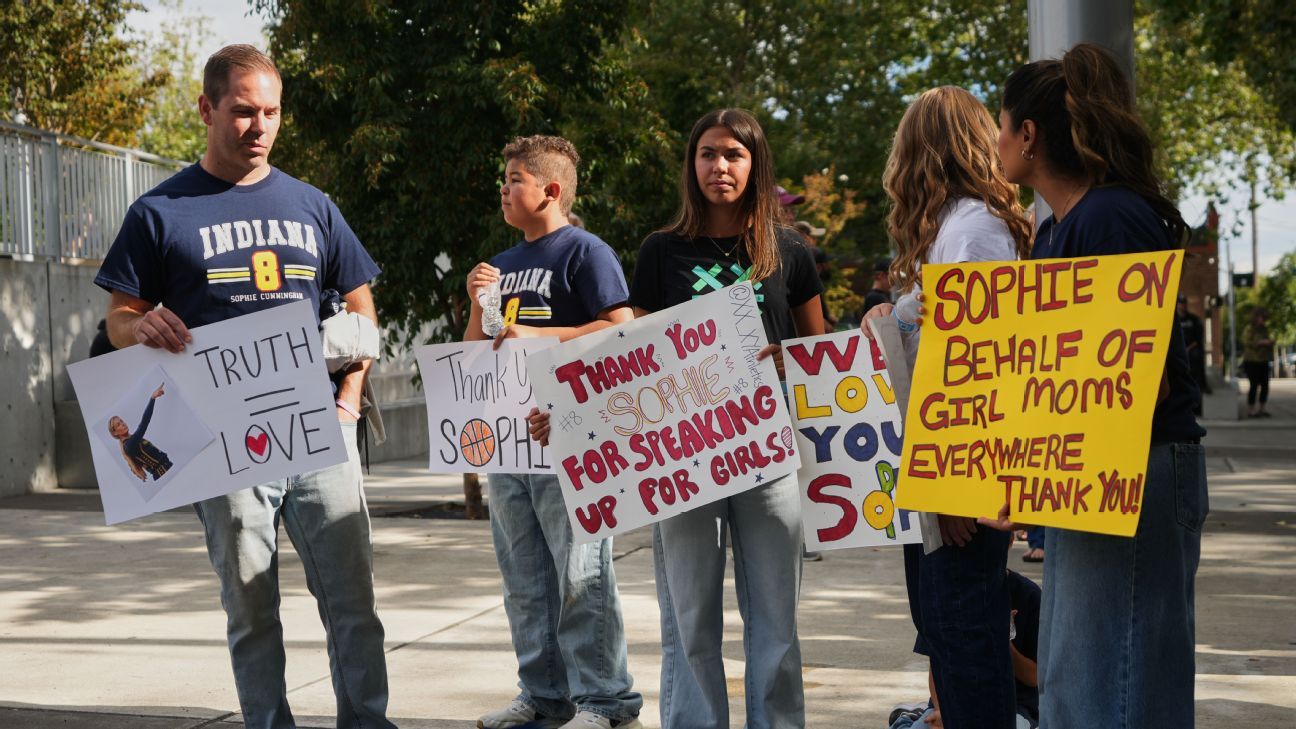
EmailPrintOpen Extended ReactionsA few dozen people gathered outside of Tuesday's Indiana at Seattle WNBA game to express support for a ballot initiative that would bar transgender students from participating in girls' athletics at schools in Washington.Two of them, who identified themselves in an online interview as 16-year-olds, later attended the game wearing T-shirts from the brand XX-XY Athletics. They also held a sign thanking Fever guard Sophie Cunningham, who has been vocal about the issue for "speaking up for girls."The way any person, organization or league should manage such a thing (no matter what side of the ballot initiative the girls were on) is to ignore it and accept that (gasp) people can have honestly held opinions.Instead, Seattle co-owner Celeste Keaton confronted the young fans."She told us we were f---ing insane," one of the girls told political commentator and podcast host Brandi Kruse."[She said,] 'You need to stop pulling this,'" the other said.The Storm later issued an apology for Keaton's actions: "We remain committed to creating a welcoming and respectful environment for anyone who attends a Storm game." The WNBA jumped in and issued a fine and five-home game suspension for the owner.Good for the league, which desperately needed to signal a measure of common sense.It will, however, do little to calm the, ah, storm.Keaton's bullying act turned something small into something potentially quite big, all but encouraging fans and politicians in other cities to stage similar demonstrations and wave signs of their own.After all, according to a 2025 New York Times poll, 79% of Americans believe transgender female athletes "should not be allowed to compete in women's sports." The issue isn't close. You think politicians are going to sit out the chance to villainize the WNBA, especially in an election year?Yes, there is a reasonable complaint that dishonest actors sometimes unfairly use the WNBA as a political pinata.Also true: The league too often hands them a stick to swing.All of this came just days after an All-Star Weekend, when the discussion centered on how the WNBA needs to focus on actual basketball rather than wedge issues. So much for that.One problem is that Keaton represents a part of the league -- players, coaches, executives, media, etc. -- that seems to believe that not only should every player, and apparently every fan, agree with them on every issue, but that everyone has an obligation to express that opinion publicly.Except not only does not every player think the same way but many simply don't want to say whatever it is they do believe. Real people, even women's basketball players, are allowed private thoughts. Demanding someone "speak up and dribble" is no better than the alternative.Perhaps not coincidentally, the league's most popular player, Caitlin Clark, is mostly nonpolitical in her comments and actions. This seems to enrage many who wish they had her platform to sway public sentiment, although the power of celebrity opinions is highly questionable.Clark is constantly being told to not merely take a side, but to denounce whatever someone said or did or wrote on social media that the league establishment disagrees with, like any of it is her responsibility.The WNBA purity tests aren't just pointless, they are counterproductive.The league has grown quickly in recent years, from an often overlooked entity to what will, by 2030, be a 18-team operation (up from 12) playing a 50-game schedule (up from 30 to 34). Perhaps the only thing that can stunt growth is continuing to insult customers.While there was a sizable contingent among longtime supporters who enjoyed the like-minded community the league could provide, it was never homogenous -- television ratings were consistently bolstered by fans of men's basketball eager for games to watch each summer.Now everything is new, bigger and more diverse. These are incredible athletes competing at the highest level. Support what they do on the court instead of trying to police what they (and their fans) think off the court.