
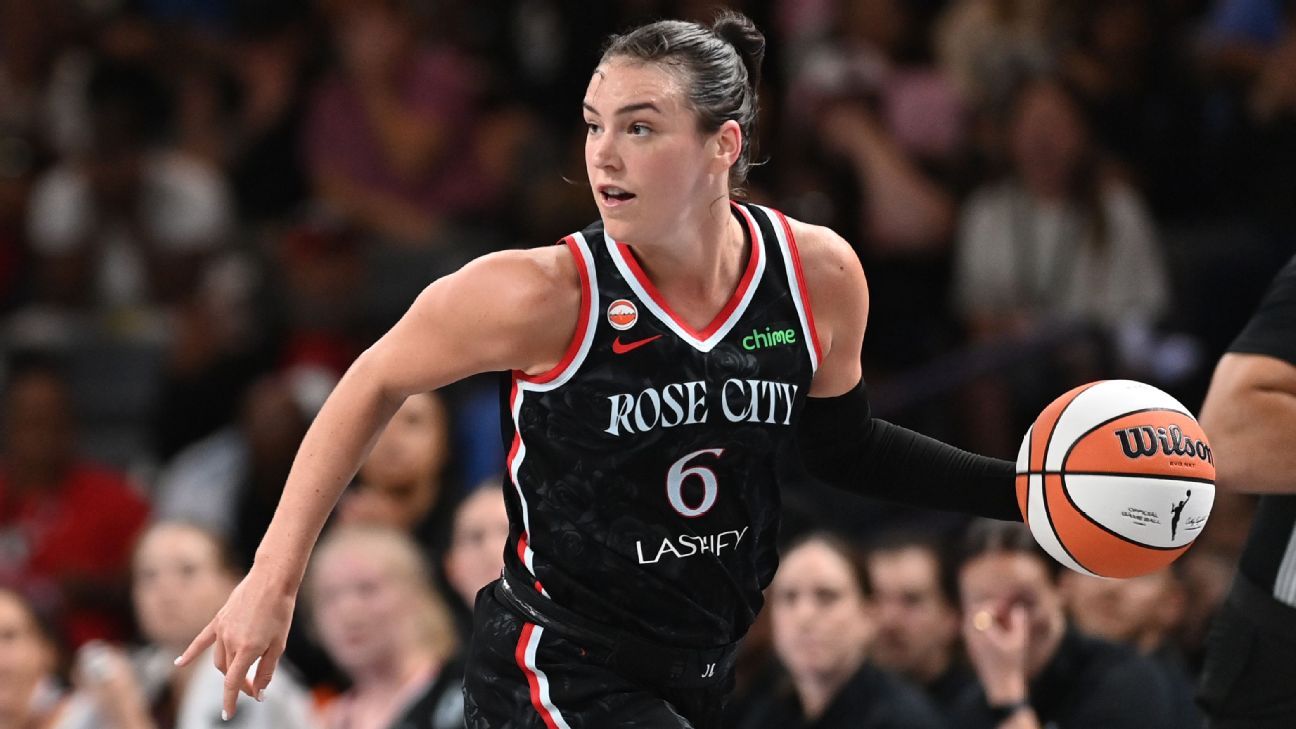
EmailPrintOpen Extended ReactionsPORTLAND, Ore. -- Bridget Carleton always liked algebra class growing up. Solving for X, the unknown variable, never felt like a task. She liked how there was always an answer with a clear solution. Going through all of the different scenarios to find X stimulated her brain.Even though she aspired to be a professional basketball player, she never questioned how she would use mathematical equations in real life.Now in her eighth season in the WNBA and first with the Portland Fire, one of the league's expansion franchises this year, almost every day for Carleton is reminiscent of those eighth-grade math classes.The Fire organization is centered on a training concept called the Constraints-Led Approach, or CLA, in which first-year head coach Alex Sarama is a leading expert. At its core, CLA is about practicing with more variability. It's knowing the shot you are supposed to take, but with different obstacles in the way -- how you get there is unknown, like solving for X."In basketball, there is always an answer," Carleton said. "Maybe there's not just one right answer, but there is an answer. So how do I put myself in the position to find the solution?"Instead of traditional training, in which an athlete learns and repeats the same movement multiple times in a structured drill, CLA is built around game-like situations and features different rules -- or constraints -- that force athletes to make adjustments.A constraint can range from the size of the ball the players practice with to the number of steps they are allowed to take to how much time they have to get off a shot."It's a boundary," Sarama said. "We want to create very specific boundaries in the activities, and that's how they'll become more skillful."CLA training in sports has been around for decades, though it's more popular in Europe, particularly in soccer and rugby. The Los Angeles Dodgers have adopted the method in the past few years. Kelsey Plum, the Los Angeles Sparks guard who ranked second in the WNBA in scoring before an injury last month, and Victor Wembanyama, who led the San Antonio Spurs to the NBA Finals, have incorporated it into their training.What sets the Fire apart is that everything they do is rooted in the Constraints-Led Approach, from practice sessions to rotation patterns to their rest and recovery. Over two months into its inaugural season, Portland has already won double-digit games, and though the Fire currently sit three games out of a playoff spot, everyone around the franchise believes CLA is exactly what the team needs to make its mark in the WNBA."To do something special, you have to make a bold start and make sure players are developing," Sarama said. "That's why I think [CLA] is so perfect here."SARAH ASHLEE BARKER grabbed an offensive rebound against the New York Liberty and darted to the far corner. With a defender closing quickly, the Portland guard turned and launched a 3-pointer. She was off balance and her body was still partially facing the baseline instead of the basket."I would never have thought to take that shot before in my life, but all of a sudden it was second nature," Barker told ESPN. "I was coming down the floor just screaming 'CLA, CLA, CLA.'"One of Sarama's main goals in his CLA training is to make games feel easier than practices. So he throws what can feel like unsolvable constraints into all of his drills.For example, when the Fire work on finishing around the rim, Sarama instructs the players to finish high off of the glass -- as if shooting over someone of Wembynama's 7-foot-4 height -- but the players' shooting hand can't go above their nose, and they have to finish off of two feet.In shooting drills, players will start by taking a standstill shot, but the next one is attempted fading to the right, then backpedaling into it, then peeling out. Sarama sometimes makes the players twirl and then release their shot, or have a defender close out with no warning. They practice shooting with five balls -- the standard WNBA size, the NBA size, the 3-on-3 ball (which is the size of a WNBA ball but heavier), a slippery ball and a small ball.All of this is built on CLA's principle that there is no such thing as muscle memory because in basketball, players will never get the same shot or look twice. Instead, they need to be able to adjust to any situation."That way, when we're confronted by particular situations, it's easier because we are more adaptable," Sarama said. "If you've only practiced in a rigid way where you've just done the same shot over and over and over again, guess what -- when you have A'ja Wilson closing out on you, and you've got to shoot it quicker and higher, you're not going to be able to because you've never practiced it."In a June practice session, players paired up and played a sort of tug-of-war with a dowel, where the goal was to maintain balance while each partner tried to shake the other's center of gravity. Sarama and assistant coach Sefu Bernard likened it to an opponent trying to displace a player on a box out, fighting for positioning on a rebound or waiting to be passed the ball down low."When I do get an on-balance shot in games, it feels easier than anything I've practiced," Barker said. "I don't ever feel in a game, 'Oh, I haven't seen that.' No, we do it in practice all of the time."PORTLAND'S PRACTICE VIDEO went viral in late May as players were captured shuffling around the court in their socks. Players, coaches and fans around the league took notice, and for some people who have been around the WNBA for 30 years, it seemed unserious.But Sarama and his staff had a reason."If I take off their shoes, they're less likely to jump because it's more slippery. That becomes the constraint," Bernard told ESPN. "When we took the shoes off ... [they're] exploring different movements their body normally wouldn't do."Drills like that are a part of what is called "differential learning," which challenges athletes to explore various ranges of motion or how they move their bodies in unfamiliar situations."Differential learning is unique; it's talking about going to the extremes," Bernard said. "That's what people latch on to and think is gimmicky. But CLA says, how do we make it representative [of game situations]." The Fire say there's a misconception around CLA -- that everything they do is a gimmick, that their style of play is a free-for-all, that there is no structure to their practices or game plans, and players simply react on a whim.In fact, Sarama said, exactly the opposite is true."We actually want to avoid randomness at all costs," he said.Offensively, the Fire average the longest average touch length in the league at 3.5 seconds, meaning they hold the ball the longest and pass the least. But when they pass the ball they make it count, with 17% of their passes leading to a potential assist, the highest rate in the WNBA, per ESPN Research.Their scoring is driven by attacking inside, making the second-most shots in the paint -- but outside the restricted area -- per game this season. Guard Carla Leite is the main initiator for Portland's attack-style offense, averaging 16.1 drives per season, which leads the league."I like Portland's team, I think they are feisty," Las Vegas Aces coach Becky Hammon said. "They compete really hard for 40 minutes, so you have to match that energy and that emotional level they play at."To maximize effort, the Fire have a deep, 10-player rotation, but each player in on the court about only four minutes at a time. Then they check out and rest for two to three minutes before returning."I look at it as I don't have time to take a play off," Barker said. "I've got four minutes to give it everything I have and then I'll rest. If I'm playing 38 minutes a game, sometimes you would take off a play. Sometimes you're thinking about how you are going to save energy. But here I'm not saving anything because I know I will have time to rest."Communicating the "why" in all of Sarama's decisions has been crucial to earn his team's trust. He always has a tape recorder in his pocket during huddles and practices, tracking everything he says to his players. At the end of each day, he listens back to his words to make sure he was as clear as possible."Am I saying the right things that will make it easy for them to come out and really understand the intentions of what we're trying to do more of?" he said.The Fire's film sessions feel more like a classroom where participation is a must. Players are constantly asked to turn to the person next to them and to work in small groups to brainstorm about the concepts they are going over in the clips. Then Sarama calls on individuals to present their ideas before he briefly shares his points of emphasis.And he never tells them what they say is wrong. Sarama wants his team to be collaborative. He wants his players to feel as if they have a voice. He wants them to know that as he throws them into a different training system than anything they've experienced before, they also have some control."We trust Alex so much and that's because he has shown so much trust in us," Barker said. "It makes you want to be open and trust what he's trying to do."BEFORE THE START of the regular season, the Fire players, coaches and front office members traveled to Eugene, Oregon, about two hours south of Portland, for a team bonding trip.As a new team -- and one put together during an abbreviated offseason -- it was important to get to know one another away from the court. Each attendee stood in front of the group and introduced themselves, trying to shed light on who they are beyond the sport they've dedicated their lives to."There were tears involved, there was a lot of emotion," Barker said. "To hear how passionate and grateful [everyone] is to be here ... everyone has a unique story and we are all here for a certain reason."Portland's roster is built by players who were the fifth, maybe even sixth, option on their former teams, and international players. General manager Vanja ernivec's tactics raised eyebrows after the expansion draft, and the Fire started the season as the consensus No. 15-ranked team."We're a bunch of overlooked players, and I think we all have a chip on our shoulder. You know, I've really never been respected as a basketball player until I've gotten here, so I'm thankful for this team, this organization," center Megan Gustafson said through tears in a postgame news conference after the Fire beat Indiana in late May. "They really believe in me."The Fire aren't the first expansion franchise to surprise people. The Golden State Valkyries -- whom ernivec helped build as their former president of basketball operations -- did it last summer when they became the first expansion team to make the playoffs in their inaugural season.Portland hopes to carve its own early path to success, but the Fire -- who previously played three seasons in the WNBA from 2000 to 2002 before folding -- didn't set end-of-season goals. There was no talk about what record they wanted, let alone the idea of reaching the postseason. The only goal they set was to make the culture a desirable place to be, and an environment that breeds growth."Out of the whole league, the whole WNBA, if you want to truly develop and get better, there [should be] no question in anyone's mind that Portland is where you need to be for that," Sarama said.But to be successful in Portland, there's also a requirement to surrender to something new and buy into CLA training."In the two to three months that I've been here, I've learned more than in the past two to three years of my career," Barker said. "So now just imagine two or three years from now. I'm excited for that."