
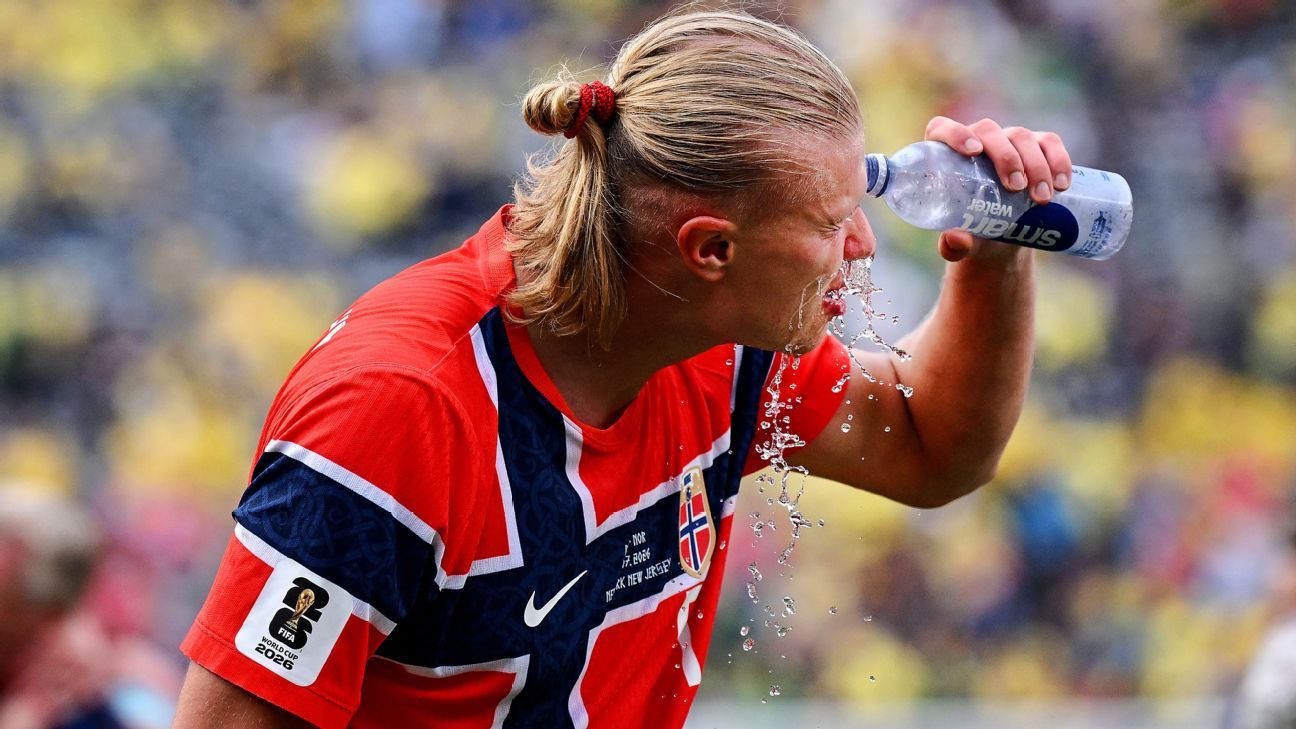
EmailPrintOpen Extended ReactionsThe legacy of this summer's World Cup is not likely to be political interference or referee conspiracies that benefit Lionel Messi. It's going to be hydration breaks.The three-minute breaks midway through each half, which FIFA mandated for every game at this year's World Cup but are not yet ubiquitous throughout soccer, are likely to become a key topic in media rights negotiations going forward, according to interviews with more than a dozen media and soccer executives in the U.S. and overseas. Fox, which is airing the tournament in the U.S. this year, will make at least $250 million on the hydration break ads alone, according to The Hollywood Reporter."It would be hard to move backwards once hydration breaks have been shown to work because of the dollars associated with it. And if it's not hydration breaks, it will be something else," said David Levy, the former president of Turner who once negotiated with UEFA and who now runs the sports marketing agency Horizon Sports & Experiences.This World Cup has done something that American media executives have long wanted to do: more effectively monetize a global sport that doesn't have the same amount of natural ad breaks as football, basketball or baseball. Even as plenty of fans have expressed their displeasure, and players and coaches have bemoaned their impacts on games, the breaks have been a boon for networks and advertisers. Coming out of this World Cup, they also raise questions about the sport's future: how aggressively American domestic leagues incorporate the breaks; how European leagues address a flattening of broadcast rights money; and how much influence the U.S. has on the global game."It's not going to happen overnight," said Charlie Methven, a former English soccer chief executive. "But as the linear TV model continues to come undone there are only a small number of levers a league can pull to make the numbers work to increase your broadcast rights fees."Or as another media executive put it: "This is found money for soccer, where companies can reach a captive audience during the most important parts of the game. There are media companies salivating at what Fox has been able to do."FIFA first introduced cooling breaks at the 2014 World Cup in Brazil after a labor court mandated players rest during games when temperatures reached 89.6 degrees Fahrenheit. Today, most worldwide leagues have rules for breaks in the flow of action that are dependent on the weather forecasts or given at a referee's discretion.In December, FIFA announced this year's World Cup would include three-minute breaks in each half regardless of the weather (and also inside climate-controlled stadiums). That allowed Fox to sell ads ahead of time, fully monetizing the breaks, and offering advertisers their first chance to reach fans at the most valuable moments of the game: during the run of play. According to the Wall Street Journal, the ads are selling for anywhere between $200,000 and $750,000 a spot. In some cases they have fully cut to commercial and in others they have run split-screen ads. (In some countries, broadcasters have chosen not to cut to commercials.)This new dynamic comes at a vulnerable moment for several global soccer leagues and their media rights. France's top domestic league, Ligue 1, has suffered through a series of failed broadcast partnerships that have left the league to launch its own direct-to-consumer platform. One recent estimate pegged the French league's TV rights' value at just 150 million euros to 250 million euros (about $171 million to $286 million). And across Europe, broadcast revenue is mostly flat. None of the top soccer leagues' media contracts have seen recent major increases like those of the biggest American leagues (see the NBA and NFL).Additionally, everyone is chasing the Premier League. According to accounting firm Deloitte, the Premier League was set to generate 7.4 billion pounds ($10 billion) in revenue this past season, more than double the Bundesliga ($4.9 billion), LaLiga ($4.8 billion), Serie A ($3.4 billion) and Ligue 1 ($2.2 billion). Still, Deloitte noted that profits are falling in the Premier League, as well. (Breaks would certainly not fill those gaps alone but would be a key part of a wider commercialization push.)The leagues have responded by looking for new ways to generate broadcast revenue. La Liga sold an 8% stake in its broadcasting and media rights for 50 years to the private equity firm CVC Capital Partners for about 2 billion euros. FC Barcelona, one of the most recognizable clubs in the world, sold a 25% stake of their portion of LaLiga TV rights for 25 years to the investment firm Sixth Street.The Bundesliga attempted a similar plan for its media rights, but abandoned it after a fan revolt."You're going to have this conversation between executives of the league and the teams where they say, 'The bad news is TV revenues are going to go down by 10%,' and the clubs say, 'What can we do?'" Methven said. "And the answer is, 'Well, we can allow TV partners to have an extra break.' That's where the rubber hits the road. How determined are the clubs within the leagues to maintain their TV revenues versus doing something that is really going to piss off their fans?"The pressure on the media rights in secondary leagues is already pretty intense. The French have already lost a TV deal. And it's widely expected that Italian leagues are under pressure. So you're already seeing clubs living with lower TV revenue."Given its history and financial might, the Premier League would almost certainly be the last place to adopt a change, executives agreed, noting specific hurdles such as government regulation over how commercials are shown on TV in the U.K. Plus, during the season, temperatures in England rarely reach higher than the 60s in Fahrenheit. The executives also noted the fan backlash to Germany's attempted private equity deal and team ownership rules that give fans more control.While breaks are less likely in those countries, the executives believed that leagues in France, Italy and Spain would be more likely to take a hard look at generating more broadcast revenues, suggesting the breaks could be rebranded as tactical rather than health-related and sold to fans as a way to improve game strategy. (On Fox, the stoppages have been called "Match Breaks," branding that specifically goes beyond hydration. Though one potential wrinkle here is that if the breaks go beyond player health, they could require official rule changes needing input from governing bodies and player associations.)A spokesperson for the Premier League declined to comment for this story. A person with knowledge of the league's thinking said it was not considering adding any new breaks. A UEFA spokesman said it had no plans to add breaks for upcoming tournaments that it runs: the 2028 Men's European Championship and the Champions League.La Liga declined comment. The Bundesliga, Ligue 1 and Serie A did not reply to requests for comment.Matt Drew, who negotiated international soccer rights deals when he worked for DAZN, said wider adoption of breaks was probably coming in the long-term, but added, "There are a lot of local nuances to pick through in Europe, and we've seen visceral reactions to fans responding to owners forcing through things. Spain would be the place I'd look to because they are focused on the U.S. market."For MLS and NWSL, it clearly makes the most sense."Indeed, in the United States, both the top domestic leagues -- Major League Soccer and the National Women's Soccer League -- will be negotiating new media deals in the next several years. Both leagues already have policies in place for extreme heat but have talked extensively about building on and monetizing the momentum from this summer's World Cup. Major League Soccer is cutting short a broadcast deal that put nearly all its games behind the Apple TV paywall."It will be difficult to resist it," said one soccer executive who works with Major League Soccer. "MLS has this big opportunity after the World Cup, and they have a next round of media rights to be able to bake in some breaks. They want to be able to unleash owners to invest in their squads and find media partners to invest along with them, so this would be a smart way to do it."In a statement to ESPN, MLS spokesman Dan Courtemanche said, "We have not discussed any changes to [the league's hydration break] policy, but as we do each year, we continually review all aspects of our competition."More broadly, MLS has a long history of creating and testing innovations that improve the game," including requiring players to be treated for injuries off the field and limited time for subbed players to leave the field, both of which he said are now being used in the World Cup.An NWSL spokesperson said: "Any commercial decision that we would make would be rooted in player safety. It's too hard to evaluate the hypotheticals right now. We're evaluating the situation in the World Cup and not changing anything we do today. We will continue to monitor."Kara Nortman, a co-founder of the NWSL's Angel City FC and managing partner of investment firm Monarch Collective, said teams and leagues could try to incorporate breaks to their benefit."There is nothing more important than the sanctity of the sport. Balancing player well-being with the commercial side of the business may be equal realities in today's game," she said in a text message. "If this does become permanent, think strategically about how this can benefit the game from not just a revenue perspective, but also from a player-health perspective and fan-engagement perspective. Have it drive growth and competitiveness."And in the immediate, is it terrible to give these athletes a chance to drink water?"Levy, the former Turner executive, recalled haggling with UEFA a decade ago over how much Turner could monetize their Champions League rights. The network was set to spend hundreds of millions of dollars and wanted more commercial integration in the broadcast, perhaps some picture-in-picture advertising or more display banners. UEFA held firm, he said.The importance of American media companies to global soccer has evolved since then with more leagues turning to the U.S. for lucrative broadcast contracts. A decade ago, the World Cup received less than 10% of its media rights money from the United States, according to media analysis firm Ampere Analysis. That number is near 25% today and could increase even more in future deals. For the UEFA Men's European Championship, that figure is up to 15% from less than 10% a decade ago. The Premier League has gone from getting around 5% of its broadcast revenue from the United States to 10%, according to the analysis. (Multiple industry experts suggested that hydration breaks could be worth tens of millions of dollars to NBC for its Premier League coverage, for example.)Methven said he thought those percentages would need to reach 30% in order for American broadcasters to have a larger say on league business. Derek Aframe, an executive vice president at the sports marketing conglomerate Octagon who has worked with sponsors at the World Cup for decades, suggested that influence is coming."There will be more and more receptivity for American companies, consumers, broadcasters to continue to refine a sport that incorporates some of their desires," he said.U.S.-based broadcast companies have a long history of revolutionizing how viewers see ads during live sports. ESPN, for one, was the first to use CGI to cover up logos on the dasher boards of hockey rinks and replace them with logos of television partners, according to Forbes.Drew said that as streamers like Netflix and Amazon attempt to build global advertising businesses, the breaks could be valuable to those companies, too. Fox, CBS, NBC, ESPN, Netflix and Amazon all declined comment when asked how added commercial breaks in soccer would impact its value as a media property or if they had plans to discuss them during rights negotiations.Even those skeptical of wider adoption said soccer leagues will be discussing them, whether they want to or not."The hydration break is so contentious that it can be used as a stalking horse to allow other forms of commercialization," said Murray Barnett, a media rights executive based in the U.K., noting things like more sponsored replays or graphics. "The threat to do hydration break advertising would encourage people to be more flexible about other commercial integrations."