
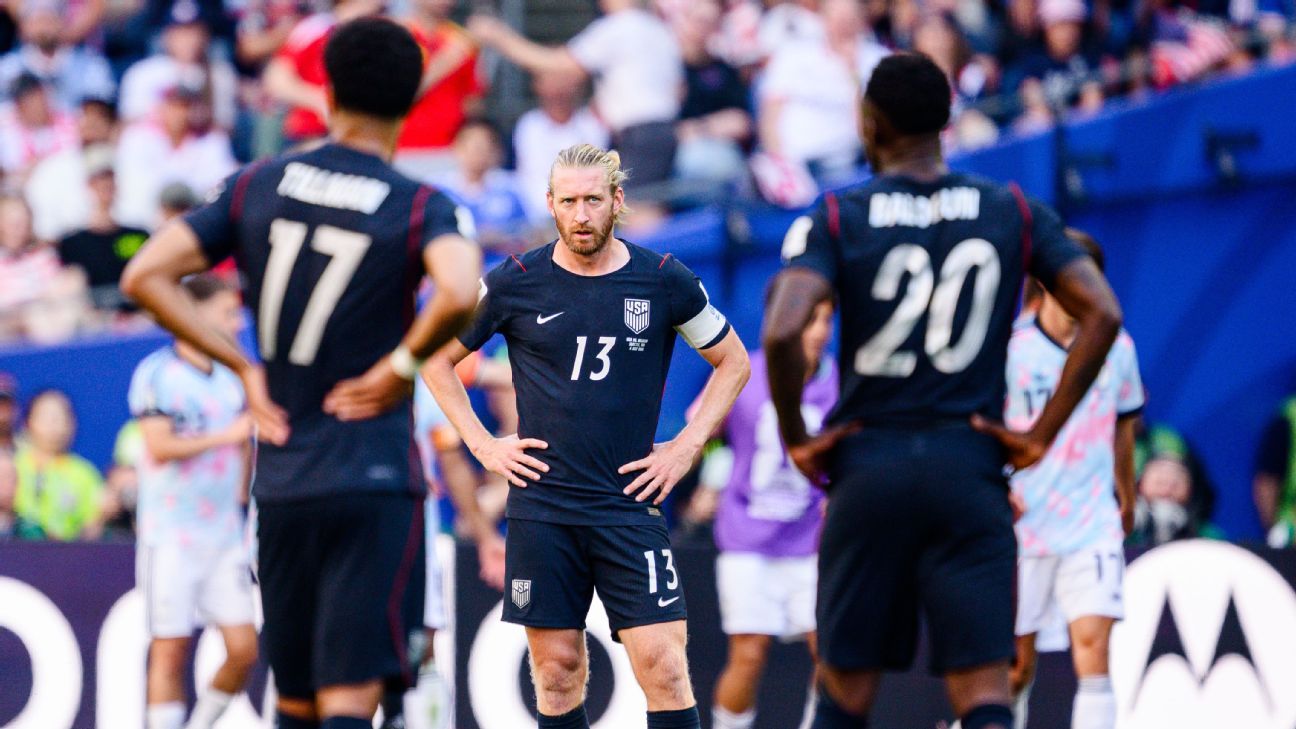
EmailPrintOpen Extended ReactionsFollowing the arc of the U.S. men's national team's performance at this FIFA World Cup is enough to induce whiplash. Everything started out so well, with an emphatic 4-1 defeat of Paraguay. Solid wins against Australia in the group, and then Bosnia-Herzegovina in the round of 32, were sandwiched around a defeat to Trkiye that meant nothing in the group standings, and that revealed little considering how many changes coach Mauricio Pochettino made to his starting XI.And then the bottom fell out in the round of 16 with a 4-1 defeat against Belgium that was just as deflating as the Paraguay win was resounding. It was as if the U.S. did its homework, aced the quizzes, and then bombed the final exam.So when it comes to handing out grades, it all depends on how much weight one puts on that final. Here's how the USMNT's report card reads.- O'Hanlon: Let's face fact that U.S. failed because of its players- Borden: U.S. will look at World Cup as a missed opportunity- Reaction: Belgium hand U.S. a reality checkPHYSICALITY: B+By just about any measure, the USMNT was among the fitter teams at the World Cup through the round of 16. Granted, there are some caveats. The U.S. played in near-perfect weather, with two games each in the Los Angeles area and Seattle. The roof at SoFi Stadium meant that the sun didn't beat down with the same intensity as it did at other World Cup venues.In addition to the mild temperatures, the U.S. didn't have to play in any adverse weather conditions, like heavy rain, nor did it have to contend with altitude.Style also plays a part in the amount of running the USMNT did. Pochettino's side took a high-pressure approach that involved intense running, and data provided by FIFA bears out just how much running the USMNT did. The U.S. ranked fourth out of 48 teams in average speed at 6.23 km/hour. The team ranked eighth, both in terms average distance covered per game (118,979 m) and in the number of sprints per game (489.2 m).It's worth noting that one team that ranked above the U.S. in all of these categories was Belgium. It reiterates that as athletic as this U.S. team was, it was at a deficit in this department against the Red Devils, especially in the center of the park in going up against the likes of Dodi Lukbakio and (before he got injured) Amadou Onana. As one source, who asked not to be identified in order to preserve relationships, put it, "When better teams match or better your work rate, you're dead."Overall, the U.S. competed well on the athleticism front, including against physical sides like Australia and Bosnia, but the Belgium match showed there are still improvements to be made.TACTICAL APPROACH: B+Pochettino's high-pressing style has long been his trademark, inspired by the influence of Marcelo Bielsa and Gerardo "Tata" Martino. While it took a while for Pochettino's concepts to take root, the U.S. players eventually bought in.There can be few complaints about the personnel Pochettino picked to implement his scheme. Sure, there was some concern when the U.S. manager announced his roster on May 26 that the team was light in midfield, but when it came to lineup choices in that part of the roster, the USMNT wasn't terribly stressed.In attack, in addition to the high press, there was an emphasis on wing play, which made sense considering it played to the team's strengths. Christian Pulisic remains the team's most talented attacking player, and the decision to push Sergio Dest forward was the right move, given his limitations on the defensive side of the ball.Defensively, Pochettino deployed Alex Freeman as a hybrid center back when in possession, and an outside back when defending deep. Freeman added some additional athleticism to the backline (he was one of the few players to come out of the Belgium game with any credit), and it allowed Antonee Robinson on the opposite flank to get forward.Pochettino's tactics did run into some limitations against a more talented Belgium side, but overall, the logic underpinning his decision was strong.TACTICAL EXECUTION: C+On the surface, the U.S. approach worked a treat. The USMNT scored 11 goals, blowing away the team's previous record of seven in a single World Cup. The team's three victories set another record. The USMNT's approach seemed quintessentially American; aggressive, on the front foot and confident.Defensively, the U.S. allowed 10.15 passes per defensive action (PPDA), the sixth-best mark in the tournament through the round of 16. It was a sign that the USMNT was winning the ball back quickly and that the press was working as advertised. The first four games involved some impressive performances."When you start the World Cup off on the front foot with energy to create some chances and get some goals, then that's big. That creates momentum," former USMNT manager Bob Bradley told ESPN. "That created tremendous excitement in the country in the World Cup where you're hosting."But in other ways, it was papering over some cracks. The U.S. benefitted from two own goals, though, to be fair, those were the result of aggressive play. The USMNT scored five goals from set pieces. After the Paraguay game, the U.S. managed just one goal from the run of play, that being Folarin Balogun's tally against Bosnia."With all of our good play, I still felt that our ability to create chances in open play and have different ways to get into the box and create chances was [a concern]," Bradley said. "And then ... there were moments [in friendlies] against Germany and Senegal where the connection defensively and the fact that in some moments guys tuned out or ball watched. And some of the situations that came up in those games still were concerns on what would happen when you played better teams down the line."Those concerns came to pass and are borne out by some of the numbers. The Americans' expected goals (xG) per game for the tournament was 1.2, which tied them for 23rd out of 48 teams. Against Belgium, some lackadaisical play in the USMNT's defensive third allowed the Red Devils to score two first-half goals.With Belgium often bypassing the U.S. midfield and playing direct to win second balls, the USMNT's press wasn't as effective. The U.S. was losing more duels as well, winning just 44.4% in the first half. And with an athletic Belgian side on the field, there wasn't a way back for the Americans.It points out that, yes, tactics matter, but they only take you so far.PSYCHOLOGICAL PREP: CThis is one area that could be split into two phases: pre-Belgium, and everything that happened after.First, credit Pochettino for fostering an incredible team spirit that had every player pulling in the same direction. This was visible in the training sessions that had plenty of smiles on players' faces, as well as the way they closed out the Bosnia match playing the last 35 minutes with 10 players to secure a 2-0 victory.U.S. captain Tim Ream lauded the way Pochettino brought the players together. "He cares, massively," Ream said of his coach. "He cares massively about the players. He cares massively about the group, the entire staff. He cares beyond what anybody can even imagine."Ream added, "[Pochettino] understands, and has created this connection with each individual player by having these conversations, studying and looking at their body language. And just making sure that we're all in such a good place, mentally, physically, emotionally and this entire staff have created that that atmosphere."And then Belgium happened.Sure, the Red Devils played superbly on the day, and manager Rudi Garcia's tactics were spot on. There has also been plenty of speculation that the uproar over Balogun's postponed red-card suspension created motivation for Belgium and weighed heavy on the Americans.In terms of the latter assertion, every player, staff member and executive within the U.S. camp that ESPN spoke to for this piece, six in all, denied that played a part in the loss. But the eye test told a different story."You're preparing for [Ricardo] Pepi and then last second, literally, you've switched to go with Balogun. That's a big change for everybody," said one former MLS manager who asked not to be identified. "Then you put all the controversy around it. It's impossible for human beings not to have been affected."What isn't in dispute is that the U.S. team's body language was all wrong -- passive even, as if it was waiting for something to happen instead of making it happen. The U.S. no longer had the instinct to look to play forward."It was the worst warmup I've ever seen. The whole thing looked off," said another source who was at the match. "No energy, no jump."That points to mentality, and some kind of psychological weight that affected the team. That it fell apart so quickly doesn't reflect well on the USMNT, and will leave a scar on those who took part.OVERALL FINAL GRADE: C+During the run-up to the World Cup, the question was often asked: What would success look like for the USMNT? The team's performance doesn't provide a black-and-white answer.For a time, the USMNT captivated the country. There is little doubt that the sport will benefit from the public being presented with a smorgasbord of soccer for six weeks. The USMNT fueled that passion. There's also no disgrace in a round-of-16 finish. Simply put, the U.S. team met expectations. Belgium was just better.However, the manner of their exit cuts deep.Contrast the departure of the other World Cup co-hosts, Mexico and Canada. El Tri went out like warriors, expending every last drop of sweat in their defeat to England. Canada went whole hog at Morocco, with the final 3-0 score flattering the winners to a degree. The memory that will linger the most for the U.S. is the last match, with the Americans standing in a midfield huddle afterwards wondering how it all went wrong.Now the USMNT must start again, and search for ways to climb up the international ladder.