
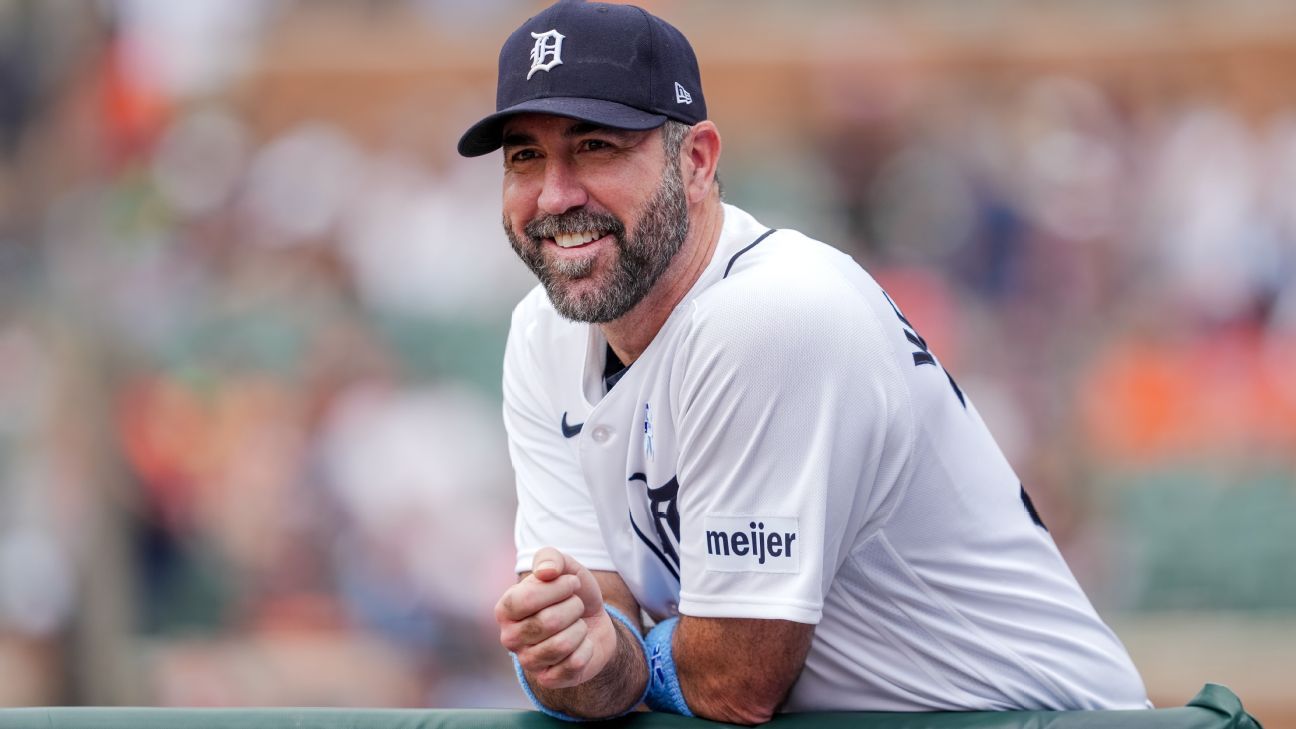
EmailPrintOpen Extended ReactionsAnd then there was one and, soon, none.With the news that Justin Verlander has decided to retire after this season, the days of the old-school ace are drawing to a close. For a generation, Verlander, Clayton Kershaw and Max Scherzer compiled Hall of Fame resumes that would not look out of place in any era of baseball history. But for the aces of the current and future generations, it's an open question as to what those resumes will look like.Verlander's announcement is just the latest shoe to drop. Kershaw, then 37, retired after last fall's World Series, save for some bullpen work for the United States team in the WBC, and now Verlander, 43, is following. Meanwhile, Scherzer, 41, has suffered through back injuries all season and has a 10.23 ERA in just six outings. Hopefully he bounces back, but at the very least we can surmise that Scherzer, too, is getting close to the end of his playing days.Thus we could be looking at the end of the era of the traditional ace -- the dominant No. 1 starter who could be counted on for both big volume and big performance.Ace pitchers will still be around -- Paul Skenes, Jacob Misiorowski, among others, are appointment viewing -- but their careers won't take the same shape. Their standards will be different, and when it comes to evaluating Hall of Fame pitching, we're already in uncertain times.If you create a list of the highest single-season innings pitched totals from active pitchers -- and include Kershaw -- you can see why I mark the news of Verlander's pending retirement in this fashion.Of course, most of the seasons on this list date back a decade or more. Indeed, Verlander, Kershaw and Scherzer all long ago reconfigured their games to fit with the new paradigm of starting pitching. Verlander once touted his ability to manage his effort early in games so he'd have plenty left to work deep into outings. A few years ago, he ditched that practice and went to the max-effort approach demanded of all pitchers, all the time, in the current iteration of the art of pitching.That this list is so outdated is entirely the point. Verlander, in 2011, threw more than 250 innings while winning 24 games. Indeed, with some breaks early in that season, Verlander might have generated buzz about becoming baseball's next 30-game winner. Everything would have had to go right, but during a 22-start stretch beginning in late May, Verlander went 20-2 with 1.75 ERA. Twenty wins in 22 starts -- from a pitcher who is still active, right now, if not for much longer. This season, the only pitcher in the majors on pace to win 20 is a reliever -- the Milwaukee Brewers' Aaron Ashby.Verlander's retirement also means the end of his quest to become the next -- and possibly last -- 300-game winner. He had stated it as a goal, at least obliquely, and said he wanted to pitch until he was 45. But, as both he and Scherzer have found, the problem with epic-length pitching careers, especially for a power pitcher who isn't named Nolan Ryan, is that even if your arm holds up, your body probably won't. Verlander has started just one game during his return to the Detroit Tigers this season, not because of arm trouble, but because of hip and hamstring injuries.In reality, Verlander, who has been sitting at 266 career wins since the end of last season, probably lost any real shot at getting to 300 a few years ago. When baseball restarted for its 2020 pandemic season, Verlander was injured after one game and subsequently missed all of 2021. He returned with a vengeance in 2022, going 18-4 with a 1.75 ERA for the Houston Astros, while winning his third Cy Young Award. But he was 39 by then, and too many starts had been lost.It is entirely possible that the last 300-game winner will turn out to be Randy Johnson, who joined the club on June 4, 2009. Who knows what sort of directions the game and its rules might take in the future, but if current trends continue, that club is now closed with 24 pitchers in its membership.That Verlander won't get there hardly diminishes his accomplishments. He won those three Cy Youngs plus an MVP award for that epic 2011 campaign. He's 24th in career bWAR for pitchers and 17th in wins above average. Only seven pitchers have struck out more batters. He's won 17 career postseason games while pitching for five pennant winners and two World Series champions.His Hall of Fame case? It's too much of a no-brainer to debate. He's been in for a long time and if he's not unanimous, it won't be because of anything related to logic or reason.Verlander will hopefully get back on the mound soon and add to those numbers, while going out strong in the Tigers uniform he wore when he was at his most dominant. He has been added to the American League All-Star roster so he can be honored next week in Philadelphia, though he won't pitch, and the rest of his season should be a long, lovely goodbye letter from the game.A few years ago, I wrote a piece wondering where baseball would find the next Verlander. Hard to believe that was eight years ago, but the central question remains more unanswerable than ever."That's a good question," Verlander told me back then. "I don't know the answer to that."Verlander also told me about holding up Ryan as a model when he was a young pitcher, and while it's nice to imagine some young hurler out there right now doing the same with Verlander, the fact of the matter is that it wouldn't matter if that youth wanted to be Verlander or Kershaw or Scherzer, as we knew them in their primes. Because the baseball industry, as it stands, would never allow them to become that type of figure, one of the traditional aces who have been among baseball's most celebrated figures for eons.With Verlander following Kershaw into retirement, and Scherzer not far away, that, as much as anything, is what we'll be losing.