
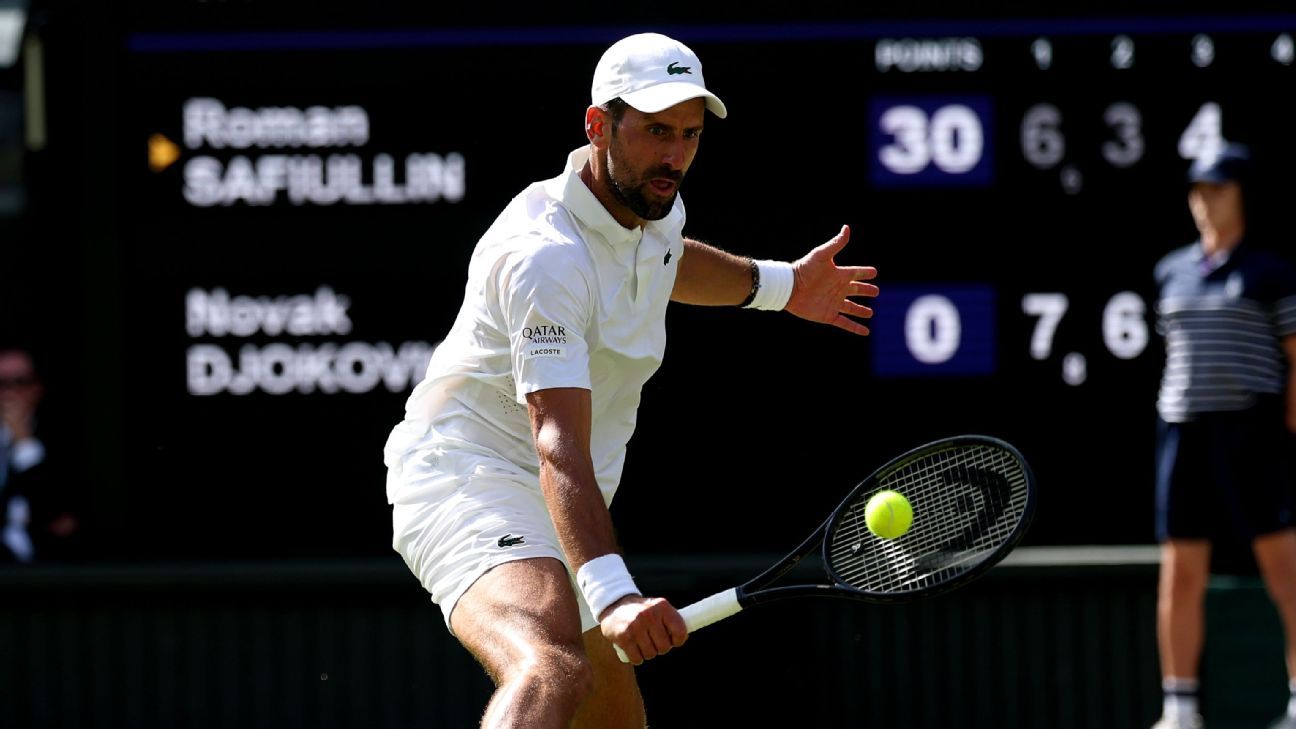
EmailPrintOpen Extended ReactionsWIMBLEDON, England -- In their third-round match at Wimbledon on Saturday evening, Grigor Dimitrov and Matteo Berrettini hit 128 backhand slices between them. It felt like a throwback to old times, when the slice was the go-to shot on grass, used so well by champions from Rod Laver and Martina Navratilova to Stefan Edberg and Steffi Graf.Zipping through the court, a good slice keeps devilishly low and causes opponents all kinds of trouble. Approaching the net from the baseline usually required a slice, the perfect way to produce a simple volley to win the point.Since the nature of the grass at Wimbledon changed in 2002, making conditions slower, the slice has gradually been overtaken by power, with the two-handed backhands ruling the roost. String technology and most recently, balls that become heavier and slower more quickly, have not helped either.But at Wimbledon, the slice is not dead. As Dimitrov and Berrettini showed, it can be a huge weapon; a winning shot, a return of serve, a defensive shot that allows players to get back into a point, or a clever tactic, a short ball that sets up an attacking position.Some players, like Germany's Tatjana Maria, who has won two titles on grass, hit the majority of shots with slice. In her first-round win over Yulia Putintseva, Maria hit 91% of backhands with slice and a remarkable 85% of her forehands with slice.The majority of slice is on the backhand, though. Dimitrov, who won the match in five sets, hit 81 of his 114 backhands with slice, or 71%. According to Rourke O'Shannessy, a Strategy & AI Data Analyst from Brain Game Tennis, that was the third-highest percentage in any match in the men's event.Only Berrettini, with 74% against Stan Wawrinka in the first round, and Dimitrov himself in his second-round win over Jakub Mensik (73%), hit a higher percentage of sliced backhands. In Saturday's battle on Centre Court, the Italian hit 47 of his 101 backhands with slice (47%). The men's tournament average is 26%. For the women, it's 22 percent.Many players use the slice regularly, and to good effect, including Novak Djokovic, who is bidding this year to equal Roger Federer with eight Wimbledon titles and claim a record 25th Grand Slam title in the process.Djokovic hit 25% of his backhands with slice in his first-round win over Wu Yibing and though his average through three rounds was just 19%, which is lower than the average of 26%, the 39-year-old says it is still a very useful shot."It's still effective, no doubt, because it's grass," Djokovic said. "Obviously the surface gets worse every single day when you play on it. Lots of bad bounces. If you are able to hit some chip shots, short slices or whatnot, it's actually a very good play."If you're not super-natural with it, it's not so easy to demand that from yourself. It's a super-important variety that you should possess on the grass, no doubt."Hotter than usual conditions at Wimbledon this year means the slice may grip a little more than when it's humid or damp. And Djokovic admits it has become more difficult to be aggressive with the slice due to changes in the balls themselves."There's some material, something that has changed that has affected the way the ball reacts nowadays," he said. "These balls that we use on the tour, also on the slams, they get slower. They were definitely slower in average comparing to, say, if I go back 10, 15 years ago, which means that the slice maybe isn't staying as low as it was staying earlier."The forehand slice is also useful, especially for blocked returns or when at full stretch, hacking the ball back into play, almost like a squash shot. The men's tournament average for forehand slices was just 9% as of Sunday morning, but Lorenzo Sonego sliced his forehand a whopping 31% of the time against Taylor Fritz in round three. Fritz has also been utilizing it cleverly."The chip returns have been great for me," he said. "Been slicing my forehand really well, chipping the forehand really well, putting a lot of returns in play with that. I think it's just the constant pressure of me serving really well and then putting these chip returns in play. It's pretty annoying for people to deal with."On the forehand, the women have been using a slice more than the men, with an average of 11%.Czech Karolina Muchova said the fact that the grass has slowed over the years means the slice needs to be struck with intent to be a winning shot."If you want to have an effective slice, you really have to play the slice [hard]," she said. "I try to sometimes play shorter, sometimes just like a defensive slice, a little bit higher to the line to gain time. Depends in what position, but a dangerous slice, I think it needs to have the speed."Former champion Barbora Krejcikova said the slice is written into her DNA."I think it's working on the grass, but I also think it's working on different surfaces," she said. "It's just something that I do. That's just how I play. I'm not really thinking about it, if it's working or not working. It's just something I do, and I want to play like that. It's something that's very natural for me. I'm obviously happy it's working."Statistics: Brain Game Tennis