
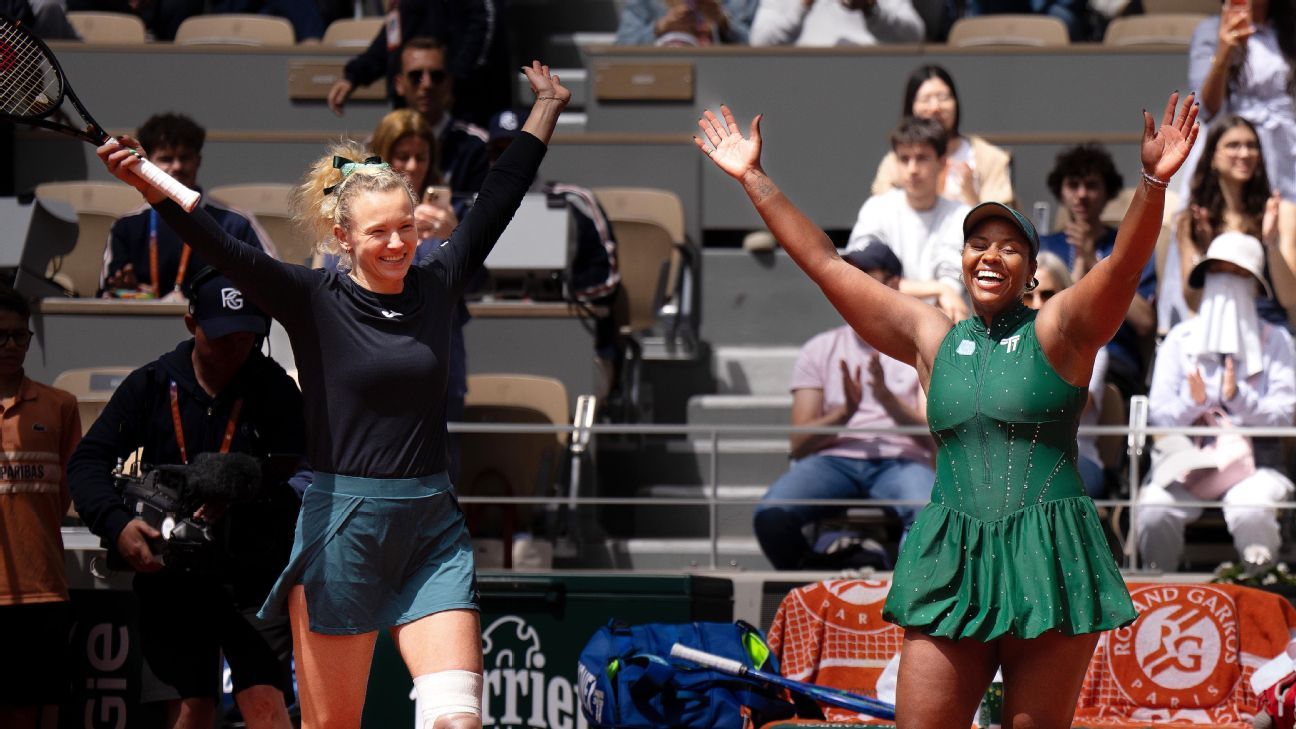
EmailPrintOpen Extended ReactionsLESS THAN A MONTH ago, inside the world's most famous clay court, Katerina Siniakova and Taylor Townsend celebrated by raising their arms to the heavens in unison.The duo had won the final point of their match to become the women's doubles champions at Roland Garros, with a 6-2, 7-5 victory over Anna Danilina and Aleksandra Krunic. It was their third Grand Slam title -- one on each surface -- and further solidified their status as the WTA's best doubles team.Since they began their partnership two years ago, Siniakova and Townsend have produced some of the most entertaining doubles highlights, leading them to No. 1 and No. 2, respectively, in the tour's doubles rankings. And they're both ranked inside the top 100 in singles, with Siniakova at No. 36, and Townsend, No. 79."Both of us are improving," Townsend said in Paris. "That's what's continuing to push us forward."The pair -- along with a handful of other notable players -- have found success in balancing the factors, from travel to scheduling to rest, that are required to win both singles and doubles matches. But it's not easy.Everyone on tour understands that the sport's biggest prestige and spotlight, where players are most often recognized and remembered, is in singles. In fact, Siniakova still plans most of her schedule -- training sessions, travel arrangements and which tournaments to enter -- with the intent of refining and polishing her skills in singles for better results.So why play singles and doubles? According to the dual-draw players at Wimbledon this week, playing both pays off in many ways -- and that's why some of the biggest names in the sport opt to do it."I always love to play more, actually," Siniakova told ESPN last week. "For me, doubles are fun. It's different and really nice to have a teammate. In the beginning of my career, I wanted to have matches. I wanted to play more and get to know those courts because everything was for the first time."You just feel different when you're playing a match than a practice match."WIMBLEDON'S WOMEN'S DOUBLES this year features a plethora of quality dual-draw players, some of whom have won a Grand Slam title: Jelena Ostapenko, Jasmine Paolini, Marta Kostyuk, Diana Shnaider, Elise Mertens, Alexandra Eala and Sofia Kenin.And then there's two of the sport's legends: Serena Williams, 44, and her older sister, Venus, 46. The Williams sisters have won six doubles championships at Wimbledon -- and last appeared together at the tournament in 2016, when they won the crown. The Williams sisters, who received a wild card, are slated to face the fellow unseeded pair of Camila Osorio and Solana Sierra in the opening round -- but their status is questionable after Serena announced on Wednesday that she had injured her knee.Ask players why they enter both draws, and you'll get a variety of answers. Siniakova has found that playing doubles has enhanced her serve and return skills more than when she's playing a match by herself. Some players love the mental challenge. In the past, Townsend has compared performing in doubles and singles to each working a different part of the brain.Ostapenko, who won the Roland Garros' singles trophy in 2017, enjoys experimenting when playing doubles, such as discovering new, unusual angles that she can hit with her forehand and backhand for winners."I adapt well to the [doubles] game," Ostapenko told ESPN last month. "I don't put a lot of pressure on myself when I'm playing doubles. That also helps me to play well. Since I was a child, I was, like, 'Why shouldn't I play doubles?'Excelling at competition, of course, is a top priority, too."I like those big tournaments," Siniakova said of the annual four Grand Slams. "I like to stay there a long time."She's done that plenty. In her 14-year career, Siniakova has won 11 major doubles titles, completing the career slam in 2022 -- and she won the Olympic gold medal the year prior with Barbora Krejcikova, too.And just as in singles, the more a player wins in doubles with their partner, the more money they earn. A long run in a doubles tournament at a slam could be the most a player earns in a single event all season. As Roland Garros champions, Siniakova and Townsend each won $350,003.81 in prize money. The winners of Wimbledon will each earn a little more than $500,000.Earlier in her career, Siniakova considered the idea of no longer playing doubles. She realized most top-10 players -- a goal she still wants to reach -- usually dedicated all of their efforts to playing exclusively singles."I was thinking maybe I should try it for a whole year," Siniakova said. "Then I actually looked for some top-20 players and they made less [money] than I did. Then I felt, 'You know, it's still a job.' I'm not ashamed of it."I decided I don't want to do it because I could work hard and there's no [guarantee] that I would be a top-10 player. I love doubles, and it can help me even more to have a team, good traveling and good hotels."THROUGHOUT THE WTA'S HISTORY, the tour has just about always featured star players who also had major victories in doubles. Legends such as Martina Navratilova, Chris Evert, Pam Shriver, Martina Hingis and the Williams sisters have won multiple Grand Slam titles in doubles.In the modern era, playing doubles has been where a number of singles stars further hone their skills.Aryna Sabalenka, the No. 1 player in singles, won her first major title in 2019 at the US Open. Sabalenka's doubles partner was Mertens, who is still one of the top doubles players on tour. Former star Ashleigh Barty followed a similar path. The most recent example is Mirra Andreeva, who reached the semifinal in doubles at the Australian Open and Roland Garros last season with Shnaider. Last month, Andreeva won the Roland Garros' singles trophy, her first slam."If you're [coach] Conchita Martinez, you're thinking [Andreeva's] going to hit a lot more of these secondary shots," Tracy Austin, the longtime host and analyst for Tennis Channel, said of Andreeva's growth in doubles. "You're developing a more all-court game, more returns and more reps -- half-volleys, lobs and [drop shots]. You're sharpening."Playing doubles, Austin said, also allows players to share the pressures on the court instead of the usual stress that can be present, and sometimes palpable, in a singles match. The environment in doubles can lead to more moments of joy, laughter and camaraderie.Austin pointed to the partnership of Leylah Fernandez and Venus Williams, a highlight during last year's US Open. In their run to the quarterfinals, Fernandez and Williams performed in front of capacity crowds inside Louis Armstrong Stadium, which holds 14,000 fans."Think of Leylah [when she was] a little girl," Austin said. "How many majors did she see Venus win or contend? Now Venus is asking you to play doubles. You're playing with a legend. That allows you to see, in the moment, how they think, how they compete and what they're saying in between points."That's a huge learning experience and tremendous amount of value. And by the way, you're also having a good time and having success. It's something that I'm sure is going to be one of her best memories."An enjoyable aspect of doubles for dual-draw players is that the rallies can be more diverse. Points in doubles can be faster or take a wild turn in deciding which pair has the advantage during a rally. Each of the four players, Townsend said, have to understand their positioning on the court and be connected with their partner, whether the point plays out the way the pair intended or if the rally requires both of them to simultaneously improvise."I still feel doubles could be more popular than they are now because they are some really good doubles players," Ostapenko said. "Sometimes for fans, it's even more interesting to watch doubles because there are more things going on. It's more like team sports."For some players, such as Ostapenko, their passion for doubles exceeds all other factors. Since the start of the 2014 season, Ostapenko has reached the doubles final in four Grand Slams, twice apiece with Lyudmyla Kichenok and Su-Wei Hsieh.Ostapenko said winning the 2024 US Open doubles crown with Kichenok proved to her that she made the correct choice to continue her doubles career."It was a great experience," Ostapenko said. "Since I [had already] won a Grand Slam in singles, I [didn't] get the same emotions that I [got] in singles ... [but] I did feel, like, 'Wow, this is a great achievement.'"THERE ARE SACRIFICES and tribulations to being any player on tour, and even more so for those in multiple draws of a tournament.In the early part of Austin's career, in the late 1970s, she played doubles. But Austin noticed a troubling trend that was not helping her in the manner she wanted."A lot of these times, I was playing indoor and doubles would be the last [event] of the night," said Austin, the two-time US Open singles champion. "You'd go on at 10:30 [p.m.], so I'm finishing at [midnight]. I'm not going to be as sharp for singles the next day. The doubles went by the wayside. Rest trumped reps on the court."Consider Townsend's chaotic 35-day stretch, which began last month. At the Italian Open in Rome, Townsend played eight total matches, including four straight singles victories, in 12 days. Entering Roland Garros, Townsend came into the tournament with momentum, rising in the singles rankings 19 spots to No. 75. But then she had to face Coco Gauff, her close friend and the 2025 French Open champion, in the opening round in singles. She was also battling illness."Honestly, I was fighting for my life during the match," Townsend said afterwards. She fell to Gauff 6-4, 6-0. "I was so sick. I just felt really bad."She recovered enough the next day to win alongside Siniakova. In total, Townsend played seven matches in 13 days in Paris -- and Siniakova played eight matches during that stretch. But for Townsend, the doubles run to the French Open title brought mixed feelings. It was her seventh consecutive week away from her 5-year-old son Adyn Aubrey Johnson. The tour's clay-court season meant that Townsend missed Adyn's last day of school, his first day of summer camp and the day he learned how to swim, during a lesson taught by her father Gary."This is one of the things I decided for myself that was going to be a sacrifice, especially early in his life," Townsend said of her son. "When he was younger, he didn't understand as much. I thought it was going to be different. But actually, the older he's getting, the harder that it is. When I'm on the road, these types of moments, I just always say 'I make it count.'"Almost a year ago, Townsend became the first mother in WTA history to become the No. 1 doubles player, a feat she accomplished with Zhang Shuai in Washington, DC in front of her son."It's not always about the trophy," Townsend said. "It's about the lessons that I learn, the person that I am. What am I bringing back home? Am I coming back the same person? No. I've grown, I've evolved. I've managed situations, dealt with myself better and learned things about myself that I can bring to him."ENTERING WIMBLEDON, THE best pair, when it comes to combining playing styles, is with the No. 1 team: Siniakova and Townsend. From the deuce side, Townsend can use her powerful forehand, an advantage that is boosted by her being left-handed. Siniakova's style fits the ad side, her backhand being one of her most reliable shots. Both women have above-average athleticism -- displaying quickness, agility and speedy hand-eye coordination -- to win most of the points at the net."Taylor can poach with a forehand volley," Austin said. "With Siniakova's righty serve, it stays down low. You've got Taylor's lefty serve. It's spinny. Every time you're returning, you're returning something completely different. It makes it difficult." In 2024, the partnership between Siniakova and Townsend began in an unusual way: Siniakova sent Townsend a direct message via Instagram, asking her if she was available for the grass season. Townsend was surprised. At the time, Townsend was recovering from an ankle sprain, one that forced her to withdraw from that year's Roland Garros. Siniakova was also the opponent, along with Krejcikova, to defeat Townsend and Caty McNally in the 2022 US Open doubles final.In just their second grass event together, Siniakova and Townsend reached the 2024 Wimbledon women's doubles final, beating Erin Routliffe and Gabriela Dabrowski in a 7-6(5), 7-6(1) thriller. When the match ended, Townsend, who earned her first Grand Slam title, turned around to hug Siniakova."She looked like she doesn't have emotions," Siniakova said of Townsend's intensity during matches. "She's always so focused. I'm the one who always shows everything, if I'm angry or happy. When we won that final and I saw her crying, I felt so proud because I helped another player get what they wanted. It was her dream. I almost cried. We did it together. I was so happy."I love the emotions of a final, the experience when you can win the trophy. Now that we know each other so well, the journey feels incredible."Together, Siniakova and Townsend are excellent problem solvers, too. In the Roland Garros final, they rallied down from a break in the second set, winning six of the final nine games."We can play any combination we want," Siniakova said. "It's really nice because it makes us a difficult team -- and it's a bonus that we click together also off the court. I love that I can tell her anything. I can speak loud if I feel bad or nervous. We're trying to find solutions to play better. You're not so stressed then. I really love this teamwork, and I know her personality more."This summer, Siniakova and Townsend have two missions. They want to repeat as Wimbledon champions and they hope to lift the trophy together at the US Open. If they are victorious in New York, Townsend would become just the 20th woman in the Open era to complete the career slam -- and she would be just the third Black woman."That's the one that's on my list," Townsend said. "It's the one that I want the most, just because for me it's at home and New York is so special. That's such a special type of vibe and energy -- and you want to win at home. The US Open would mean everything."