
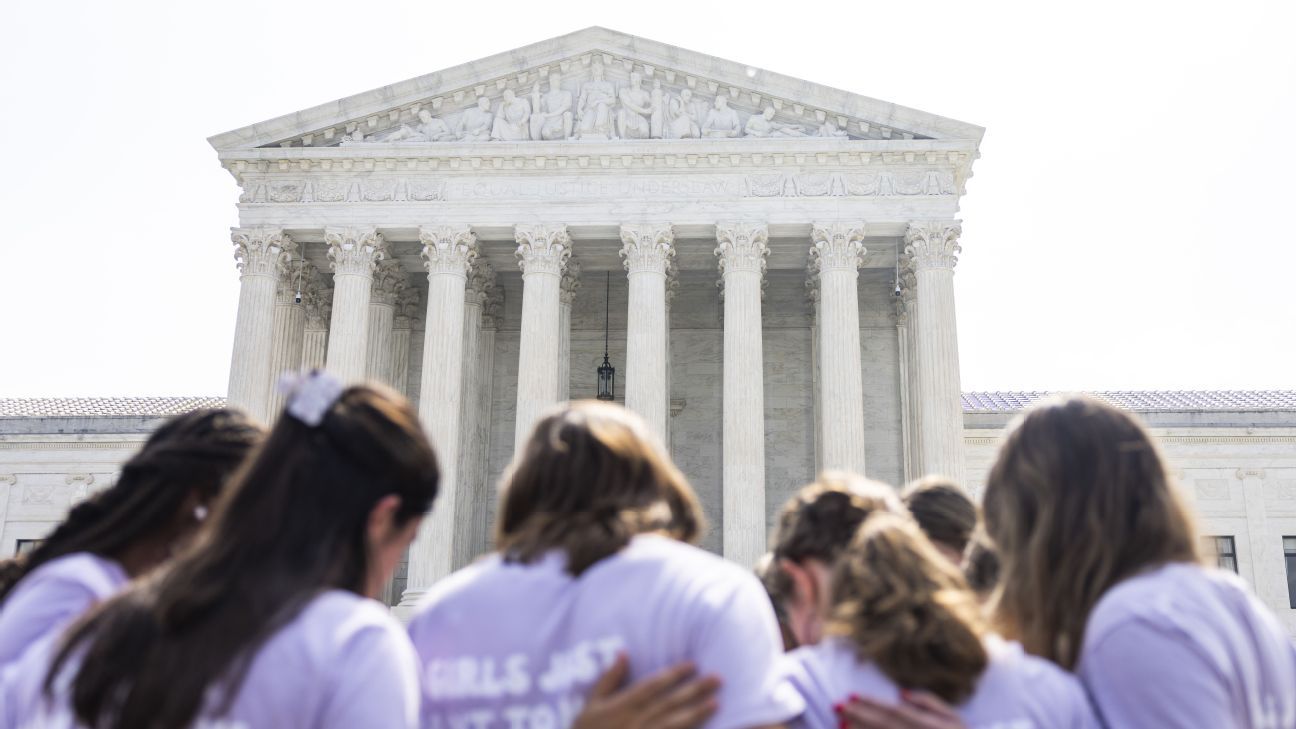
EmailPrintOpen Extended ReactionsThe U.S. Supreme Court ruled Tuesday that states can lawfully prevent transgender girls and women from competing in girls' and women's school sports."The Court concludes that separate sports teams for biological males and biological females are reasonable given the inherent physical differences between the sexes," Justice Brett Kavanaugh wrote in the opinion. "In assessing the reasonableness of the regulations, the Court must recognize the distinctiveness of competitive sports -- and the safety and competitive fairness issues that can arise when females are forced to compete against males."All nine justices agreed that the Idaho and West Virginia laws that were argued in front of the court on Jan. 13 do not violate Title IX. Justices Sonia Sotomayor, Elena Kagan and Ketanji Brown Jackson dissented on the constitutional question about the 14th Amendment's equal protection clause specifically presented in the West Virginia case."This litigation implicates deeply sensitive, contentious, and evolving issues," Sotomayor wrote. "These circumstances demand exercising judicial restraint, not rushing to answer conclusively difficult questions without sufficient evidentiary development."Idaho's HB 500, which was challenged in front of the Supreme Court by Boise State student Lindsay Hecox, was the first state law to restrict transgender athlete eligibility and transformed the landscape beyond school sports. Since then, 26 additional states have passed similar legislation, including West Virginia, whose law was challenged at the Supreme Court by transgender track athlete Becky Pepper-Jackson. The NCAA, the U.S. Olympic and Paralympic Committee, the International Olympic Committee, numerous international federations and national governing bodies, and two additional high school associations in the United States have adopted policies that either heavily restrict transgender girls and women from competing in the women's category or bar them completely."Over six years ago I could see that this issue would quickly become a defining issue for our country and our generation," HB 500 author and Idaho state Rep. Barbara Ehardt said to ESPN on Tuesday. "Women were told we didn't matter. I said we do matter. Today, we have finally, definitively won this war for women in sports on all fronts."According to a June 2025 Gallup survey, 69% of Americans believe transgender girls should be allowed to play only on boys' teams.Proponents of transgender inclusion, however, did not see today's ruling as a total loss."[The Supreme Court] issued a narrow decision focused specifically on the unique context of sports," ACLU senior counsel Joshua Block said. "It didn't issue a broader decision saying that Title IX, in general, didn't protect transgender students. It didn't say that other states couldn't make a different policy choice and allow transgender girls to participate with cisgender girls. And it didn't issue a sweeping ruling saying that under the Constitution it's perfectly fine to discriminate based on transgender status."The decision leaves many questions. Here are some answers.Does the ruling impact transgender athletes in all 50 states?It does not. The Supreme Court said that the laws in question, specifically in Idaho and West Virginia, do not violate Title IX and the 14th Amendment. The Supreme Court did not say that Title IX requires transgender girls and women to be barred from participation in girls' and women's sports.In other words, if a transgender athlete was eligible to play school sports yesterday -- which is the case in 21 states including California and Massachusetts -- they still are today. The inverse is also true in the 27 states that have passed restrictive laws.How will the ruling affect sports teams and leagues outside of schools?Title IX applies only to educational institutions, and the equal protection clause generally applies only to state and government actors. Leagues outside of school settings, including youth and adult recreation, are typically private, nonprofit entities and don't fall under those provisions, nor do professional sports.Does this ruling apply to transgender boys and men? How about cisgender girls?Not exactly. The primary contention around transgender athletes rests with transgender girls wanting to play in girls' sports. Every law confronts that question. However, a handful of states have language in their transgender athlete laws that restrict transgender boys' ability to play boys' school sports. Texas and Tennessee are two examples. The court did not explicitly address that issue, and it was not asked to in either of these cases.A footnote in the Supreme Court ruling does address the question of cisgender girls and women wanting to play on boys' and men's teams: "nothing in this opinion should be interpreted to address or limit participation by biological females on male or co-ed sports teams." This could be seen as at odds with laws like the ones in Texas and Tennessee, which do limit participation by people assigned female at birth on boys' teams. But that would need to be separately litigated.Where does this leave us?With a lot of unanswered questions. The first is about the constitutionality of policies and laws that allow transgender girls and women to participate in girls' and women's sports. The first federal lawsuit about transgender athletes was filed in 2020 to challenge a policy in Connecticut. If judges rule that Connecticut's policy violates Title IX, that opens the door to the legal possibility that not only can states bar transgender girls and women from girls' and women's sports, but that they must. That would be a significant step further than what the Supreme Court ruled on Tuesday. The Connecticut case is currently at the district court level after more than six years of stop-and-start litigation. No hearings are currently scheduled.Additionally, President Donald Trump signed an executive order on Feb. 5, 2025, that said schools and states that allow transgender girls and women to participate in girls' and women's school sports are in violation of Title IX and risk federal funding. In the days after the order, the NCAA and U.S. Olympic and Paralympic Committee barred transgender girls and women from the girls' and women's categories in the sports the organizations govern. The executive order is being challenged by two athletes from New Hampshire, but that case was stayed while the Supreme Court heard the Idaho and West Virginia cases. It is expected to resume following Tuesday's opinion. Both New Hampshire athletes have been allowed to compete while litigation has continued. Tuesday's opinion has no immediate effect on the challenge to the executive order.The U.S. Department of Education has launched a number of investigations into school districts, state high school associations and institutions of higher education around transgender athlete participation. Many of those investigations are ongoing."This is a tremendous victory, and we look forward to ensuring that every educational institution in America abides by the law of the land," Secretary of Education Linda McMahon said.The department did not immediately respond to questions from ESPN regarding how the Supreme Court decision affects its enforcement of the executive order and what it would do in states without transgender athlete bans.What reaction has the ruling spurred? As expected, divided."My support for the transgender community is strong, and I really want to make sure that they have equal rights and access," New York Liberty star Breanna Stewart said at Barclays Center before shootaround ahead of the Commissioner's Cup championship. "This ruling by the Supreme Court shows that they don't, and I think it's unfair to tell a person that they can't play sports when they're just being who they are.""I think it's pretty apparent that transgender athletes are used as political pawns," Las Vegas Aces forward Brianna Turner said. "I think it's just a way to spread hate and to exclude people ... so I think this ruling is extremely disappointing."Riley Gaines, who finished tied for fifth with transgender swimmer Lia Thomas in the 200-yard freestyle at the 2022 NCAA championships, posted on X. "The law of the land now reflects reality and common sense."Said former volleyball player and Independent Women ambassador Payton McNabb: "This ruling recognizes what so many of us have been saying all along: that protecting women's and girls' sports is not exclusion, it's justice. Biology isn't bigotry, and today that truth was finally given weight!"Kavanaugh directly acknowledged the continued division and politicization in his opinion. He wrote: "No student-athlete on either side of the issue, whether a biological female or transgender, deserves to be ostracized or vilified."Paula Lavigne contributed to this story.