
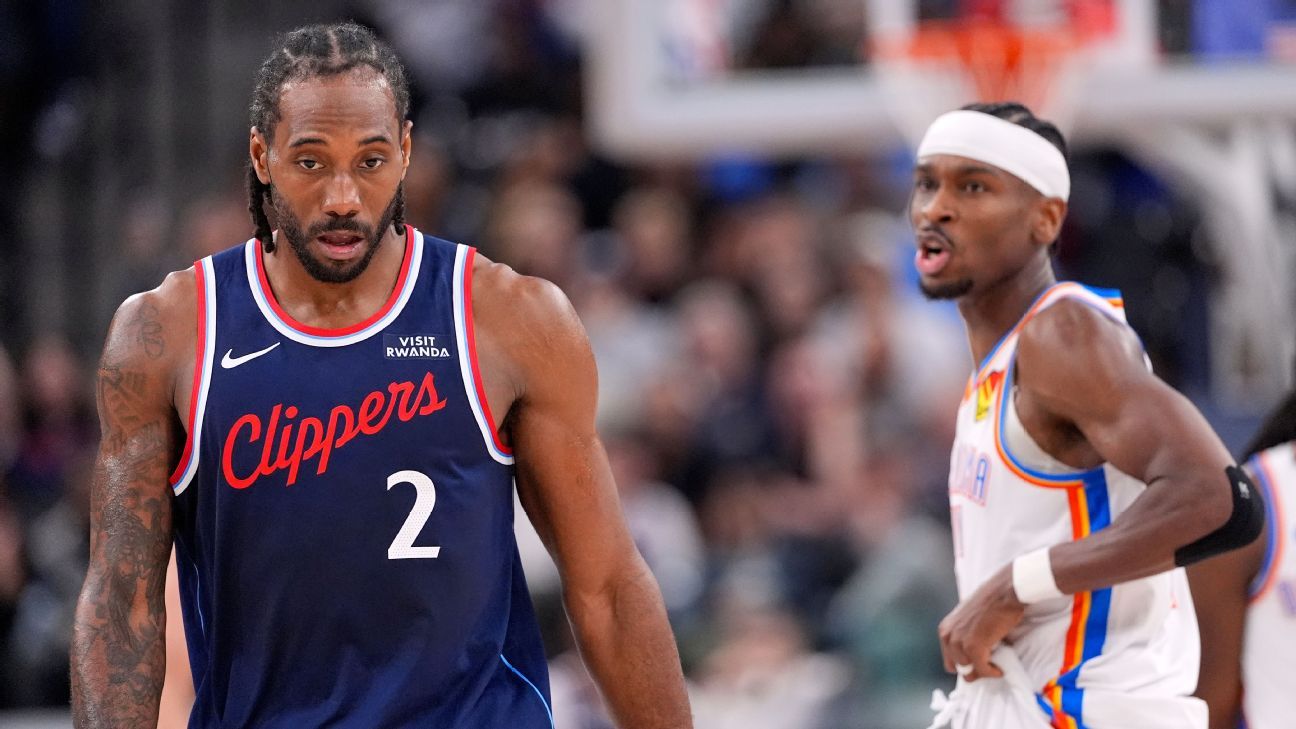
EmailPrintOpen Extended ReactionsEight years ago, the Toronto Raptors were stuck as a strong regular-season team unable to break through in the playoffs. So they took a home run swing, trading their leading scorer (DeMar DeRozan), a recent lottery pick with middling production (Jakob Poeltl) and draft capital for Kawhi Leonard in the two-way star's final season before free agency.You know what happened next.Fast forward to 2026, and the Raptors are trying the same move once again. They're aiming to raise their ceiling by trading their leading scorer (this time, Brandon Ingram), a recent lottery pick with middling production (Gradey Dick) and draft capital for Leonard in his final season before free agency. They can only hope this deal works out as triumphantly as the last one.The full deal, according to ESPN's Shams Charania, will send Leonard to Toronto in exchange for Ingram, Dick, two unprotected first-round picks, one pick swap and two second-round picks.Let's get to the grades to analyze whether the Raptors were right to run back the same Leonard play that worked last decade, and whether the Clippers were right to trade him seven years after landing him in a seismic NBA event.Quick links: Buzz | Trade grades | Free agency gradesTrade machine | Depth charts | More coverageToronto Raptors grade: A-When he's available, Leonard remains one of the NBA's best players. Remarkably, the 34-year-old seven-time All-Star averaged a career-high 27.9 points per game on a career-high usage rate last season. LeBron James is the only player in NBA history with a better box plus/minus at that age or older.Leonard's offensive gifts have scarcely departed him despite his age and injury history. Since returning from an ACL tear that cost him the entire 2021-22 campaign, he has made 40.5% of his 3-pointers. For context, Stephen Curry's at 40.6% over the same span. And out of 60 players over the past four seasons with at least a 25% usage rate, Leonard ranks 10th in true shooting percentage, despite a difficult shot diet.He is also the rare No. 1 option on offense who is equally adept on the other end, even if the two-time Defensive Player of the Year is no longer at his peak on every possession. Leonard still averaged 1.9 steals per game last season, a top-five mark in the league. The other players in the top five were all 25 years old or younger.Just look at how much Leonard improved the Clippers every time he stepped on the floor. In every season in Los Angeles, he had a positive on/off differential in the double digits, per Cleaning the Glass, which placed him among the league leaders annually.That combination of production, efficiency and on/off impact means advanced stats continue to regard Leonard as one of the NBA's elite. Some of the best public metrics even place him ahead of Giannis Antetokounmpo, which would make Leonard, not Antetokounmpo, the best player traded this offseason.All of that lofty praise is assuming Leonard's availability, of course, and that's a big assumption. Over the past four seasons, he has played 52, 68, 37 and 65 games, or 67.7% of the Clippers' games in that span.He made the All-NBA second team both times he reached 65 games, but those on/off numbers show how much his team suffered in the third of the time that he wasn't available. Like with Antetokounmpo, Leonard's injury concerns have also extended to the postseason: Across the 2023 and 2024 playoffs, he played in just four out of a possible 11 games.Gambling on Leonard's health, however -- even as he enters the back half of his 30s -- is a worthy risk for a Toronto team in specific need of higher-caliber offensive firepower. The Raptors' top four scorers last season had remarkably similar efficiency:Brandon Ingram: 57.3% true shootingRJ Barrett: 58.5%Scottie Barnes: 57.7%Immanuel Quickley: 57.7%The NBA as a whole was at 58.1% true shooting last season, so the Raptors' best players all had basically average efficiency. That's how Toronto finished 15th in offensive rating, before scuffling to a 111.9 offensive rating in the first round of the postseason, which was the worst mark among Cleveland's three playoff opponents.Granted, Quickley missed that entire series and Ingram missed two games, but it's still doubtful they could ever form the core of a genuine championship offense. And while Barnes is a phenomenal young player, unless he develops a 3-point shot -- which is looking less likely by the year, after he made 30% of his attempts on reduced volume last season -- he's unlikely to ever be a No. 1 scoring option on a contender.The chief difference between the two Leonard trades to Toronto is that this current Raptors core is far less accomplished than its decade-ago predecessor. Led by DeRozan and Kyle Lowry, that group had come up short before the Finals in five consecutive postseasons -- the last three with dispiriting losses to LeBron's Cavaliers -- before trading for Leonard. They were out of answers, barring a Hail Mary trade for an impending free agent superstar.The current Raptors, conversely, just reached their first postseason in four years, so it's less obviously clear that they've reached a hard ceiling. Yet the roster's makeup reinforces the general perception of a high-floor, low-ceiling pseudo-contender.Just a touch of offensive help could make an outsized difference for the Raptors, because with Barnes leading the way, the team's defense is worthy of a top playoff seed. The 2025-26 Raptors finished fifth in defensive rating, behind the top two regular-season teams in each conference (Oklahoma City, Detroit, San Antonio and Boston).Leonard should provide that help, as a meaningful upgrade on Ingram as Toronto's go-to scorer. And he's a vastly superior option on the other end, where Leonard, Barnes and rising sophomore Collin Murray-Boyles could form an impenetrable defensive trio.The other main difference between the two Leonard trades is the cost in draft capital, even if the players involved (DeRozan and Poeltl on one side, Ingram and Dick on the other) have similar value.Toronto's deal to acquire Leonard back in 2018 was, in retrospect, the last major superstar trade that didn't involve a giant collection of draft picks. In part due to a lack of leverage for the Spurs at the time, Toronto traded only one first-round pick for Leonard and Danny Green; it landed at No. 29 in the 2019 draft.But a year later, the Lakers and Clippers traded for Anthony Davis and Paul George, respectively, and changed the standard superstar price forevermore. It's now common to see upwards of half a dozen future unprotected picks and swaps changing hands in trades for an All-NBA mainstay.So of course the Raptors would have to pay a higher price for Leonard in 2026 than they did in 2018 -- but compared to other recent superstar trades, they actually got something of a bargain.Leonard's reported desire to sign an extension before next summer with Toronto, but nowhere else outside Los Angeles, surely played a role here. But it's not as if the Raptors gave up everything they could have, even for a player of his caliber.And after years of trading away first-round picks for middling players -- Poeltl, Ingram, Thaddeus Young, Kelly Olynyk and Ochai Agbaji -- the Raptors finally held all seven of their future first-rounders before this deal. Trading control of only three of them means they still have flexibility to make further additions in the years to come. And Leonard, who has the potential to lead Toronto to another title, is worth the cost of first-round picks in a way that those other previous acquisitions never were.It's unlikely he'll actually lead Toronto back to the promised land; the parallels between his two trades can only go so far. But the Raptors are now a bona-fide contender, breaking out of the middle once again.LA Clippers grade: BThe Clippers have quietly been stuck in the middle even more than Toronto. They haven't won a playoff series since 2021, and in all five seasons since, they've finished with a winning record but lost in the play-in round twice and the first round of the proper playoffs thrice.In response to all that mediocrity, the front office has actively disassembled the team's core over the past couple of years. The Clippers' top 16 scorers from the 2022-23 team that won 51 games have all cycled off the roster. That exodus includes some departures via free agency (most notably Paul George), but mostly a succession of trades: of Russell Westbrook, then Norman Powell, then James Harden, then Ivica Zubac and now Leonard.All of those transactions have wrought dramatic changes to the roster. The Clippers were the NBA's oldest team in each of the past three seasons, per Basketball Reference. But they should get much younger in a hurry, as they pursue a complete rebuild around the backcourt duo of Darius Garland and No. 5 pick Keaton Wagler. With Leonard gone, 38-year-old Brook Lopez and 32-year-old Kris Dunn are the only remaining Clippers in their 30s.A lack of draft picks could complicate that rebuilding effort: The Clippers don't have a first-round pick in 2028, and they owe pick swaps to the Thunder in 2027 and the 76ers in 2029, although they'll receive a first-rounder from the Pacers in 2029, via the Zubac trade. They could lose additional draft picks once the NBA finally completes its Aspiration investigation.But from owner Steve Ballmer on down, the Clippers' brain trust deserves credit for acknowledging they weren't going anywhere with their current core, which had failed with better supporting casts in recent years. The Leonard-George duo missed its best chances at a title in 2020, when they fell apart in the Orlando bubble, and 2021, when the first conference finals trip in franchise history was marred by Leonard's torn ACL.In retrospect, every Clippers transaction since has been a matter of delaying the inevitable, from trading valuable draft assets for Harden -- and not receiving a single playoff series victory in return -- to reuniting with Chris Paul and importing Bradley Beal for more veteran help last offseason; that duo played a combined 22 ineffective games.Looking forward, the Clippers can use the Toronto picks they acquired in this trade to help replenish their draft coffers, and they can complete their rebuilding pivot by seeking further trades with their remaining veteran contributors.Most prominently, they can try to flip Ingram to a contender, though it's unclear how much interest he'll garner with a $40 million contract in 2026-27 and a $41.9 million player option in 2027-28. Ingram was an All-Star last season, but he solicited little enough interest on a smaller contract two years ago.Lopez and ace defenders Dunn and Derrick Jones Jr., meanwhile, could tempt more teams into a trade, given their role player skill sets and relatively light salaries. Jones is the most expensive of the three, and he'll earn only $10.5 million next season.In any case, the Clippers were briefly the center of the NBA universe, but they now face a long road back to relevance. They got a decent head start with their return in the Leonard deal, but they'll likely spend their time ruing the missed opportunity of the Leonard-George era for a while longer.