
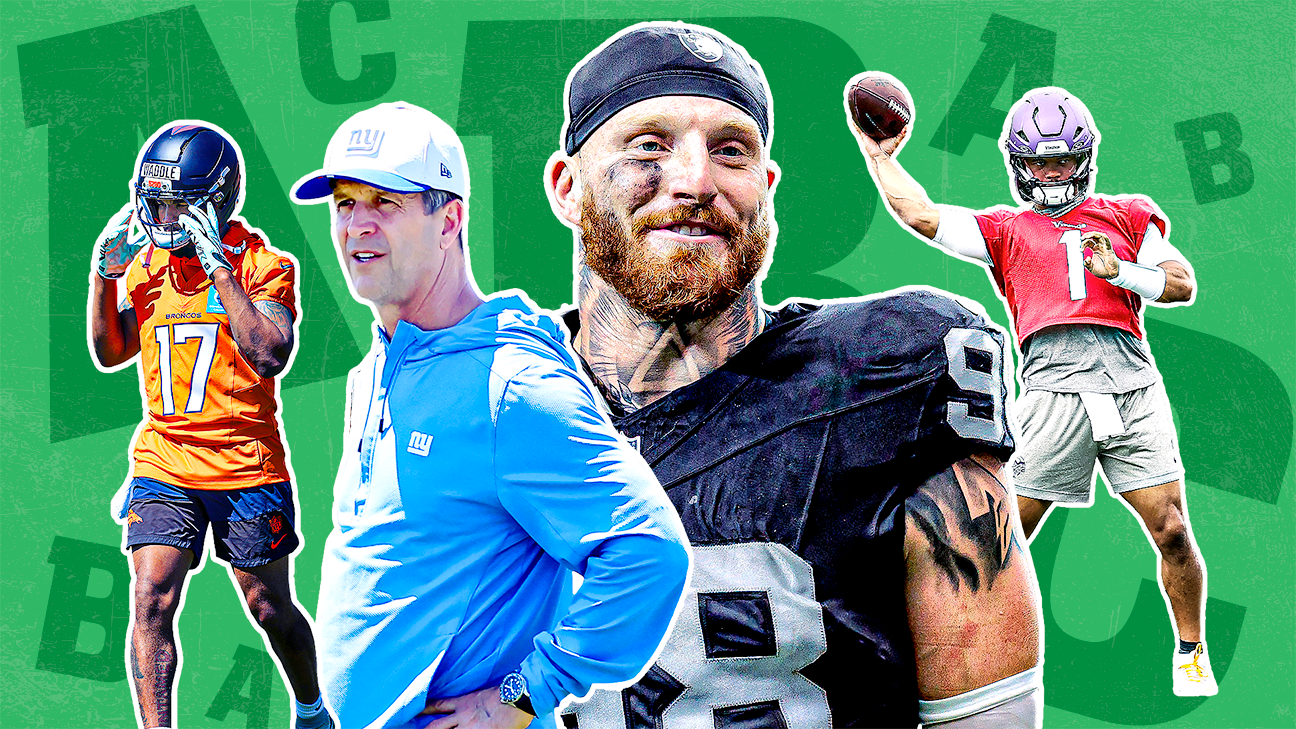
EmailPrintOpen Extended ReactionsFree agency is done, the draft is behind us, and we're through the flurry of post-June 1 trades. It's time to hand out 2026 offseason grades for every NFL team.We'll evaluate the actual decisions each team has made during the offseason. This is not a measurement of talent gained or lost. That's a valid exercise, but a different one. For example, the Raiders have unquestionably improved their roster between the Super Bowl and now. But did they make good team-building choices to get there? I have doubts.Similarly, we are only measuring decisions made this offseason. So while the Jets added a ton of talent in the draft, that extra draft capital stemmed from choices made at last year's trade deadline.But essentially everything else counts: signings, trades, cuts, firings, hirings, etc. Player evaluation, contracts, draft pick compensation and contending time horizons all come into play. Let's dive into the decisions each team made during the 2026 offseason, starting with some retooling from a recent Super Bowl champion. Here's all 32 offseason report cards.Jump to a team:ARI | ATL | BAL | BUF | CAR | CHI | CINCLE | DAL | DEN | DET | GB | HOU | INDJAX | KC | LV | LAC | LAR | MIA | MINNE | NO | NYG | NYJ | PHI | PIT | SFSEA | TB | TEN | WSHPhiladelphia Eagles: ABiggest move: Trading WR A.J. BrownMove I liked: Signing CB Riq WoolenMove I disliked: Extending DT Jordan DavisAs is often the case, Eagles general manager Howie Roseman was busy in the trade market this offseason. That meant the long-awaited and finally consummated Brown deal to the Patriots, netting Philadelphia a 2028 first-round pick and a 2027 fifth-round pick. Losing Brown is a short-term knock, but it became clear his time as an Eagle was up and Philadelphia was able to flip him for a first-round selection -- which comes with years of expected value -- before Brown's decline really set in.The Eagles prepared for the loss of Brown by trading fifth- and sixth-round picks for Dontayvion Wicks and selecting Makai Lemon in the first round of the draft. I particularly like the Wicks acquisition. The former Packer has a 69 open score over the past three seasons -- well above average -- and perhaps has not fully realized his upside.The Eagles made another critical acquisition I was a fan of in trading for edge rusher Jonathan Greenard. High-end veterans have become so inflated on the trade market lately that I rarely believe the acquiring team is the winner in deals like this -- but the Greenard trade was an exception. The Eagles land a player whose sack production was down (only three sacks in 12 games last season) but who consistently wins on a down-to-down basis (his 23.3% pass rush win rate at edge would have ranked fourth had he qualified). He fills a need after Philadelphia lost Jaelan Phillips in free agency, which will likely net them a third-round compensatory pick next year per OverTheCap.com.The Eagles also one of my favorite free agency signings of the offseason, nabbing Woolen for one year and $12 million. Woolen is not considered among the game's best corners despite metrics that suggest elite-level play. Over the past four seasons, Woolen ranks first among all cornerbacks with at least 500 coverage snaps in air yards allowed per coverage snap, just ahead of new teammate Quinyon Mitchell and Pat Surtain II.My lone critique was the three-year, $78 million extension for Davis, which was a bit rich for a nose tackle. Davis is a good player against the run, but I need more pass rush to justify that type of contract.Los Angeles Chargers: A-Biggest move: Hiring Mike McDaniel as offensive coordinatorMove I liked: The McDaniel hireMove I disliked: Not spending more at guardThe Chargers' biggest, and arguably best, move this offseason was not a player transaction. It was bringing in McDaniel, the former Dolphins coach, as their new offensive coordinator to replace Greg Roman, who was fired after last season.The McDaniel acquisition brings new hope for an offense that could be exceptional with quarterback Justin Herbert at the helm behind perhaps the best tackle duo in the game in Joe Alt and Rashawn Slater -- if they can stay healthy. While it didn't work out for McDaniel in Miami, no one has forgotten the heights he brought that offense to early in his tenure -- and with a less talented quarterback, too.On the field, the Chargers spent money to retain some high-end veterans. They inked Derwin James Jr. to an extension that looks expensive for a safety or nickel at first glance given that it's technically worth $25.2 million per year, but that number is buoyed by non-guaranteed money in the back half of the contract. James is still at the top of his game and allowed 0.6 yards per coverage snap last season, best among all nickels.Odafe Oweh, who delivered sacks for the Chargers after a midseason trade from Baltimore, departed in free agency (which should net them a fourth-round compensatory pick, per OverTheCap.com), but Los Angeles re-signed Khalil Mack and drafted Akheem Mesidor in the first round. Mack is still good when he's on the field -- though understandably diminished from his previous heights -- but the Chargers would benefit from an instant impact from Mesidor, with Tuli Tuipulotu an average pass rusher opposite Mack.Along the offensive line, the Chargers signed Tyler Biadasz to play center (and drafted Jake Slaughter in the second round, too). Biadasz should be an immediate upgrade over Bradley Bozeman. Bozeman had just a third percentile pass block win rate last season while Biadasz was in the 53rd percentile. The team did lose guard Zion Johnson in free agency to the Browns, though.Overall, this was a good offseason. But I wonder if the Chargers should have spent a little more. As of this writing, they have the fourth-most cap space in 2026 and rank in the top 10 in 2027 cap space. Could they have used that money to get a better guard than Cole Strange? I'd have shelled out for Elgton Jenkins or Isaac Seumalo if I were them.Miami Dolphins: A-Biggest move: Signing QB Malik Willis to a three-year, $67.5 million contractMove I liked: Signing WillisMove I disliked: Roster left a little too bareThe Dolphins opted for a full reset, firing coach Mike McDaniel after ousting former GM Chris Grier during the 2025 season. They later cut quarterback Tua Tagovailoa, prompting new faces at the three most important roles on the team. In came a wave of former Packers in coach Jeff Hafley, GM Jon-Eric Sullivan and Willis at QB.I think the Willis signing makes a world of sense for a team that's starting over. While he comes with clear red flags -- a tiny sample size, inability to rise up the depth chart in hist first two seasons in Tennessee -- I believe Willis is well worth the risk. His numbers in Green Bay were unbelievable -- an 86.3 QBR, 9.2 yards per dropback and a plus-7% completion percentage over expected, per NFL Next Gen Stats. And in his lone start last season, in Week 17 against the Ravens, Willis looked incredible. Teams don't often find franchise quarterbacks in free agency, but Willis' profile -- brilliance in a sample small enough to make teams pause -- is how it would go down. Even with $45 million fully guaranteed, this is a risk worth taking for Miami.The group he'll be throwing to is remarkably barren, however. That's because the Dolphins traded Jaylen Waddle and a fourth-round pick to the Broncos for first- and third-round selections. It wasn't a perfect move, because giving Willis a playmaking wide receiver could have been helpful to his development, but the return was too high to pass up.With Waddle traded and Tyreek Hill released, the Dolphins now have Malik Washington, free agent signings Jalen Tolbert and Tutu Atwell, and rookies Chris Bell (a third-rounder who would have been off the board far earlier had he not tore his ACL late last season), Caleb Douglas and Kevin Coleman Jr.One playmaker the Dolphins locked down is running back De'Von Achane, who Miami signed to an extension. I would have been tempted to trade Achane, but perhaps the offers weren't there and losing all of their playmakers might have been a bridge too far. But the pairing of Willis and Achane could yield dividends over next couple seasons.Considering the Dolphins rank third in 2027 cap space, per OverTheCap.com, could they have added a middle-class free agent at wide receiver, edge, tight end, cornerback or safety to raise the floor? Sure. But it's hard to knock them too much considering how intentional they've been about their rebuild.Chicago Bears: B+Biggest move: Trading WR DJ Moore to the BillsMove I liked: The Moore tradeMove I disliked: Not adding at edgeChicago opened its second offseason of the Ben Johnson era with a strong value trade, getting a second-round pick for Moore and a fifth-round selection. That might not sound incredible, but consider the situation. Moore was coming off consecutive disappointing seasons and the extension he signed prior to the 2024 campaign is really kicking into gear only now. Even though there are hefty cash salaries remaining on the contract, the Bears somehow got the Bills to give up real draft capital to take that money off Chicago's books.In early March, center Drew Dalman made the surprising decision to retire at age 27. It was a blow, as Dalman was part of a successful offensive line makeover made the year before. The Bears moved quickly in a tight center market, trading for Garrett Bradbury to give themselves a floor at the position. They also drafted Logan Jones, who they hope can take over long term, in the second round.The Bears' defense generated a ton of turnovers last season, but those takeaways helped disguise the fact that it was one of the worst defenses in the league on non-turnover plays. Turnovers are high leverage but fluky, and the Bears did well in not assuming they could repeat that feat. They underwent significant secondary change, letting safeties Kevin Byard and Jaquan Brisker and cornerback Nahshon Wright depart. They brought in two new safeties in free agent signee Coby Bryant and first-round pick Dillon Thieneman.The Bears are in a pretty tight cap situation, but it's hard not to look at this team and think it could have used reinforcements on the edge. The focus will be on quarterback Caleb Williams and the offense, but Chicago's defense is still a question mark.Cleveland Browns: B+Biggest move: Trading Edge Myles GarrettMove I liked: Trading GarrettMove I disliked: Trading for OT Tytus HowardIt has been awfully bleak in Cleveland the past couple seasons, but the decision to trade away a franchise icon could be what jump-starts a turnaround. The Browns shocked the NFL world by sending Garrett to the Rams in a June trade, receiving Jared Verse and first-, second- and third-round picks in exchange.There can be reasonable debate over the Rams' side of this trade, but this was an unquestioned home run for Cleveland. Garrett is the reigning Defensive Player of the Year and just broke the single-season sack record, but he is 30 years old, and the Browns are not close to contention. By the time they get there, Garrett will be well into his decline.And the return was pretty remarkable. Verse, who still has two years left on his rookie contract (plus a possible fifth-year option), will cost Cleveland just about $5 million over the next two seasons. He's a great, ascending player who would have surely been worth more than a first-round pick on the trade market, perhaps even approaching two first-rounders. To turn Garrett -- whose superstardom was worth less to the woebegone Browns than to any contender -- into Verse and picks that can help build the next good Cleveland roster is solid team-building.At the start of the offseason, the Browns fired coach Kevin Stefanski and hired Todd Monken to replace him. Both choices seemed reasonable. Monken wasn't the hottest coaching candidate this cycle thanks to the Ravens' down season on offense. But Lamar Jackson was the MVP in his first season working with Monken and finished second in the voting the next year.The Browns also did a hard reset of their offensive line, adding Spencer Fano in the first round of the draft -- after a good-value trade down with the Chiefs -- bringing in Zion Johnson and Elgton Jenkins in free agency and trading for Howard. These moves were a mixed bag.At $12 million per year, Jenkins was a very good signing. He has been excellent in the past and brings positional flexibility. But I didn't like the pricier Johnson deal as much and did not understand the Howard trade at all. The Browns traded a draft pick to pay Howard good money despite his poor numbers in recent seasons (24th and 31st percentiles in pass block and run block win rate last season, respectively).One area Cleveland where did not add much at was quarterback. Though the Browns drafted Taylen Green, an intriguing long-shot prospect, they are entering training camp seemingly set for a competition between Deshaun Watson and Shedeur Sanders.A better path would have been to treat Watson as a sunk cost and perhaps acquire another long-shot quarterback -- Spencer Rattler? Tanner McKee? Tyson Bagent? -- to compete with Sanders. The Browns need as many chances as they can get to find their next long-term quarterback, and Watson is almost certainly not going to be it.Green Bay Packers: B+Biggest move: Extending WR Christian WatsonMove I liked: Extending WatsonMove I disliked: Trading WR Dontayvion WicksAfter spreading the receiver wealth over the past few seasons, the Packers' moves suggested a consolidation of targets. Romeo Doubs left via free agency to New England. Wicks was traded to the Eagles. And the Packers re-affirmed their commitment to two other wide receivers, handing extensions to Watson and Jayden Reed.The Watson extension, which averages $23 million a year per OverTheCap.com, is a bet that he can stay on the field and turn his per-route numbers into a seasonlong set of impressive figures. I like that thought process. Watson averaged a remarkable 2.74 yards per route run last season and has averaged at least 2.35 in three of his four pro seasons. At that rate, he has a great chance to exceed the value of the deal with Green Bay.Reed is a similar story, albeit at a lower magnitude. He missed time last year, but he has averaged more than 2.0 yards per route run in all three seasons of his career and cost only $16.75 million per year on the extension. Another deal I like.Letting Doubs walk made sense -- he'll make $17 million per year from New England, and the Packers are expected to collect a fourth-round compensatory pick in exchange. The only receiver transaction I'm lukewarm on is the Wicks deal. They got fifth- and sixth-round picks for him, but I believe Wicks -- who has shown an above-average ability to get open throughout his career -- might have more production in him than he has shown to date. Granted, Matthew Golden and Savion Williams are still around, but we have yet to see either player make a big impact.As expected, the Packers lost quarterback Malik Willis in free agency and should net a fourth-round comp pick for him, too. They let linebacker Quay Walker walk in a move that made sense considering they have Edgerrin Cooper and traded for Zaire Franklin, who will get less than Walker signed for with the Raiders.On paper, the quizzical move was letting left tackle Rasheed Walker leave in free agency for a deal with a base value of only $4 million. Former first-round pick Jordan Morgan will replace Walker. Though it's surprising that the Packers didn't match Carolina's deal for Walker, the left tackle signed for so little that it suggests there might be more to the story than we realize. Walker was publicly considered one of the top free agents heading into March.New York Giants: B+Biggest move: Hiring John Harbaugh as coachMove I liked: Trading DT Dexter Lawrence IIMove I disliked: Signing LB Tremaine EdmundsNothing was more significant that the Giants successfully landing Harbaugh. He should be a stabilizing force given his long track record of success in Baltimore, and he rightfully gives fans hope in the franchise's new direction.But in terms of players, the biggest decision the Giants made was to trade Lawrence to the Bengals for the No. 10 pick. That was a huge win. As much as I -- and probably the Giants! -- like Lawrence as a player, he was coming off a down season, and the value of the No. 10 pick was simply a much better return than the veteran defensive tackle is likely worth.Thanks to that trade, the Giants had two top-10 picks in the draft. They added linebacker/edge rusher Arvell Reese -- who surprisingly fell to No. 5 -- and OT Francis Mauigoa at No. 10. Those two young players can be the foundation of the Giants' new core if they play well. New York also made a poor-value trade in moving up to get receiver Malachi Fields on Day 2.In free agency, the Giants lost receiver Wan'Dale Robinson following his breakout 2025 campaign, leaving them with a weakness at the position -- especially with Malik Nabers uncertain to be back by Week 1 from the knee injury he suffered early last season. The team re-signed Jermaine Eluemunor to keep consistency at right tackle and brought in DT DJ Reader (to fill the hole left by Lawrence), CB Greg Newsome II and Edmunds -- the last of whom was an overpay at three years, $36 million.Adding Reese gives the Giants have a surplus at edge, which should put Kayvon Thibodeaux firmly on the trade block. They haven't found a deal for him yet, but that doesn't mean they won't before the start of the season.Nothing will affect the Giants' win total in the short term more than second-year quarterback Jaxson Dart's development. But this offseason was more about setting up a foundation for the medium to long term.San Francisco 49ers: B+Biggest move: Signing LT Trent Williams to a new contractMove I liked: Signing WR Mike EvansMove I disliked: Drafting WR De'Zhaun Stribling with the first pick in Round 2The Seahawks are fresh off a Super Bowl victory, and the Rams spent the offseason loading up for another run. But despite a quieter offseason, the 49ers shouldn't be overlooked in the NFC West.San Francisco scored an early victory in free agency, landing Evans on a three-year deal that pays him just over $14 million per year and is fully guaranteed for only the $14.3 million he'll earn in 2026. It was clearly a below-market deal, and it's a testament to Kyle Shanahan and the 49ers that Evans wanted to take it to play for San Francisco. And it meant the team could upgrade at wide receiver without sacrificing its future financial situation.Jauan Jennings left in free agency (for cheap) for the Vikings, but the 49ers also added Christian Kirk and used its first draft selection on Stribling at pick No. 33. The Stribling selection was a bit of a head-scratcher. He'd been a late riser but this was a reach -- and reaching in the draft is bad process.The 49ers also had success on the trade market, exchanging a third-round pick for defensive tackle Osa Odighizuwa. Considering how inflated trade costs are for impact players in their prime, this was good work. Odighizuwa is coming off a season in which he recorded a pass rush win rate in the 84th percentile at defensive tackle, and he will cost only $16.75 million in cash in 2026.And perhaps the biggest move was to maintain the status quo by signing Williams to a new two-year, $50 million contract, fully guaranteeing $37 million to placate the future Hall of Fame tackle. Even though Williams will be 38 in July, it still seems worthwhile considering how much top-tier talent costs at other premium positions. Given that -- and how difficult it is to find quality tackle alternatives -- the Niners did well to ensure Williams' status on the team.Detroit Lions: BBiggest move: Drafting OT Blake Miller to help replace Taylor DeckerMove I liked: Trading RB David Montgomery to the TexansMove I disliked: Extending LB Jack CampbellThe Lions had a quiet offseason as they attempt to rebound from a disappointing 2025 season in which they won only nine games and missed the playoffs. Perhaps the most impactful move was on the coaching staff, as coach Dan Campbell replaced former offensive coordinator John Morton with Drew Petzing, who was the Cardinals' OC the past three seasons.In terms of player personnel, one key change will be at tackle, as Detroit granted longtime left tackle Decker's request for release. In response, the Lions are expected to move star right tackle Penei Sewell to the left side. They used their first-round pick on Miller to fill the ensuing hole at right tackle.Similarly, the Lions released veteran center Graham Glasgow, who was due $7 million in cash per OverTheCap.com, after a disappointing season following Frank Ragnow's retirement last summer. They replaced Glasgow with free agent Cade Mays, who should be a mild upgrade for a similar price.Perhaps Detroit's best move of the offseason was dealing Montgomery for a fourth-round pick, seventh-round pick and OL Juice Scruggs. Any time a team can get that type of draft capital for a 29-year-old backup running back, it has to jump at the chance. The Lions were right to do so even though Isiah Pacheco, who they signed in free agency, will likely be a downgrade.The Lions also locked up Campbell to a four-year, $81 million extension, securing the linebacker for years to come. That strikes me as a little rich for Campbell, but not wildly out of line.Baltimore Ravens: BBiggest move: Signing Edge Trey HendricksonMove I liked: Signing DT Calais CampbellMove I disliked: Almost trading for Edge Maxx CrosbyBaltimore opened its offseason with the bold, controversial decision to fire John Harbaugh, ending a long and incredibly successful tenure that began in 2008 and included 12 playoff appearances and one Super Bowl title. The team hired Jesse Minter, a former Harbaugh assistant who excelled as the Chargers' defensive coordinator. On paper, Minter looks like a good hire -- he got the most out of Los Angeles' defense over the past two seasons.The Ravens' biggest move was one they didn't ultimately make: trading for Crosby. The trade -- in which they sent two first-round picks to Las Vegas -- was a bad deal for the Ravens, who would have been giving up major draft capital for the right to pay a player in the second half of his career. We'll never know whether or not that had anything to do with the trade being called off, but the deal fell through and the Ravens quickly turned their attention to Hendrickson.In a vacuum, the Hendrickson signing -- for $28 million per year with $60 million fully guaranteed -- was fine, if slightly overpriced considering the risks he bring with his age (31). But it was a much better deal than the one proposed for Crosby, for the simple fact that it doesn't cost the Ravens two first-rounders (though it did drop a projected compensatory pick down from a third-rounder to a seventh-rounder, per OverTheCap.com).Hendrickson isn't nearly the same player Crosby is in the run game, but that difference was not worth all the extra draft capital. Baltimore also brought back Campbell, who is still a valuable player despite turning 40 in September.The Ravens lost center Tyler Linderbaum in free agency and were correct not to match the outrageous $27 million per year contract the Raiders gave him. Tight end Isaiah Likely and edge rusher Dre'Mont Jones walked, too, but both were reasonable to let go (and will net the Ravens compensatory picks).New head coach or not, Crosby or not, the Ravens enter 2026 back where they usually are -- as one of the AFC's favorites.Jacksonville Jaguars: BBiggest move: Signing Edge Travon Walker to an extensionMove I liked: Signing OL Cole Van Lanen to an extensionMove I disliked: Drafting TE Nate Boerkircher in the second roundThe first season of the Liam Coen era in Jacksonville yielded a 13-4 record, a resurgence from quarterback Trevor Lawrence and optimism about the direction of the franchise. And by and large the 2026 offseason was about maintaining the status quo while picking up a few compensatory picks along the way.The Jaguars signed two players along the line of scrimmage to extensions, 2022 first overall pick Walker and Van Lanen. After a disappointing start to his career. Walker has turned into a solid edge rusher with two seasons of 10-plus sacks (in 2023 and 2024).Van Lanen's deal has a chance to be excellent for Jacksonville. He had been a bench player entering last season but started at left tackle when Walker Little was out with a concussion and then kept the job. Van Lanen's numbers backed up the decision to switch starters. He recorded a 91.9% pass block win rate and 78.1% run block win rate at tackle, respectively, both above average for a starter at the position. If he keeps up that pace going forward, he'll be a steal at $17 million per year.The Jaguars do not have much cap space, which is likely part of the reason why free agents such as LB Devin Lloyd, RB Travis Etienne Jr. and CB Greg Newsome II departed. I think letting each of them walk was probably the correct decision. Lloyd was the hardest to see go, but as productive as he was on splash plays last season he wasn't an every-down player. Jacksonville is projected to gain fourth-, fifth- and sixth-round compensatory picks for those three, per OverTheCap.com.Where Jacksonville probably erred was the draft. Without a first-round pick, the Jaguars spent their first selection -- pick No. 56 -- on Boerkircher. The pick was a reach, part of an unexpected train of blocking tight ends that went earlier than expected, which indicates bad drafting process. If the rest of the league thought he wasn't worthy of a selection at that spot, he's less likely to be worth it -- and the Jaguars could have traded down with a decent chance of landing him later.Carolina Panthers: BBiggest move: Signing Edge Jaelan PhillipsMove I liked: Not extending QB Bryce YoungMove I disliked: Signing LB Devin LloydFresh off winning the NFC South -- albeit with an 8-9 record -- the Panthers invested money in free agency to try to improve their defense. The headliner was Phillips, whom they signed to a $30 million per year contract. Carolina badly needed help in both rushing the passer and stopping the run. Phillips will help on both fronts.He has a greater impact than his sack total (five between Miami and Philadelphia last season) suggests. But Phillips also comes with injury risk -- he suffered a torn Achilles in 2023 and a partially torn ACL in 2024 -- therefore, I think the contract was a bit rich. Still, Carolina had to find a way to improve its defensive line.The team also upgraded the second level of the defense, signing Lloyd to a $15 million per year contract. I went into free agency expecting to be quite down on Lloyd's signing. While he made impactful plays last season, Jacksonville didn't trust him to stay on the field for all snaps, which is a red flag. But he got less than I thought he would, so while I don't love the deal it's not terrible, either.Carolina also made what looks like the steal of free agency on paper in signing offensive tackle Rasheed Walker to a one-year, $4 million deal. Walker fills an important short-term need for Carolina, with Ikem Ekwonu's 2026 season in question after he suffered a patellar tendon rupture in the playoffs. I was expecting Walker to make $20 million per year (or even more), so the $4 million he received makes him an incredible value. The Panthers also drafted tackle Monroe Freeling in the first round.Carolina extended wide receiver Jalen Coker at $11.3 million per year, which was a nice move. The former undrafted free agent has shown promise, with 1.7 yards per route run over the past two seasons combined.Arguably the biggest looming decision for Carolina is what to do about Young. So far they have done nothing, which I think is the correct choice. The Panthers have Young under contract through 2027 (thanks to the fifth-year option), and he hasn't played well enough on a consistent basis to justify the Panthers hitching themselves to him long-term at this point.New Orleans Saints: BBiggest move: Drafting WR Jordyn TysonMove I liked: Signing G David EdwardsMove I disliked: Signing RB Travis Etienne Jr.The Saints enter 2026 feeling like they might have found their quarterback of the future in 2025 second-rounder Tyler Shough, at least to where they felt they could focus their offseason efforts elsewhere.Their biggest signing was bringing in Edwards from Buffalo. Last season, he recorded pass block and run block win rates at guard in the 83rd and 86th percentiles, respectively. He not only fills a hole for the Saints but also will be a clear upgrade. His deal, which I liked quite a bit for the cost, came in at $15.25 million per year.The Saints also brought in Etienne, who should help Shough and the offense. But I cannot get behind this deal, especially at $12 million per year. Though Etienne is coming off a good season in which he recorded 44 rush yards over expected, per NFL Next Gen Stats, he finished with fewer rush yards than expected the prior two seasons. Regardless of whether Alvin Kamara was going to remain on the team, the Saints needed running back help. But that contract for a player without a great track record isn't worth it.Tyson, drafted with the No. 8 pick, has the potential to be a big-time playmaker for Shough and the Saints, too.On defense, the Saints lost cornerback Alontae Taylor, who signed for too much with the Titans, and linebacker Demario Davis, who is in the twilight of his career. But they brought back Kaden Elliss, who is one of the best blitzing linebackers in the league and could help the team's lackluster pass rush.Denver Broncos: BBiggest move: Trading for WR Jaylen WaddleMove I liked: Re-signing LBs Alex Singleton and Justin StrnadMove I disliked: Re-signing RB J.K. DobbinsAfter getting oh-so-close to the Super Bowl in 2025 -- you could argue that Bo Nix's postseason ankle injury was the reason they didn't make it -- the Broncos made a few tweaks but mostly return the same squad for the 2026 season.The big addition was Waddle, for whom Denver traded first-, third- and fourth-round picks (along with getting a fourth-round pick back). It's a move I can understand more than most trades of this caliber, given the Broncos' limited window with Nix's rookie contract. Denver's recipe is to surround Nix with an exceptional roster, and the receiver position needed augmenting. Plus, Waddle is currently on a below-market deal in terms of the cash the Broncos need to pay him.He'll slide into an offense now led by Sean Payton and Davis Webb, the former quarterbacks coach who was promoted to offensive coordinator and playcaller after the team fired former OC Joe Lombardi.On defense, the Broncos lost defensive tackle John Franklin-Myers, who was an unsung but effective part of the unit. Considering the $21 million-per-year deal Franklin-Myers earned from Tennessee and how much strength the Broncos' defense still has, letting him go -- and likely picking up a projected fourth-round compensatory pick in the process -- made sense.Denver released Dre Greenlaw but brought back fellow linebackers Singleton and Strnad on very reasonable terms ($7.5 million and $6 million per year, respectively). The team also re-signed Dobbins on a two-year, $16 million contract with $8 million guaranteed -- an overpay for an injury-prone 27-year-old back.Tampa Bay Buccaneers: BBiggest move: Drafting Edge Rueben Bain Jr.Move I liked: Signing Edge Al-Quadin MuhammadMove I disliked: Not retaining CB Jamel DeanThe Buccaneers are at an interesting point in their team-building arc. Franchise icon Mike Evans walked in free agency, the team is trying to figure out how much it wants to commit to quarterback Baker Mayfield going forward, and yet the Bucs are still the favorites to win the NFC South.The Evans loss stung because he took a below-market deal with the 49ers, but the Buccaneers are in fine shape at receiver with Chris Godwin Jr., Emeka Egbuka, Jalen McMillan, Tez Johnson and third-round pick Ted Hurst III on the roster.The Mayfield decision is trickier. He said in early June that he and the team were "not anywhere close" and that he set a start-of-training-camp deadline to work out a deal. Mayfield is in the final year of his contract and is slated to make $27 million in cash this season. Given that, it probably makes sense for the Buccaneers to try to extend Mayfield, but it all depends on cost and guarantees. The 31-year-old has been solid, but the Buccaneers probably shouldn't do anything that would preclude them from taking a top quarterback in next year's draft if one happens to fall into their lap.The Buccaneers also lost Dean in free agency. Given the contract he signed -- $12.25 million per year from the Steelers -- I would have tried to keep him. They did add elsewhere, though, bringing in Muhammad (for a cheap $4 million after his 11-sack season), linebacker Alex Anzalone, defensive tackle A'Shawn Robinson and running back Kenny Gainwell. The team also re-signed tight end Cade Otton. Bain, its first-round pick, should provide some pass-rushing juice.The Buccaneers also made a change at offensive coordinator, firing Josh Grizzard and bringing in Zac Robinson. They're hoping Robinson will be closer to what they had in Dave Canales and Liam Coen, who left Tampa for head coaching opportunities.Minnesota Vikings: B-Biggest move: Signing QB Kyler Murray to a one-year, $1.3 million dealMove I liked: The Murray signingMove I disliked: Trading Edge Jonathan Greenard for two third-round picksThe Vikings made a peculiar move as far as timing was concerned when they fired general manager Kwesi Adofo-Mensah on Jan. 30. But the move itself wasn't that shocking considering the results of his tenure. That former Vikings quarterback Sam Darnold won the Super Bowl in Seattle probably didn't help, though I don't think it was Adofo-Mensah's fault the Seahawks' defense was so dominant (the primary reason they were there). Still, moving on from the GM was understandable.The best thing about the Vikings' offseason is them signing Murray to a veterans minimum deal, which was possible due to his offsets from his contract with the Cardinals. It was a boon for Minnesota. Murray's services would be worth many millions more on the free market, and he provides an answer at quarterback in the wake of J.J. McCarthy's rough 2025 season.But I think chalking this up to luck undersells Minnesota's role. Murray surely had several options, and it's a credit to Minnesota -- with its strong head coach in Kevin O'Connell and elite wide receiver in Justin Jefferson -- that he chose the Vikings. Adding Murray doesn't necessarily solve the Vikings' long-term quarterback questions, but it gives them something to work with in the short term ... and potentially longer.The Vikings released veteran defensive tackles Javon Hargrave and Jonathan Allen in March, consequences of ill-advised spending on the aging veterans the prior year. Those transactions left a hole at defensive tackle, which perhaps is why Minnesota reached for Caleb Banks with the No. 18 pick in the draft, far earlier than he was expected to go (the Draft Day Predictor gave Banks only an 18% chance to be selected in the first round).During the draft, the Vikings dealt Greenard, one of their best players, to the Eagles in exchange for two third-round picks. I don't think it was worth it, especially in the current trade environment for high-end players. Despite only three sacks in 12 games last season, Greenard's 23.2% pass rush win rate at edge would have ranked fourth at the position had he qualified.The Vikings made a nice postdraft acquisition of Jauan Jennings on a one-year, $8 million deal. That's good value for a No. 3 receiver, especially one with the upside Jennings showed in 2024, when he averaged 2.5 yards per route run.Seattle Seahawks: B-Biggest move: Extending WR Jaxon Smith-NjigbaMove I liked: Extending OT Charles CrossMove I disliked: Letting Edge Boye Mafe leave in free agencyAfter winning the Super Bowl, the Seahawks were inevitably going to have some departures. Super Bowl MVP running back Kenneth Walker III went to the Chiefs. He was followed by safety Coby Bryant (Bears), cornerback Riq Woolen (Eagles) and Mafe (Bengals). And offensive coordinator Klint Kubiak became the Raiders' head coach.The Seahawks weren't going to be able to keep their Super Bowl-winning roster intact, so they had to prioritize. And instead of bringing in outside personnel, they focused their spending on extending homegrown talent. Smith-Njigba, the reigning Offensive Player of the Year, received a massive (and deserved) $42.15 million-per-year extension. Cross received a $26.1 million extension for his work at left tackle. Derick Hall was given a middle-class edge rusher extension at $14 million per year. Seattle also re-signed CB Josh Jobe and WR Rashid Shaheed.Regarding those decisions on whom to keep and whom to let go, I'm less fond of the choice of Hall over Mafe. This was the easier path because Hall was still under contract, but I would rather have Mafe -- who has proved to be very good against the run and the pass on a per-snap basis. Perhaps Seattle could have traded Hall and paid a few more million for Mafe.Woolen is a tough loss on paper, as he has been one of the very best yards-per-coverage-snap cornerbacks in the NFL for years. But he was benched at several points as a Seahawk and committed a nearly disastrous taunting penalty in the NFC Championship Game. So, it probably was time for all parties to move on.In the draft, the Seahawks selected Jadarian Price with pick No. 32. Drafting running backs in the first round is a tough sell (I flesh it out more in the Cardinals writeup), though the last pick in the first round is much more palatable than a top-10 pick. Still, in addition to playing a non-premium position, Price was a light reach at No. 32.Tennessee Titans: B-Biggest move: Hiring head coach Robert SalehMove I liked: Signing DT John Franklin-MyersMove I disliked: Signing CB Alontae TaylorThe Titans reset this offseason, handing over the head coaching keys to Saleh and 53-man control to GM Mike Borgonzi. Saleh, the former Jets coach, hired former Giants coach Brian Daboll to be his offensive coordinator. The hope is clear -- that Cam Ward will develop under Daboll the way Josh Allen and, at least briefly, Jaxson Dart did.On the field, the Titans were aggressive in free agency, spending $21 million per year ($42 million fully guaranteed) on Franklin-Myers. That's a lot of money but is well worth it for the player Franklin-Myers has become. Over the past two seasons, he has ranked in the 87th and 94th percentile in pass rush win rate and run stop win rate, respectively, among defensive tackles. Those numbers were likely buoyed by all the talent surrounding him on Denver's defense, but still -- they are impressive. And considering the dearth of available defensive tackles on the market this year, Franklin-Myers was always going to get paid. He was a good signing.As for the Titans' cornerback signings? Not as good. Tennessee gave Taylor a three-year, $58 million deal with $42 million fully guaranteed, per OverTheCap.com. He was coming off a legitimately good season with the Saints but allowed 1.6 yards per coverage snap -- far higher than average -- in each of the previous two seasons. Given the year-to-year variance, I'd be very hesitant to pay this kind of money without a longer track record.That Cor'Dale Flott received a three-year, $45 million deal was perhaps even more surprising. His yards-per-coverage-snap numbers have been solid in each of the past two seasons, but he wasn't expected to receive this much money heading into free agency.The Titans signed another ex-Giant in wide receiver Wan'Dale Robinson on a four-year, $70 million contract. But I felt this was a strong signing. Robinson broke out in 2025 with 2.1 yards per route run and a very impressive 28% target rate. With first-round pick Carnell Tate, young players who flashed last season such as Elic Ayomanor and Chimere Dike, along with Calvin Ridley (back after taking a pay cut), there's real upside for the receiver group Ward will be throwing to.The Titans also recently extended star defensive tackle Jeffery Simmons on a massive deal that averages over $35 million per year. Simmons is coming off a superb season in which he was a first-team All-Pro and probably would have ended up on some Defensive Player of the Year ballots had he been on a better team. I had him at No. 13 in my hypothetical 100-player MVP ballot after the season.On paper, I don't think doing this extension makes sense. Simmons was under contract for two more years, and if you tack a franchise tag on top of that, it means the Titans would have had team control (without future guarantees) through his age-31 season. Sometimes, though, teams must dish out more money to keep their franchise pillars content -- and Simmons is certainly at the Titans' core.Atlanta Falcons: B-Biggest move: Extending WR Drake LondonMove I liked: Signing QB Tua TagovailoaMove I disliked: Extending TE Kyle Pitts Sr.The Falcons reset in 2026 with a new president of football (Matt Ryan), new coach (Kevin Stefanski), new GM (Ian Cunningham) and, perhaps, a new starting quarterback in Tagovailoa.The Falcons were able to bring in Tagovailoa on a one-year deal worth only $1.2 million thanks to offsets in his deal with the Dolphins that provided no incentive for him to sign for more. No matter your opinion of Tagovailoa, signing him was a bargain and a no-brainer for Atlanta, which needed a second quarterback. Incumbent Michael Penix Jr. is coming off ACL reconstruction surgery and was inconsistent when healthy. Both players are left-handed, which should ease the transition from one to the other.Though there's a good chance the Falcons are looking for a new quarterback a year from now, for the moment, the Tagovailoa addition was logical and gives the Falcons a season to find out if either signal-caller can be a long-term answer.The Falcons extended their star receiver, handing London a $35 million-per-year contract. It makes him the second-highest-paid wide receiver in the league behind Jaxon Smith-Njigba, but after accounting for cap inflation and comparing to past contracts, it's not a crazy figure to pay a high-end receiver who is a tier below the true elites.Just recently the Falcons also extended Pitts with a three-year, $54 million deal after franchise-tagging him earlier in the offseason. That's not an unreasonable number for the best tight ends in football, but is Pitts one of them? His 1.77 yards per route run last season was his best number over the past three seasons but also ranked only 10th among tight ends. But even with the two extensions, pass catcher remains a weakness for the Falcons. Next up on their depth chart are Jahan Dotson, Olamide Zaccheaus and third-round pick Zachariah Branch.Right tackle Kaleb McGary retired this offseason after missing all of 2025 with a knee injury. The Falcons brought in a couple of former Chiefs to replace him -- Jawaan Taylor (free agent) and Wanya Morris (trade) -- but it still could be a weak point on Atlanta's offensive line.Houston Texans: B-Biggest move: Extending Edge Will Anderson Jr.Move I liked: Pivoting from Tytus Howard to Braden Smith at RTMove I disliked: Trading for RB David MontgomeryHouston spent a lot of money keeping its players at home. That most notably included a massive extension for Anderson averaging $50 million per year with more than $100 million fully guaranteed, putting him at the top of the current non-QB APY rankings. Anderson is an elite player, but even if we adjust for salary cap inflation, that is the second-highest APY on a non-quarterback deal ever, behind only Micah Parsons' 2025 contract (which sneaks over the $50 million mark when adjusted for 2026 dollars).Anderson's edge partner, Danielle Hunter, also earned an extension after his 15-sack campaign last season. Hunter's new deal added one year (2027) and $40 million, almost all fully guaranteed. It was a nice payday for a player who will turn 32 during this upcoming season but does add a little risk if Hunter starts to decline this season.Houston also handed star wide receiver Nico Collins a raise, increasing his cash payments by a total of $17 million over the next two years, boosting his deal to two years and $60 million. The Texans also extended LB Azeez Al-Shaair and TE Dalton Schultz and re-signed DT Sheldon Rankins and G Ed Ingram.The Texans have struggled with their offensive line for years, so it was somewhat surprising when they traded Howard to the Browns. But it was a good deal, as Howard ranked in the 24th percentile and 31st percentile in pass block and run block win rate, respectively, last season. He is several seasons removed from the last year when he had strong pass blocking metrics.They got a fifth-round pick back in the deal, but that's more than they should have received considering Howard was scheduled to make $17.5 million in 2026. Smith, signed as a free agent for $10 million per year, should supplant Howard at right tackle. Despite a more modest salary, Smith had better numbers last season, with roughly average win rates.I was much less enthused by the Montgomery trade, in which the Texans gave up fourth- and seventh-round picks (plus OL Juice Scruggs as a throw-in). The team needed a running back to pair with Woody Marks, but considering Montgomery's age -- 29 is ancient in running back years -- this was an inefficient use of resources.By and large, Houston is running back the team it had a year ago, hoping that better receiver health and offensive line tweaks can take this squad to the next level. As for the quarterback? The Texans did not extend C.J. Stroud despite now being able to. It makes sense. Though I think Stroud has now become a bit underrated, the Texans might as well see how he performs this season before deciding whether to hand him a massive contract, especially because he still has his fifth-year option in 2027.New England Patriots: B-Biggest move: Trading for A.J. BrownMove I liked: Getting G Mike Onwenu to take a pay cutMove I disliked: Signing Edge Dre'Mont JonesThe Patriots entered the 2026 offseason in an interesting spot. Even though they are the defending AFC champions, they have clear needs and are far from a favorite to return to the Super Bowl.New England had one of the league's most efficient passing offenses last season, but the weakness at wide receiver was apparent, especially after the release of Stefon Diggs. The Patriots spent significant resources to address it, signing Romeo Doubs in free agency and dealing first- and fifth-round picks for Brown. The latter deal was a bit rich, but I can understand why they did it. I feel Brown -- even after a down 2025 season -- could be a serious asset to the offense. He still can be one of the very best wide receivers in the NFL, and I would expect a production spike in a pass-heavy offense with a better passer in Drake Maye throwing to him.Offensive line was also a need entering the offseason, especially after rookie left tackle Will Campbell struggled in the Super Bowl. The Patriots added Caleb Lomu in the first round of the draft. Whether Lomu becomes the left tackle and bumps Campbell inside or a long-term replacement at right tackle with Morgan Moses entering his age-35 season, the addition adds talent to a group that needs it. The Patriots also took a swing on guard Alijah Vera-Tucker, though I thought they overpaid considering his struggles to stay on the field with the Jets and metrics that lag behind his reputation. Vera-Tucker offers upside, however.One area that still looks a bit weak is edge rusher. New England lost K'Lavon Chaisson in free agency after a solid season and replaced him with Jones. Putting aside that Chaisson signed with the Commanders for a cheaper contract than Jones was signed to, I would rather have held on to Chaisson, as Jones recorded a pass rush win rate at edge in just the 22nd percentile.Kansas City Chiefs: C+Biggest move: Trading CB Trent McDuffie to the RamsMove I liked: The McDuffie tradeMove I disliked: Trading up to draft CB Mansoor DelaneFollowing a playoff-less 2025 season that ended with a Patrick Mahomes torn ACL, the Chiefs spent the 2026 offseason trying to set up a rebound -- for this season and beyond. The biggest changes came at cornerback, an area that has excelled in defensive coordinator Steve Spagnuolo's scheme. Two years ago, they traded L'Jarius Sneed, betting on their ability to replace him, and they repeated that process this offseason.Kansas City traded McDuffie to the Rams and let Jaylen Watson -- a former seventh-round pick who turned into a valuable cornerback -- also go to the Rams as a free agent. McDuffie is a legitimate star, but the Chiefs got a good return -- first-, fifth- and sixth-round picks in 2026 and a third-round pick next year.As much as it stung to lose McDuffie, it was worth it. The Rams were surrendering more than a first-round pick's worth of value for the right to pay McDuffie a market rate. The Chiefs get the benefit of the surplus value from the draft capital and the money saved from not paying McDuffie. Those resources can be used elsewhere on their roster. Watson signed a more reasonable deal that Kansas City could have considered matching, but the Chiefs are tight on cap space, so it was reasonable to allocate those resources elsewhere.They allocated them in an interesting way, moving up to pick another corner. The Chiefs traded picks Nos. 9, 74 and 148 for No. 6 to select Delane. He was the best cornerback in the draft, but considering the Chiefs' prowess in developing corners, dealing to move higher in the top 10 to select one seems like bad value. There was some probability that Delane could have fallen to No. 9, too. At safety, the Chiefs lost Bryan Cook in free agency but added Alohi Gilman for several million less per year than what Cook received in Cincinnati.The Chiefs entered the offseason needing to upgrade the offense, which has been an issue despite having Mahomes. The team did not renew offensive coordinator Matt Nagy's contract and brought former coordinator Eric Bieniemy back. Kansas City also made a high-profile free agent signing in reigning Super Bowl MVP Kenneth Walker III. I can't endorse spending real money at running back, especially for a player who hasn't shown special receiving ability in his NFL career, but Walker will be an upgrade to the Chiefs' running game. It was also better to sign Walker than use one of their first-round picks (they also selected defensive tackle Peter Woods at pick No. 29) on a running back.But the Chiefs still have questions at receiver. Rashee Rice served a 30-day sentence in jail while rehabbing a knee injury, Xavier Worthy has failed to meet his draft expectations, and tight end Travis Kelce is in the twilight of his career.With Mahomes' status for the start of the season not guaranteed, the Chiefs traded a future sixth-round pick to the Jets for Justin Fields, who took a pay cut to make the deal happen. It was a subpar choice. Fields played poorly in New York last season, and backup quarterback is too important a job for the Chiefs to be risky with, especially this season. Signing Marcus Mariota, who went back to Washington on a one-year, $7 million deal, would have been a better option.Los Angeles Rams: C+Biggest move: Trading for Edge Myles GarrettMove I liked: Signing CB Jaylen WatsonMove I disliked: Drafting QB Ty SimpsonThe Rams have a limited contention window with reigning MVP Matthew Stafford entering his age-38 season. So pretty much all but one decision they made this offseason seems to have been directed at maximizing the team's chances to win the Super Bowl at its home stadium in February. And the Rams certainly succeeded in that regard.We have to start with their biggest swing -- trading for Garrett, the reigning Defensive Player of the Year fresh off breaking the single-season sack record. Los Angeles dealt edge rusher Jared Verse along with first-, second- and third-round picks to acquire the Browns' superstar. Verse alone offers more surplus value -- the difference between what he is being paid vs. what he would be paid on the open market -- than Garrett over the next two years. Even though Garrett will make below-market money from the Rams, Verse is also a very good edge (this cannot be overlooked!) who is making next to nothing.Surplus value doesn't tell the whole story, however. It makes sense to prioritize the present as Super Bowl favorites with a waning quarterback window. But what kind of present value tariff is worth it? Should the Rams sacrifice two percentage points of future Super Bowl probability later for one point today? Three? It's an open question, but Garrett for Verse straight up would have been reasonable and a win-win, even with the surplus value loss. But the addition of three picks, including a first-rounder, is too rich for me.There's one X factor that I didn't originally consider, though. If this deal results in Aaron Donald coming out of retirement, then Garrett's worth to Los Angeles specifically would increase even further. Overall, I was quite harsh on the Rams when I originally graded this trade and have somewhat softened my stance since. But I still feel it was not the best choice the Rams could have made.Incredibly, that was not the Rams' only splash trade this offseason. They also dealt first-, third-, fifth- and sixth-round picks to the Chiefs in exchange for cornerback Trent McDuffie, whom they promptly extended at $31 million per year. I think McDuffie is fantastic, but this type of trade -- giving up premium draft capital for the right to pay a player market price -- rarely makes sense. It's an even tougher sell for a cornerback, given how variable the position is from year to year. But the contention windows argument also applies here, and McDuffie has been very good for years.It also was one of two moves the Rams made at cornerback, their biggest weakness from last season. They also signed Watson in free agency on a $17 million-per-year contract. I thought this was a very good signing to address a need, and the Rams didn't have to give away any more draft picks.On offense, the team extended Stafford, guaranteeing him $50 million in 2027 and ensuring the reigning MVP would stick around. But they swerved drastically from their Super Bowl window-maximizing approach when they drafted Simpson with the No. 13 pick.Selecting a player who won't play without a Stafford injury is the opposite of maximizing their current window. And it looks even stranger after the Garrett trade. It's not because backup quarterbacks don't matter -- they do -- but a veteran backup could have been had for much less capital.Not to mention that Simpson was a reach at No. 13; the Rams could have traded back and still had a good chance to select him later. The argument that it wasn't the Rams' original pick (it was the result of the Falcons trading up to draft James Pearce Jr. in 2025) and therefore was "extra" is irrational -- it's still worth the same! It was a big missed opportunity to add a non-quarterback (like a third wide receiver) who could have helped in 2026.While I have been critical of some of their moves, I appreciate the Rams' aggression and willingness to pursue a championship. Their strategy undoubtedly has increased their probability of success, which is worth commending. How much it affects their probability to win championships after 2026 is worth debating, but there's no question that the Rams are mighty dangerous right now.Indianapolis Colts: C+Biggest move: Signing QB Daniel Jones to an extensionMove I liked: Signing Edge Arden KeyMove I disliked: Transition-tagging Jones instead of franchise-tagging WR Alec PierceThe Colts faced a difficult decision early this offseason: Which pending free agent should they tag, Jones or Pierce? They opted for Jones, giving him the transition tag ahead of free agency. It was a tough call, but I would have gone the other direction.This would have been a scarier path, but I struggle to see which team would have been nearly as excited as the Colts to give Jones real money coming off an Achilles injury. And because Jones was recovering from the injury, the Colts almost certainly wanted to make sure they would retain his rights for 2027, considering there were no guarantees about his 2026 availability at the time.Ultimately, the Colts got a two-year deal done with Jones. I consider it a mutually beneficial agreement that essentially becomes either a one-year, $50 million deal or two-year, $88 million deal -- with the team in position to choose. That gives the Colts upside if Jones is healthy and productive like he was last season and also limits the downside if he's not. I wonder if they would have been able to get a cheaper two-year deal had they not tagged Jones first, however. And tagging Jones forced them to pay up for Pierce.Instead of a one-year, $27.3 million franchise tag deal for the receiver, Indianapolis gave him a contract that pays him $60 million over the next two years, fully guaranteed. That looks worse now because of Pierce's ankle surgery that came after the signing. Still, even without knowing that at the time, the Colts likely would have been better off making Pierce -- coming off a breakout 2025 campaign -- prove it again before guaranteeing him multiple years.With Pierce returning, the Colts opted to trade Michael Pittman Jr. to the Steelers for a late-round pick swap. Considering Indianapolis still has Josh Downs and that Pittman was scheduled to make $24 million in 2026, I imagine they were considering cutting the wide receiver. Instead, they were able to get something for him.It wasn't as high profile, but I like what the Colts did at edge rusher. They let Kwity Paye -- who had the worst pass rush win rate at edge among all qualifiers last season -- walk in free agency and replaced him with Key at half the salary. Over the past three seasons, Paye has 20.5 sacks to Key's 16.5, but Key has been on a worse team (making sacks tougher to come by) and has a substantially higher pass rush win rate at edge (18.3% to 10.2%).No matter how the Colts navigated this offseason, they were going to have an uphill battle to contention in 2026, needing Jones to be healthy and continue his strong play from 2025, at minimum.Dallas Cowboys: C+Biggest move: Keeping WR George Pickens on the franchise tag -- and only the franchise tagMove I liked: Keeping Pickens on the franchise tagMove I disliked: Trading DT Osa OdighizuwaThe ripple effects of Dallas' decision to trade Micah Parsons ahead of the 2025 season were still being felt this offseason. That was most apparent when the Cowboys were among the teams vying for Maxx Crosby. They didn't get the Pro Bowl edge rusher, who landed back in Las Vegas.But losing Parsons was also likely a factor in the Cowboys' decision to trade a fourth-round pick for edge rusher Rashan Gary -- an overpay considering Gary is a vastly diminished relative to his pre-torn-ACL self and still will make $16 million per year.The Parsons effect was also felt at defensive tackle. The Cowboys had used some of their extra draft capital from the deal to trade for Quinnen Williams in midseason, creating a bit of a surplus at interior lineman with Kenny Clark and Odighizuwa. Dallas' solution was to trade Odighizuwa to San Francisco for a third-round pick. The Cowboys chose the wrong D-tackle to deal, as Odighizuwa is younger and makes less than Clark, plus is arguably better than the veteran at this stage of their respective careers. The Cowboys would have gotten less draft capital for Clark, but I don't think they fared particularly well with the Odighizuwa deal and wonder if they didn't trade Clark, who was part of the Parsons deal, due to the optics.Dallas' other major player decision was related to Pickens. After the wide receiver's exceptional 2025 season, the Cowboys applied the franchise tag but said they wouldn't negotiate a long-term deal with him. This was the right move. Handing him a new contract right now would be paying Pickens at the peak of his worth. And I can't help but think about Pickens falling out of favor in Pittsburgh -- even with Mike Tomlin there -- and wonder if there's a risk of that happening in Dallas, too. Considering that, I don't see a great reason for Dallas to commit to him long term before it has to. And it doesn't have to right now.The Cowboys made a change at defensive coordinator after finishing last in defensive EPA per play last season. They replaced Matt Eberflus with Christian Parker, who was the Eagles' defensive passing game coordinator and secondary coach. Dallas added safety Caleb Downs and edge rusher Malachi Lawrence in the first round of the draft, signed free agent safety Jalen Thompson and traded for linebacker Dee Winters.If the coordinator change and personnel reinforcements can make Dallas' defense roughly average while the offense maintains its torrid 2025 production, the Cowboys can quickly become a contender.Pittsburgh Steelers: C+Biggest move: Re-signing QB Aaron RodgersMove I liked: Signing CB Jamel DeanMove I disliked: Trading for WR Michael Pittman Jr.After 19 seasons at the helm of the Steelers, Mike Tomlin stepped down in January. That pushed one of the most stable organizations in the NFL into a coaching search. Unlike the last time, when the Steelers went with a young and unproven coordinator, they went with Mike McCarthy, a veteran coach on his third head coaching stint. The move was reminiscent of the Steelers' team-building decisions over the past few years -- pushing for immediate contention despite the odds.There is strength to this roster, but the reason the Steelers are a long shot to contend for the AFC crown in 2026 is their quarterback. They chose to re-sign Rodgers on a one-year, $22.5 million deal. He is one of the all-time greats, but the last time he was even an above-average NFL quarterback was five years ago (granted, he was the MVP that season). The chances that he comes close to his previous level of greatness are very slim.I understand the impulse to re-sign Rodgers and maintain a higher floor, but there was at least one realistic quarterback option who I felt was clearly superior -- Malik Willis, who comes with incredible upside. Kyler Murray would have been preferable, too, but he was unlikely to choose Pittsburgh over Minnesota. Adding Drew Allar in the third round was a worthwhile dart throw at quarterback for the future.The Steelers did add to Rodgers' receiving group, trading for Pittman and drafting Germie Bernard in the second round. The Pittman trade was a mistake, though. He has $24 million due in 2026, which is more than I think he would receive on the open market. Why pay Pittman $24 million when Wan'Dale Robinson made $17.5 million per year as a free agent? In essence, the Steelers traded a late-round pick swap for a negative value contract.One interesting roster move was extending edge rusher Nick Herbig on a four-year, $100 million deal. Herbig is worthy of that contract, but it's a fascinating move because he did not play all that much in games when both Alex Highsmith and T.J. Watt were available.The Steelers did make a strong free agent signing in the secondary, acquiring Dean on a three-year, $36.75 million contract. Dean has a longer track record than cornerbacks such as Alontae Taylor or Cor'Dale Flott, who made quite a bit more. Dean recorded an impressive 0.7 yards per coverage snap last season, per NFL Next Gen Stats, eighth best among corners with at least 300 coverage snaps. He will make a nice corner tandem with Joey Porter Jr.If things break just right, the Steelers' defense could keep them relevant in 2026. But it's hard to see the offense having enough firepower for the team to make a serious run.Washington Commanders: C+Biggest move: Signing Edge Odafe OwehMove I liked: Signing S Nick CrossMove I disliked: Firing offensive coordinator Kliff KingsburyWashington opened its offseason by firing both Kingsbury and defensive coordinator Joe Whitt Jr. The former dismissal was a curious choice. Although the Commanders massively disappointed by going 5-12 in 2025, the defense was the biggest culprit, ranking 30th in EPA per play.Of course, quarterback Jayden Daniels' injuries didn't help -- nor did his late-down efficiency crashing back to Earth after a banner 2024 -- but the fact that the Commanders were middle of the pack in offensive EPA per play without Daniels for half the season (and were actually more efficient without him!) is a testament to the offensive coaching. If anyone should have been on the hot seat after 2025, I think it should have been head coach Dan Quinn, not Kingsbury.As far as personnel, the Commanders made moves to address their older, underperforming defense, headlined by signing Oweh to a four-year, $96 million contract. That looks and seems expensive on the surface, but Oweh is better than he is given credit for: His 16.7% pass rush win rate at edge last season between the Ravens and Chargers ranked 10th best at the position. Washington also added K'Lavon Chaisson on a one-year deal after his solid 2025 season with the Patriots.The Commanders brought in other middle-class, free agent defenders in Cross, CB Amik Robertson and LB Leo Chenal. They also selected linebacker Sonny Styles with the No. 7 pick in the draft.Offensively, they signed offensive tackle Laremy Tunsil to an extension and made a smart move by re-signing backup quarterback Marcus Mariota to a one-year, $7 million deal. But the Commanders could have done more, as they questionably released center Tyler Biadasz (who immediately got a raise by signing with the Chargers) and questions remain about their pass catchers.Washington is still led by receiver Terry McLaurin, though he's no longer a sure thing given his down 2025 season and age (he will turn 31 in September). The Commanders signed TE Chig Okonkwo in free agency and added WR Antonio Williams in the third round of the draft, but I wanted to see more done in this area. There weren't amazing options in free agency, but the Commanders have money to spend -- as of this writing, they rank third and eighth in 2026 and 2027 cap space, respectively, per OverTheCap.com.New York Jets: CBiggest move: Trading for QB Geno SmithMove I liked: Trading for DT T'Vondre SweatMove(s) I disliked: Acquiring aging veteransIf you knew nothing else about the Jets other than their player acquisitions this offseason, you might think this was a team pushing for a title. Because why else would a team sign 33-year-old defensive tackle David Onyemata, 37-year-old linebacker Demario Davis and trade for 29-year-old safety Minkah Fitzpatrick and the 35-year-old Smith?The Jets have generally been rational since GM Darren Mougey took over, recognizing their status at the trade deadline last year and dealing Sauce Gardner and Quinnen Williams for more value than either was worth. But some of the additions this year were puzzling for a team with no hope of contention in 2026 and hinted at raising the floor for a coach on the hot seat.The Smith deal is the most important. And the quality of that trade depends entirely on the context around it. Adding Smith cost very little -- a sixth- and seventh-round pick swap and $3.3 million in cash for 2026. If Smith's role was to be a bridge quarterback who would start a few games before giving way to a young quarterback with upside, I would be all about it.But the intention seems to be having Smith be the starter the season -- a wasted opportunity to find out if the Jets could hit the quarterback lottery on a younger player. The Jets took only a light swing on a young QB, selecting Cade Klubnik in the fourth round of the draft. There are also potential off-field concerns, as police are investigating a June assault accusation made against Smith.Mostly, though, this offseason was about building for 2027 and beyond. They made three first-round selections in edge rusher David Bailey, tight tend Kenyon Sadiq and wide receiver Omar Cooper Jr. and took cornerback D'Angelo Ponds in the second round. (They don't get credit here for the extra picks realized here -- those were the result of their decisions prior to this offseason.) And they extended running back Breece Hall and center Joe Tippmann. The Jets also made a nice trade for Sweat and brought in Joseph Ossai as a free agent pass rusher.Squint at the Jets' roster and you can see a brighter future. The offensive line is solid, there's upside at pass catcher and Bailey could be a high-end pass rusher. But it will all hinge on how the draft picks perform and, of course, who their quarterback of the future is.Cincinnati Bengals: CBiggest move: Trading for DT Dexter Lawrence IIMove I liked: Signing Edge Boye MafeMove I disliked: Trading for LawrenceCincinnati has been plagued by bad defense after bad defense. Edge rusher Trey Hendrickson's long-awaited departure wasn't going to help in that regard, so the team got aggressive in adding a different type of defensive star.The Bengals made a high-profile trade, sending the No. 10 pick to the Giants in exchange for Lawrence. The move was both uncharacteristic and unwise. Yes, Cincinnati needs to invest resources into its defense. But this was not the way to do it. Lawrence is a good player who has been elite in the past. But he is coming off a down season -- just an 8.4% pass rush win rate and 0.5 sacks. There's also a big difference between sending the No. 10 pick and, say, a late first-rounder. And that's why this was too pricey a trade.At the time I graded the deal I thought Lawrence would get a significantly revamped contract, which would have basically meant the Bengals paid a first-round pick for market value. However, the contract revisions were minor, so that part was not as bad as anticipated.The Bengals also added Jonathan Allen to play next to Lawrence on a two-year, $25 million deal. Allen was great in his prime, but it has been several years since he was that player -- he didn't produce much last season in Minnesota or in eight games with the Commanders the year before. So, this is not how I would have spent my money if I were the Bengals.I wasn't down on every Bengals defensive addition, though. They added Mafe in free agency on a $20 million-per-year contract. Mafe has always fared well in the win rates and finished in the 80th percentile or better in both pass rush win rate and run stop win rate last season. The question will be whether he can keep up that level of play with a larger workload in Cincinnati. If he can, he'll offer a heck of a value.The team also added safety Bryan Cook from the Chiefs and extended offensive tackle Orlando Brown Jr. Brown's play has dropped off the past couple of seasons, but the money -- $16 million per year -- reflects that.The Bengals need a healthy Joe Burrow and some semblance of a defense to get back to the playoffs in 2026. But they face the easiest schedule in the league this year, per ESPN's Football Power Index.Buffalo Bills: CBiggest move: Firing coach Sean McDermott and replacing him with Joe BradyMove I liked: Re-signing C Connor McGovern to a four-year, $52 million dealMove I disliked: Trading for WR DJ Moore in a pick swapThe Bills opened their offseason with the controversial decision to fire McDermott, followed by retaining and promoting general manager Brandon Beane, then promoting Brady -- their former offensive coordinator -- as their new coach.I'm wary of all these moves. While Buffalo did not reach the Super Bowl under McDermott, which is rough given the quality teams it had, I would blame that mostly on close-game luck and variance rather than any systemic issues that McDermott could be blamed for. The best argument for replacing McDermott with Brady was ensuring offensive continuity for former MVP quarterback Josh Allen (because Brady could have been hired elsewhere). But the move comes with significant risk. The Bills haven't had a great defense on paper, and the defensive-minded McDermott could have been getting the most out of those players. So, what happens now that Buffalo doesn't have him?It seems clear that Beane would have been the most logical person in the power structure to replace, yet he remained. Still, the Bills remain a serious threat to win the Super Bowl every season -- which would be the case this season regardless of who the head coach or general manager was.Buffalo's biggest move was a two-five draft pick swap to obtain Moore. At the time, I graded the trade a "D" for Buffalo, and when I spoke to a few people around the league afterward the sentiment was unanimous -- this was an overpay. While Buffalo needed help at wide receiver, the price was substantial considering Moore is coming off back-to-back disappointing seasons in Chicago. The Bills also paid draft capital for the right to take over the bulk of his contract -- paying him $24.5 million in each of the four remaining years of his deal.Buffalo's best move came just before free agency, when it re-signed McGovern to a four-year, $52 million contract. At $13 million per year, that contract immediately looked like a bargain once Tyler Linderbaum signed a deal worth $27 million per year with the Raiders. McGovern and Linderbaum had almost identical pass block win rates last season, and McGovern had a higher run block win rate. The Bills lost guard David Edwards in free agency, which stings, but retaining McGovern helps soften that blow.In other on-field moves, the signing of edge rusher Bradley Chubb to a three-year, $43.5 million deal was one of the worst in free agency. Chubb recorded 8.5 sacks last season after sitting out 2024 following a torn ACL in late 2023, but the down-to-down numbers told a different story. Chubb's pass rush win rate was only 7.6% last season (14th percentile), roughly a third of what he posted in 2023 (21.4%).Despite my criticisms, the Bills have an open Super Bowl window for at least the next three seasons thanks to Allen, the best quarterback in football. But I don't think this offseason helped their chances.Las Vegas Raiders: CBiggest move: Drafting QB Fernando Mendoza No. 1 overallMove I liked: Trying to trade Edge Maxx CrosbyMove I disliked: Signing Edge Kwity PayeThe Raiders brought in Klint Kubiak as coach and drafted Mendoza this offseason, but perhaps the team's most noteworthy decision was one that ultimately came undone -- trading Crosby to the Ravens, only for it to fall apart.That trade was a home run for the Raiders. They were a rebuilding team trading a soon-to-be-29-year-old player on a salary-laden contract (meaning: mostly off their books) for two first-round picks. It was a clear victory, despite the emotional pain. Unfortunately for Las Vegas, it was not to be.So, Crosby is still a Raider and remains a pillar as the Raiders progress to the next version of their franchise with Kubiak and Mendoza leading the way. That change is significant, and nothing will determine which direction the franchise goes more than the success or failure of those two men. Even though Mendoza is probably the most important acquisition of the offseason, the Raiders don't get credit in the grade because they had the No. 1 pick.But the Raiders did more beyond bringing in Kubiak and Mendoza and (almost) trading Crosby. They made many moves that could be needle movers, spending a ton of money to raise the low floor of the roster. Did it make the team better? Almost certainly. Did they spend reasonably doing so? They did not.The largest of those deals was signing Tyler Linderbaum to a three-year, $81 million contract that obliterated the center market. To put this contract in perspective, since 2011, the highest average-per-year contract for a center if we adjust for salary cap inflation had been Frank Ragnow's 2021 deal. That contract, if adjusted to the 2026 cap environment, would have been for $22.3 million per year. This was for $27 million per year!There are certainly arguments for the signing. Linderbaum is one of the best centers in the league and in the prime of his career. Players like that don't often reach the free agent market. And there could be extra value in a rookie franchise quarterback pairing up with a high-quality, experienced center. But how high of a number does that take you to? It's a tough sell to get all the way to $27 million.The Raiders also dished out $16 million per year to Paye in what I thought was one of the worst free agency contracts this offseason. Paye ranked last among qualifying edge rushers in pass rush win rate. Las Vegas further spent on defense by bringing in not one, but two, free agent linebackers in Quay Walker and Nakobe Dean. The Raiders also re-signed Malcolm Koonce and traded for nickel Taron Johnson. On offense, they brought in Jalen Nailor to help a very lacking wide receiver room.The Raiders are a tough team to evaluate in this type of exercise. I don't love most of their decisions this offseason, and the one I really thought was great didn't end up happening. It's hard to fault them for not trading Crosby when they essentially did, but the players they brought in -- and what they spent to do that -- in their free agency spending spree were not ideal.Arizona Cardinals: DBiggest move: Releasing QB Kyler MurrayMove I liked: Signing G Isaac SeumaloMove I disliked: Drafting RB Jeremiyah Love at No. 3The Cardinals entered this offseason in a rough position and erred on two critical decisions that could determine the future of the franchise.First, Arizona opted to release Murray. Did it really need to? Murray was due more $78 million over the next two years, which would have been guaranteed had he remained on the roster on March 15. That was more than any team would have wanted to take on for him. But what if Arizona had paid his $17 million roster bonus and then traded him? The Cardinals could have even converted some of his salary into a signing bonus. They could have received draft pick compensation for Murray while paying him, say, $20 million this year to not play for them. Or even $30 million!Instead, the Cardinals released the quarterback, will pay him $35.5 million to not play for them and didn't receive any compensation. Perhaps no team wanted to bite on option A. But if that's the case, was it worth cutting Murray? If the $35.5 million was sunk cost, all the Cardinals would be signing up for by keeping him was a league minimum salary in 2026 and $19.5 million fully guaranteed in 2027 (he'd have been owed another $17 million or so if they wanted to keep him for 2027). Surely Murray was worth that.After releasing Murray, the Cardinals signed Gardner Minshew II, who is essentially redundant when paired with returning quarterback Jacoby Brissett (who is disgruntled with his contract). But they did draft Carson Beck, who at least presents some long-term upside, in the third round.While their Murray process was not ideal, what the Cardinals did in the first round of the draft -- selecting Love with the No. 3 pick -- was a much easier mistake to avoid.Let me be clear -- Love is an exceptional running back prospect. But to take any running back at No. 3 flies in the face of positional value, or lack thereof. The running back position doesn't move the needle all that much. Even when running backs do hit early in the draft, they deliver less surplus value than other positions (because they are otherwise so cheap to sign and therefore immediately expensive even on rookie deals), and the opportunity cost of finding an elite player at a position you can't land in free agency (like offensive tackle) is substantial.I think this 2023 article by ESPN's Bill Barnwell on whether Bijan Robinson ought to be a first-round pick is excellent additional reading on this subject. It also looks particularly prescient in retrospect. Robinson has turned into the best running back in the NFL, and the Falcons have yet to finish above .500 since selecting him.For all those reasons, selecting Love at No. 3 was baffling.One move I did like was the signing of Seumalo, who finished in the 95th percentile or better in both pass and run block win rate at guard with the Steelers last season.