
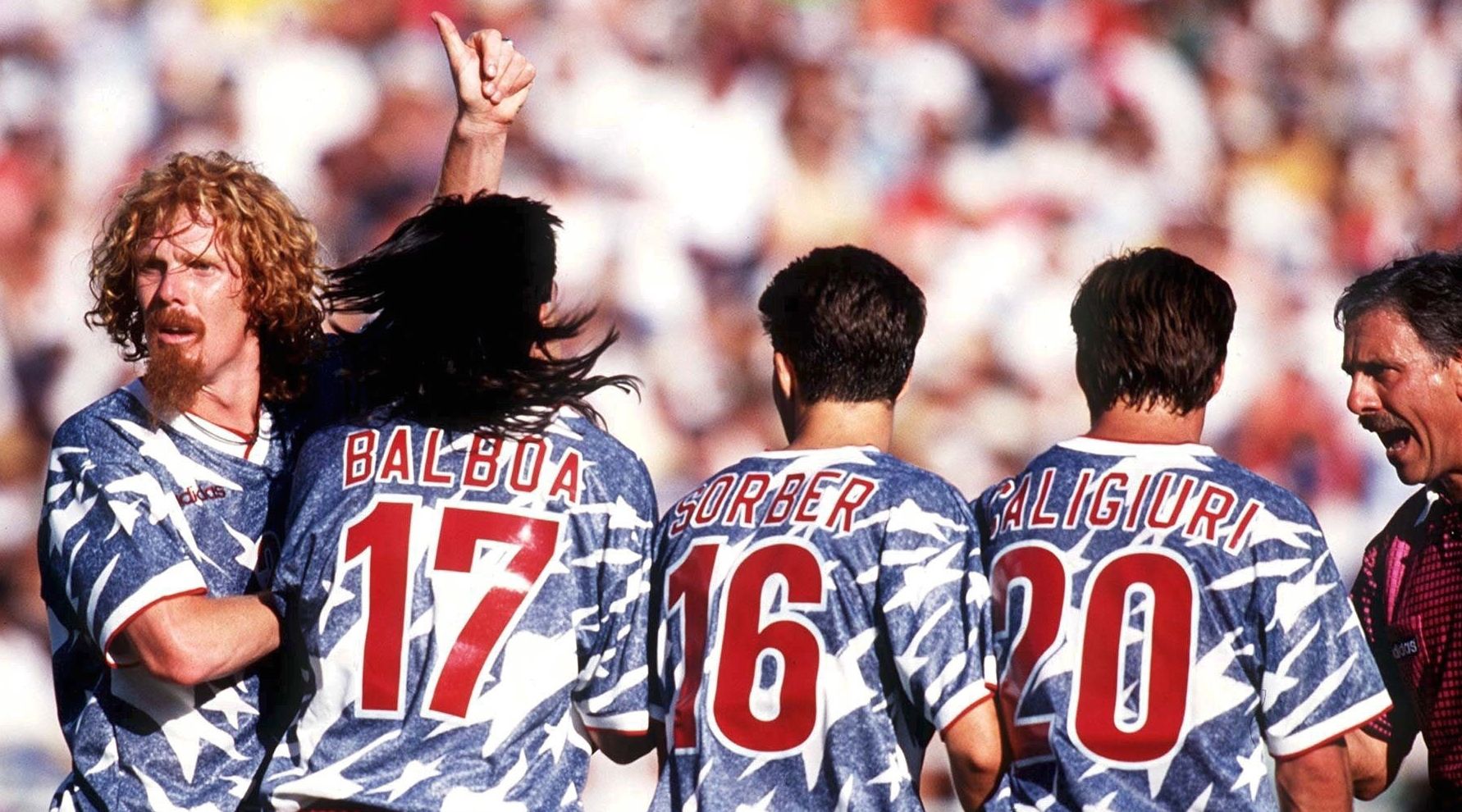
Copy linkFacebookXPinterestEmailShare this article 0Join the conversationFollow usAdd us as a preferred source on GoogleNewsletterSubscribe to our newsletterIt has been 38 years since the United States won the hosting rights for the 1994 FIFA World Cup.This decision caused plenty of controversy: the USA hadn't played in a World Cup since 1950. And unlike fellow bidders Brazil and Morocco, soccer wasn't the number one sport in the country. It was barely a footnote.But FIFA saw the potential to tap into the biggest sports consumer market in the world and set the path for soccer's rise to relevance in the USA.The 1994 World Cup kickstarted soccer's ascent to popularity in the USATheir gamble proved correct: 32 years later, the 1994 edition is still the most financially successful World Cup ever with overall attendance of 3,587,538 and an average attendance of 68,991 per game.Back in 1994, soccer ranked as America's 67th-favourite sport, behind tractor pulling. 71% of Americans didn't know the World Cup was coming to their country, whilst 29% didn't care. Fast-forward to today, and you'd be hard-pressed to find a department store, supermarket or restaurant that isn't actively promoting the 2026 World Cup. You may like USA '94 legacy: why two big misses didn't prevent a World Cup hit JULES BREACH: The USA knows how to put on a sporting event and the World Cup is the biggest of them all and there will be no escaping the crazy, gripping, emotional entertainment this summer The United States World Cup 2026 home kit is here - the nods to 1994 are irresistible MLS is the legacy of the 1994 World CupBut the greatest impact was had on the United States' soccer infrastructure. FIFA awarded the USA the 1994 hosting rights on the condition that they implement a professional soccer league, with the U.S. lacking a top division since the North American Soccer's League demise in 1984.This void was finally filled by Major League Soccer in 1996. And whilst MLS will be paused until July 16, they'll nevertheless be playing an integral role in the co-hosting process of the 2026 FIFA World Cup, proving to the world that the USA is indeed a soccer country now.Get FourFourTwo NewsletterThe best features, fun and footballing quizzes, straight to your inbox every week.Contact me with news and offers from other Future brandsReceive email from us on behalf of our trusted partners or sponsorsBy submitting your information you agree to the Terms & Conditions and Privacy Policy and are aged 16 or over.Five MLS stadiums will host World Cup matches, whilst 14 MLS and MLS NEXT PRO clubs will host national teams at their official Team Base Camps. More than 20 other MLS club facilities will host different events like pre-World Cup matches, pre-World Cup camps, fan festivities and official Venue-Specific Training Sites."When the U.S. was awarded the World Cup in 2018, we said, 'We've got this north star to look at, an 8-year ramp-up," stated MLS Chief Communications Officer Dan Courtemanche to FourFourTwo. "Since 2018, we actually have experienced significant growth with nine new soccer stadiums and two more on the way in New York and Chicago, and we certainly believe Boston in the coming years.""We've added 12 new training facilities, we've increased player sales by 5.75% and we've also increased attendance by 33%. 8 of the top 50 most valuable soccer clubs are in MLS, and you need to have those special homes and the world-class training facilities not just for the first team, but for the second team and youth academies." What to read next What happens to MLS during World Cup 2026? World Cup 2026: Dates, fixtures, stadiums, tickets and everything you need to know 'People have judged me my whole career, now it's time for me to judge them' Fox Sports reveal star-studded 2026 FIFA World Cup punditry panel featuring big name ex-players Order FourFourTwo's Ultimate World Cup Wallchart HERE!Large A1 Football Wall Chart with Space for Scores and Predictions: Designed for easy viewing and interaction with room to write results and build predictionsView DealWhen Courtemanche joined in 1995, MLS was getting ready to launch with 10 teams playing in borrowed football stadiums.Today, 27 of the 30 clubs play in stadiums built or renovated for soccer, the result of a cumulative $11 billion invested in soccer-specific stadiums, elite training facilities, youth academies, and community-based infrastructure projects.More than anything, MLS has helped to install a professional soccer pathway for kids across the U.S. and Canada, with over 650 homegrown players arriving in the league (the majority since 2020). Some of these players, like Weston McKennie, Alphonso Davis and Ricardo Pepi, will be playing in the World Cup.An MLS-record 44 players have been called up to the world's biggest stage. : https://t.co/XmwjOk5gvY pic.twitter.com/cFKubkIJeoJune 2, 2026MLS academies have absorbed the costs for elite youth players, including training, coaching, travel, and tournament fees, ensuring that talent is identified on merit and not affluence. These players have daily access to professional facilities, sports science, and nutrition, and with MLS Next Pro launching, they now have a bridge from youth soccer to first-team soccer.Major League Soccer is the United States' legacy of the 1994 World Cup. More than just providing a professional soccer league, they've sowed the seeds for soccer to take hold in the U.S. with an elite soccer infrastructure and heightened accessibility for young players across North America."We have become a top league when you look at our infrastructure, our facilities, the valuation of our clubs, and a total attendance that is second in the world to the Premier League, added Courtemanche. "For us, the World Cup presents an incredible opportunity for Major League Soccer to showcase where the league's at and where it's going."Zach LowySocial Links NavigationZach Lowy is a freelance football writer who covers a wide range of football leagues from Serie A to the Premier League to Ligue 1. Fluent in Spanish and Portuguese, Zach has interviewed a wide range of players and ex-players such as Sim�o Sabrosa, Louis Saha, Andrs Villas-Boas and Diego Forln. Over the past 6 and a half years, he has served as the co-creator of Breaking The Lines (@BTLVid on Twitter), the chief editor of the website and the main social media producer. Zach has also covered the Portuguese league on a consistent basis, interviewing players from various Primeira Liga clubs like Braga, Rio Ave, Famalic�o, Tondela, Estoril Praia and Arouca. He has traveled to Russia and France to cover the World Cup and Toulon Tournament, respectively.