
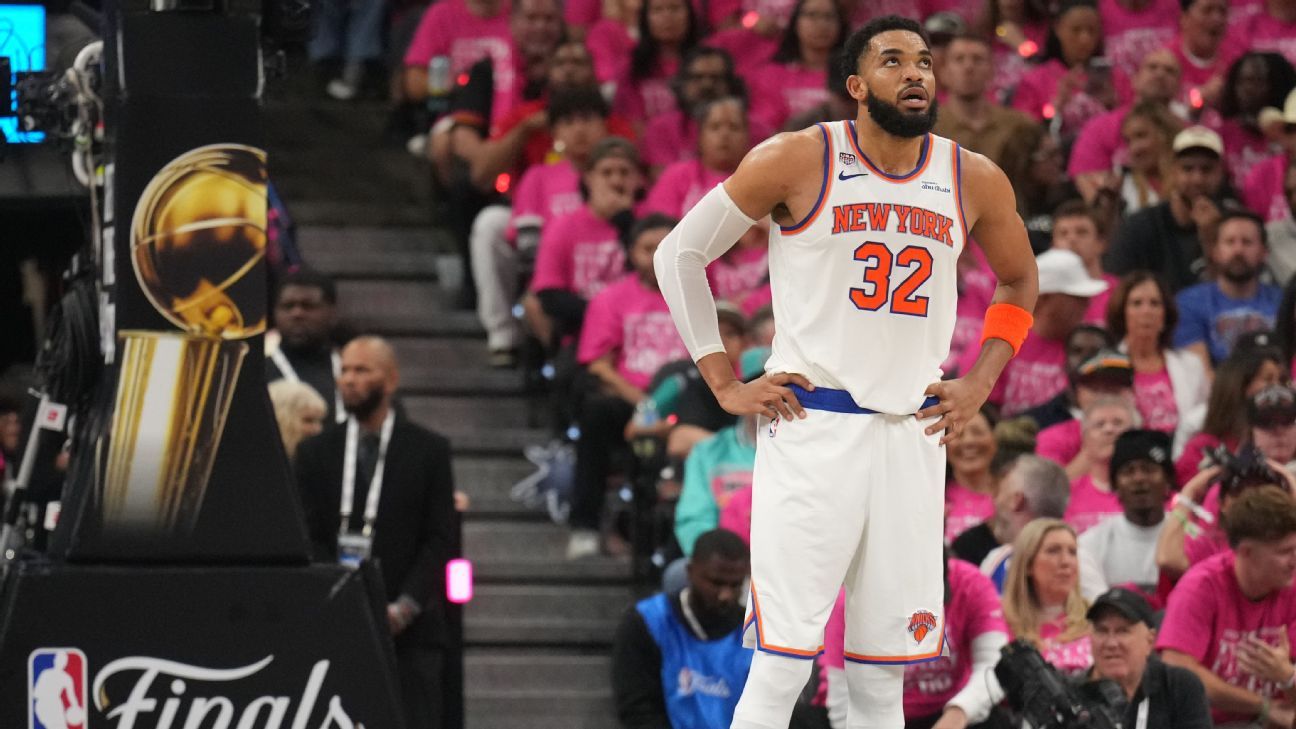
EmailPrintOpen Extended ReactionsGame 1 of the 2026 NBA Finals was a tactical defensive slugfest more emblematic of the 1990s, when the New York Knicks last made the Finals, than of 2026.The Knicks' 105.0 offensive rating in the game would have ranked 30th in the regular season this season, and the San Antonio Spurs' 96.0 offensive rating would have ranked last by a double-digit margin. The two teams shot a combined 39% from the field and 28% from 3-point range.Thanks to superior performances from their stars and a tremendous closing kick, the Knicks overcame a 14-point deficit to steal Game 1 on the road, 105-95. New York has now won 12 games in a row and needs just three more victories to claim its first championship in 53 years.Let's break down Game 1 from all angles, from its most important plays to the key indicators and matchups to watch in Game 2 (Friday, 8:30 p.m. ET, ABC/ESPN app).Quick links: Schedule | Bracket | TakeawaysSights, sounds | Playoff coverageThe most important plays of Game 1The home team was in control for most of Game 1. San Antonio led by 14 points midway through the third quarter, 65-51, before New York came alive.With Spurs backup center Luke Kornet in the game in place of Victor Wembanyama, Karl-Anthony Towns found a curling Mikal Bridges for a jumper. Then Towns dished to a cutting Landry Shamet -- who benefitted from no Wembanyama blockading the rim -- for two more points. Towns then blew past Kornet for an and-1 layup on the next trip down the floor. Spurs coach Mitch Johnson called a timeout and reinserted Wembanyama, but Towns' hot hand didn't dissipate. He grabbed an offensive rebound over the young Frenchman for a putback layup, and on the next possession, he showed why the Spurs have such difficult matchup choices in these Finals.With Wembanyama nominally guarding Josh Hart -- the Spurs' preferred assignment, because it allows the unanimous Defensive Player of the Year to roam the baseline in a free safety role -- the Knicks offense struggled to create an opening. Wembanyama corralled a Jalen Brunson pick-and-roll, halted a Hart drive and deterred Shamet from venturing into the lane. The shot clock wound down, and Hart was forced to launch a semi-contested 3-pointer over Wembanyama's outstretched left arm. That's normally a great outcome for San Antonio.And indeed, Hart's shot missed. With Wembanyama now on the perimeter, though, Towns had precious room to work down low. He outmuscled Keldon Johnson for another offensive rebound, shook off the contact and scored another and-1 layup. A 14-point lead had dwindled to two in less than four minutes. When Towns is at his best, he blends force at the basket with a reliable 3-pointer with a newly discovered playmaking spark. Spurs wings such as Johnson, Devin Vassell and Julian Champagnie aren't big enough to stop him, and Kornet isn't fast enough. That leaves Wembanyama as perhaps the only Spur who can keep him off the scoreboard.The Spurs used Wembanyama on Towns more than expected in Game 1, but they create the most defensive havoc when Wembanyama can serve as the league's best backline helper, rather than spacing out with a shooter. They want to match him with Hart. Yet as Towns showed on this key play in the Knicks' crucial third-quarter run, he might be too tricky a matchup for anyone else to handle.That difference between Towns and Chet Holmgren -- who did not make the Spurs pay for guarding him with a wing -- is why the Knicks won Game 1 in the Finals (and the Oklahoma City Thunder didn't win Game 7 of the Western Conference finals).Towns' final stat line of 18 points, 12 rebounds and four assists doesn't capture his holistic impact on Wednesday night. He wasn't solely a one-way player; if anything, he excelled even more on the defensive end, where he held up better than expected against Wembanyama.The Knicks almost exclusively defended Wembanyama with centers (Towns and Mitchell Robinson), rather than mixing in coverage from a physical wing such as Hart or OG Anunoby. And that approach worked. Wembanyama drew several fouls on Towns, but he shot just 2-for-13 from the field when Towns was his primary defender, according to GeniusIQ tracking. He had nine points and five turnovers against Towns.Overall, Wembanyama finished Game 1 with his most turnovers (six) and missed shots (15) in any game this postseason. He'll need to solve Towns' challenge -- on both ends -- going forward.Three key Game 1 lessons1. Hart continues to struggle with his jumper in this postseason -- he's now down to 29% on 3-pointers -- but he remains the Knicks' most important glue guy, and he has a clear place in this series. Although he ended Game 1 with just three points, he contributed 15 rebounds, six assists and four steals, and he was a game-high plus-22.Larry Bird is the only other player in NBA Finals history with at least 15 rebounds, six assists and four steals in a game. And Hart is the first player to lead a Finals game outright in all three categories, per ESPN Research.It's no coincidence that the Spurs won the first half (when Hart played just seven minutes due to foul trouble) but lost the second half (when Hart played 20 minutes) convincingly.2. De'Aaron Fox made a couple of huge plays to end the first half: He swiped the ball from Brunson, converted a fast-break dunk and made a nifty kickout pass to Julian Champagnie for a corner 3.But Fox was otherwise invisible in Game 1. His seven points were the fewest for any Spurs starter, and he recorded as many turnovers (three) as made field goals. (So did Wembanyama, with six of each.) Immediately after Brunson made a go-ahead 3-pointer in the final minutes, Fox missed an open pull-up jumper that would have tied the score.Put another way, one lefty All-Star point guard made his clutch shot, and one lefty All-Star point guard didn't. Sometimes, the sport is that simple.Meanwhile, another dynamic lefty point guard -- Spurs rookie Dylan Harper -- was arguably San Antonio's best player on Wednesday. The 20-year-old backup was aggressive and fearless in his first Finals game, scoring 16 points on 6-of-10 shooting; he was the only Spur who made at least half of his shot attempts.Fox is a veteran with a solid end-of-game reputation -- who can forget that he was the inaugural Clutch Player of the Year winner in 2023, two years before Brunson claimed that award? -- but it was still a surprise that Harper wasn't in Mitch Johnson's closing group. That dynamic is worth watching if a gap between the two players' performances persists.3. "Our transition defense was terrible in the first half," Knicks coach Mike Brown said to sideline reporter Lisa Salters at halftime.He wasn't wrong. According to ESPN Research, the Spurs had 16 transition plays in the first half, which was tied for the most by any team in a Finals half in the tracking era (since 2013-14). They scored 21 points on those plays.The Knicks shut down that outlet for easy Spurs points after the break, however. In the second half, New York committed only one turnover, and San Antonio scored just one point from three transition opportunities.Given how much the Spurs struggled to score in the halfcourt in Game 1, they needed to run to generate offense. But New York has allowed the second-fewest fast-break points in the playoffs, behind only Toronto. (San Antonio ranks third.) The Spurs need to identify more opportunities to push the pace throughout Game 2.Notes and loose ends looking ahead to Game 2 One encouraging sign for San Antonio is that its offensive process wasn't as dire as its offensive results. According to GeniusIQ, the two teams were just about equal in quantified shot probability, which estimates a team's "expected" effective field goal percentage based on factors like shooter identity and defender location.The Spurs underperformed their expected effective field goal percentage by 10.1%, their second-worst mark in any game this season, and their worst in the postseason. The Knicks also underperformed, but by a less outlier-y 5.1%.Better shooting luck for the Spurs in Game 2 would go a long way toward evening the Finals. The Spurs attempted to defend Brunson with rookie Carter Bryant for a stretch in the second quarter. Bryant is the sort of big, physical wing who can slow Brunson in theory.But in practice, Brunson torched the rookie with repeated drives to the basket. He shot 3-for-4 with Bryant as his primary defender, and Bryant didn't get off the bench in the second half.Add in an ineffective stint from Harrison Barnes and just eight minutes for Sixth Man of the Year Keldon Johnson, his fewest in any playoff game, and the Spurs are looking thin at the forward positions. Beyond that abbreviated stretch with Bryant, however, the Spurs made Brunson work for every one of his 30 points in Game 1. He wasn't very efficient, with 31 field goal attempts, and his quantified shot probability was just 48%, per GeniusIQ -- his lowest mark in any game this postseason.Such is life against the Spurs defense. Out of the 15 games that Shai Gilgeous-Alexander played in these playoffs, the bottom six in shot quality all came against San Antonio last round.Brunson has demonstrated, time and again, his ability to make tough shots. But the shot diet in Game 1 was difficult even for him. One of the main battlegrounds in this series is the Knicks' relentless rim attacks versus the Spurs' dominant rim defense. Entering the Finals, New York led all playoff offenses with 54.8 points in the paint per 100 possessions, while the Spurs led all playoff defenses by allowing just 40.9.The Knicks won that battle in Game 1, with 50 points in the paint, and that stat continues to be predictive of San Antonio's results this spring. The Spurs are now 3-6 in the playoffs when they allow at least 40 points in the paint, versus 9-1 when they hold teams below 40.