
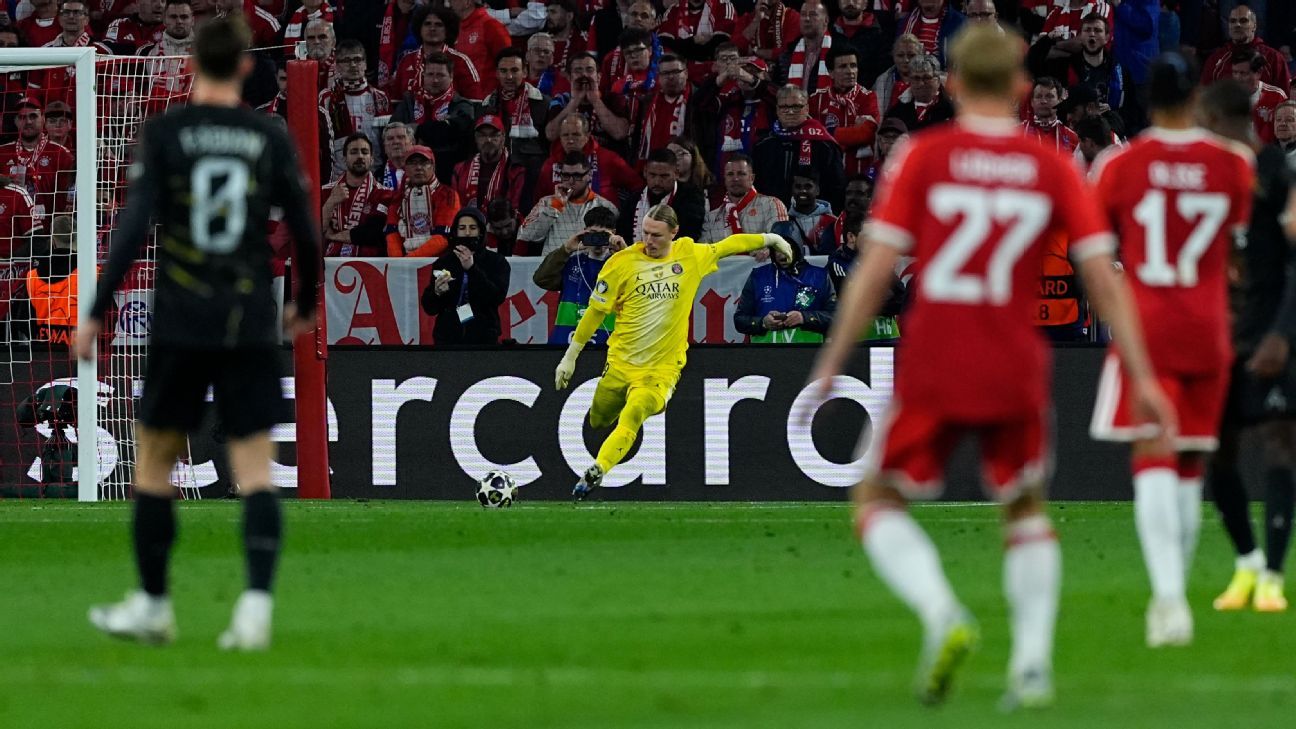
EmailPrintOpen Extended ReactionsSaturday's UEFA Champions League final in Budapest pits Paris Saint-Germain against Arsenal -- two very good football sides, but in very different ways.The teams' traits are set in stone, which means the pattern of the game can be relatively easy to envision: Pass-happy PSG, who averaged an astonishing 64.6% possession per game in the French Ligue 1 this season, will duck and weave their way through the lines to make their way up the pitch neatly; while the Gunners, who conceded fewer goals (27) and scored more from set pieces (25) in the Premier League than any other side in Europe's top-five divisions, will aspire to be a combination of obstinate and opportunistic.That's not to say it will be Luis Enrique's attack vs. Mikel Arteta's defense -- in fact, Arsenal boast some exceptional difference-makers on the ball, while PSG can showcase a more pragmatic side when required -- but many fans will head into the game knowing broadly how things will shake out.Beyond that general pattern, however, there are a few tactical quirks and nuances that could potentially define European club football's showpiece event.- Olley: Inside Arsenal's 5-phase plan to win PL title- Ogden: PSG on brink of greatness after reaching another final- Champions League final venue has led to travel mix-ups beforePSG's bizarre kickoff routineIn the age of set piece innovation, perhaps it shouldn't come as a surprise to see a team simply punting the ball straight out of play into the opposition half from kickoff. Clearly there's an intention behind it.But the fact that it's PSG -- arguably the best team in the world -- who have taken to this rudimental strategy more than others makes it difficult to process. So why do they do this?"It's about boxing the opposition in," set piece analyst Stuart Reid, who has worked with a litany of clubs that includes Champions League qualifiers Como and newly promoted Hull City, said. "Push high up the pitch immediately and try to win the ball back from the resulting throw-in. Then you've got possession in the opposition third quickly."This is exactly what PSG do, and they do it well. In their last two Ligue 1 games of the season, they regained possession within 30 seconds of kickoff. Curiously, though, they don't tend to use it as a platform to get an early shot off -- the stats show that they booted it straight out of play 28 times in Ligue 1 and 15 times in the Champions League this season, yet not once did they take a shot within 60 seconds.Instead, PSG tend to recycle the ball back toward the defensive line and establish possession. You might argue they could have just done this from kick off by passing backwards, but as Reid points out, "at kickoffs, there's generally a lot of space between the players" and it's possible Luis Enrique sees this as a weakness opponents could exploit.After all, the Premier League recently saw two goals -- Erling Haaland for Manchester City vs. Everton, and Sunderland's Wilson Isidor vs. Aston Villa -- scored immediately following kickoffs, as the gaps between the defenders were artificially big. This cannot happen when PSG are starting the game as, once the ball goes out of play, they squeeze up the pitch as a unit.PSG's goal-kick tactics in the semifinal against Bayern Munich also caused a stir, as what initially looked like Matvei Safonov getting his distribution repeatedly wrong -- when he kept sending the ball straight out of play just past the halfway line -- quickly became a pattern."There's a mental aspect to it," Reid says. "You pen them [the opposition] in, put them on the back foot, it sets up a press in the place of your choosing; it's mind games."Also, specifically in the first leg, Safonov kept kicking the ball out on Bayern winger Michael Olise's sidem -- which was a ploy to stop him getting on the ball."You don't want to give him a lot of space, so you're crowding him out," Reid adds. "You're trying to stop him imposing himself on the game."So could PSG deploy the same tactic to crowd and pressure Bukayo Saka, who is Arsenal's biggest difference-maker and plays in the same right wing spot as Olise?Kai Havertz or Viktor Gykeres? Arteta's big callIt's not often that teams arrive at the Champions League final with legitimate question marks over who might start up front; if you're on for a potential league and European double, you've usually got the answer locked in.But Arsenal buck that trend. Arteta has two options to choose from: Havertz or Gykeres. Both are imperfect, and the key to victory may well come in utilizing them in the right order.Some would argue Gykeres deserves to start, on account of his improved form over the back end of the season, his strong Champions League strike rate (five goals in 11 starts) and, most importantly, his exceptional semifinal outings against Atltico Madrid.As shown here, Gyokeres needs room to run so he can stretch defenses. (Credit: +Foot Direct)It would be no exaggeration to suggest his performance in the second leg, despite not scoring, was by far his best all-around showing in an Arsenal shirt. He bullied Diego Simeone's defense, pulling them into uncomfortable positions, dominating them with his back to goal, and finding passes into the penalty box to set up chances cleanly.Gykeres is best fed with this pass -- but it's high risk, and if it misses the mark, Arsenal will lose the ball too frequently. (Credit: Sky Sports)But there's a caveat: Gykeres only tends to look like this when he has a physical advantage over his opponent. His first touch and control isn't anywhere near the highest standard, so he compensates for that through size, aggression and speed.Atltico's Robin Le Normand, Dvid Hancko and Marc Pubill were outrun and outmuscled. But will he do the same to PSG pair Willian Pacho and Marquinhos? It's a lot less likely ... at least when they're fresh.Havertz is much neater, and better at retaining the ball, than Gykeres in tight spots. (Credit: CBS)That gives credence to the idea that Havertz -- who is a better technician, neater link player, and excellent presser -- should start. If Arsenal do find it hard to come by the ball, his ability to hold it up and allow his teammates to get up the pitch could become invaluable.Then, later on, Gykeres' physical approach could work better either against tired opponents, or when Arsenal are potentially chasing the game.There's merit in both suggestions and Arteta must make a difficult call, which he'll no doubt do ruthlessly.Right back is an area to target, for both sidesNeither team will head into the final entirely happy with the situation on their right flank.Arsenal's first-choice option, Jurrin Timber, hasn't made a matchday squad since mid-March due to injury. He's desperate to be fit, but even if he makes it, he won't be anywhere near 100%. Meanwhile his backup, Ben White, sustained a season-ending knee injury in May against West Ham United.That leaves a choice between center back Cristhian Mosquera, holding midfielder Martn Zubimendi, or box-to-box dynamo Declan Rice. All three have played right back over the last month as Arteta shuffles between his options.The most likely of those choices is Mosquera, given he's at least a natural defender and the influence of the other two would be missed in midfield. But it's a big ask for the 21-year-old, signed last summer for an initial �13 million as a development player, to contain PSG winger Khvicha Kvaratskhelia and his supporting left back Nuno Mendes -- arguably the best left-sided combination in the world.To make matters more difficult, "Kvara" rotates with the other two PSG forwards in a very fluid manner, so at times Mosquera will be facing Ousmane Dembl or Dsir Dou and won't be able to specifically prepare to just deal with one opponent.Worse yet, sometimes both PSG wingers will pop up on the same flank and work in tandem, overloading and overpowering a fullback, which feels like a lot for a stand-in to deal with.Khvicha Kvaratskhelia and Ousmane Dembl or Dsir Dou can sometimes operate on the same side. (Credit: CBS)Arteta will at least be relieved that Les Parisiens are not expected to be at full strength at right back either. Reports suggest Achraf Hakimi, who sustained a hamstring injury in the semifinal first leg against Bayern Munich, is racing to be fit. If he doesn't make it, central midfielder Warren Zare-Emery will slot in.Zare-Emery is still only 20 but has covered the right back position plenty this season, playing 21 times there and really settling into the role. Yet he doesn't offer the same attacking thrust as Hakimi and is not a natural on the flank, so there could be moments where Arsenal's left winger -- Leandro Trossard, Gabriel Martinelli, Eberechi Eze, or perhaps a left-sided combination -- finds joy.If Hakimi does play, it'll be his first game for a month at the end of a stop-start campaign that's basically lasted two years due to the Club World Cup. There may still be some fatigue or rustiness from him for Arsenal to probe.