
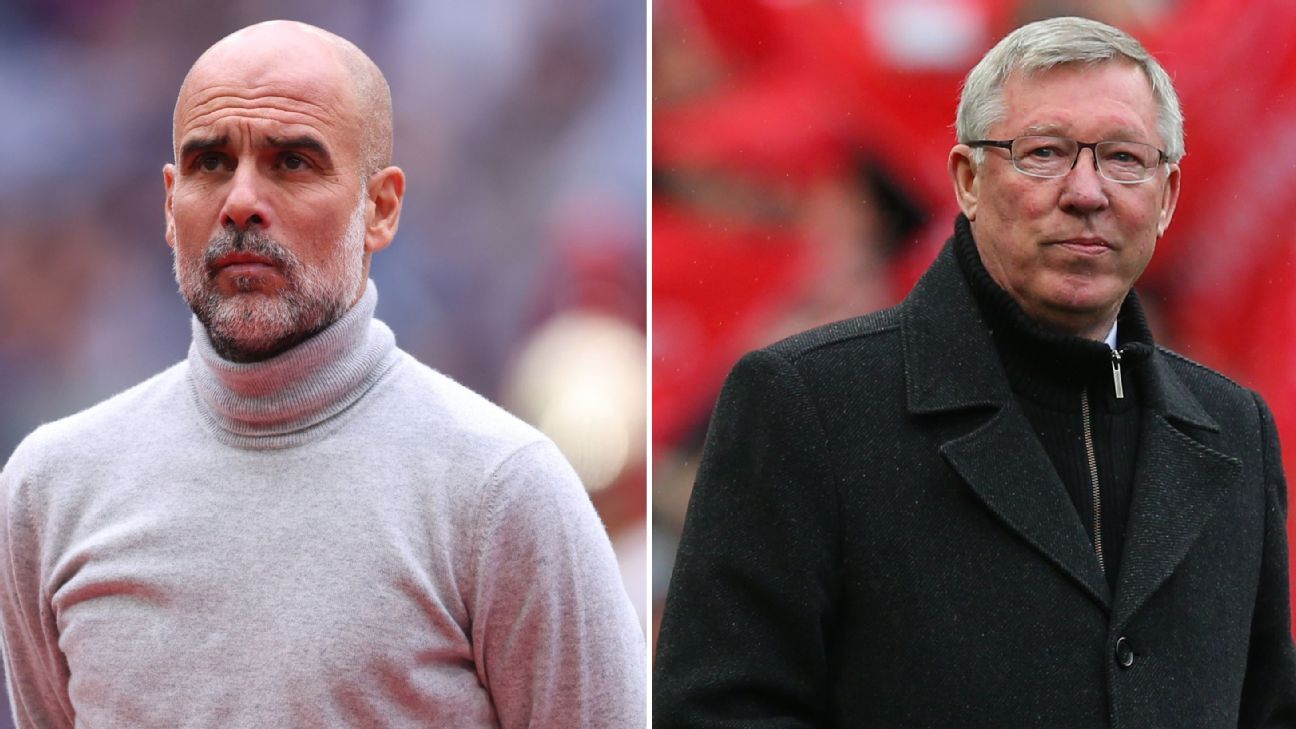
EmailPrintOpen Extended ReactionsThe Pep Guardiola era at Manchester City is over, and the former Barcelona and Bayern Munich coach leaves the Etihad as arguably the greatest manager the league has ever seen -- yes, perhaps even greater than Manchester United's Sir Alex Ferguson.Guardiola engineered a period of dominance at City that saw the club win 17 major honors, including six Premier Leagues and one Champions League, since taking charge in 2016. On a wider scale, he also influenced a change of the sport's landscape across England, with teams at all levels attempting to adopt many aspects of his philosophy.But does his incredible record elevate above Ferguson in the Premier League's pantheon of top managers?Ferguson reigned at United for almost 28 years, predating the start of the Premier League in 1992-93, and won 28 major honors including 13 Premier Leagues and two Champions Leagues. He was the game's dominant force in England for two decades and built a succession of great teams, with home-grown players as the bedrock of many of them.- Dawson: Premier League, Man City won't be the same post-Guardiola- Is Carrick up to the task as Man United's new boss?- Hamilton: A fans' view of the Premier League's relegation battleBoth Ferguson and Guardiola are guaranteed their place on the Premier League's Mount Rushmore, but which one can we consider to be the greatest?Premier League dominanceThis category is a simple mathematical equation. Ferguson won more Premier League titles than Guardiola, but the United manager won his 13 Premier Leagues over a period of 21 seasons. Guardiola's haul of six Premier League titles came from 10 seasons at the Etihad, which means the margins are incredibly tight.With 13 titles in 21 seasons, Ferguson has a Premier League title rate of 61.9%, with Guardiola's six in 10 seasons seeing the 55-year-old finish at 60%. If we judge Ferguson over the full range of his time at Old Trafford, starting with the 1986-87 season, then the Scot had a title-winning success rate of 46.4% with 13 titles from 28 seasons. But we are judging the greatest manager of the Premier League era, so Ferguson wins this category by a margin of just 1.9 percentage points.Had Guardiola guided City to this season's title, his winning percentage would jump to 70%, but Ferguson also had near misses in 2011-12 (second on goal difference) and 1994-95 (second by one point). One thing is certain: Both can boast incredible consistency.Champions League and missed opportunitiesOne competition in which both Ferguson and Guardiola underperformed with United and City, respectively, was the Champions League.Ferguson had 19 seasons in the Champions League with United (in the early 1990s, only the league champions qualified for the competition) and won it twice, while Guardiola (who won two Champions Leagues with Barcelona in 2009 and 2011) has delivered just one title to the Etihad in 10 seasons. Under Ferguson, United also lost two Champions League finals -- both to Guardiola's Barcelona -- while City lost to Chelsea in Porto in 2021, before going on to win it for the first time against Internazionale in Istanbul two years later.Overall, Ferguson's Champions League win rate with United was an underwhelming 10.5%, but it still keeps him fractionally ahead of Guardiola because his one win in a decade at City sees him end up at 10%.Ferguson often spoke about his frustrations at failing to win more Champions Leagues during his time at Old Trafford. Considering United's lengthy period of domestic dominance, United unquestionably underperformed in the biggest club competition. However, the same can be said of Guardiola.When City hired him in the summer of 2016, he arrived on an initial three-year contract with the clear goal of making City European champions in that time. It eventually took Guardiola seven years to win City's first -- and only -- Champions League. Had he declared at the outset of his reign that he would stay for 10 years and win just one Champions League, it would have been very difficult to believe his time would not result in many more European titles.Total trophy haulIf we discount Community Shield wins -- the season curtain-raiser is not classed as a competitive fixture by the English Football Association -- and remain within the Premier League era, Ferguson can point to 24 major honors during 21 Premier League seasons at Old Trafford. Guardiola's 10 seasons at City have resulted in 17 major honors being added to the club's trophy cabinet.No other managers in the Premier League era come close to matching Ferguson and Guardiola when it comes to their trophy collections.Arsene Wenger won 10 major honors -- three Premier Leagues, seven FA Cups -- during a 22-year tenure as Arsenal manager. Jose Mourinho delivered nine major trophies, including three Premier Leagues, during his time at Chelsea and United. Jurgen Klopp won seven major honors in nine years at Liverpool, with a Premier League and a Champions League title ensuring his status as an Anfield legend.Wenger, Mourinho and Klopp are also Premier League greats, but none is in the same league as Ferguson and Guardiola.Youth developmentThis is a category Ferguson wins emphatically, and in so doing, focuses the spotlight on an area in which Guardiola has failed to deliver for City.Ferguson famously dismantled his first great United team in the mid-1990s to rebuild around Old Trafford's now-legendary "Class of '92," a group of young players including Ryan Giggs, Paul Scholes, David Beckham, Nicky Butt and Gary and Phil Neville. At the time, it was a stunning decision. Ferguson offloaded key players Paul Ince, Mark Hughes and Andrei Kanchelskis to make room for his young stars, but the kids delivered with United winning a 1995-96 Premier League-FA Cup double in their first season together.Giggs and Scholes would remain with the team until Ferguson stepped down in 2013, while the others also made crucial contributions to successes including the 1999 treble and 2008 Premier League-Champions League double. Aside from the Class of '92, Ferguson backed many other homegrown players over the years including Wes Brown, John O'Shea, Darren Fletcher, Jonny Evans and Danny Welbeck, all of whom contributed to major trophy wins.Beyond delivering repeated success at Man City, Guardiola's remit was to also oversee a stream of homegrown talent that would end up in the first team, much like what happened with Barcelona and their fabled La Masia academy. But aside from Phil Foden, a central figure in Guardiola's successful teams and the Premier League's Player of the Season winner in 2023-24, only Nico O'Reilly has shown signs of being able to secure a long-term future with the City team.Rico Lewis and Oscar Bobb both failed to build on early promise, while highly rated youngsters including Cole Palmer, Morgan Rogers, Jadon Sancho and Liam Delap were allowed to leave the Etihad as Guardiola blocked their first-team path with expensive signings.City have undoubtedly built a formidable Academy under Guardiola, but other clubs have arguably been the biggest beneficiaries. Under Ferguson, United kept their best youngsters and trusted them to win big trophies at Old Trafford.Style of playThis category is where Guardiola comfortably wins out over Ferguson.Though Ferguson built several powerful and exciting teams at United, he left Old Trafford in 2013 without a "Ferguson philosophy" permeating the game at lower levels in England. His approach was comparatively simple: Build a team focused on passion, desire, power, bravery and skill, and leave the players to beat their opponents by meshing all of those qualities into a formidable squad.Ever since he started out as Barcelona coach in 2008-09, Guardiola has built teams based on possession, with the desired outcome being that the opponents are passed into submission. Ball-playing goalkeepers, inverted fullbacks, and center backs who are prepared to bring the ball out from the back have all been key elements of Guardiola's philosophy. At their peak, City were virtually unbeatable. These tactics kept City ahead of the chasing pack, with four consecutive Premier Leagues from 2021 to 2024 and a domestic treble in 2018-19. They were also the first team to amass 100 points in a season, with 32 wins and four draws taking them there in 2017-18.The manager's philosophy has evolved in recent years -- for example, Gianluigi Donnarumma doesn't fit the classic Guardiola profile of a ball-playing keeper -- but possession remains at the heart of his approach.At their best, United were always about pace and power rather than control, and that approach worked against them in Europe when faced with opponents as adept as Guardiola's Barcelona. The Ferguson way was perhaps more exciting to watch, but Guardiola's City were able to dominate the Premier League in a way that even Ferguson's United couldn't.The rivals they had to overcomeHow strong was the challenge to Ferguson and Guardiola's teams when they were at their best? That is a key factor in judging who is the greatest because the quality of your rivals can often be the true measure of your success.Ferguson had countless rivals during his Premier League era. Kenny Dalglish (Blackburn Rovers) beat Ferguson to the title in 1995 before United regained it the following year, when Kevin Keegan's Newcastle emerged as a threat to Ferguson's Old Trafford empire. Dalglish and Keegan had their moments, but Ferguson saw them both off.Arsene Wenger was a different challenge and his Arsenal team slugged it out with United for the best part of a decade, yet Ferguson's side won more trophies than the Gunners during that period. Jose Mourinho's Chelsea were a real threat, and thanks to the bankroll of Russian oligarch Roman Abramovich, they won back-to-back titles in the mid-2000s. Ferguson, however, was able to win that battle too by restoring United to the top of the pile.Guardiola's time at City was largely defined by his rivalry with Jurgen Klopp's Liverpool, who were to Guardiola what Wenger's Arsenal was to United. Klopp and Liverpool were a constant thorn in City's side, but Guardiola's team won six titles to Liverpool's one during that period of rivalry, which clearly forced Guardiola and City to new levels of quality.In this category, Ferguson and Guardiola can't be separated. They both faced down and beat formidable rivals to win titles.Final verdictHow do you separate two of the most influential and successful managers of all time, not merely of the Premier League era?In so many ways, Ferguson and Guardiola are equals, sharing their place at the summit. Ferguson's longevity and peerless ability to build and rebuild makes him a compelling candidate to be billed as the greatest, but Guardiola has matched the United manager's achievements -- and bettered them, in some cases -- during his remarkable decade at City.Though it is fair to reflect the part played in Guardiola's success by the financial strength of City under the Abu Dhabi owners, Ferguson also benefited from United being the most powerful force in the game for the majority of his time in charge, breaking the British transfer record several times to sign players including Roy Keane, Andy Cole, Juan Sebastian Veron and Rio Ferdinand.Maybe this is an unfair way to judge the best, but Ferguson squeezed every last drop out of his managerial skills to win his final title at United in 2012-13 at the age of 71. He left having done everything possible to keep winning, but Guardiola is vacating the stage at the age of 55. Imagine how much more he could have won had he committed to another decade at the helm.Guardiola is leaving at his peak, with the promise of more to come had he stayed, which is good news for Ferguson's legacy. But overall, the greatest manager of the Premier League era is Pep Guardiola.