
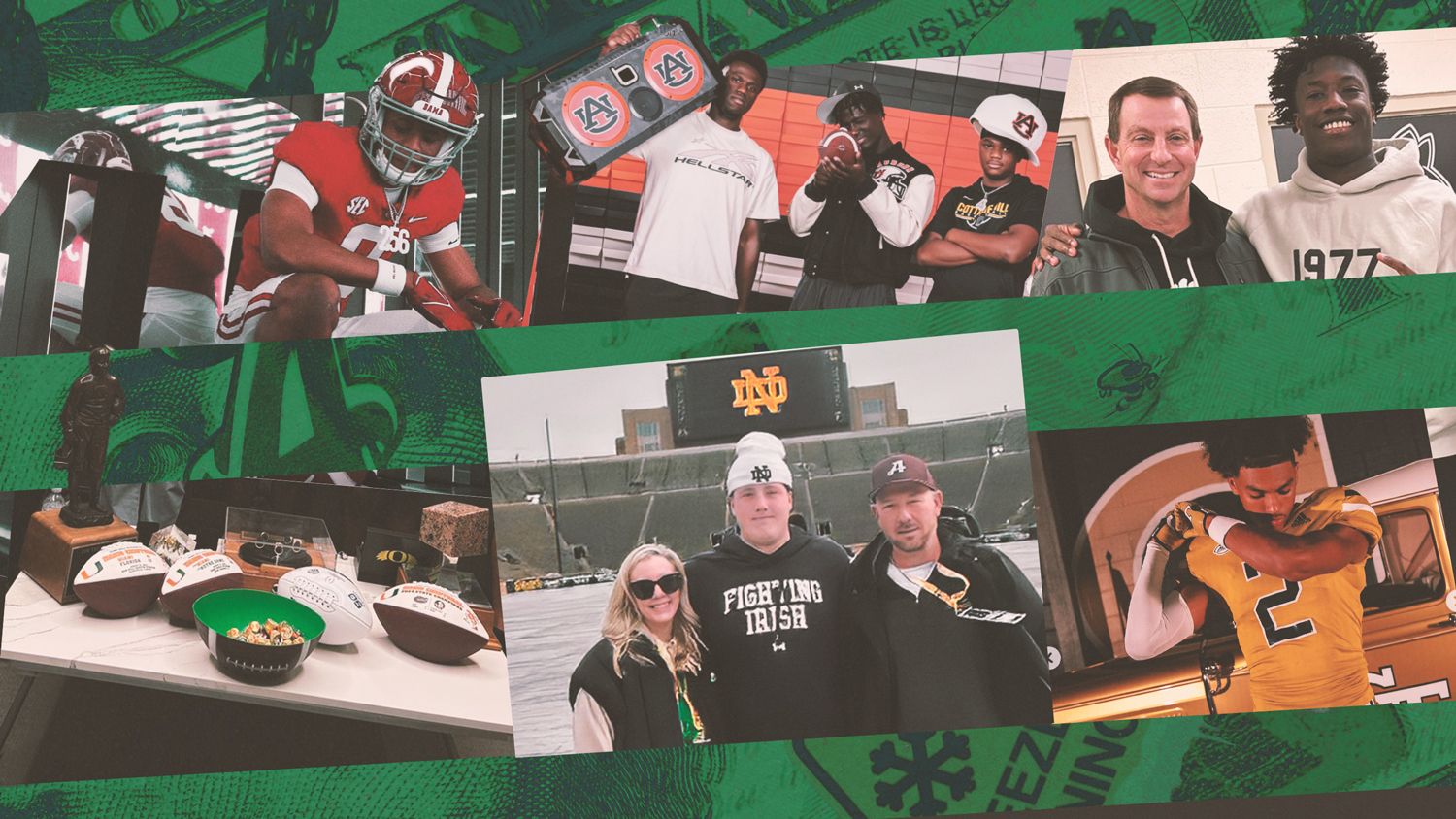
EmailPrintOpen Extended ReactionsELABORATE PHOTO SHOOTS with live animals; lavish five-course meals; fleets of Lamborghinis; the slow-motion dance moves of ex-LSU coach Brian Kelly. The oft-extravagant excesses of the modern official visit weekend have been woven into the fabric of major college football for years.Top programs are still rolling out the red carpet for coveted high school recruits this spring. But as elite prospects flock to campuses from now to late June, a consensus is forming among head coaches and general managers across the country in 2026: Spring official visits, once a tentpole of the modern recruiting calendar, don't carry nearly the same weight they used to."With some kids now, there's not one thing you can do over those 48 hours that matters one bit," Georgia Tech coach Brent Key told ESPN. "The only question is: 'What am I getting paid?' There's nothing wrong with that. But if you don't tell them what they want to hear, they're gone."College football's official visit weekends have always been painstakingly curated affairs. After the NCAA began permitting high school juniors to take springtime officials in 2018, the months of May and June progressively morphed into the epicenter of the recruiting cycle, and the 48-72 hours recruits and their families spend on campus exploded into a blur of ever-grander recruiting accoutrements. Goodbye cookie cakes, hello displays of luxury sports cars.But 11 months into the college football's revenue-share era, the complexion of spring official visits -- and their place in an accelerated recruiting calendar -- is less straightforward.Egged on by the proliferation of revenue-share contracts and third-party NIL deals, top prospects are committing earlier than ever before in the Class of 2027, many well before official visit season. Last spring, 136 of ESPN's top 300 recruits (45.3%) held commitments on May 19, per ESPN Research. A year later, that number stands at 165 (55%). "Any kid committing early in the spring, it's because they have some kind of term sheet in front of them," Alabama GM Courtney Morgan said. "Most of those guys aren't going to go take a bunch of other visits from there."As programs across the country prepare to host coveted targets over the next five weekends, the financial side of the equation is occupying more space on the official visit agenda, too.Many Power 4 programs integrated some form of a business meeting into their visit weekends following the advent of NIL in the summer of 2021. Five years later, the logistical and financial questions facing programs are more complex. When to host a priority recruit? Where to work a financial meeting into the visit schedule? How many official visit weekends to hold altogether?Every program is attacking the challenge differently."We're still doing a lot of the stuff that we used to do," an ACC GM said. "There's just an added tension in the room. Everybody knows there's this other component involved. And that's a financial component."This spring, ESPN spoke with nearly two dozen coaches, GMs, agents and top-100 prospects -- some on the condition of anonymity in exchange for their candor -- to answer two pressing questions: How did official visit season become the (un)official business window of the college football recruiting calendar? What role do official visits still hold in 2026?"These are the do-or-die months," said Key, a former All-ACC offensive lineman who was officially named Tech's head coach in 2023. "It still has to be a good visit. Does a recruit really care where you're going to eat? Probably not. But it still better be a good steak."DAYS AFTER THE January transfer portal window closed, phones in recruiting offices started ringing again. The calls were from player agents, many of them the same ones who had just negotiated portal deals, ready to open financial conversations on behalf of clients in the 2027 recruiting class.In 2026, negotiations between programs and high school prospects, their families and/or their representatives begin long before a sit-down meeting in the coach's office in May or June."[The calendar] starts earlier and earlier every year," an SEC GM said.Recruits cannot formally sign written offers until December. But deals are getting done early, and at an increasingly rapid pace. Four years ago, only 25% of ESPN's top-100 prospects in the 2024 class were committed to schools on May 19, 2023, per ESPN Research. Last spring, as programs doled out front-loaded deals ahead of the July 1 House Settlement, that count reached 42%. In the 2027 class, 58 of the nation's top-100 recruits have already given a verbal pledge."I've definitely felt the pressure," said five-star wide receiver Eric McFarland, who has official visits planned with Florida, Georgia, Tennessee and Texas A&M. "But it's my decision, and this isn't a short-term thing. So I'm going to take my time to make sure I make the right decision."Early financial agreements are only the latest wave in a tide that's thrust the high school recruiting cycle forward into the front half of the calendar year across the past 15 years.Mack Brown was one catalyst. During his time at Texas from 1998 to 2013, the Longhorns began working the recruiting trail earlier and earlier each cycle, practically inventing the term "Junior Day" to highlight top upcoming talent. In a short time, programs across the nation were doing the same, and late-spring unofficial visits increasingly became as important as the fall or postseason official visits in the run-up to the February national signing day."You felt like if you could get them on campus during the summer, then you had a chance to get them," North Texas coach Neal Brown said.More formal changes arrived at the calendar in the late 2010s.Coaches including Alabama's Nick Saban grumbled when the NCAA approved measures to establish the December early signing period and opened the door for juniors to take spring officials beginning with the 2018 cycle. Come late spring 2017, however, programs across the country dove headfirst into the opportunity to host officials in the relative quiet of summer, albeit with old-school caution relative to today's recruiting environment."We were very careful then," said Purdue coach Barry Odom, who was at Missouri when summer officials took off. "Ten years ago, if you gave a kid a T-shirt you were going to jail. Recruiting has changed more in the last three or four years than it has in the last 25 combined."In the years since, the prominence of the transfer portal, rule changes allowing programs to offer high school recruits earlier and measures limiting to evaluation windows and road time for coaches have all combined to pull recruits on-campus sooner. In 2026, the standard unofficial visit in February, March or April looks more and more like an official, packed with many of the same agenda items -- sessions with strength coaches, medical staff, academic advisors, etc. -- that previously made up the nuts-and-bolts of a typical late-May or June visit itinerary.For programs chasing top prospects, it's effectively become a requisite to host a string of unofficial visits first just to remain in the running come June. By the time that recruit arrives for an official visit weekend in late-spring, he's likely already logged five or six trips to campus."If the official visit is the first time a kid ever comes to see you, you're not going to have a chance to get that kid unless you just decide you're going to be his highest offer," one SEC GM said. "He's a stranger at that point."As team payrolls creep into the $40 million range at the very top end of the sport, major college football programs are constantly monitoring their roster budgets and thinking ahead with a firm sense of positional needs and roster space. High school recruiting, where USC spent more than $10 million to land the nation's No. 1 class last cycle, is part of that equation.Per ESPN sources, at least five 2027 prospects are set to sign deals that will pay them more than $1 million in their first college season, and as of May 19, only seven of ESPN's 21 five-star recruits remain uncommitted. Under the right circumstances, the only thing keeping a program from locking down a coveted recruit for the future early is a substantial financial investment."I think the GMs and programs that are waiting until June to make decisions financially are the ones that are getting killed," a Big Ten GM said. "You've got to make decisions so fast."Agents and general managers spend the weeks leading up to official visits hammering out financial details. Both sides typically prefer to be on the same page headed into a visit weekend. Agents want their clients to have a full picture of the offers on the table before they leave for a visit; coaches, GMs and front office staff do their best to avoid surprises or squandered efforts."We want to know all the school's offers about a week or two before the first OV," one agent told ESPN."If you have that meeting on Sunday morning and you are not aligned on the money," one Big 12 GM explained, "the whole weekend was a waste of time."Recruiting, in spite of it all, remains a relationship game. Prospects still frequently talk about longstanding connections with assistant coaches who offered them as eighth graders. Coaches who spend the years cultivating bonds with recruits and their families can still be the difference.However, in college football's money era, official visit invites and committable offers can disappear quickly, and relationships can fracture in an instant if the business end falls through."If we can't come to an agreement, you just don't bring them for an OV -- we'll cancel the kid's visit," said Alabama's Morgan, who followed coach Kalen DeBoer to the Crimson Tide from Washington. "There was a big-time player last year, top of his position, we just told him don't come because we couldn't meet on the terms he wanted."AS A RECRUIT, Key didn't hear from the Yellow Jackets until the day after Thanksgiving of his senior year in high school. To that point, he'd been recruited almost exclusively by small schools and Ivy League programs in the fall of 1996.Boston College head coach Bill O'Brien, a graduate assistant with Georgia Tech at the time, helped sell the Yellow Jackets while driving Key and his mother around in a beat-up van during the official visit. Today, Key prefers to handle the program's negotiations on his turf. Specifically, his home just off campus."We do them all at my house," Key said. "I want it to be on my terms.""All the kids are swimming and hanging out, having fun," he continued. "It releases the tension from the whole thing. You're not in the football office. You're at somebody's house hanging out."College football programs have been preparing for official visits with the same attention to detail as fall Saturdays for years. With business increasingly at the forefront, coaches and GMs are reconsidering every element of the weekend. And the operation, on most campuses, is growing, too, with ever-expanding personnel departments, chiefs of staff and lawyers all part of the process alongside head coaches, assistants, GMs and top-level recruiting staffers."You've added this whole other variable," said James Madison and ex-Florida coach Billy Napier. "It's become an organization-wide effort. It takes a huge infrastructure to run it all now."For years, coaches and recruiting staffs quibbled over whether it was better to get the first or the last visit on a recruit's slate of official trips. Multiple coaches and GMs told ESPN that the prevailing wisdom now mirrors that of the transfer portal: The sooner you can get a priority recruit on campus, the better. "If they get blown out of the water on the first official visit, they might take that offer and never make it to your campus," one Big 12 GM explained.Some schools are scaling back on official visits this spring altogether. USC, for instance, plans to add roughly half as many high schoolers in 2027 after signing a massive, 35-man class in the 2026 cycle. In turn, the Trojans are hosting just one official visit weekend next month.Top-end Group of 6 programs recruit prospects on the Power 4/G6 bubble and seldom commit substantial dollars to high school recruits. Several, including North Texas, have shifted their visit weekends to later in June this cycle, aiming to catch recruits after they've taken Power 4 visits."It gives them time to get clear on what's really there for them before they come to see us," said Brown, the former West Virginia coach who took over the Mean Green in December.The strategy continues once a recruit finally lands on campus. At Washington, the Huskies typically hold their financial meeting at the start of the weekend, opting to get business out of the way early. But most programs prefer to wait until the very final hours of a visit weekend, reserving Sunday morning to talk money and make a final pitch. By then, prospects and their families have often been in town for two or three days, ample time to gather crucial information.Offers from other schools; family priorities; the key decision-makers in a prospect's inner circle. Coaches want every detail before they walk into a closing meeting. So they lean on eyes and ears in every corner of the team facility to pick up intel throughout the weekend."You want to see somebody's ass ripped? Don't have information by Sunday," Key said. "Everybody hears different stuff. Players get information when they're hosting. It's why you have a big staff. I want information."For the outsized role financials now play in the process, recruits are still all about the red carpet treatment, and many of the same principles that guided official visit weekends of the not-so-distant past remain intact.Photo shoots, which the NCAA barred from unofficial visits in 2023, remain a central attraction for recruits. Multiple coaches and GMs told ESPN that they've trimmed their hosting budgets in recent years. But programs across the Power 4 still spend thousands on elaborate sets, high-end lighting and props of all kinds, from live goats at Texas A&M to a custom IndyCar at Indiana."As a kid, you always wanted to put on the gear and it's going to be exciting," five-star cornerback Josh Dobson said. "I'll have those photos forever. I'll be able to show my kids someday."Programs continue to make the most of the natural resources at their disposal, too.At Cal or Washington, a typical official visit weekend inevitably ends up somewhere overlooking a body of water; Texas (Austin) and USC (Los Angeles) lean into their proximity to business and entertainment giants. At North Texas in June, dinner will be served at nearby Dallas Motor Speedway."You always want to have a 'wow' factor," North Texas GM Errin Joe, who previously worked at Alabama, Georgia Tech and Texas. "It's got to be something that's going to set us apart."College football programs will always be searching for ways to distinguish themselves. But with the claws of business now officially dug into every level of the recruiting process -- accelerating the calendar, driving commitment decisions and reshaping visit weekends -- it's fair to wonder: How much longer will programs continue to invest in all the elaborate and expensive bells and whistles when recruits and their families land on campus for an official visit?Posited one Big Ten GM: "What would you do all weekend if you didn't?"