
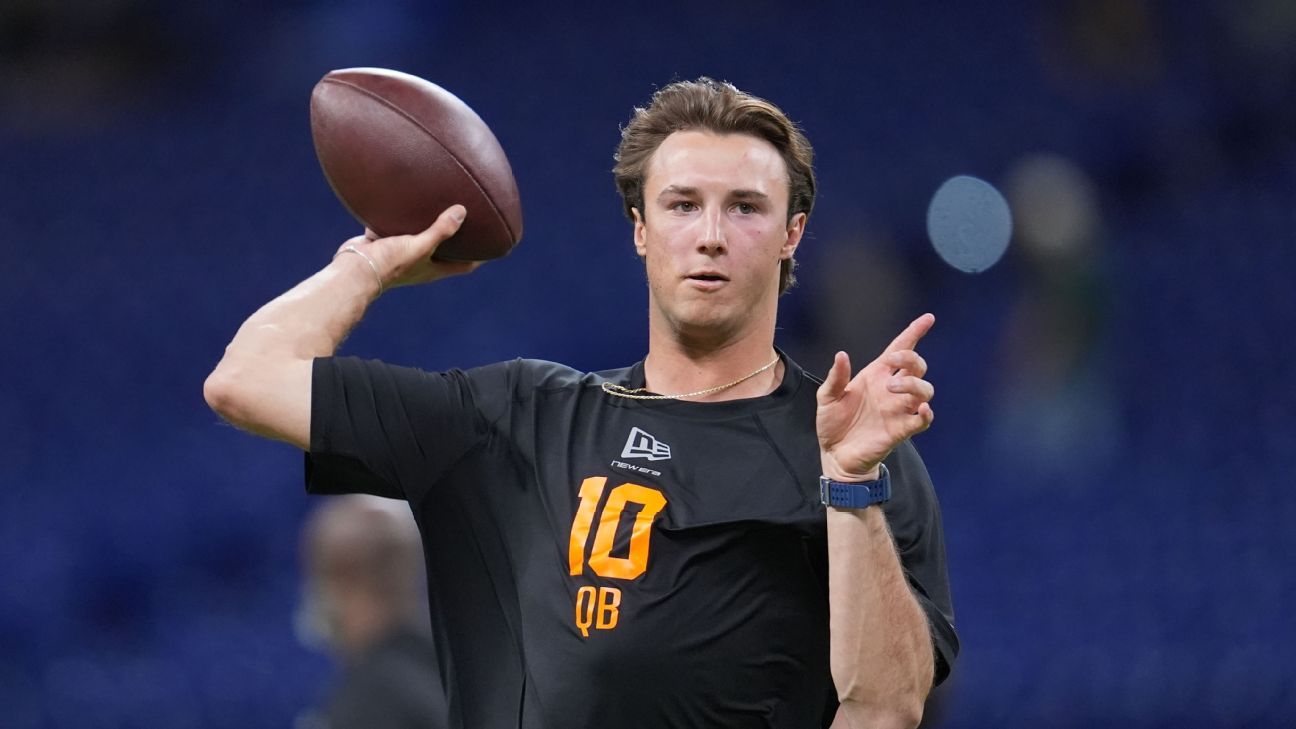
EmailPrintOpen Extended ReactionsFLORHAM PARK, N.J. -- A look at what's happening around the New York Jets:1. Missing piece: In their last two drafts, the Jets' top-50 picks included edge rusher, offensive tackle, wide receiver and cornerback -- all so-called premium positions.One premium position is conspicuously missing: Quarterback.That's a "Wait-till-next-year" story.On Saturday, the Jets used a fourth-round pick on Clemson's Cade Klubnik (No. 110 overall), though any player drafted on Day 3 -- especially a quarterback -- can best be described as a lottery ticket.The Aaron Glenn-Darren Mougey grand rebuilding plan, which began last November with the trades of Sauce Gardner and Quinnen Williams, likely won't be fully executed until they take the big quarterback plunge. All signs point to the 2027 draft. Experts say it will be rich with quarterback talent, and the Jets can attack it with three first-round picks.The objective over the past few days was to continue the roster building, and they accomplished that with a dynamic edge rusher in David Bailey and potential firepower on offense with tight end Kenyon Sadiq and wide receiver Omar Cooper Jr. -- all first-round picks.Sadiq and Cooper will be catching passes this season from Geno Smith, 35, a bridge quarterback. While the Jets believe Smith can rebound after a down year with the Las Vegas Raiders, it behooves them to secure the position for the long term. They weren't going to find that guy in this draft, so the focus was on the supporting cast.Understandably, Glenn didn't want to look that far ahead."We brought in Geno to be our starter, and I'm not going to put a cap on him on how many years he can play, so I don't even go into the fact of he's here for a year [under contract]," the coach said Saturday night. "As long as he's producing and as long as he's the best guy, he's going to continue to play."But, obviously, in this league, you have to have a system where there are backups and they've got to push the starter," Glenn added. "You always want to create that type of competition. Listen, I'm not going to sit here and say exactly where Cade's going to play. The thing is, those guys are going to go out there and compete. So right now, I like our room. I like where it's at."2. Backup plan: Mougey didn't rule out the possibility of adding an experienced backup. That would be prudent, considering Bailey Zappe and Brady Cook have a combined starting record of 4-9.3. Hall talks: One of the postdraft items on Mougey's things-to-do list is to reconnect with Breece Hall's agent. Mougey said there have been no talks since February, when they placed the franchise tag on their top running back."I think we made a good attempt to get something done," he said.Failing a long-term deal, Hall will play on the $14.3 million tag.4. Attention, draft nerds: You might find this interesting. For this draft, the Jets used a new player-grading system, one they created over the course of the year. It included a new numerical system and new color codes for different categories on the draft board. They decided to make a unique grading scale instead of using a previous one.5. New York, New York: The Bailey-Arvell Reese debate raged for weeks among draftniks, and it figures to continue for years now that both are playing in New York. Reese was drafted fifth overall by the Giants, three spots after Bailey.We checked with officials from other teams to get their take."[They're both] great players," an AFC coach said. "Bailey is an edge guy only. Reese can create all kinds of problems and be a force multiplier for his teammates."An AFC personnel director believes the Jets made the right decision, saying, "You can't ignore [Bailey's] rush production" -- 14.5 sacks last season. He said there's less guesswork with Bailey because "you've seen him play the position, and his primary position is edge rusher."The rush production was super high, with perhaps a better arsenal and more rush moves [than Reese] at the moment," the director added. "Reese is a highly explosive athlete whose skills translate to edge defender. He didn't have the sack production that Bailey had because of how he was used, but he has pass-rush talent and potential."In the end, the Jets took production over potential, factoring positional value into the equation. Pure edge rushers carry more value than every position except quarterback.6. Miller time: In college, Bailey started studying Von Miller, trying to emulate his pass-rushing moves. He was so fixated on improving as a player that he had video cut-ups of Miller on his phone. He also studied Aidan Hutchinson's get-off out of a three-point stance.Bailey's first step is what separates him from other rushers. His 10-yard split at the combine was 1.62 seconds. For a comparison, Myles Garrett registered 1.63 seconds at his combine in 2017.7. Eye popping: The Sadiq pick is fascinating because his measurables are off the charts, but he didn't have a ton of college production (882 receiving yards in three seasons). The Jets made this choice based largely on traits and potential.He runs like a wide receiver (4.39 seconds in the 40-yard dash) and jumps like a basketball player (43 inches vertical). He received a 95 athletic score from Next Gen Stats, which quantifies a prospect's physical traits based on combine or pro day data. He ranks fourth among all players in this year's draft, and he's tied for the sixth highest among all tight ends since 2003 (when they started tracking it).Two of the tight ends above him were Jets draft picks -- Zack Kuntz (2023, seventh round) with a 99 score and Dustin Keller (2008, first round) with a 96. Kellen Winslow, a 2004 first-round pick by the Cleveland Browns who finished his career with the Jets, scored a 97.For various reasons, none of them fulfilled their potential. Tight ends are tricky to scout. Some of the best ones come from the middle rounds.8. Fun facts on tight ends: With Sadiq and Cooper, the Jets became the first team in 57 years to draft a tight end and a wide receiver in the first round, per ESPN Research.With Sadiq and Mason Taylor, a second-round pick last year, they became only the third team in the last 24 years to take a tight end in the first two rounds in back-to-back drafts. It's worth noting that the 1985 Kansas City Chiefs picked a tight end in the first and second round in the same draft.9. Catch a rising star: It was a life-changing moment.Cooper's spectacular, toe-tapping touchdown catch last Nov. 6 against Penn State raised his profile on campus and among NFL scouts. Mougey happened to witness it live; he was in State College, Pennsylvania that day, scouting quarterback Fernando Mendoza."It changed [my life] dramatically, I would say," Cooper said. "I mean, just getting from the locker room to the bus, I had gained so many followers [on social media]. But it definitely started changing just how people recognize me, especially in Bloomington. Every time I went to the store or something, at least one person would recognize me and ask for a picture, so it definitely made me a little bit more popular on campus."It also put him on the NFL radar."I feel like that's kind of what got my name really known," he said. "I feel like that play, they started really seeing who I was and started watching me a little bit more after that."10. Small Ponds, big fish: Once upon a time, Glenn thrived as an undersized cornerback (5-foot-9). But the game has changed since the 1990s. The receivers are bigger and so are the corners.Second-round pick D'Angelo Ponds (5-9) is entering a small fraternity (no pun intended). In 2025, there were only six corners listed at 5-9 and under who played more than 200 snaps on defense, three of whom played primarily out of the slot. Ponds will play inside and outside, Glenn said.The Jets downplayed Ponds' size, insisting he has more than enough talent to excel at 5-9. They asked wide receivers during the pre-draft process to name the best corner they faced in college. Many of them cited Ponds, according to Mougey.